

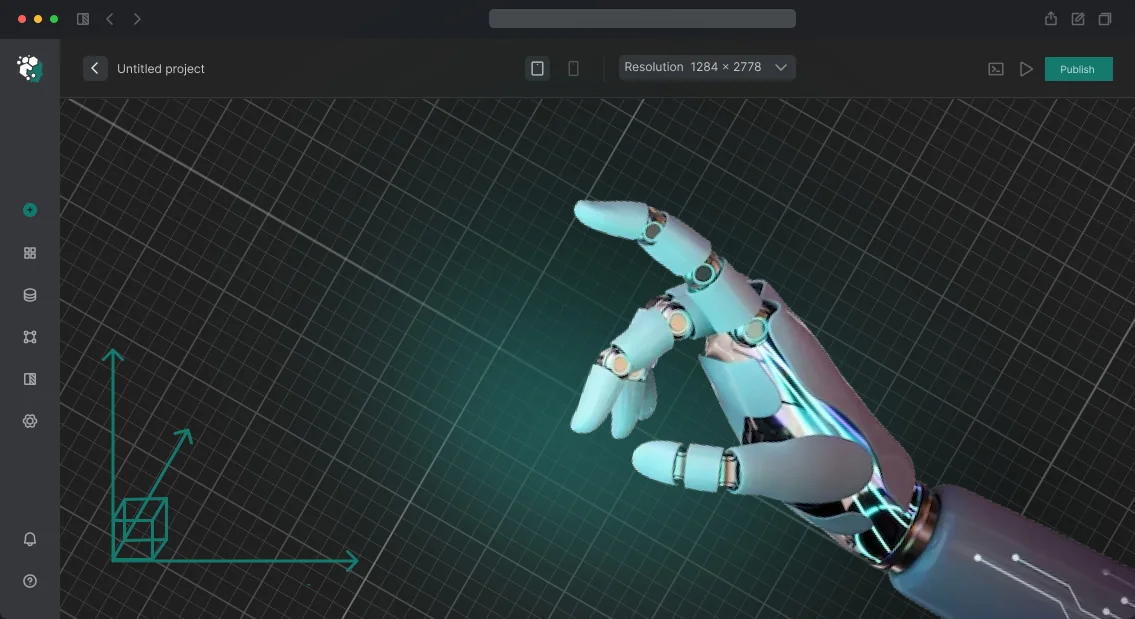
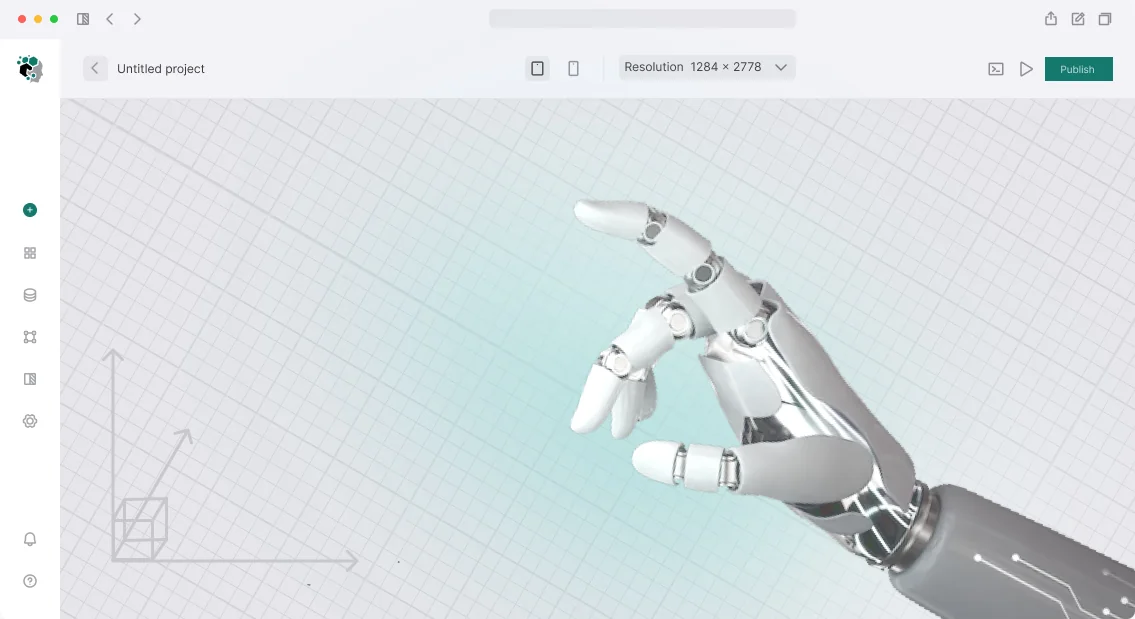






Clients Are Leaving for Competitors with 3D on Godot Engine
Your clients remember only vivid experiences, while outdated presentations with flat images and “boring” videos no longer work.
Instead of browsing a catalog, a customer opens Instagram and scrolls past — attention fades within a couple of seconds, and the decision is made in favor of those who know how to surprise.
In the end, you invest in marketing, but customers still leave for competitors whose product can be “touched” with the eyes.
The solution is interactive 3D presentations on Godot Engine. This is not just a video, but a living space where the client rotates the product themselves, looks inside the mechanism, or “walks through” a future interior.
Such a presentation holds attention far longer than a regular video: the person is not a passive viewer, but a participant who explores the object at their own pace. That means they have more time to understand the product’s value — and they talk themselves into the purchase.
3D visualization for business on Godot Engine is also a practical sales tool. You get an interactive version of the product for exhibitions, your website, and the sales department, which can be updated without reshoots or long approval processes.
Modern 3D graphics look so realistic that clients doubt until the very end whether it is a render or a photograph. This is the level clients are used to seeing from market leaders, and it immediately places you on the same footing.
Godot Engine development brings another important advantage — the speed of making changes. Want to change the body color, add a detail, or rearrange the furniture? No need to reshoot video or wait for a new 3D model.
Simply make edits in the project, and the update is immediately available to the client. For business, this is flexibility that turns a presentation into an ongoing working tool rather than a one-off event.
As a result, you gain a competitive advantage that is visible both to the client and to your team. Buyers linger at your booth on their own, managers spend less time on explanations, and presentation materials stop becoming outdated within the first month.
We help implement interactive 3D presentations turnkey — from idea to launch, taking into account the specifics of your product and audience.
What Modern 3D Graphics Gives Your Business
Modern 3D graphics have stopped being just decoration — today they are a working tool that directly affects the behavior of guests and clients.
Dynamic animation or an interactive 3D zone holds attention far longer than a static banner or text: a person examines details, gets involved in the process, and remembers your brand.
As a result, guest engagement grows — they spend more time at the booth, more willingly take part in activities, and share impressions on social media.
For business, this means a measurable effect: increased reach through visitors’ photos and reposts, higher brand recognition, and a growth in leads after an event.
Visual marketing works ahead of the curve — when a client has already seen your product in a bright and clear 3D format, it is easier for them to make a purchase decision.
That is why interactive 3D configurators, visualizations, and promotional videos are increasingly used in presentations, at exhibitions, and in digital campaigns.
Another important advantage is lead generation through interactivity. Offer a guest the chance to assemble their own product variant, view it from all sides, or play a short 3D game — and you get not just attention, but contact data from an interested audience.
Such mechanics increase conversion into inquiries because the person has already “tried on” the product and is emotionally ready for a dialogue. The key advantage of 3D graphics is that they work on several levels at once: they attract, hold, engage, and bring in customers.
We create 3D models and graphics on a professional engine that allows us to quickly embed ready-made scenes into your projects and adapt them to different tasks — from a promotional video to a full-fledged interactive booth.
Thanks to optimization, the final materials load quickly for users and look equally good on any device, without delays or technical failures.
You get a ready-made tool that works for your business from the very start — capturing attention, collecting contacts, and increasing conversions.
3D Visualization Formats on Godot Engine for Any Task
A single 3D model can support an entire line of communication: from a button on a website to an exhibition booth. Visualization created in Godot Engine is not a static “file” but a living tool that sells, explains, and engages.
The main thing is to choose the right format for your task — then the budget works toward results rather than just a pretty picture.
Below are three working formats most often ordered by businesses. In each case, you get not “video for the sake of video,” but a specific business effect: higher conversion, fewer returns, and saved manager time.
| Format | Who It Is For | What It Gives the Client |
|---|---|---|
| Interactive 3D configurator | Online stores, furniture and appliance manufacturers, car dealers | The buyer changes color, materials, and configuration themselves and immediately sees the result. Fewer doubts — more orders. The return rate decreases. |
| Animated 3D video | Marketing, sales departments, presentations | Clearly demonstrates product advantages, even if the product is complex or “invisible” inside. Used in advertising, at exhibitions, and on social media — increases recognition. |
| Virtual tour | Real estate, museums, tourist locations, campuses | Allows visitors to “walk around” online without traveling. Removes barriers, saves viewing time, and increases the number of targeted inquiries. |
This is not the full list, but the basic set. We adapt any of these formats to your industry and task. If you are unsure which one suits you best — start with a short consultation: we will discuss your funnel and propose the solution with maximum return.
How We Develop a 3D Project: Stages and Control
We have structured the 3D creation process so that you can see at every stage where time and budget are going. No “black boxes”: you receive a plan, intermediate results, and fixed deadlines.
We work on the professional Godot engine — this guarantees smooth 3D graphics and easy launch on any device.
- Task definition and immersion. We gather requirements, goals, audience, and style for the future project. You receive a clear work plan and a cost estimate before we start.
- Plan and script. We prepare a storyboard and a description of what the 3D video or presentation will look like. We approve it with you and make changes before production begins.
- Design and 3D modeling. We create models, environments, and graphics. We show intermediate versions — you see how the project is developing.
- Animation and visualization. We bring scenes to life, set up lighting, cameras, and effects. We present a draft version for quality control.
- Approval and final edits. You give feedback, we make changes. The result — approved material ready for launch.
- Launch of the 3D presentation. We deploy the project and check compatibility with your equipment. We help integrate it into an event, website, or application.
- Support and development. We stay in touch after launch: we fix errors, update content, and add new scenes.
The entire process takes from two weeks — depending on complexity. You get transparent stages, a fixed cost, and a single point of contact. This is how we handle most 3D projects: from small clips to large-scale event presentations.
What Is Included in the Delivery: A Kit for Launch and Development
You receive not just a finished image or video, but a complete working kit with which you can continue developing the product — on your own or with our help.
All materials are packaged so that your team never asks “where do we get this?” or “how do we change this?” Below is what you hold in your hands after project delivery.
- Source files of 3D scenes and models — all created objects in editable form. You are not tied to us: any changes can be made by your own team or handed to another contractor.
- Godot Engine project — a compiled scene file that opens and runs immediately. This is a ready-made foundation, not a “semi-finished product”: we understand that speed to market matters to you.
- Technical project documentation — a clear description of the structure: where scenes are located, how models are connected, and how animations and logic are arranged. Written for those who will maintain the product after us.
- Update and launch instructions — a step-by-step guide: how to export a new build, how to change a texture, or how to add localization. No need to dive into code or figure things out by trial and error.
- Training material for your team — short videos or text notes on how to work with the delivered source files. This removes the main risk: dependence of a business process on a single contractor.
- Rights to 3D models and graphics — you receive all rights to the created objects and scenes. Use them in any advertising, on your website, in applications, and on social media without restrictions.
- Animation logic and script — a description of how movements, transitions, and interactive scenes are arranged. This is important when you want to add new features or change object behavior.
- Support after delivery — we set a support period during which we answer questions and help with integration. You are not left alone with the result.
In essence, you are not buying a “picture” but an asset that continues to work for your business. You can scale the product, create new versions, and adapt it to different platforms — the key point is that all source files and knowledge remain with you.
Case Study: How 3D Visualization Increased Inquiries by 80%
An interior salon faced a typical problem: clients spent a long time looking at photos in the catalog but could not imagine how a piece would look in their own interior.
Managers spent up to half an hour on a single consultation, and decisions were often postponed — “we need to consult with a designer.” This way, a significant portion of potential inquiries was lost.
How We Increased Conversion
We proposed replacing static images with an interactive 3D configurator. Built on Godot Engine, it allowed the buyer to change the color of facades, countertop material, hardware, and even the layout of modules in real time.
This was not “just a pretty picture,” but a working sales tool: every parameter immediately showed the final cost. This approach turns 3D graphics from a decorative element into a mechanism that accelerates decision-making.
Business Results
The results of 3D graphics proved measurable: two months after launch, the number of inquiries grew by 80%, and the time a client spent selecting products tripled. Buyers felt more confident because they saw exactly their own future interior. The share of repeat orders and recommendations also increased — the salon gained more trust.
This 3D visualization case is a clear example of a 3D project that works as a sales tool.
Additionally, we created a web version of the configurator for designer partners: the client received not just a model, but a full-fledged channel that generates inquiries around the clock without a manager’s involvement.
Already a month after project delivery, the salon returned for a virtual tour for regional dealers — another confirmed effect of investing in visualization.
How to Choose the Right 3D Development Format for Your Project?
Choosing a 3D development format is not a technology question, but a question of which business problem you are solving.
A video, an interactive, and a tour answer different buyer questions: “what does it look like,” “how does it work,” and “what is it like to be inside.” When the goal is clear, the right format chooses itself.
A video is a story you tell. It is ideal for presentations, advertising, and social media: easy to distribute, requires no software installation, and works on any device.
If you need to quickly communicate a product idea to a broad audience without depending on user actions — choose a video.
An interactive is a dialogue with the client. The user rotates the model, opens details, and changes configurations themselves. Such engagement increases conversion into inquiries: a person studies the product at their own pace and makes a decision faster. This format suits catalogs, configurators, and training materials.
A tour is immersion in a space. It is indispensable when the client needs to assess scale: an office interior, a building layout, an exhibition booth.
A virtual walk eliminates the fear of “what if I don’t like it” and reduces the number of unnecessary meetings with those who are still hesitating.
We understand these differences and therefore use Godot Engine as a universal foundation — it allows us to create cinematic videos, flexible interactives, and tours without being tied to a narrow specialization.
Come to us with your task — we will advise which format will deliver the maximum result for your budget and deadlines.
Frequent Questions About 3D Animation for Business
Before ordering 3D animation, business owners ask the same questions: how the result is approved, what happens with revisions, what the deadlines are, and what to do if something goes wrong. This is expected — you are investing budget and time, so you want predictability. Below, we answer the common concerns.
What if I don’t like the result at some stage?
We do not show the project only at the end. The work is divided into stages: first references and script, then draft versions, and only then final rendering. You see intermediate versions and provide comments — all key decisions are approved and recorded before the final image.
If something does not match expectations, it becomes visible in advance, not at the end of the project.
How are revisions made to already finished 3D graphics?
For this, the cost estimate includes iterations at each stage: usually up to three rounds of revisions for each key scene. You send comments on the draft, we make changes, and show the updated version. All notes are recorded in writing so no details are lost.
If revisions go beyond the approved task, we warn you in advance about changes to deadlines and budget.
What are the development timelines for 3D animation for business?
It depends on the scope: a short video up to 30 seconds usually takes 2–3 weeks, a full visualization with multiple scenes takes from a month. We set the exact deadline in the contract and send a calendar plan with control points.
You know in advance when intermediate versions will be ready and when the final file will be delivered.
What happens if the project “breaks” or requires further work after delivery?
We hand over all source files and project files to you, so you are not “tied” to us. After delivery, we provide free technical support for a month: if something works incorrectly or a small fix is needed — we handle it without extra charges. We provide a guarantee on all work, and the terms are fixed in the contract.
Can I use the 3D graphics on my own platform or in another program?
Yes. We work in Godot Engine, but we deliver results in universal formats that open in most editors and can be embedded in websites, presentations, and applications. You receive the rights to use the graphics, and you can apply them for your own purposes without restrictions.
Shall We Discuss Your Project? Get an Estimate and a Commercial Proposal
Every 3D graphics or animation project starts with an accurate estimate. We know how difficult it is to assess the scope of work, deadlines, and budget when it comes to a complex scene, character, or video.
Therefore, the first step is always a free consultation and a transparent commercial proposal — without hidden conditions.
Leave a request for 3D — and in response you will receive:
- A preliminary 3D project estimate tailored to your tasks: what will be included in the work, how long it will take, and what resources will be needed.
- A 3D commercial proposal with a fixed cost and a clear description of stages — no unexpected surcharges along the way.
- Realistic deadlines that account for the complexity of modeling, animation, and final rendering — you will know exactly when it will be ready.
- Examples of similar work from our portfolio, so you can see the style and quality before the project begins.
- A free consultation with a 3D specialist: we will help you choose the format, resolution, and technique that suit your task.
- A personal optimization recommendation: how to achieve the maximum visual effect at a reasonable cost.
We work with Godot Engine and other popular tools, so we can offer a solution that fits into your existing process. You do not need to understand the technical details — we will handle the entire implementation, from idea to final video.
To discuss the details and get an estimate, just write to us. We will respond within a business day, ask a few clarifying questions, and prepare a proposal that will save you time and nerves.