

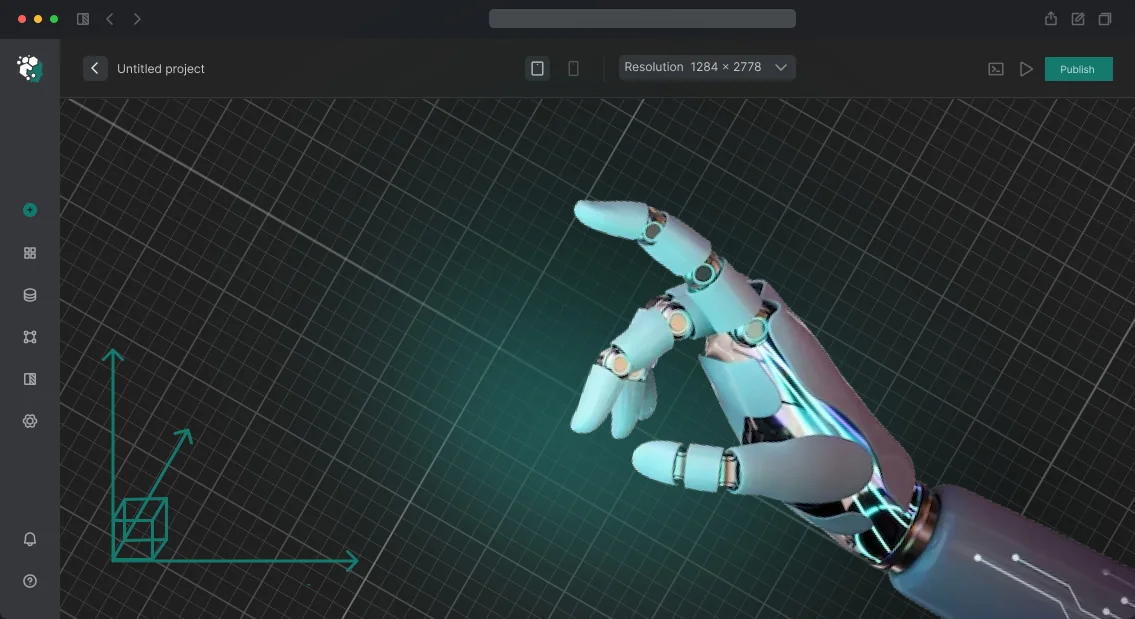
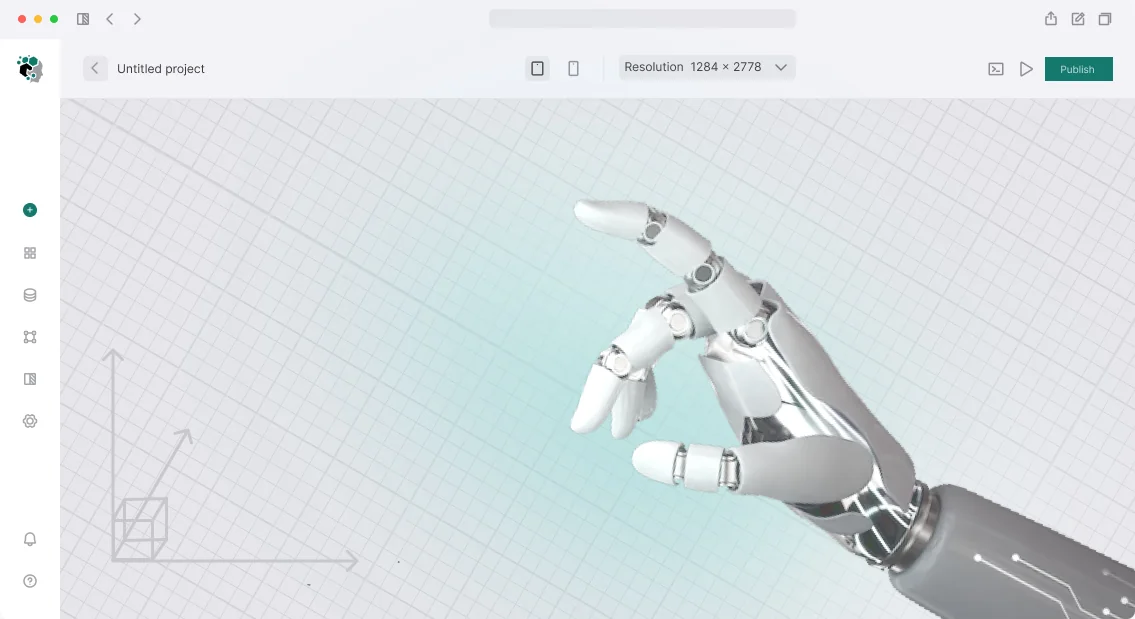






Why your brand loses customers without WebAR solutions
A visitor walks past your booth in three seconds. A banner, a poster, even a quality video on a screen — familiar background that the brain barely registers.
Attention is held only by something unexpected: the chance to rotate an object, look inside it, or see the product in your own space.
Without interactivity, you lose the battle for reach. Competitors add AR projects, and potential customers go where they're engaged with rather than just shown a picture.
This is how memorability and repeat orders are lost — a brand that offered nothing to "hold in your hands" is easily forgotten after an event.
Augmented reality turns ordinary advertising into a mini-event. Visitors get involved, take photos, share the experience — and your brand keeps being discussed after the event is over.
That's why interactive WebAR-based advertising delivers a higher response rate than static graphics.
We solve this pain through WebAR development. No need to download apps or buy special equipment — the user opens a link or points their phone camera, and interactive 3D graphics appear in front of them.
It works on shop windows, packaging, printed materials, and exhibition booths: any physical medium becomes an entry point into a dialogue with the brand.
The difference is especially noticeable at events and in retail, where capturing attention quickly matters. A guest doesn't just look at the product — they examine it from the right angle, can "try it on" or place it in their own interior.
This visibly proves the product's value before purchase and increases the number of inquiries and repeat visits.
What you get by implementing interactive 3D projects
An interactive 3D project in web format turns ordinary advertising into a live interaction: the customer doesn't watch — they participate, get an emotional experience, and leave their contact details themselves.
At the same time, the company solves several tasks at once — from attracting attention to growing repeat sales. our team has been developing this area for many years and builds such projects around the goals of a specific business.
Increased engagement
Users control the scenario themselves: they move the product, change its color, open up details. They spend several times more time with the brand than when watching an ordinary video, and they remember the product better.
This activity directly affects sales — the person has already studied the product and is ready to make a purchase decision, especially if a good offer awaits them at the end.
Brand memorability
People remember not information, but impressions. An interactive experience stays in the memory for a long time and becomes "that one time" they tell their friends about.
Repeated contact with the brand after such an interaction builds trust and increases the likelihood that people will choose your company over competitors.
A source of leads
Interactivity can be designed so that users leave their details: participation in a giveaway, receiving a promo code, signing up for a test drive or a fitting. This turns entertainment mechanics into a transparent channel for collecting inquiries.
The client gets not just reach, but the contacts of potential customers who have already shown interest — they can be nurtured further and moved toward a deal.
Brand awareness through sharing
An unusual web experience makes people want to share it: the link or photo spreads through messengers and social media. Each participant brings several new people, and reach grows without an additional advertising budget.
For the brand, this is a free distribution channel that keeps working even after the campaign ends — the project stays online and continues to attract attention.
Attracting visitors
In offline locations, interactivity brings shop windows, booths, and product packaging to life.
All you need is to point a smartphone camera to "bring" the image to life — this draws passersby in, increases the time spent at the location, and encourages them to step inside.
Examples from practice show that a properly built scenario increases visitor flow and conversion to the target action by 20–30%.
WebAR project formats for every business task
The same WebAR can be adapted to different business tasks, from shop windows to training. Instead of a one-size-fits-all solution, we match the format to your goal so that the client gets a measurable result: higher sales, audience reach, or savings on product demonstration.
Popular WebAR formats
Below are the typical scenarios that business owners and marketers order most often. The format isn't chosen just because it's trendy, but based on where the client meets your product: at a shop window, on social media, or during training.
| Format | Who it's for | What it gives the customer |
|---|---|---|
| AR catalog | Online stores, manufacturers | The buyer sees the product at real size and how it fits the surroundings — fewer returns, more trust |
| AR mask | Promo campaigns, social media | Visitors share branded content — free viral reach and recognition |
| 3D presentation | Training, complex products | Clearly shows the structure and how it works — understood without a manual, higher conversion to inquiries |
| Virtual showcase | Offline retail, exhibitions | Attracts attention and keeps people at the booth — longer contact, more conversations with the manager |
Formats can easily be combined: for example, an AR catalog can be supplemented with a virtual showcase for offline events.
At our team, over 10+ years we have delivered such projects for retail, promo, and training — each format adapts to your task and budget, and you get a clear tool that works toward a measurable result.
How development works: from brief to launch
We've structured the process so that you always know what stage the project is at and what happens next. No "we work in a closed studio" — every decision is approved with you, and all revisions are made before production begins.
The result is predictable timelines, a clear budget, and interactivity that solves business tasks from day one.
- Brief and immersion in the task. We document why you need the WebAR interactive: to attract new customers, bring a shop window to life, train staff, or increase brand awareness. The output is an unambiguous document with goals and expected results.
- Strategy and concept. We choose the format: AR mask, 3D product model, virtual fitting, or interactive instruction. We show how it will fit into your marketing and what experience the user will get.
- Scenario and sketch approval. We prepare a storyboard, describe the interactive logic and visual style. You see how the final product will look and work before development even begins.
- 3D graphics and animation development. We create models, textures, and motion. Here we also set up the interactivity: hover, rotation, touch, transitions between scenes — everything planned at the concept stage.
- Testing on real devices. We check how the scenario behaves on different smartphones, under different lighting conditions, and with weak internet. The result is stable performance without lags or freezes.
- Launch and integration. We hand over the finished interactive and help you place it on your website, in an app, or behind a QR code on packaging. Everything is turnkey: just open the camera — and the scene comes to life.
- Post-launch support. We stay in touch: answer questions, make targeted fixes, help with updates. The interactive keeps working as long as you need it.
On average, a project takes 2–4 weeks depending on complexity. You always know which stage comes next, and we'll tell you if things can be done faster without losing quality.
What's included in the delivery and what you own
You get not just a finished video or 3D scene, but a complete delivery package that your team can work with independently. We hand over all source materials, rights, and documentation — you own the result as an asset rather than depending on a contractor for every update.
- Project source files: 3D models, scenes, textures, and animations in editable formats — your team can make changes themselves.
- Full rights to the result: intellectual property transfers to you, and the project can be used commercially without restrictions.
- Instructions for launching and configuring the WebAR scenario: a clear description of how to place the experience on your website or social media without involving developers.
- Training for your staff: a short session that lets a manager or marketer change texts, buttons, and content on their own.
- Support during publication: we help put the experience on your domain, connect analytics, and verify that everything works in the required browsers.
- Technical support after launch: we answer questions and help with setup for the agreed period.
- Performance guarantee: we test the experience on different devices and browsers so that visitors see a correct image from the first try.
The entire delivery is organized so that you can launch the project quickly and then manage it without a technical specialist on staff.
Case study: how AR helped triple time at the booth
For the company Atlas, we developed a WebAR project for a major industry exhibition. An ordinary booth with brochures held attention for less than a minute — visitors quickly walked past. The client wanted to stop the flow, engage the audience, and collect leads in person.
We replaced the static banner with an AR scene: visitors just pointed their smartphone camera at the booth, and a 3D model of the product came to life. A full viewing took 3–4 minutes — enough time for managers to approach and start a conversation.
Results in numbers
- Time at the booth tripled: from ~40 seconds to 2+ minutes, and the most engaged guests stayed for 5 minutes.
- Over three days, the AR scene was launched 850+ times, and 92% watched through to the contact screen.
- The exhibition generated 74 leads — 2.5 times more than a similar booth without AR a year earlier.
Atlas's marketing manager summed it up: "We expected interest, but we got real buzz.
People walked up, asked how it worked, and left their contacts on the very first day." A month later, the client ordered two more AR configurations for regional exhibitions — the best proof of its value.
This case demonstrates that WebAR isn't just booth decoration. It's a working tool that increases contact with the audience, extends conversations, and collects leads. Tell us about your event — we'll choose a format that will deliver numbers for you too.
How to choose a format for your budget and timeline?
The cost and timeline of WebAR depend directly on the task you're solving, not on an "average market price." A banner with an augmented reality effect, an interactive 3D product visualization, and a full campaign with a character and scenario are three different scopes of work, and their budgets differ significantly.
So the first thing we find out from a client is the project's goal: attract attention, show the product in detail, train users, or simply amaze event guests.
If you need a quick idea test or a short 2–3 week campaign, a compact format works well: a simple 3D model overlaid on the user's surroundings, or 2D animation in AR.
Such a project takes minimal time — we usually finish within a few working days — and the budget stays reasonable. It works great for reach and grabs attention without requiring deep attention to detail.
When the goal is to launch a product that will become a permanent sales tool or be used at a large event with thousands of visitors, it's worth budgeting time for a detailed 3D model, thoughtful interactivity, and testing on different devices.
This version delivers not a one-time spike but a long lifespan: it can be embedded in a website, in an offline event zone, added to email campaigns, or used in partner presentations.
Timelines start at two to three weeks, but the result looks solid and pays off through repeated use.
A practical recommendation is simple: if your budget allows, start with a prototype — short and inexpensive — to test audience response. Based on engagement metrics, you can easily decide whether to scale the format.
Conversely, if the task is serious from the start — a summer advertising campaign or a new product launch — allocate budget for a full-fledged project from the beginning so you don't have to do double work later.
We don't push the most expensive option. Instead, on a call or via Telegram, we clarify the task, show possible formats, and give realistic timelines and a budget for your specific case.
You get a clear estimate and understand what you're paying for: a quick result, a long-term tool, or a representative effect for an event. The key is that the format solves your business problem — not just that it's a trendy technology.
So if you're not sure which option to choose, write to us — we'll help you figure it out and stay within your constraints.
Addressing common concerns before you start
Before launching any digital tool, the same questions always come up: "What if it doesn't open?", "What if visitors don't understand it?", "Who will support us?" That's normal — especially with WebAR, which your visitors might be encountering for the first time.
Below, we address the most common concerns so you can feel confident before the project even starts.
What if visitors have old phones or poor internet?
We build WebAR scenarios so they work reliably on most modern devices and with unstable connections. Before launch, we test the project on different phone models — from flagships to budget devices.
If a feature isn't available on a particular device, we plan a fallback: for example, a 2D version or a link to a regular video. Visitors are never left without content.
How do you guarantee everything will work on event day?
Any surprises are possible on launch day, so we build preliminary testing and real-time technical support into the project. You get a clear plan: when we test, what exactly we check, and who is responsible for the launch. If anything goes wrong, we're on call and resolve the issue within minutes, not hours.
Will WebAR break our website or steal data?
Integration happens without changing your core infrastructure — it's a separate scenario that breaks nothing. We don't request access to visitors' personal data, and we don't collect unnecessary analytics.
Everything the phone camera captures is processed locally and isn't stored on third-party servers. Your guests can use the feature safely.
What if visitors find it hard to figure out?
The WebAR scenario starts with a single tap or by pointing the camera — the interface is intuitive even for people seeing augmented reality for the first time.
We add a short hint like "point your camera at the marker" or "press the button." We brief your team and give guests a simple guide that doesn't require reading long instructions.
Who will support the project after launch?
We don't abandon you after delivery. We provide a guarantee on all work and stay in touch: if a month later you want to change the text, add a new model, or replace the background — just write to us.
We tailor a support plan for each project, from a one-time consultation to full support throughout the campaign, so you always feel at ease.
If you have a question that isn't on the list, just write to us. We'll honestly tell you what fits your task and what's better to skip, and we'll offer a solution that won't require technical knowledge from you.Let's discuss your project? Get a consultation today
Not sure where to start or what result you'll get? That's normal — before meeting a contractor, it's hard to assess how WebAR will work in your specific scenario.
So the first step is a free consultation: tell us about your task, and we'll advise on how to solve it faster and more effectively.
In a 15-minute conversation, you'll get not general words but specifics for your project: whether WebAR will deliver value here and now, how long implementation will take, and which formats fit your audience best. The consultation is non-binding — it's a way to make an informed decision.
After reaching out, you'll receive:
- A preliminary project estimate: we'll give you a budget range and timelines with no fine print or hidden surcharges.
- An honest assessment of the idea: we'll tell you which WebAR scenarios will work and which won't deliver the expected effect.
- Demo examples from your industry: we'll show cases similar to your task so you can see the possible result.
- A clear action plan: we'll outline the stages from brief to launch — you'll understand what happens at every step.
- Answers to all your questions: from technical limitations to how to embed the camera into an existing app or website.
- Scenario recommendations: we'll advise on how to guide users toward the target action — a purchase, registration, or repost.
The consultation is free and non-binding. Leave a request, and we'll get in touch within one business day to discuss your project.
[Submit a request for a project estimate] ---