

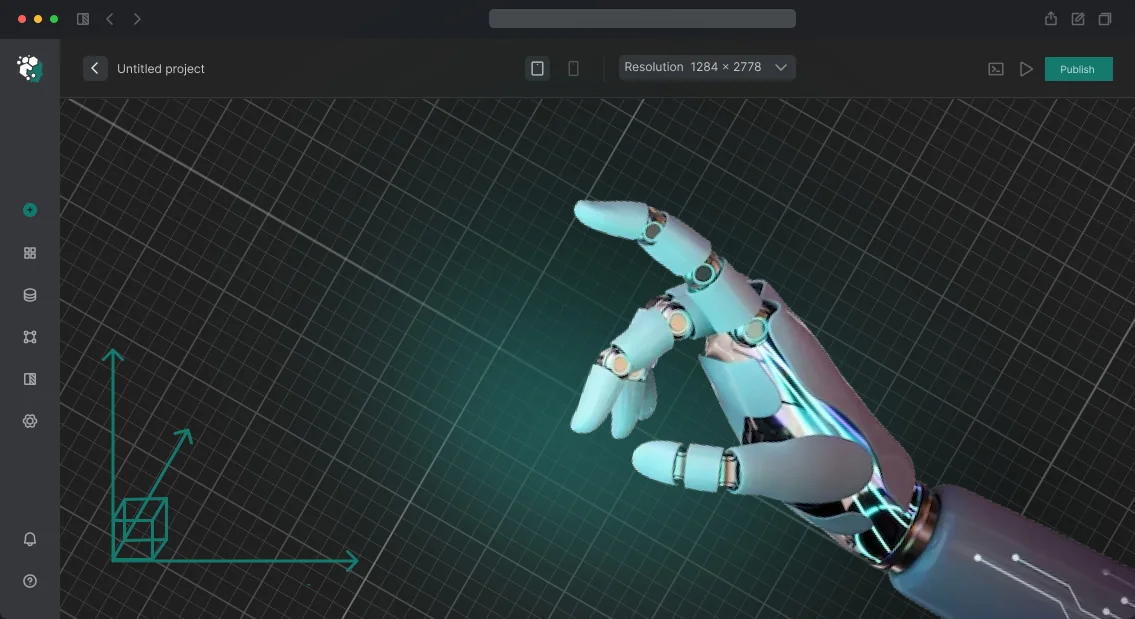






Digital twin companies take clients from businesses without 3D
Buyers make decisions with their eyes. If you show your product in drawings and flat images while digital twin companies present it in three dimensions, the choice is obvious.
That's how deals are lost: the client goes where their idea is not just described, but shown from every angle — in motion, in context, in the workflow.
3D visualization removes the main objection, "what will it look like?", before the contract is even signed, which is why 3D product presentation has become the standard in the B2B market: clients are more willing to pay for a clear picture than for abstract promises.
For your business, this is a competitive advantage that works ahead of the curve: while competitors send drawing files, you show an interactive prototype or a high-quality video.
It's not just a "pretty picture" — it's a sales tool: it shortens the sales cycle, reduces the number of revisions, and creates the impression of a reliable partner who has already thought through every detail.
We specialize in 3D visualization, animation, and videos for industrial and consumer products, turning your drawings, models, or sketches into a presentation any client can understand.
We already work with digital twin companies and know how to quickly put your product in the best light — you get a visual image that sets you apart from competitors and sells before the first contact with an engineer.
What you get: from a 3D model to sales growth
A digital twin is not just a pretty picture, but a working sales tool. With it, you show your product in action before production even starts, clearly demonstrate its advantages, and address client objections.
Such a presentation is memorable and leaves the impression of a tech-driven business that people want to work with.
Visual recognition directly influences client choice. Against competitors using flat photos and drawings, your 3D video or interactive model stands out from the first seconds.
This strengthens the image of a reliable, modern manufacturer, increases trust in the company, and creates lasting associations with a market leader.
The main value is lead growth. Videos and visualizations work at every stage of the funnel: they attract attention in ads, keep visitors on the website, and help managers explain complex solutions faster.
As a result, deals close faster and the average order value grows — the client is more willing to pay for a product they've already seen in action.
A digital twin also pays off through repeat sales. You can use it in catalogs, at exhibitions, and in email campaigns, getting new inquiries every time without additional investment in content production.
A model created once keeps generating leads for months, strengthening marketing without increasing the budget.
The bottom line is simple: from an impressive presentation to recognition, leads, and revenue growth.
An investment in 3D visualization delivers measurable business results that set you apart from competitors and turn an ordinary product presentation into a source of new contracts.
Digital twin formats for your task
A digital twin is not a single format, but a set of ways to show a product or facility. We choose the option for your task: sales, training, investor presentations, visual demonstrations.
What matters is that the format speaks the language of your audience and leads it toward the desired action.
| Format | For whom | What it gives the client |
|---|---|---|
| Interactive 3D model | Sales departments, online stores | The buyer examines the product from all sides, as if in person, and makes a decision faster. |
| Virtual tour | Real estate, manufacturing, showrooms | Shows the entire facility, saves time on site visits, and creates a sense of presence. |
| Animation and video | Marketing, social media, exhibitions | Explains a complex product in 2-3 minutes, increases recognition and reach. |
| Process digital twin | Staff training, operations and maintenance | Allows practicing actions without stopping production and reduces risks. |
We work with professional 3D tools, so every format is consistent in quality and easily adapts to your media — from a tablet to a widescreen display.
To choose a format for your task, we go through six steps:
- Brief — we find out what needs to be shown, to whom, and for what purpose.
- Format selection — we offer the best option for budget and timeline.
- Prototype — we show a draft image and scenario before the main work begins.
- Development — we create an interactive model, animation, or tour.
- Review — we test it on your devices and adjust the details.
- Launch and support — we deploy, train the team, and continue supporting the project.
How the project goes: from brief to launch
We've structured the process so that you understand what's happening and what you get at every stage. No "black boxes": you participate at key points, approve intermediate results, and see how the final product is born. All project stages are fixed in the plan in advance, so the timeline and budget stay transparent.
-
Brief and immersion. You fill out a short brief or simply have a call with us. We clarify the tasks, audience, and expected result — the format, style, and tone of the animation depend on this. If needed, we study your product and competitors to propose a solution that actually works.
-
Plan and estimate. We lock in the scope of work, timeline, and cost. We send a clear plan with stages and checkpoints — you know in advance when you'll get the result and what it costs. No hidden fees: all revisions within the agreed scope are already included.
-
Concept approval. We show the script, storyboard, or visual references. You make edits before production starts — this eliminates rework after the video is finished. At this stage, it's easy to change emphasis, style, or content blocks without losing time or budget.
-
Production. Our engineers and artists create 3D models, animation, and visualization. At intermediate checkpoints, you receive versions for review and can leave comments. We show the process, not just the final picture, so you always understand how the work is moving.
-
Launch. We deliver the final video in the required formats for the website, social media, ad accounts, or presentations. We check how the video looks on different devices and platforms. If needed, we help with publishing and setting up the first impressions.
-
Support. After launch, we maintain the product: we quickly make small revisions, answer questions, and create updates when necessary. If you need a new video in the same style later, you won't have to explain everything from scratch — we already know your product and audience.
What's included in the delivery: a package for your team
We understand: after the project is delivered, you don't need a "black box" that only works in the presence of developers. That's why the delivery always includes a complete package so your team can manage and develop the result without our constant support.
Here's what you get with the finished 3D model:
- Ready 3D model — fully adapted to your tasks: from a promo video to an interactive product catalog.
- Source files — all project files and assets are transferred to you, remain your property, and aren't locked behind our access.
- Integration — we set up embedding into your website, CRM, or presentation systems so your employees work in a familiar interface.
- Team training — we run a short hands-on course for your specialists: they'll learn to update the 3D model and launch videos without a programmer.
- Documentation — a clear guide to installation, setup, and standard operations; any changes in the team won't stop the work.
- Warranty and support — during the agreed period, we're in touch: we fix bugs, answer questions, and help with refinements.
All of this comes together in one package, so you're not dependent on a specific contractor. You get a ready-made business tool, not just a pretty picture.
Case study: a digital twin delivered +40% more leads
An oil and gas company came to us when they realized that regular 3D presentations and drawings no longer held the attention of foreign partners. Investors and potential clients traveled to the site to see the production in person — and a visit took up to two days.
We suggested replacing part of those trips with a digital twin: a virtual copy of the facility with detail down to individual components and the ability to "walk" through the shops online.
For the oil and gas company VolgaTech, we built an interactive model of the entire production complex.
Instead of a stack of documents and static renders, the partner received a link: they open the browser, walk through the facility, zoom in on the needed equipment, and see specifications in real time.
Approvals that used to take weeks now happen in a couple of meetings — data no longer needs to be sent by email and cross-checked against drawings.
The main result is a 40% increase in conversion from inquiry to deal. Managers stopped endlessly arranging business trips to the site, and clients stopped waiting a month for the next visit.
Savings on travel and approvals exceeded the development cost in the first year, and the sales department got a tool that works in any time zone.
What does this mean for your industry? The same metrics: faster approvals, fewer business trips, more deals. A digital twin pays off not as "nice visualization" but as part of sales and client engagement.
If your industry makes it hard to show a product in person, we're ready to calculate the effect on your data.
Addressing the fears: guarantees and support
Any project is a risk: what if the result doesn't match expectations, the timeline stretches, and the team disappears after delivery.
For 3D visualization and animation, these fears are especially strong: it's hard to imagine the final product from a description, and mistakes at later stages are expensive. We remove the uncertainty with a contract, clear stages, and a guarantee — here's how it works.
What if we don't like the finished video?
We work in iterations: you approve the script, style, and key frames before we launch the final render. Acceptance criteria are fixed in the technical specification — if the result doesn't match it, we redo it at our own expense. In practice, only a few revisions reach the final stage, and they all stay within the agreed scope.
Who is responsible if something breaks after launch?
We provide a warranty period for the result — usually 3 to 6 months. During this time, we fix errors in the files for free, adapt to new platform formats, and answer questions.
After the warranty, you can sign up for ongoing support: quick revisions and video updates for new tasks.
What if the deadlines slip?
Before we start, we create a schedule with checkpoints — you see intermediate versions every few days. We report any risk of delay in advance, not at the last moment. Deadlines missed due to our fault are compensated with a penalty specified in the contract.
Why might the price increase during the process?
We fix the estimate before work begins and don't change it if the scope hasn't changed.
An additional payment only arises when you add new scenes, change the runtime, or make edits beyond the agreed technical specification — and you always know the cost of such a change before it's made.
We deliberately make the process transparent: clear stages, fixed prices, and written guarantees. So you get not just a video, but a predictable result within the agreed timeline — without surprises or hidden costs.How to choose a digital twin format for your budget?
A digital twin is not a goal in itself, but a tool for a specific business task.
Before calculating a budget, it's important to understand what you want to get: a visual 3D animation for presentations, an interactive product catalog, or a virtual copy of a facility for employee training and client demonstrations.
The complexity of the development — and therefore the investment — depends on the answer to this question.
We often see companies order the most feature-packed option and then use a small fraction of its capabilities.
The opposite situation also happens — they save on interactivity even though it's the thing that pays off fastest: it reduces demonstration time, cuts sample logistics costs, and lets you show a product in action when a physical sample doesn't exist yet.
That's why at the start we look not at the price, but at the usage scenario and the expected result.
Here's a rough budget guide.
The cost of a simple 3D video for a one-time presentation is calculated after an audit — it solves the task of "showing a nice picture." An interactive digital twin with controls and scenarios — its cost is also calculated after an audit, but it works for years: in sales, at exhibitions, in training, and with remote clients.
The difference is like between a photograph and a full-fledged showroom: the first option helps once, the second brings value on an ongoing basis.
We calculate the payback together with you: how much an hour of demonstration or training costs today, how many clients you lose when you can't show the product in action. If interactivity cuts those costs by at least a third, it justifies the investment. If the task is a one-time campaign or a presentation to a narrow circle, a quality video is enough.
We help you choose a format for your task and budget and don't offer anything extra. Even with a limited budget, you can get a working tool, not just a pretty picture. Tell us about your goal — we'll recommend the best option and estimate the payback before the work starts.
Order your digital twin development today
A digital twin is a working tool for monitoring facilities, training employees, and presenting a product to clients. But for it to deliver value, it's important to accurately define the task, format, and scope of work from the very beginning. We help do this quickly and without unnecessary costs.
Submit a request for a consultation and project assessment — and within two days you'll know how to solve your task, what it costs, and what timelines are realistic. During this time, we'll prepare a complete package:
- Preliminary consultation — we'll break down your task and recommend which digital twin will solve it best.
- Project assessment — timeline, stages, team composition, and a clear cost calculation.
- Format recommendations — 3D visualization, interactive models, virtual tours: we'll advise what works in your specific case.
- Solution examples — we'll show similar projects so you understand what result you'll get.
- Answers to technical questions — we'll explain where and how the digital twin will be used: on the website, in presentations, in training.
- Next steps plan — we'll propose a sequence of actions to launch the project without pauses.
The request doesn't obligate you to anything. It's needed so you get a transparent picture: what, how, and why we'll do it. Fill out the form or message us — we'll respond within a couple of hours and prepare solution options.