

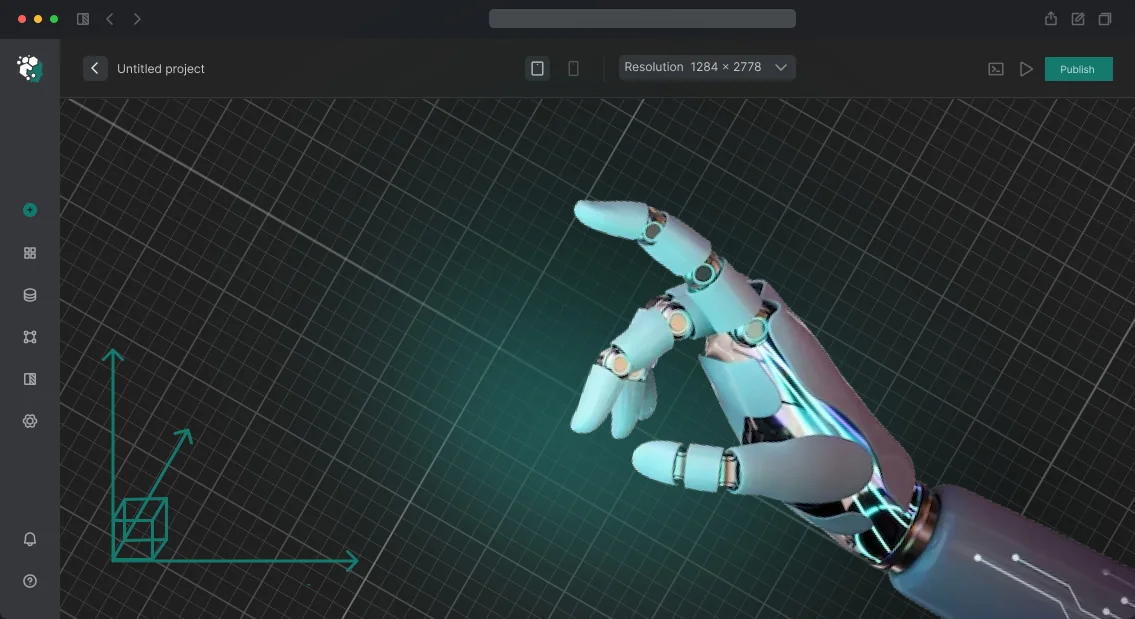






Without a Digital Twin, Clients Leave for Competitors
Static 3D renders no longer sell complex equipment and industrial solutions.
A customer sees a nice image but doesn't understand how the product works, how it fits into their production process, or what tasks it solves — so they compare offers by price and go to whoever managed to demonstrate value.
Industrial clients already expect an interactive digital twin: the ability to “walk up” to the object, take it apart into assemblies, see the movement of mechanisms and operating modes before buying.
This removes the main sales objection — distrust that the stated characteristics will become a real result. Visualization turns from a picture into a working tool for alignment, presentation, and deal support.
Our team has been designing digital twins for manufacturers, engineering companies, and machine-building enterprises for over 10 years.
We create controllable 3D models that can be shown on any device — from a sales representative's tablet to a large screen in a meeting room — and fill them with scenarios that guide the client toward a purchasing decision.
As a result, you get not just visualization but a sales system: shorter deal cycles, fewer objections at the presentation stage, higher lead conversion.
The client sees exactly their future object, immerses themselves in the product, and decides faster — even before visiting the site and running pilot tests.
What Benefits Interactive 3D Visualization Delivers
A buyer can't walk up to the product, turn it around, and look inside — static photos are no longer enough; they don't convey scale, shape, or details.
An interactive digital twin closes this gap: the user explores the product themselves, changes options, and sees the result in real time. This kind of 3D visualization turns an ordinary catalog into a sales tool.
Engages and Holds Attention
With an interactive model, a visitor stays on the page 2–3 times longer than with conventional images. They rotate the product, zoom in on assemblies, try different colors and materials — that's how interest in the product is born.
The longer a person studies the product, the higher the chance they become a customer. Attention in itself is the first step toward an order, and in a market crowded with competitors, that's already an advantage.
Increases Conversion to Inquiries
3D visualization removes doubt: the buyer sees the product “as it is in life,” not a schematic mockup. This is especially important when the product is complex, expensive, or sold without a physical sample. Uncertainty disappears — and so does the fear of making a mistake.
Our clients report an increase in inquiries after launching a digital twin — by one and a half to two times. According to the head of sales at an industrial enterprise, this format paid for itself in the first month through a flow of new leads.
Builds Trust in the Product and Brand
When a company shows a product in the finest detail, it demonstrates confidence in its quality. This approach immediately sets the brand apart from competitors who limit themselves to flat images and generic promises.
A 3D model is convenient to use everywhere: on the website, in presentations, and at exhibitions. It speaks to the company's technological sophistication and helps the client feel its reliability even before personal contact.
Accelerates Decisions and Reduces Risks
In complex equipment sales, approval often drags on due to misunderstandings among engineers, procurement specialists, and managers. An interactive twin shows everyone the same picture: structure, dimensions, options, final appearance.
Decisions are made faster, and there are fewer disputes and unexpected returns. For the client, this means predictable results — they get exactly what they saw and chose.
Formats: From Animation to a Full Digital Twin
We select a format based on your business task, not on available tools. If you need to quickly announce a product, we make a 2D/3D video for social media and exhibitions.
If it's about control and operational efficiency, we build a full digital twin of an industrial facility that connects a 3D model with current data and supports decision-making.
Scale ranges from a single assembly to an entire plant. Each format solves a specific task: attract attention, train employees, sell a complex product, or reduce downtime.
Formats and Results
The table shows typical scenarios our clients bring to us and the main business result.
| Format | For Whom | What It Gives the Client |
|---|---|---|
| 2D/3D animated video | Marketing, social media, advertising | Fast reach and increased awareness without a film crew |
| 3D product visualization | Catalogs, website, presentations | Shows the product at its best before a physical sample exists |
| Interactive 3D review | Exhibitions, sales department | The client explores the object themselves — fewer questions, faster deal |
| Training animation | Technical staff, clients | Reduces training time and lowers the number of errors |
| Object digital twin | Management, engineers | Unified model with current data: control, forecasts, maintenance savings |
Any format can be embedded into your processes: from a video for launching ads to a digital twin that becomes part of an enterprise management system. We'll help you choose the optimal scale for your budget and timeline.
How a Project Runs: From Brief to Launch
The project follows a transparent process so you can control the result at every step. We don't operate like a “black box”: you know the deadlines in advance, see intermediate versions, and make edits before the work is finished.
- Brief and task analysis. We gather exactly how the digital twin will be used: on the website, in partner presentations, in employee training, or at an exhibition. We define the business goal — increasing awareness, product visibility, reducing demonstration costs.
- Work plan and prototype. We propose a concept, visual style, and list of stages. We lock in budget and deadlines, and approve checkpoints so you understand when and what will be ready.
- Creating the 3D model and animation. Artists assemble a digital copy of the object. You receive initial images and draft motion, provide feedback — we make edits at this stage rather than after final delivery.
- Intermediate approvals. We show key scenes and check consistency with the materials and script. If necessary, we adjust details: colors, shapes, animation behavior.
- Final assembly and testing. We produce the final video or interactive scene and test how it looks on different devices and in the required formats. You receive a review link and approve the final version.
- Launch and integration. We place the digital twin where it will be useful: on a web page, in a mobile app, on a presentation screen, or in a training course. We provide usage instructions.
- Support and refinement. After launch, we stay in touch: we help update data, fix errors, and adapt the digital twin to new tasks. This saves your time — no need to find a new team for every change.
Thanks to this process, you always understand what you'll get in the end and how long it will take. The project doesn't drag on for months — each stage has clear boundaries, and the final result is already tested and ready to use.
What's Included in the Delivery: A Complete Package
We deliver not just a finished video or image, but a full working package that your team will start using on launch day. The delivery includes everything needed for future work: from interactive models to source files, documentation, and content rights.
Here's what you get:
- Interactive 3D models and animations that can be placed on the website, in presentations, at exhibitions, or in a catalog — in the exact form your clients need.
- Project source files in editable formats (e.g., Blender) — your specialists can make edits without our involvement and without buying expensive licenses.
- Full documentation: project structure description, setup and integration instructions, content update procedure.
- Exclusive rights to the created content — you can use it in advertising, on the website, in employee training, on social media, and in any other channels.
- Training videos and checklists for your team — to quickly get up to speed, learn to change model parameters, and update data in a timely manner.
- Support during the first month after launch — we stay in touch and help resolve issues that arise in real work.
This package eliminates the client's biggest fear: “What will we do when the contractor leaves?” You get full control over the product and can develop it with your own team.
One of our industrial clients said: “We thought we were just buying a nice demo, but we got a full-fledged tool that is already being used with our customers.”
Case Study: 2x Conversion Growth at an Exhibition
Case Study: A Manufacturing Holding
The client is a manufacturer of industrial systems. At exhibitions, their booth stood out with a large mockup and piles of brochures, but a conversation with a manager only started after long questioning. Our task was to make the exhibit so that visitors would come to the seller with a ready-made need.
We developed a digital twin of the system — an interactive model that visitors can rotate, take apart into assemblies, and see the mechanism work from the inside. For the client, this was a digital twin development service tailored to their specific equipment.
Preparation took three weeks, but the project paid for itself in the first half-day at the exhibition.
What Changed for the Business
Previously, the seller had to look for customers; now the customer engages on their own. A visitor spends on average 4–5 minutes at the screen and approaches the manager with questions about installation and maintenance.
This shortens the deal cycle and increases the average ticket, because a complex product stops being a “black box.”
Exhibition results in numbers:
- Conversion of booth visitors into qualified leads grew 2 times — from 15% to 30%.
- Managers began spending 20% less time on introductory explanations and more on discussing price and timelines.
- The client received 12 targeted contacts from plant managers over the three-day event.
The digital twin didn't stay in the pavilion: the model was integrated into sales presentations and the website, and it's also used for training service engineers. One project supports three business areas.
“For the first time, we got a booth that sells on its own. Visitors don't ask ‘What is it?’ — they ask ‘How much would implementation cost for us?’ We'll definitely come back to you.” Client's Head of Marketing
How to Choose the Right Format for Your Task?
Deciding between a simple video and an interactive digital twin is easier than it seems: the main thing is to determine what task the content must solve. If you need to quickly show the product to a wide audience and create a first impression, a high-quality video is enough.
You embed it on your website, social media, and email campaigns, and it starts driving awareness from the first days.
But when the client needs to study the object — examine it from different angles, take the device apart, and test it in operation — a video is helpless. Here the digital twin wins.
It's an interactive copy of your product or facility: the user chooses the angle, opens assemblies, and switches modes. This kind of engagement increases confidence before purchase several times over, especially in complex sales.
The practical rule is simple: a video answers “What is it?” while a digital twin answers “How does it work?”, “What will happen if…?” and “Is this right for us?” So for mass marketing and quick presentations, choose video; for selling complex equipment, training staff, and virtual exhibitions, choose digital twin development. Often both formats work together: the video generates interest, while the twin leads to a decision.
We help you choose the right format without overpaying: we assess your task, audience, and presentation format, then propose a solution that is highly likely to deliver the needed result.
If you're unsure, we start with a video and gradually expand it into an interactive experience, or build a digital twin prototype and test it with real clients. Either way, you get not a “pretty picture” but a tool that works for your revenue and reputation.
Answers to Common Questions About Development
We understand: ordering 3D animation or a digital twin is a serious investment, and you have questions about timelines, budget, and guarantees. Below are honest answers to the most common ones.
If you didn't find your question, write to us and we'll discuss your case in detail during a free consultation.
How long will development take?
The timeline depends on complexity: a simple 2D video takes from 2 weeks, a full 3D twin with interactive elements takes from 1.5 months. We set the deadline in the contract and stick to it.
If risks arise during the process, we warn you in advance, not on the delivery day. This way you always know when you'll receive the finished material for launch.
How much will it cost?
The cost depends on the scope of work: modeling, animation, rendering, integration. At the start, we assess your task for free and provide a transparent estimate with no hidden costs.
You pay in stages — the cost is fixed in the contract and won't increase during the process. No “sudden extra charges” after work begins.
What if we don't like the result?
We work iteratively: we show intermediate versions, you give feedback, and we adjust. All edits within a stage are already included in the cost.
If something isn't satisfactory in the end, we continue working until you accept it. Our goal is a result that works for your business, not a formal project handover.
How can we use the finished 3D model?
You receive all source files and usage rights. The finished model can be placed on your website, in a mobile app, on social media, and used at exhibitions and in presentations.
We help with integration into your project and provide technical support after launch. We'll advise on how to update content and add new features in the future.
What about support after project delivery?
We stay in touch and provide a warranty on the completed work. If something goes wrong because of our code or model, we fix it for free.
If you wish, you can sign up for extended support: regular updates, interactive refinements, and consultations on developing the digital twin for new tasks.
Discuss Your Task — Get an Implementation Plan
A digital twin pays off when it precisely fits business needs: reducing downtime, accelerating training, increasing sales. To hit the mark, you need not just creativity but an implementation plan tied to your metrics. That's why we start with a consultation — free and without obligation.
At the meeting, we examine your situation: what already exists, what task we're solving, and what results you want to see in 3–6 months. As an outcome, you receive an implementation plan and a cost estimate — transparent, with stages and timelines.
What you'll get from the consultation:
- Understanding of how a digital twin works specifically in your process.
- A clear plan from the first step to launch and team training.
- A budget estimate with no hidden charges — we lock in the estimate before starting.
- Recommendations for integration with existing systems and equipment.
- An assessment of the impact: where you save and what drives revenue growth.
- Solution examples for your industry and real practice cases.
- Timelines and a work plan for the coming weeks — not abstract, but concrete.
Contact us in any convenient way — we'll send you an invitation to a consultation. Afterward, you decide whether to move forward or stay with a ready-made plan and estimate. Either way, you benefit.