

Clients Are Leaving to Competitors — Ethnographic Park Loses Visitors
An ethnographic park is living history, but if people don’t know about it, the exhibits stand empty. The modern visitor chooses entertainment in a couple of clicks: themed festivals, interactive museums, parks with unusual attractions.
Against this backdrop, the traditional tour loses out — potential guests drift toward flashier formats without even reaching the gates.
The problem is not the uniqueness of the exhibits, but how they are presented. People are looking for experiences and are willing to set aside time and money only if, at the selection stage, they can see what awaits them.
An ethnographic park without a virtual tour remains invisible to those who plan their weekends online.
A virtual tour solves this problem — it shows the park’s space, key objects, and atmosphere even before arrival. The visitor gets an emotional response and adds the park to the “must visit” list.
This is a direct answer to competition: you offer the same visual experience as interactive venues, but with authenticity they don’t have.
To attract visitors, not only outdoor advertising matters, but also a digital storefront. Photos and videos on social media don’t create a sense of presence, while a virtual tour immerses people in the environment and surprises them even before they hear the cashier.
We’ve been making such projects for ethnographic parks for more than 10 years — accounting for open spaces, seasonal routes, and the particular ways historical material should be presented.
The result is more inquiries from parents, tour operators, and school groups, an increase in repeat visits, and a natural expansion of where visitors come from. The park stops being a “closed territory” and becomes clear to an audience that is used to choosing with their eyes.
What a Virtual Tour Will Give Your Park
A virtual tour of an ethnographic park removes the main objection of a potential guest: “I don’t know if it’s worth the trip.” Instead of static photos and descriptions, the person finds themselves inside the space, sees the utensils, hears the sounds, and examines the details.
This creates a sense of presence and the desire to come in person — to experience the atmosphere live.
The growth in interest directly affects attendance. After a virtual tour is launched, such venues typically see a noticeable increase in the share of guests who came because they saw the tour online.
The tour also acts as a guide: people study the territory in advance and plan their route, which improves the quality of the visit.
The modern presentation of cultural heritage strengthens the park’s image. You show that you preserve traditions while using new formats. This attracts the attention of journalists, tour operators, and a younger audience — those looking for unique experiences.
Accessibility expands reach. People from other cities and countries, visitors with limited mobility, and school groups can watch the virtual tour.
After the tour, we connect a feedback form — the visitor leaves a request for a real excursion or asks a question, and all contacts are collected in a convenient table for your manager.
We use professional equipment and refined panoramic shooting tools so the result is consistent and opens on any device — without installing apps or complicated registration, just via a link.
With this solution, the park gets a modern promotion tool that pays off through increased attendance and new inquiries.
Virtual Exhibition Formats for an Ethnographic Park
An ethnographic park is a live immersion into history, but not every guest can come in person: distance, seasonality, and lack of time get in the way.
Virtual exhibition formats remove these barriers: the exhibit becomes accessible from anywhere in the world, and the park gets additional channels to attract visitors.
Each format solves its own problem — from a quick introduction to deep immersion with a guide. When choosing an option, focus not on the number of “features” but on the goal: sell a ticket, interest a partner, or host a school class.
| Format | For whom | What it gives the client |
|---|---|---|
| Virtual tour | Website visitors, travel companies, journalists | A quick look at key locations without a trip; strengthens the desire to come and shows the park in any season |
| 3D showroom | Event organizers, investors, grant providers | A clear presentation of the space in negotiations and applications: you immediately see the scale, atmosphere, and route logic |
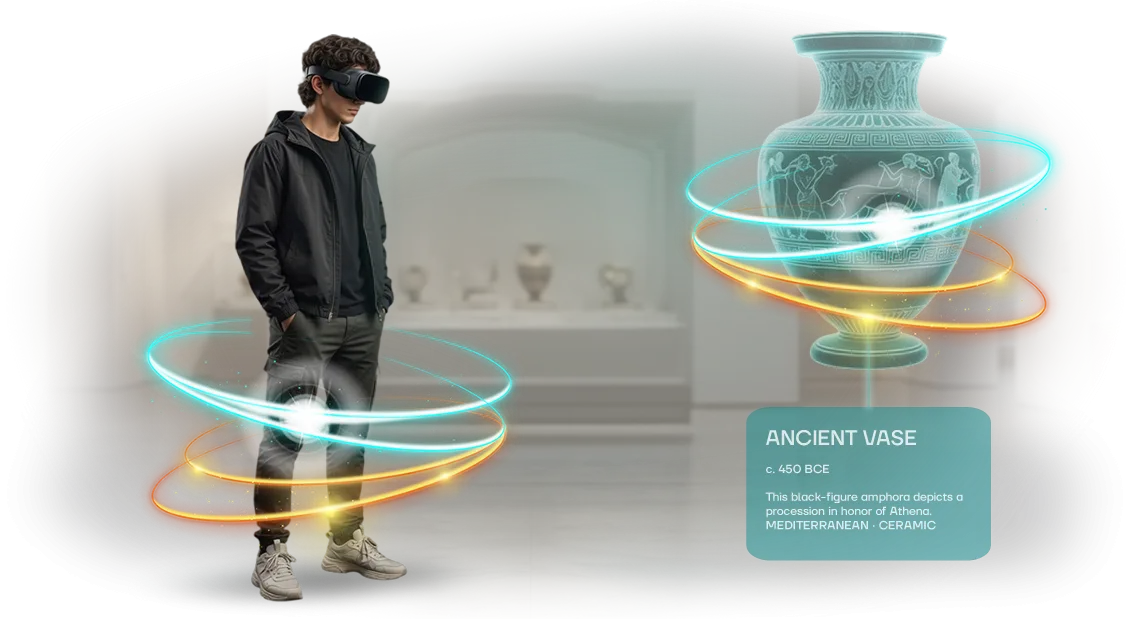
| VR guided tour | School groups, corporate clients, people with limited mobility | A full interactive session with narration and live communication; expands the audience and provides access to the exhibit for those who cannot come |
You don’t have to choose just one: a virtual tour works for reach, a 3D showroom for presentations, and a VR tour for deep engagement.
We will select formats for your exhibit, help you launch them on your website and social media, and most importantly — they will work for increasing park attendance, not just sit in a gallery. We will also advise you on how to measure results and reinforce the format in the next season.
Stages of Developing a Virtual Tour: From Brief to Launch
A clear process is half the success of a project. We divide the work into stages so you can see the result at each step and have input into it. No “black box”: after the brief, you always know what is happening with the tour and when it will be ready. We coordinate all key decisions with you before launch.
-
Brief and immersion in the task. We discuss the goals of the tour, the park’s audience, and the features of the territory. We gather materials about the exhibit, legends, and objects that are important to show.
-
Concept and script. We propose a route, a narrative structure, and interactive points. We agree on the script so it matches your vision and guests’ expectations.
-
3D content development. We create panoramas and object models, add sound, descriptions, and interactive markers. We regularly show you intermediate versions — you see how the tour is being born.
-
Review and revisions. You provide feedback, we adjust the details — from texts to the placement of interactive zones. Iterations are included in the project, so there are no unexpected additional costs.
-
Pre-launch testing. We check the tour on computers, tablets, and smartphones, making sure it works reliably even in park conditions. You get a finished product without “surprises.”
-
Project launch and support. We host the tour, set up access for guests, and train staff if necessary. After launch, we stay in touch and quickly update content.
What Is Included in the Delivery of a Virtual Tour Project
For an ethnographic park, a virtual tour is not just a promo video, but a working tool for attracting guests. The delivery package includes everything needed to launch and use it: from the tour itself to instructions and support.
- A ready-made virtual tour of key objects: farmsteads, workshops, exhibits. The guest explores the territory and gets an impression they want to experience in person.
- Adaptation for website and social media: the tour opens via a link without installing apps, and can be shared in messengers — free reach for your park.
- Control panel: you can change descriptions, add new points and seasonal events yourself. Edits are made in minutes, without contacting developers.
- Audio guide with professional voiceover and texts — guests listen to the tour at home, and arrive at the park already “familiar” with it.
- Built-in request form or ticket purchase: the visitor leaves contacts or pays for entry, and you receive a ready-made inquiry.
- Training materials for your team: how to use the tour when talking with guests, where to place links, how to answer questions.
- Warranty support after launch: we fix issues, help with refinements, and the tour works reliably in your promotion.
As a result, you get not just a “picture for the website,” but a ready-made tool that brings in guests and reduces the load on administrators. All that remains is to place the link and tell visitors about it — the technology and content will already be ready.
Case Study: How a Virtual Tour Brought New Visitors to the Park
The ethnographic park “Nasledie” is an open-air museum where guests learn about the daily life and crafts of past centuries.
The problem was typical for this format: the park is located outside the city, and potential visitors are not ready to make a blind trip — they need a reason and confidence that the trip is worth the time.
Ordinary photos and the description on the website didn’t convey the atmosphere, so excursion inquiries were rare.
We proposed making a virtual 3D tour of the park’s key locations: the guest house, the blacksmith shop, the apiary, and the observation deck.
The result appeared already at the presentation stage: at a travel exhibition, we launched a demo on a large screen, and in two hours more than 150 people came up to the booth — every fifth person left a contact for booking a visit to the park.
People weren’t just watching video; they controlled the movement, went inside the buildings, and examined interior details — this sparked genuine interest and a desire to see it all in person.
After the online version was launched, the effect held: the number of inquiries for group excursions doubled, and the share of visitors who came by recommendation increased by a third.
The park got a free promotion tool — the virtual tour can be embedded in social media, on the website, and in mailings, and it works around the clock, attracting guests from other regions.
For us, this project confirmed a simple rule: a virtual tour is not a replacement for a live visit, but its best salesperson. It removes the fear of the unknown, shows the value of the trip, and gives visitors a reason to choose your park.
After the successful launch, the client ordered additional seasonal scenes from us and now uses the tour as a permanent channel for attracting visitors.
What If I Have Specific Requirements for the Venue?
Every ethnographic park is unique — its own territory, its own buildings, its own display scenario. A standard ready-made showcase won’t work here: guests need a sense of authenticity, not just a beautiful picture.
That’s why we build the project around your venue, not the other way around: we study the layout, the specifics of the exhibit, the logic of visitor movement, and then assemble a virtual route around it.
If you have a non-standard venue — for example, an open territory with several objects or a building with historical layout — we adapt the navigation and viewing points so that a virtual guest gets the same experience as a real one.
You can show the interior of a house, the courtyard, craft workshops, and even seasonal changes without changing the physical space. To do this, you don’t need to rebuild the park — just do the shooting and assemble the route in the digital environment.
Adaptation concerns not only geography but also format. We create an individual project for your tasks: a sightseeing tour for tourists, an educational route for school groups, a themed tour for a holiday, or a closed presentation for partners.
You choose the depth of detail, the number of points, the language, and the style of presentation — and we adjust the mechanics to the scenario you need.
It’s also important that the project isn’t tied to specific equipment. Guests can watch the tour from a phone, tablet, or computer without installing apps, and you can embed it on the park’s website or in QR codes around the territory.
This gives you freedom: the virtual venue works both as a standalone product and as part of a live visit.
So specific requirements are not a limitation, but a reason to make the project more precisely tailored to your audience.
Tell us about the features of your venue at the brief stage, and we will offer a solution that takes all the nuances into account and preserves the atmosphere of your park.
Frequent Client Concerns — We Answer Directly
When ordering a virtual tour for an ethnographic park, a manager thinks not about technology but about risks: will the system work on opening day, will the staff manage, will the project drag on forever.
These are normal questions — and we answer them with direct guarantees, not general promises. Below we address the four most common concerns.
What if the equipment fails at the most critical moment?
We specifically design the system to work without failures during peak hours. Before opening, we conduct full testing at the venue, and on the day of the event our specialist is on duty with a backup kit. If something goes wrong, the replacement happens within minutes, and visitors won’t even notice.
Who will maintain the tour after launch?
You get comprehensive support: park staff receive a short training session, and we stay in touch by phone and through a remote monitoring system. Content updates and equipment maintenance are included in the support package, so you don’t need to hire a separate specialist.
Won’t the virtual tour be too complicated for visitors?
The interface is designed for people of any age and skill level: entering the tour takes one click, and navigation guides you through the next steps.
Guests who have never used similar technologies complete the tour without an instructor, and park staff are always nearby if needed.
What guarantees that the project will be delivered on time?
The timeline and stages are fixed in the contract with clear responsibility for both parties.
You see intermediate results at every stage, so there is never a situation of “we don’t know what they’re building for us.” If we delay the handover — that’s our area of responsibility, not your sleepless nights before the opening.
This approach is the result of dozens of launched projects for museums, parks, and exhibition spaces. We understand that you are responsible for the guests’ experience, and we help ensure that the technical part never lets you down. If you still have doubts — ask a direct question, and we will honestly tell you how we will solve your task.Order a Virtual Tour and Attract New Visitors
A virtual tour is not just an online walk, but a working tool for attracting new visitors. Today, guests first study the park on the internet and only then buy a ticket — and you can show them everything interesting before they hit the road.
By ordering a virtual tour, you get a ready-made sales channel that works without days off or holidays.
Why you should order a virtual tour right now:
- Online guests see the park before their visit — they arrive already interested and ready to buy.
- The tour is available around the clock: the park is open even at night, on holidays, and in the off-season.
- Viewers easily share the link in social media and messengers — every view brings in new people.
- The virtual format works for school groups, travel agencies, and corporate events — you expand your audience without additional investment.
- After the tour, the guest sees a clear call to action: buy a ticket, order a tour, or leave a request — every step is thought through.
- You get the foundation for repeat sales: special offers, seasonal promotions, and new routes can easily be added to an already completed tour.
Leave a request on the website, and we will contact you within one business day. We’ll tell you how a virtual tour fits into your marketing, show you examples, and offer a scenario that will attract precisely your visitors.
While preparations for the season are underway — now is the best time to order a tour and get new guests within the coming months.