

VR Speech Practice: How to Retain Clients and Reduce Turnover
Clients don't leave because of price—they leave because of an uncertain dialogue. When a manager stumbles, can't handle an objection, or loses their train of thought mid-presentation, the deal falls apart—and the brand is left blamed, not the employee.
Executives see this in declining conversion rates, but they often write it off as "weak salespeople," hire new ones, and repeat the cycle.
The second problem is hidden inside the team: employees who fear public speaking avoid complex negotiations and calls, burn out, and quit. Turnover is expensive—it means hiring, onboarding, and training costs, plus the loss of established client relationships. An uncertain salesperson doesn't just underperform; they damage the company's image.
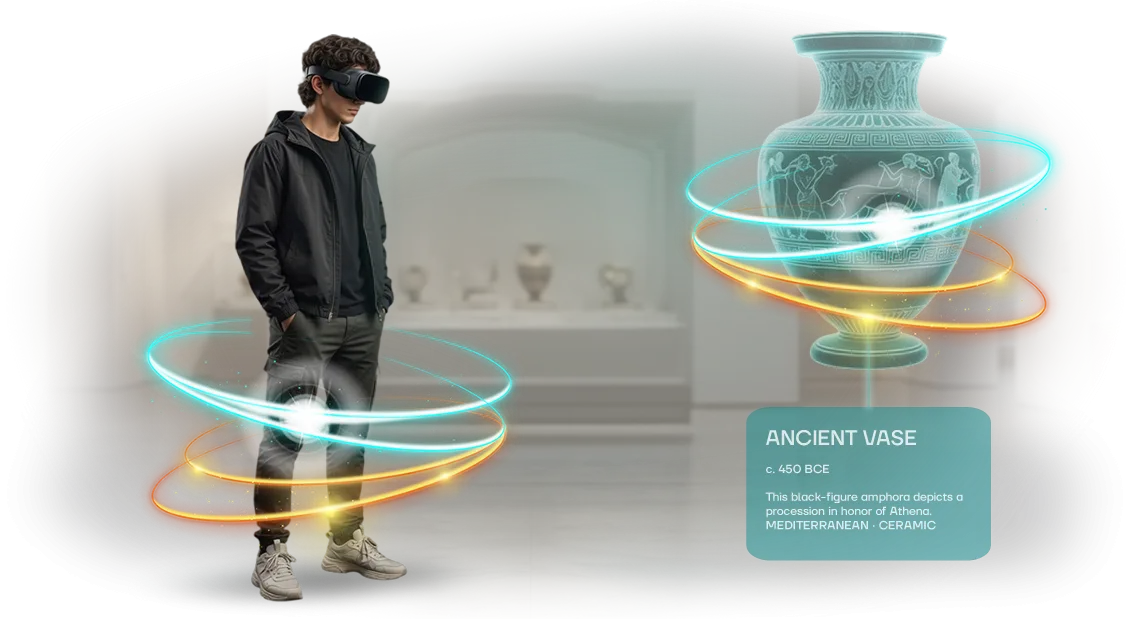
Confident speech is not an innate talent; it's a trainable skill like any other. VR speech practice allows employees to rehearse presentations in a realistic environment: in front of a virtual audience, with a timer, video recording, and error analysis.
The employee gets dozens of attempts without the risk of losing a real client, and the manager gets controlled skill growth instead of "hope for the best."
We are already helping companies build such programs. Presentation training, speech skills, and negotiation confidence—all of this is integrated into regular sessions that deliver measurable results: fewer lost deals, higher client retention, and a more stable team. The solution exists, and it's available right now.
Business Results: From Confidence to Higher Repeat Sales
Stage fright and camera fear cost businesses dearly: even a strong product loses to an uncertain delivery. Clients sense doubt and switch to competitors, and a presentation that should sell becomes the reason contracts are lost.
We solve this problem with VR training—a safe environment where employees refine their speech, gestures, and objection handling until they become automatic.
Instead of abstract theories, we offer realistic practice, the results of which are directly visible in negotiations and sales.
Higher Negotiation Conversion
An employee who has rehearsed dozens of scenarios in a virtual environment leads meetings more calmly and persuasively. They don't waste energy on fear; they focus on arguments and client needs.
As a result, negotiation conversion rises: fewer lost leads, more closed deals. For a sales department, this is a measurable metric that becomes visible within a few weeks of training.
Reduced Camera and Public Speaking Fear
For many professionals, recording video or speaking in front of a large audience is stressful. VR allows them to experience this repeatedly and safely until the anxiety fades.
During webinars, presentations, and meetings with partners, employees carry themselves confidently, speak clearly, and don't get flustered by questions. The audience senses this and trusts the brand.
Brand Recognition Through Strong Presentations
Every high-quality presentation is advertising for the company. When a speaker is confident, the content is delivered vividly, and the presentation looks professional, viewers remember the brand and tell others about it.
Team Training Without Interrupting Work
VR training fits into the work schedule: employees practice for 15–20 minutes whenever convenient. There's no need to gather a group, bring in a trainer, or rent a hall—skill growth happens in parallel with day-to-day tasks.
We create VR simulators that deliver predictable business results: confident presentations, higher sales, and a strong brand. Our engineers configure scenarios for your industry, and your team gets a tool that pays off from the very first deals.
Work Formats for Your Task: Individual and Group
Every business approaches training formats differently: some need fast results for a single speaker, others need systematic preparation for an entire team. We select the format based on your task, not a one-size-fits-all solution.
All formats share one thing: you get a ready-made VR speech simulator integrated into your workflow. Our engineers handle development, scenario configuration, and support—all you need to do is assign participants.
Format Comparison
| Format | Who It's For | What It Gives the Business |
|---|---|---|
| Individual training | Executive, speaker, key salesperson | Personal rehearsal of an important presentation, increased confidence and persuasiveness in 2–3 sessions |
| Group session | Team of up to 10 people: sales department, brand ambassadors | A unified communication standard, objection practice in a safe environment without risking client relationships |
| Turnkey program | Entire company, multiple departments | Full cycle: equipment, VR speech simulator, methodology, and training for internal trainers. Scales to new teams and branches |
If you're not sure which format fits, start with an individual session—within an hour we'll show results on your scenario. Or order a turnkey program when you're preparing several teams at once: you'll save on off-site training and get measurable growth in speaker confidence.
How VR Training Implementation Works: Stages and Timelines
VR training implementation is structured as a transparent process: you understand what happens at each step, how long it takes, and what result you get.
We start with a brief and task analysis, and finish with launch and support—so within a few weeks, your employees are already rehearsing presentations in a virtual environment.
- Brief and analytics: we discuss goals, audiences, and typical presentation scenarios—pitches, negotiations, project defenses. We define success criteria, such as reduced anxiety and increased confidence.
- Plan and estimate: we prepare a step-by-step implementation plan, timeline, and cost. We agree on control points so you can adjust the work as it progresses.
- Scenario design: together we define speech situations, virtual audience reactions, and difficulty levels. We configure the VR training for your industry and specific employees.
- Pilot project: we launch a test session with a small group. We collect feedback, measure changes, and refine the program—without risk to core operations.
- User training: we conduct onboarding for employees so they quickly get oriented and start practicing immediately. We prepare cheat sheets and short tips.
- VR training launch: we deploy the solution, connect all necessary scenarios, and hand over management rights to you.
- Support: we stay in touch after launch—updating scenarios, helping with technical issues, and expanding the program to new groups if needed.
What's Included in the Deliverable: Materials, Access, and Support
You get not just a simulator for the sake of technology, but a working tool integrated into your team's training system. We provide a complete package: from a configured virtual scene to a methodology for evaluating employee progress.
- Deliverable package — access to the virtual scene, user profiles, and configuration for your company's tasks.
- Methodological materials — ready-made recommendations for structuring training, analysis of common mistakes, and exercises to correct them.
- Presentation scenarios — templates for various business situations: project defense, client presentation, public speech. They can be adapted to your specifics.
- Team instructions — a clear guide for HR specialists and managers: how to launch training, assign roles, and interpret results.
- Post-launch support — our engineers and methodologists stay in touch, help refine scenarios, and answer team questions.
- Evaluation methodology — clear progress criteria: confidence, speech clarity, audience engagement. You see how each employee's skill grows.
As a result, you get not a one-time solution, but a working process for upskilling presentation abilities. Employees train in a safe environment, receive objective assessment, and you get a tool that quickly pays off through increased confidence and presentation quality.
Case Study: Confidence and Sales Growth After Implementing Training
After two months, the company recorded a measurable result. The number of completed negotiations grew by a third, and conversion to deal closure rose from 18% to 27%. The average sales cycle shortened: managers stopped dragging out meetings and moved faster to discussing terms.
The department head noted that the team became more confident in handling objections and less likely to lose clients at the final stage.
Sales Management Center (name changed) continued to use the simulator in onboarding new employees.
For us, this confirms that VR training delivers predictable business impact, not just a "novelty effect." If you have a similar challenge—we'll help implement the same format for your specific context: we'll build scenarios, configure the simulator for your products, and show results within the first three weeks of work.
What If You Have Specific Format Requirements?
Yes, adapting to your requirements is a standard part of the work, not an exception. We don't offer a rigid template that you have to force into your context.
Every project starts with an analysis of tasks: what industry employees work in, what communication scenarios they face, and what standards and scripts the company uses.
If you need a salesperson to train on dialogues with a demanding wholesale client, or a doctor to practice explaining a diagnosis to anxious relatives, we recreate exactly those situations.
The program will include your speech modules, typical objections, and behavioral rules—not abstract examples. Employees rehearse on material drawn from their daily practice.
We also take a flexible approach to format: session length, stages, difficulty levels, and control questions at the end of the session. If needed, we add virtual characters with specific personalities and communication styles—from a strict manager to a skeptical colleague. This allows you to play out difficult conversations in full detail without involving real people.
To ensure the program fits your specifics exactly, we first conduct a short brief and study your dialogue scenarios. Then our specialists build a working version, and you can make edits before the training becomes available to the whole team.
As a result, you get not a generic "one-size-fits-all" simulator, but a corporate tool that speaks the language of your business.
People train on their real tasks and use new skills immediately after the session—this shortens time-to-result and increases confidence in workplace communication.
Frequently Asked Questions About Virtual Presentation Training
Before starting virtual training, many people have questions: how does it work, will special equipment be needed, and does training guarantee results? We've collected answers to the most common concerns—honestly and without technical jargon.
All sessions take place on our platform, and participation takes no more time than a regular rehearsal. You don't need to configure a complex system: we'll help with setup and connection so you can focus on your presentation.
Do I need to buy expensive equipment for training?
No. A regular laptop or computer is enough. If you want full immersion, a basic virtual reality headset will do—we'll help you choose and set it up remotely.
How many sessions before results are noticeable?
The first changes appear after 2–3 sessions: you start holding pauses more confidently and controlling your voice better. A stable skill forms after a month of regular training.
Are my data and presentation recordings safe?
Recordings are stored on secure servers and accessible only to you. No one except authorized participants will be able to view or download them.
What if the format isn't a fit? Is there a guarantee?
Yes, we guarantee results: if after the first session you don't feel it's useful, we'll refund your payment. You can also start with a free session to evaluate the format.
Order a Pilot Project and Evaluate the Business Impact
VR presentation training pays off faster than it seems: a confident speaker negotiates more effectively and has a stronger impact on the team. You don't need to start with a large-scale rollout—a pilot project is enough to evaluate the effect on real employees.
We'll analyze your task on a free consultation, propose a format for your scenario, and calculate the exact cost of the pilot.
Within a few weeks, you'll see the dynamics: reduced anxiety, clearer speech, increased confidence—and you'll be able to make a decision based on numbers, not promises.
What you get after reaching out:
- Cost calculation for a pilot project tailored to your task—with accurate timelines and no hidden fees.
- A trial session: your employees try the VR simulator and evaluate the effect before purchasing.
- Result assessment using clear metrics: reduced anxiety, speech clarity, audience engagement.
- A launch plan for integrating VR training into your learning program—from pilot to company-wide scaling.
- Team support at every stage: scenario selection for your industry, simulator configuration, and material refinement.
- Recommendations for developing speaker skills after the training ends.
Leave a request for a consultation—within two business days, we'll get back to you with a pilot project plan, timeline, and cost. No obligations: you make the decision based on the results of the trial session. If the format isn't a fit—we'll tell you honestly and suggest an alternative.