

Emergency evacuation simulator: are your employees ready for a fire?
Most employees are not prepared to evacuate in the event of a fire. In a critical situation, people act chaotically: they waste time, head for the wrong exit, and give in to panic. For a company, this means fines for fire safety violations and a threat to life. Briefings do not build a lasting skill — the information is forgotten within a few days.
Emergency evacuation simulator is our way of turning formal evacuation training into practical practice. The employee finds themselves in a realistic situation: smoke, limited visibility, noise, and limited time.
They make decisions, search for an exit, and use protective equipment — exactly as they would have to act in a real fire. The simulator records every step, showing where the employee loses precious seconds and what mistakes they make.
As a result, management gets an objective picture of the readiness of each department and the entire enterprise. You can see who confidently knows the route and who needs additional practice.
Based on this data, we adjust the training program, and you get documented proof that employees actually know how to evacuate. This reduces the risk of fines and, more importantly, saves lives.
We developed the simulator for facilities of different scales — from an office to a production workshop. The scenarios take into account the specifics of your building and the requirements of supervisory authorities.
If you want to test your team's readiness and avoid fines, write to us — we will select a scenario and show you how the simulator works.
What does emergency evacuation offer employers?
Quick response in a critical situation
In a real fire or emergency, every second determines whether personnel can leave the building. Our simulator drills actions until they become automatic: the employee learns to find the exit, open emergency doors, help colleagues, and act without panic.
As a result, evacuation time is reduced by 30–40% — this is confirmed by measurements taken at production sites where we implemented simulators. A quick response reduces the risk of injuries and losses, and for management, this means direct cost savings.
Reducing the risk of fines and reputational damage
The labor inspection authority assesses not only documentation but also the real readiness of personnel to act in an emergency. Fines for violations can be substantial, and suspending operations costs even more.
Regular training in a virtual environment shows inspectors that training is not being done just for show. This reduces the likelihood of orders and preserves the company's reputation as a reliable employer.
Reducing production downtime
Traditional drills require stopping workshops, involving dozens of people, and take hours. A virtual simulator allows employees to train without interrupting work — a session lasts 15–20 minutes and can be completed in shifts.
Even if training takes place during working hours, it does not stop the production cycle. This is especially important for continuous production: an hour of downtime can be extremely costly, and the simulator pays for itself after the first training evacuation.
Increasing engagement and training effectiveness
Boring lectures and posters are forgotten within a week. An immersive scenario with near-realistic graphics and sound makes the brain remember routes and rules as personal experience, not as an abstract instruction.
Employees complete training with interest rather than "just for show," which directly affects their behavior in a real threat.
After implementing the simulator, the number of correct actions during a practice evacuation increases many times over. Management gains predictable safety without additional burden on personnel and without stopping business processes.
Formats for implementing the evacuation simulator to fit your task
Evacuation during a fire or other incident is a process where the cost of a mistake is measured not in money but in lives. Most companies conduct briefings formally, so in a stressful situation employees act confused.
A VR simulator allows skills to be drilled to the point of automaticity, but the implementation format must match your tasks, layout, and training system.
We have prepared three implementation approaches: ready-made scenarios, custom development, and full support. The difference is not only in price — it also lies in how deeply the simulator integrates into your company's processes and what results you get on the other end.
| Format | For whom | What it gives the client |
|---|---|---|
| Ready-made scenarios | Companies with standard layouts that need to quickly meet training requirements | Quick start without lengthy development, stable results, and a clear action assessment system |
| Custom development | Enterprises with unique buildings, complex routes, and industry-specific risks | Exact alignment with real conditions, practicing actions specifically at your facility |
| Full support | Large enterprises, training centers, and holding companies | An integrated simulator in the training program, updates for new regulations, and analytics for each employee |
Whichever format you choose, we remain available throughout the entire period of operation. Simulators adapt to changes in regulations, and you get a clear tool for monitoring personnel readiness. We will help you determine the right option during a free consultation.
Stages of launching a VR simulator: from brief to training
Launching a VR simulator is a project with clear stages, not a "black box." We structure the work so that at every step you see results and control the budget. Below is the typical path our evacuation simulator implementation projects follow.
- Brief and audit. We study your specifics, current labor safety instructions, and typical scenarios so that the simulator solves exactly your tasks.
- Scenario and plan. We create a detailed evacuation scenario, coordinate it with your specialists, and set production timelines.
- Prototype. We show a working version of the key mechanics — you see the logic of actions and interaction with objects in advance.
- Production. We fill the simulator with a detailed 3D environment, sounds, and inputs as close as possible to the real situation.
- Testing with employees. We run a pilot at your site, collect feedback, and refine details.
- Launch and training. We install the equipment, train your instructors, and integrate the simulator into the regular training program.
- Support and development. We update scenarios, add new inputs, and provide technical support — the simulator stays relevant.
We take on project management and keep you regularly informed about progress. As a result, you get a ready-made tool that quickly pays for itself by reducing risks and increasing personnel readiness for emergency situations.
What is included in the corporate simulator package
We have put together a complete delivery package so that you do not have to figure anything out or buy anything extra. Everything needed to launch training comes at once — from ready-made scenarios to instructions for your specialists.
- Evacuation scenarios. Several typical situations — fire, smoke, emergency equipment shutdown — with varying degrees of difficulty. Each scenario is adapted to your facility's layout and production specifics.
- Methodological materials. A ready-to-use training program: instructor instructions, a lesson plan, and checklists for assessing employee actions. Your occupational safety specialist gets a complete set for conducting training without additional preparation.
- Automatic reports. After each session, the system generates results: who completed the training, what mistakes were made, and which skills need reinforcement. You do not need to collect data manually — everything is stored in a convenient log.
- Technical support. Our engineers support implementation: they help set up workstations, run the first launch, and train administrators. After launch, support stays with you — we answer questions during the working day.
- Regular updates. Scenarios and methodological materials are supplemented based on new labor safety requirements and feedback from your employees. Updates come automatically, and nothing needs to be configured.
This package covers the task entirely — from the first briefing to regular readiness checks. You get not just a program, but a working tool that can be integrated into your regulations as early as next week.
Case study: how evacuation training reduced risks for a manufacturing plant
For the machine-building enterprise StankoLeader, we developed a VR emergency evacuation simulator. Previously, employees underwent formal briefings: posters and signatures in a log did not develop skills.
When the alarm went off, people became disoriented, followed memory, and wasted extra minutes — and in a real emergency, those minutes decide the fate of dozens of lives.
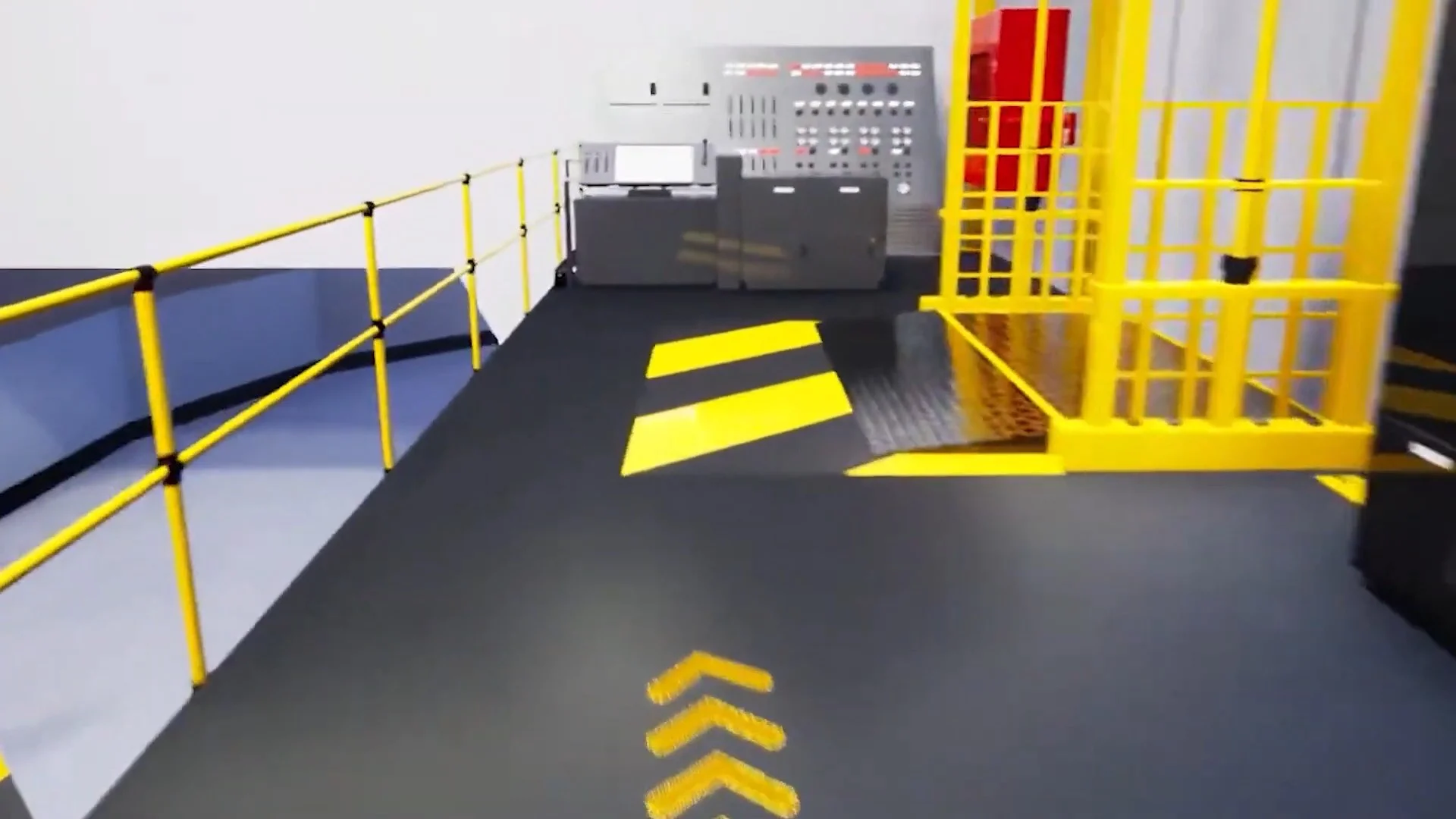
The simulator reproduces the factory workshops with accurate layouts, smoke, and limited visibility. In a short session, each employee experiences the path from the alarm signal to reaching a safe zone.
Mistakes are reviewed immediately, so the correct route is reinforced to the level of automatic response.
Implementation results
- Reaction time to the alarm signal decreased by 60%: people exit via the optimal route rather than at random.
- In three weeks, 400+ employees completed the training — previously this took two months and took people away from their machines.
- Emergency preparedness was confirmed by an inspection. The enterprise avoided an order and a substantial fine, as well as a possible workshop shutdown.
We received a repeat order for simulators for the warehouse and the administrative block. The production manager noted that employees no longer confuse exits and act more calmly during practice alarms.
This means VR training pays off not only on inspection day, but every day as part of the safety culture.
How to choose an emergency evacuation format for your enterprise?
The emergency evacuation format is not chosen from a catalog, but according to the specific situation at the enterprise. The three main criteria are the number of personnel, the specifics of the facility, and the training budget.
For a company with a staff of 30 and for a factory with a thousand employees, different scenarios work: in the first case, one universal simulator is enough; in the second, a system is needed that covers several buildings, workshops, and routes.
The specifics of the facility determine the realism of the simulation. Chemical production, an office center, a warehouse, or a thermal power plant differ in layout, sources of danger, and rules of behavior in an emergency.
Our engineers visit the site, study evacuation diagrams, and transfer them into the virtual environment — the employee trains not in an abstract maze, but in familiar corridors, with the same signs, doors, and floors.
This is critical because in a stressful situation the brain relies on muscle memory, and it is formed only by repetition in conditions close to real ones.
Budget is not a limitation, but a reason to choose the right scope. You can start with one scenario for a pilot group and scale up after the first results, or you can immediately deploy a full package with custom scenarios for different professions and difficulty levels.
We select a solution so that you pay for what actually reduces risks: the number of employees who will complete the training, the frequency of their sessions, and the coverage of critical scenarios — not for excessive options.
The main piece of advice is not to choose a format before talking to those who will use it. Study where delays occur during evacuation, which mistakes are repeated most often, and how quickly personnel lose skills.
The answers to these questions will show whether you need a simulator for a few hours or a full program of regular training. We help with this diagnosis for free and only then suggest the format — so you get a solution that pays for itself from the first launch.
Common concerns: safety, price, implementation
Before ordering a simulator, managers most often ask about cost, compatibility with existing equipment, the complexity of implementation, and guarantees.
We answer these questions directly — based on experience from dozens of implementations in industry, construction, and logistics.
Our approach: we solve your task rather than sell a "box." Therefore, we first analyze your scenarios, fix the scope of work, price, and timelines, and then you make a decision.
How much does simulator development cost, and what makes up the price?
The cost depends on the number of evacuation scenarios, the level of detail of the premises, and the need for integration with your training portal. After the brief, we provide a transparent estimate with a breakdown by stage — you see what you are paying for.
Often, a VR simulator is cheaper than regular offline drills: it does not require renting venues, employee downtime, or repeated organizational costs. The simulator pays for itself by reducing training costs and decreasing the number of mistakes during a real evacuation.
Will the simulator work with our equipment and systems?
We use professional equipment, but we adapt the simulator to your technical capabilities — you do not need to purchase expensive stations.
The simulator runs on a standard PC and a typical VR headset, and if necessary, it is integrated into your personnel training and record-keeping system.
Is it difficult to implement and train employees?
Implementation usually takes from two weeks to a month: we configure scenarios, test them on your equipment, and provide a brief instruction to the administrator. An employee masters the simulator in 10–15 minutes — no special skills or technical knowledge are required.
What guarantees and support are included?
Obligations are fixed in the contract: a warranty period for the system, free error correction during that period, and scheduled support after launch. Engineers remain available, and scenarios can be expanded when your regulations and floor plans change.
Ready to improve safety? Leave a request
Employee safety is not an expense item — it is protection of your business from downtime, fines, and reputational losses. Even the best briefings do not guarantee that a person will behave correctly in a real emergency. A VR simulator allows you to drill actions to automaticity — without risk to life or equipment.
Leave a request — and within one working day we will hold a consultation, show examples of projects for your industry, and prepare a preliminary cost calculation. No obligations: you will get numbers, timelines, and an implementation plan, and the decision will be yours.
What you get after contacting us:
- consultation from a specialist in implementing VR training at your enterprise;
- cost estimation for your scenario and the number of employees;
- examples of simulators for similar production facilities and tasks;
- a pilot launch plan for one site — with minimal investment;
- an assessment of the effect: savings in briefing time and reduced risk of injuries;
- answers to questions about integration with your current training and certification system.
Fill out the form — and as early as next week, your employees can train in conditions as close to real as possible. Leave a request to discuss the details and get your cost estimate.