

Occupational Safety in Road Construction: Why Old Methods Don't Work
The road construction industry is one of the most dangerous sectors for workers. Road workers operate near moving traffic and heavy machinery, in poor visibility conditions, and during shift work. Any mistake leads to injury, project shutdown, and disputes with regulatory authorities.
Traditional occupational safety training is no longer reliable protection. Lectures, posters, and videos provide information, but they do not build behavioral skills for emergency situations.
An employee may know the requirements of the manual and still freeze when a dump truck passes by or equipment malfunctions.
The cost of such preparation is real incidents. Every accident in road construction means medical expenses and compensation, missed deadlines, loss of reputation with the client, and unscheduled inspections.
The entire business pays for one worker's mistake: fines, equipment idle time, and work suspensions only increase the damage.
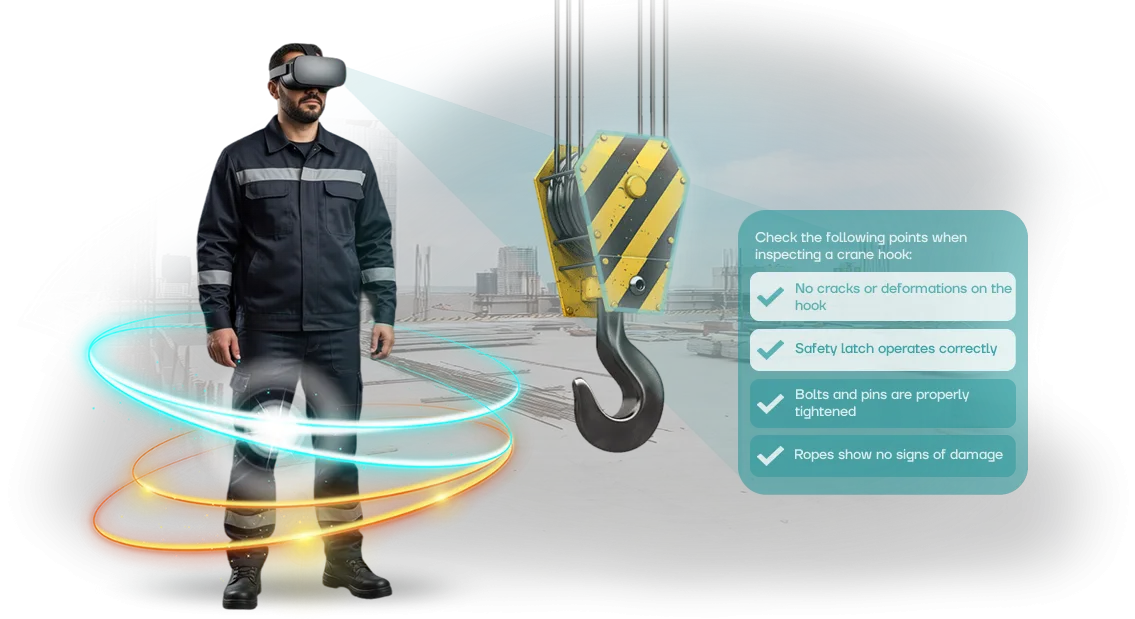
That is why companies are switching to safety training with VR simulators. Virtual reality makes it possible to practice dangerous situations without risk to life, putting employees through scenarios that cannot be safely simulated at a real site.
We develop VR simulators for occupational safety in road construction and help turn training into measurable results: the employee gains practical experience, and the manager gains confidence that everyone who goes to the site knows how to act.
What VR Training Gives Your Company: Safety, Savings, Reputation
Every manager in road construction knows what safety violations lead to: injuries, work stoppages, fines, and problems with contractors. Regular briefings provide theory but do not prepare workers for a real dangerous situation.
VR training closes that gap—the employee experiences a scenario at a construction site or highway in a safe environment. It is not a replacement for briefing, but an enhancement that brings measurable benefits to the business.
First of all—safety. The employee practices responses to falls, equipment run-overs, work at height, and other risks without endangering life or health. Muscle memory kicks in later: when the situation occurs at a real site, the person acts automatically and without panic.
The manager gains confidence that personnel are ready for emergencies, not just signed in a logbook.
The second benefit is savings on fines and downtime. Government inspectors increasingly check not paper documents but actual staff skills. If an employee confidently completes a VR scenario, it confirms the quality of training and reduces the risk of compliance orders.
In addition, fewer injuries mean less site downtime, sick leave, and payouts. One prevented incident easily pays for the implementation of simulators.
The company's reputation deserves special attention. In tenders and competitions for road projects, safety is increasingly becoming a selection criterion. Demonstrating a modern approach to training sets the company apart from competitors and strengthens client trust.
It also helps attract talent: professionals go where they are cared for, not forced to work in dangerous conditions.
Finally, VR training increases employee engagement. People remember much more when they see the consequences of their mistakes in 3D-realistic situations.
This reduces resistance to "check-the-box" training and creates a safety culture—where employees themselves do not want to violate, not just because they are forced.
We develop exactly these scenarios tailored to the realities of road construction, so that training works for your business rather than lying as dead weight in reports.
VR Simulator Formats for Road Construction Tasks
The road construction industry employs different categories of workers: heavy machinery operators, road workers, engineers, and site supervisors. Each has its own typical risks, so a universal training format does not deliver the required effect.
We develop VR simulators in three formats—individual, group, and stationary—so you can choose a solution for a specific task.
To simplify your choice, we have compiled the key differences between the formats into one table: you can see who each option suits and what benefit it brings to the enterprise.
| VR Simulator Format | For Whom | What It Gives the Enterprise |
|---|---|---|
| Individual | One employee practices the scenario independently | Assessment of personal skills and actions in an emergency; convenient for beginners and rare accident scenarios |
| Group | A team of several people in a shared scenario | Practicing interaction and role distribution; fewer mistakes during real road works |
| Stationary | Any employee in a training area | Regular briefings without travel or downtime; quick access to training and knowledge control |
The individual format is chosen when it is important to assess the actions of a specific person—for example, during an emergency involving equipment. The group format is suitable for practicing team actions: site fencing, coordination with the operator, working as a unit.
The stationary option is for when training must be conducted regularly and integrated into the shift schedule.
We will help determine which format or combination of formats will cover your enterprise's tasks. We analyze the specifics of road construction, work processes, and headcount, then design a simulator that can be easily integrated into the occupational safety system. The result—fewer injuries, fewer violations, and less downtime.
How VR Training Is Implemented in a Company
Implementing VR training in road construction does not require stopping production or restructuring internal processes.
We structure the project so that simulators complement the existing occupational safety system and employees acquire safe skills without risk to themselves or others.
- Brief and audit. We study your regulations, typical violations, and work specifics—from road maintenance to operating machinery. We determine which scenarios will deliver the maximum effect.
- Scenario design. Together with your occupational safety specialists, we describe real situations: dangerous maneuvers, weather conditions, and actions in an emergency. Scenario approval takes minimal time because we work from a clear technical specification.
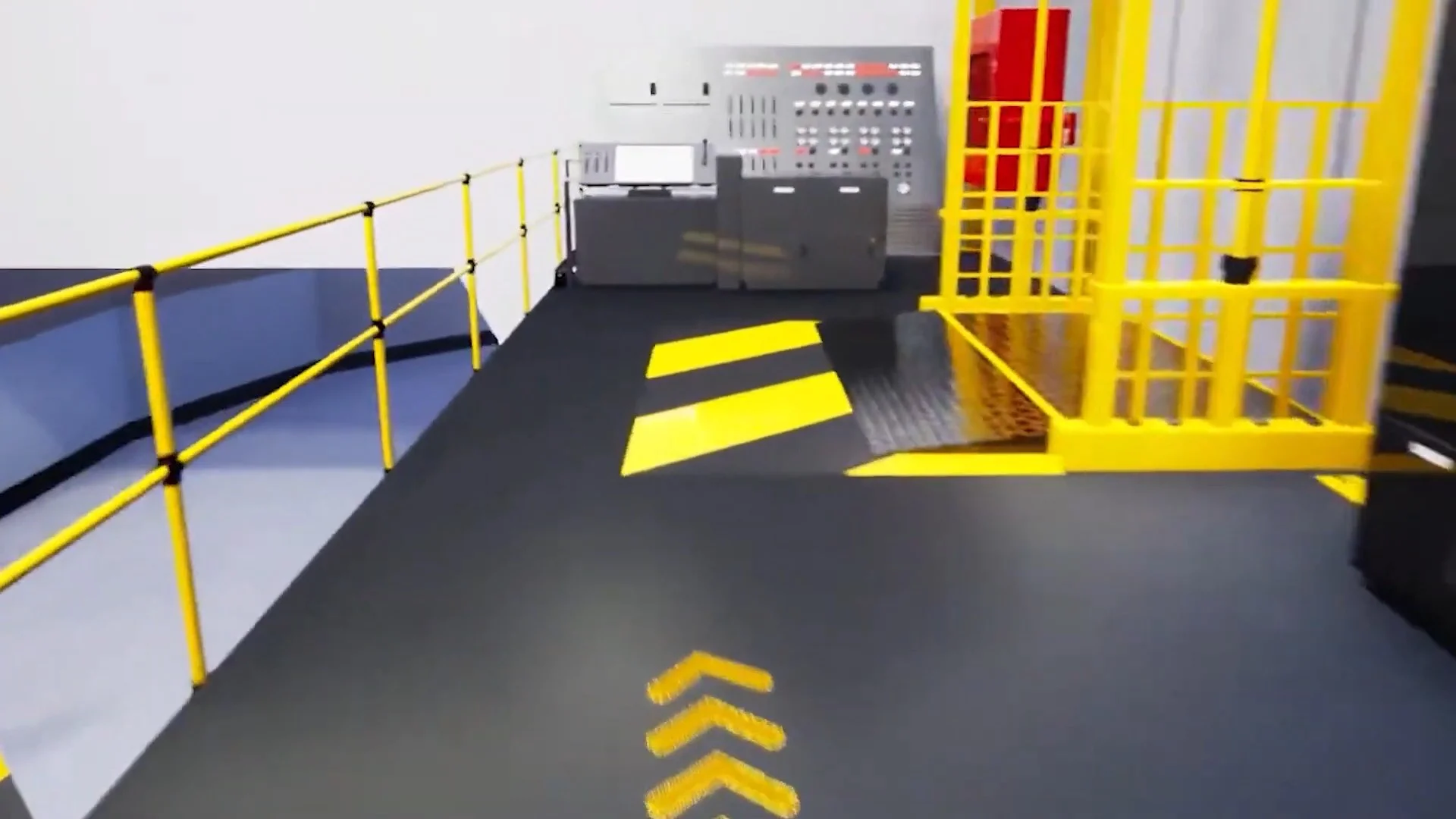
- Simulator development. We create a virtual environment that mirrors your sites: road sections, intersections, repair zones. The employee enters a familiar setting and learns to act correctly.
- Pilot launch. We test the simulator with a small group of workers. We collect feedback and refine details—from hint logic to the interface.
- Full deployment. We integrate VR training into the training plan and briefing schedule. Personnel complete the course at a convenient time—individually or as part of a team.
- Support and development. We update scenarios for new regulations, add seasonal situations, and, if necessary, expand the program to other departments.
In the end, you get a working safety tool, not a one-time demonstration. Employees practice actions until they become automatic, and managers see training results without interrupting production.
What Is Included in the Delivery of a VR Simulator for Occupational Safety
So that you do not have to assemble the solution piece by piece, we deliver a turnkey VR simulator—from equipment to training your staff. The package already includes everything needed to launch occupational safety training, and you will not need to purchase anything separately.
- Virtual reality equipment—headsets, controllers, and related components, ready to work. Everything is configured and tested, so simulators launch immediately after unpacking.
- Software with a scenario library—situations typical for road construction: working near machinery, actions in emergency situations, safe behavior on site. The software is regularly updated, and scenarios remain relevant.
- Methodological materials and instructions—session regulations, instructor checklists, and result assessment criteria. Everything is adapted to occupational safety requirements and ready to use.
- Staff training—our specialist visits your site and trains your instructors to work with the VR simulator. After that, they conduct sessions independently without a contractor.
- Delivery, commissioning, and setup—we bring the kit, install it, connect it, and verify functionality at your location. You receive a fully ready-to-use system.
- Warranty and technical support—for both equipment and software. If questions arise, our engineers help remotely and, when necessary, promptly travel to the site.
Thus, the delivery of a VR simulator is a complete solution for personnel training. You get the full cycle: equipment, content, methodology, and training, so you can launch your first sessions as early as the first week after delivery.
Case Study: How One Enterprise Reduced Injuries by Half
Road construction enterprises face a high injury rate because of work in close proximity to machinery, difficult weather conditions, and limited visibility. Traditional briefings and posters do not build lasting skills—information is forgotten within days. Therefore, mistakes recur, and the consequences are costly: from downtime to serious incidents.
For one client, we developed a series of VR simulators replicating typical work situations: pavement repair, working near an excavator, actions during icy conditions, and sudden pedestrian appearance.
Employees practiced safety algorithms in conditions as close to real as possible, including rare emergency scenarios that cannot be safely simulated at a training ground. Within six months, all line workers and site foremen completed the training.
The result was striking: within a year, the enterprise recorded a twofold reduction in injuries—from 14 accidents to 7. Managers attribute this to workers noticing danger in advance rather than reacting after the fact.
The numbers also affected the bottom line: compensation for health harm and lost work time decreased. The company ordered an expansion of the system to other departments and included VR training in its onboarding program for new employees.
This case study confirms that modern VR simulators are a working tool for reducing injuries, not entertainment. We build training on professional equipment and proven scenarios, so the result is stable and reproducible across different enterprises in the road industry.
How to Choose the Right VR Simulator Format for Your Task?
The right VR simulator format is chosen not by what is trendy, but by the specific task: who we are training, what risks need to be practiced, and what result the customer expects.
In road construction, the same virtual environment can solve different tasks—from checking knowledge of high-visibility vests to practicing responses to pedestrian run-overs or working near moving traffic.
The specific requirements of the industry dictate the details.
For example, training a road machinery operator requires a realistic cabin and controls, while training pavement repair workers requires full immersion in an environment with noise, wind, and vehicles on the adjacent lane.
It is also important to define the scenario: what we are teaching—rules, accident response, procedures for a traffic accident, or tool handling.
That is why we divide simulators along three axes: duration (from short 10–15 minute modules to a full course), level of immersion (from briefing to a scenario with body movements), and type of interaction (one person or a team).
Choosing the right format shortens training time and improves comprehension of your specific regulations.
For quick knowledge checks before work authorization, a short scenario with action choices is suitable. For practicing complex situations—such as bitumen fire or falling from height—a full simulator with consequences and physics is better.
And for coordinated team work, a shared scenario is ideal, where each person sees colleagues' actions and learns coordination.
How to choose? We start with a brief: you describe your tasks, regulations, and hazardous locations, and we propose a format that solves them within your timeline and budget.
In the end, you get a simulator that is not just impressive, but actually reduces injuries and helps you pass inspections from supervisory authorities.
Frequently Asked Questions About VR Simulators for Occupational Safety
Even when VR simulators have already proven effective, customers still have doubts: is it too complex, too expensive, and is it safe for employees? In road construction, where personnel work in the field and training time is limited, these questions are especially important. Below are answers to the main objections we hear during negotiations.
Is it difficult to integrate a VR simulator into the work process?
Not at all. We deliver a complete equipment kit, set it up, and train your instructor to use the system within a few hours. Employees take turns wearing the headset, so training can easily be built into a shift without site downtime.
For road construction, we have worked out options for traveling directly to the base or a shift camp—all logistics are already thought through.
How much does a VR simulator cost, and does it pay for itself?
The cost depends on the scenario and the complexity of the virtual object, but we offer both standard solutions for road services and custom developments.
The simulator pays for itself through reduced injuries and downtime, and also because you do not need to rent grounds or invite instructors each time. We calculate the exact cost after an audit—so you understand the expenses before the work starts.
Is VR training safe?
Absolutely safe. All skill practice takes place in a virtual environment, so a trainee's mistake has no real consequences. It is even safer than training at a live site, especially when working near roads and machinery. The equipment is certified, and hygienic standards are provided for time spent in the headset.
Order a VR Simulator Demo for Your Enterprise
At road sites, the cost of a mistake is people's lives and health, and for the enterprise—fines, downtime, and reputational losses. Standard training does not always allow practicing rare but dangerous situations.
A VR simulator provides that opportunity, but before integrating it into the occupational safety program, it is useful to see the result with your own eyes. That is why we offer a demo at your enterprise: it is free and carries no obligation.
After your request, you receive:
- A personal consultation—we analyze the specifics of your road works and recommend which VR programs cover the risks of your particular enterprise.
- A live demonstration—we show how an employee operates the simulator and how an instructor sees mistakes and progress.
- Samples of training modules—you can evaluate the content: regulations, signs, barriers, and procedures for road emergencies.
- A format calculation for your teams—we advise on how to train workers, machinery operators, and foremen without stopping production.
- A pilot training session—we suggest running a VR session on one shift and comparing the level of preparation before and after.
- An implementation plan—we describe step by step what is needed for launch: equipment, premises, schedule, and responsible staff.
- Post-launch support—we stay in touch, help update programs for new regulations, and answer employees' questions.
Leave a request—we will call you back and agree on a convenient time. You will see a live tool, not a presentation, and you will be able to assess how VR training fits into your occupational safety system. Start with a demo—it is the first step toward reducing risks at road sites.