

Why VR simulators are mandatory for occupational safety in metallurgy
In metallurgy, the price of a mistake is measured not in fines, but in people's lives. Traditional occupational safety training — briefings, posters, and tests — conveys rules but does not develop the skill to act in an emergency.
One in two incidents at work occurs due to human factors: the employee knows how things should be, but when metal spills, smoke appears, a crane fails, or chemicals leak, they get lost and make the wrong decision in seconds.
For business, this means a workshop shutdown, investigation, compensation payments, and loss of reputation. One serious case crosses out months of work by the industrial safety service, increases insurance premiums, and distracts managers from development.
Supervision requirements are tightening, and workplace injuries remain the biggest headache. The problem is not the lack of regulations — the employee simply has not lived through a dangerous situation before encountering it in real life.
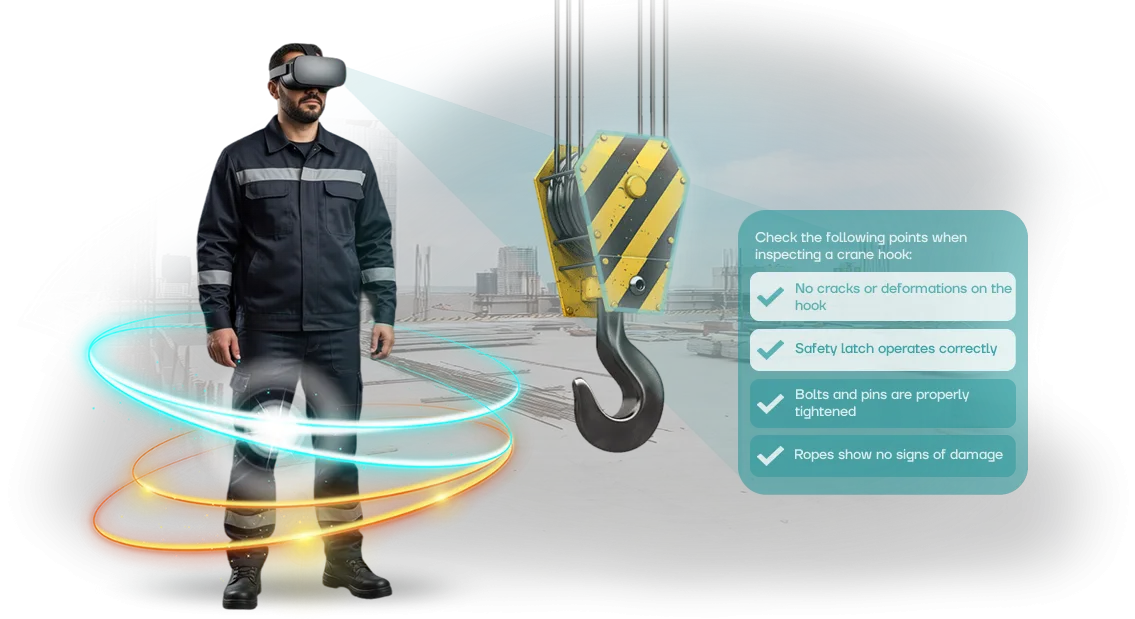
The VR simulator from our team closes this gap. In a safe virtual environment, the employee practices actions during an accident, metal spill, and other risks, learns to make decisions under pressure and without threat to life.
Scenarios can be repeated until the skill becomes automatic. This turns occupational safety training from a formality into real experience, and the enterprise gets predictable safety without downtime and unnecessary costs.
Industrial safety becomes manageable — you know exactly that every employee is able to respond to risk.
Advantages of VR simulators for personnel safety
Every year, metallurgical enterprises lose money on downtime, fines, and compensation due to injuries that could have been avoided. The reason is that "instruction-only" training does not form lasting skills: employees know the rules, but act at random in an emergency.
Implementing VR simulators transforms occupational safety from a formal procedure into real protection of people and business.
Reducing accident rates in production
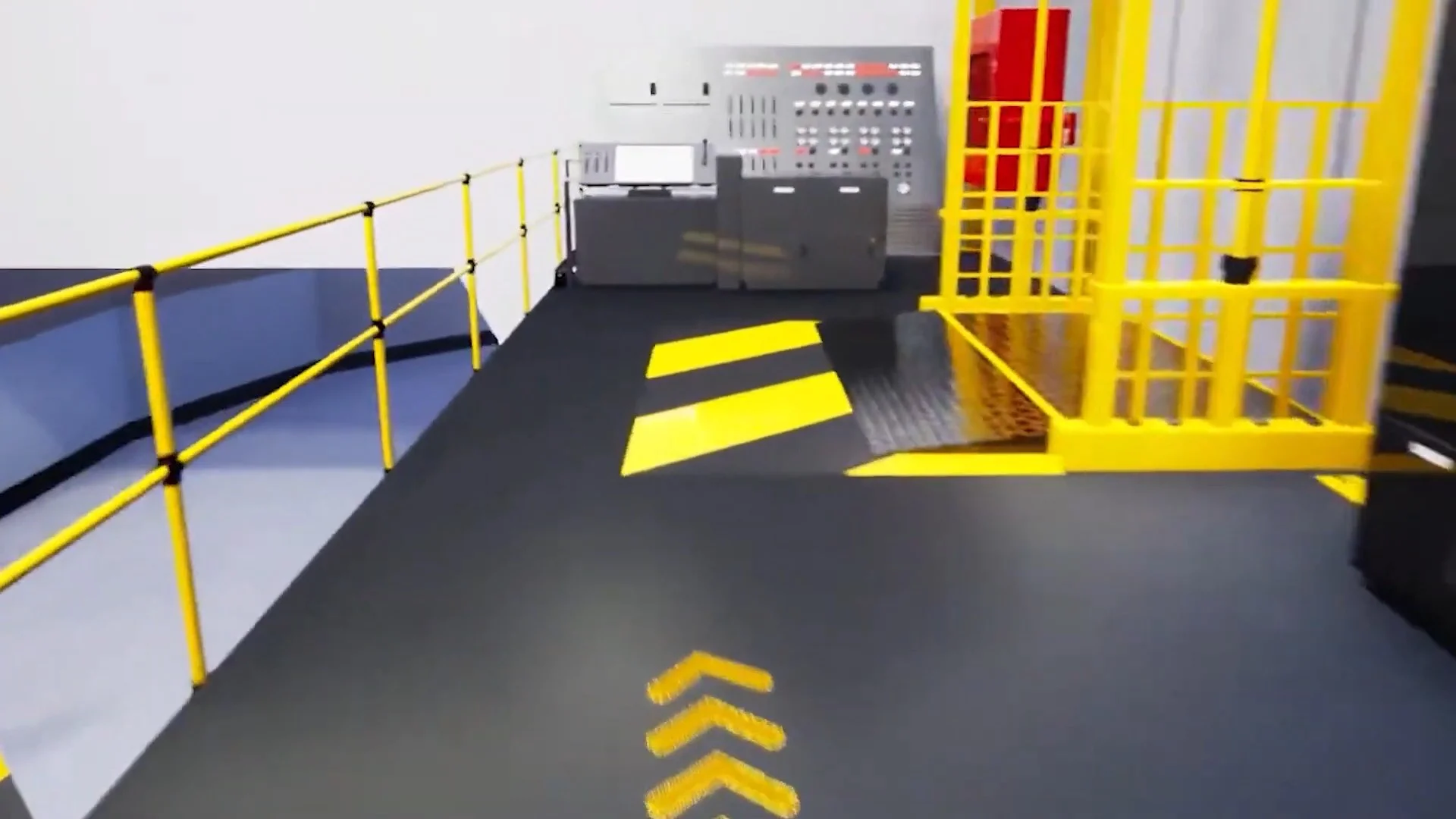
The virtual simulator reproduces the workshop, equipment, and hazardous areas of your enterprise — from the movement of a ladle to gas leakage. The employee enters an environment as close as possible to real conditions and learns to notice risks before they lead to an incident.
Practicing responses in emergency scenarios builds muscle memory. When the situation occurs in real life, personnel react quickly and correctly — without panic and without wasted seconds of hesitation that cost dearly.
Fast and safe practice of dangerous scenarios
In real production, you cannot "pretend" to drop a load or create smoke — that is risk and work stoppage. In the VR environment, such scenarios are practiced repeatedly and safely for people and equipment. A mistake in the simulator does not lead to injury — but the experience remains.
Savings on fines and downtime
Every accident is not only an employee's health, but also inspections by supervisory authorities, fines, and line stoppage.
Companies with confirmed training effectiveness go through inspections much more calmly: the inspector has proof that personnel actually practiced skills rather than listened to a lecture.
At the same time, training takes place without interrupting production: one instructor can accompany several workers simultaneously, and the schedule adapts to shifts. You do not lose working hours gathering a group in a training classroom.
Growing personnel engagement
Employees perceive VR training as a modern and respectful practice, not as "another safety lecture." This increases attention and material retention many times over.
Sessions are interesting, which means the knowledge truly stays with people and works in production every day.
VR simulator formats for metallurgical enterprises
For metallurgical enterprises there is no single "ideal" training format — the appropriate VR simulator is determined by the scale of training, shift schedule, and budget.
For some, a mass onboarding training for newcomers is enough; for others, practicing emergency scenarios with maximum immersion.
We select a training format for your tasks and show how it will pay off. All options run on professional equipment with unified server-side analytics — you get result tracking for every employee.
| Format | Who it is for | What it gives the client |
|---|---|---|
| Desktop VR simulator | For scheduled training and checking all personnel | Wide coverage at a minimal budget, a uniform knowledge standard, savings on instructors |
| Standalone VR kit | For training in the workshop and shift teams | Launch without stopping production, flexible shift schedule, instant reports |
| Full-immersion VR class | For key specialties and rare emergency scenarios | Maximum realism, lasting safe-work skills without risk to people |
Any of these formats can be adapted to the specifics of metallurgical production.
You can start with desktop simulators for mass training, and add full immersion for operators of complex units — as a result, you get a program that fits the budget and covers the most critical risks.
Sign up for a demo: we will show what the scenarios look like in action and calculate the optimal format for your enterprise.
How a simulator is developed: from brief to launch
We know that timelines and predictability matter for metallurgical production. That is why the entire process is built as a transparent route: you see what happens at each step and approve key decisions before they become expensive. No hidden stages — only a result that is accepted by your employees.
Stages of work
- Brief and analytics — we discuss your regulations, hazardous areas, and frequent personnel errors. We compile everything into a clear technical specification.
- Training scenario — we prepare a detailed scenario and coordinate it with your instructions. You approve the text and logic before development.
- Prototype and approval — we show key scenes and controls. At this stage you can make edits without extra payment.
- Full version development — we create all scenarios, the action assessment system, and hints. The simulator undergoes internal testing.
- Implementation and setup — we deploy the solution on your equipment, configure result tracking, and train instructors.
- Pilot launch — your employees complete their first sessions under our supervision. We collect feedback and refine details.
- Support — we keep the simulator up to date and update scenarios when regulations change.
This approach has already proven itself in metallurgical enterprises: they started with one workshop and then expanded training to other sites without additional downtime.
What is included in the VR simulator delivery package
We do not sell a "box with a program," but a ready-made training system that works at your production site from the first day.
The delivery package includes everything needed to launch — from configured equipment to methodological materials — so you do not spend time searching for contractors and do not incur extra expenses.
-
VR equipment — headsets and controllers, fully configured and synchronized with the simulator. You do not need to buy or configure anything: the hardware is tested before shipment and ready to work immediately after connection.
-
Software with a license and installed occupational safety and security scenarios. For metallurgy, these are typical production situations: working with hot metal, emergency actions, and rules for using protective equipment.
-
Methodological materials — an instructor's manual, lesson plans, and assessment forms. Your staff can conduct training on their own without waiting for external specialists and without pulling people away from work for long courses.
-
Tracking system for progress control: the manager sees which employees have completed the training and who still needs to. Results are saved automatically; if necessary, a report can be generated for supervisory authorities.
-
Training for your team — introductory instruction and system setup tailored to your regulations. We show how to launch the simulator, work with reports, and assign training so you do not depend on us in daily work.
-
Support for the entire service life — software updates, consultations, and prompt replacement of equipment in case of malfunction. Training will not be idle: we can visit your site upon request and help resolve any issue.
Results of implementing VR training in production
The numbers in occupational safety reports are not an abstraction. Behind every statistic is people's health and stable workshop operation.
To prove the effectiveness of VR simulators in real conditions, we launched a program at a metallurgical production facility with a continuous cycle.
Case study: a metallurgical plant reduced injuries by 72%
The plant's management approached us with a specific pain — recurring injuries when working with hot metal and at height. We developed VR training for 400 employees in core occupations.
Each person quickly practiced real emergency scenarios, from molten metal spill to equipment failure.
A year later, the plant — let's call it Metallurgical Combine "Vostochny" — recorded a 72% reduction in injuries according to its own occupational safety service.
Additionally, the number of micro-injuries that previously did not make it into reporting dropped by 60%, and the time for initial safety briefing was halved.
The most important thing is that the effect was sustainable. After several months, the indicators did not return to previous levels: skills are fixed at the level of habits, not temporary memory. Personnel began to follow regulations more carefully, and new employees integrate into work faster.
After the first results, the client expanded the program to all sites of the combine. We continue to support the training and provide the occupational safety service with transparent reports on each worker's progress. For us this is confirmation: VR simulators are a working prevention tool, not entertainment.
We answer frequently asked questions about development
We answer frequently asked questions about development
Before ordering a VR simulator, metallurgy clients ask the same questions: whether the solution will fit their processes, who will maintain it, and how employees will react.
These are the right questions — they determine whether you get real value from training or just an expensive toy. We explain how we address each of these concerns.
What if the simulator does not fit our regulations and scenarios?
We start with an audit: we analyze your instructions, typical situations, and the places where mistakes most often occur. We adapt the scenario to each regulation — work zones, equipment, and action sequences.
We make edits before launch, and after a pilot check we fine-tune the logic to your requirements at no extra charge.
Who is responsible if the simulator breaks down or becomes outdated?
We provide a development warranty and fix support conditions in the contract. We update content when safety standards change, monitor system performance, and quickly resolve failures. You get one responsible contractor — no running around between subcontractors.
Will employees reject VR training and treat it as a game?
A properly presented VR simulator is perceived as a modern format, not entertainment. We train instructors, prepare reference cards, and short introductory sessions. People see the benefit: a skill is practiced on a realistic model, not in a lecture. Implementation goes without resistance because we think through the employee experience in advance.
How long does development take and what are the timelines?
Timelines depend on the number of scenarios and the complexity of modeling — from a few weeks to a couple of months. We create a schedule with stages and checkpoints so you see interim results.
The key point: we have already completed dozens of similar projects, so schedule delays are excluded.
Metallurgy clients — from plants to service companies — had the same doubts. After launch, they return with new scenarios and recommend us to colleagues. If you still have a question, ask us directly — we will advise and calculate a solution for your task.Order a VR simulator for occupational safety
Leave a request, and we will show how a VR simulator fits into your enterprise's training system. We start with a free consultation: you tell us about the specifics of your metallurgical production, and we propose scenarios that address your risks.
We will prepare a cost estimate based on the number of employees and the scope of scenarios, and then demonstrate a demo using a real example.
We have been working with industrial enterprises for more than 10 years and know how to make safety training clear and measurable. No unnecessary theory — only the practice of actions that reduce injuries and help pass inspections.
What you get when you contact us:
- Free consultation on implementing VR training in your processes.
- Cost estimate for your scenario: number of employees, complexity of situations, launch timelines.
- Demo of the simulator on a typical scenario or on your actual site.
- Adaptation to your internal occupational safety regulations and enterprise standards.
- Integration with your current training system and corporate reporting.
- Support at all stages: brief, development, launch, updates.
You can leave a request on the website or by phone — we will get in touch quickly, clarify the task, and propose a solution that pays off by reducing risks and training costs. Do not postpone employee safety: request an estimate and demo today.
How to choose the right VR training format for your task?
To choose a VR training format, first answer the question: exactly what does an employee need to practice, and with what regularity?
For metallurgy, this is most often either initial workplace safety training or practice of rare emergency situations — for example, actions during a molten metal spill or fire.
Mass training of a new group of workers requires short scenarios that can be completed in 10–15 minutes with immediate result checks. And for narrow specialists — crane operators or gas welders — detailed modules with repetition up to a confident skill are needed.
Look at the type of risk and the consequences of an error. If the cost of an error is high, it is better to choose a format with full immersion and step-by-step action control.
If the task is to regularly refresh knowledge for hundreds of employees, lighter modules that launch directly in the workshop or training room without complex setup are more practical.
This saves time and money: you do not need to pull people away from work for a whole day; training fits into the shift.
Rely on the contractor's expertise in your industry. Our team have already designed solutions for metallurgical enterprises, so we immediately see where a typical scenario is enough and where individual development is needed.
We will advise which format will deliver quick results and which will provide long-term skill development, and we will assemble a program for your budget and timeline.
The main rule: start with a pilot scenario on one group of employees, measure how safety indicators change, and only then scale.
This way you avoid unnecessary expenses and get clear numbers for management — for example, a reduction in the number of briefings or an increase in workers' confidence when acting in an emergency. Contact us for a consultation — we will help you choose the format and calculate the scope of work.