

VR Simulators for Occupational Safety in Building Materials Production
Injuries in building materials production do not happen out of malicious intent — they happen because of a habit of skipping occupational safety regulations.
An employee sees the same instruction dozens of times and stops noticing it, and in a real dangerous situation acts at random. Traditional formats do not let a person feel the risk before it becomes a threat to health.
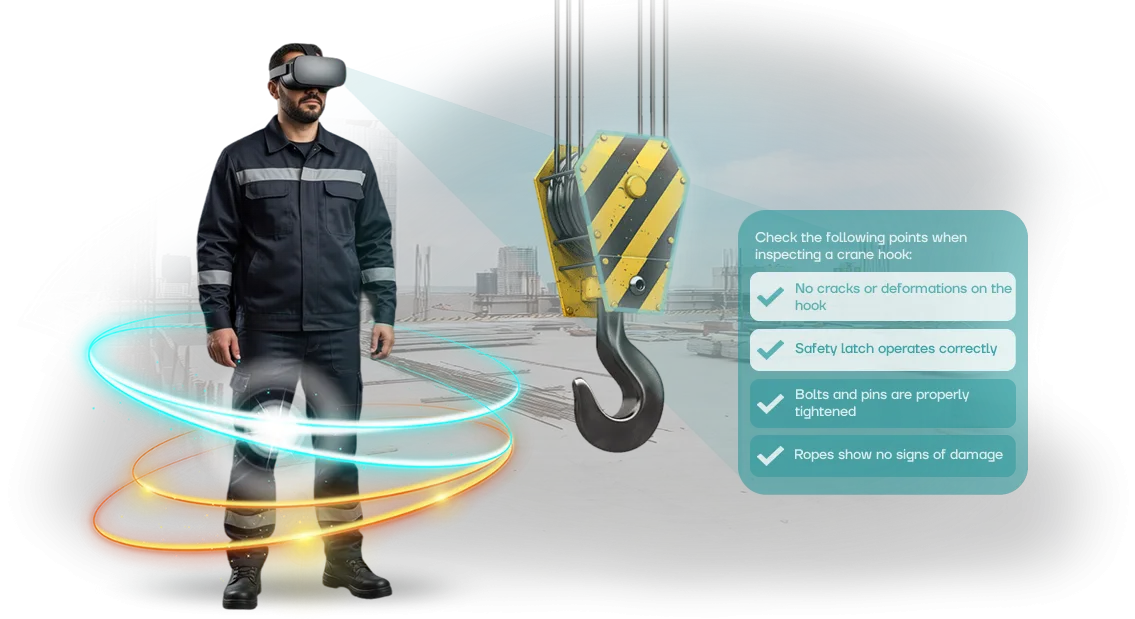
VR training changes this: the employee enters a virtual workshop where they repeat real operations and encounter emergency situations without risking themselves.
An error in the simulator triggers the same emotions and reactions as on the actual site, but the consequences stay in the digital world. This way, production safety is practiced at the skill level, not as a formal lecture attendance.
For a manager, this means predictability: fewer incidents, less downtime, fewer inspections and fines. Employees remember VR scenarios through personal experience and retain correct actions longer in stressful situations.
In addition, the modern format increases engagement in training — people perceive it not as an obligation, but as part of the company's care for its team.
This is exactly how we work at our team: we take your occupational safety regulations, transfer them into realistic VR simulators, and support the implementation. We build scenarios around your specific areas — from crushers to packaging lines in building materials production.
This allows you to reduce risks without stopping workshops and obtain clear reporting on every employee.
What Benefits Does an Enterprise Get from VR Safety Training
Injuries in building materials production mean not only sick leave, but also downtime, fines, loss of qualified personnel, and a blow to the employer's reputation. Traditional briefings provide theory but do not teach how to act at a critical moment.
That is why we at our team build VR simulators so that the employee experiences a dangerous situation safely, while the enterprise gets a measurable result.
Reduced Injury Rate
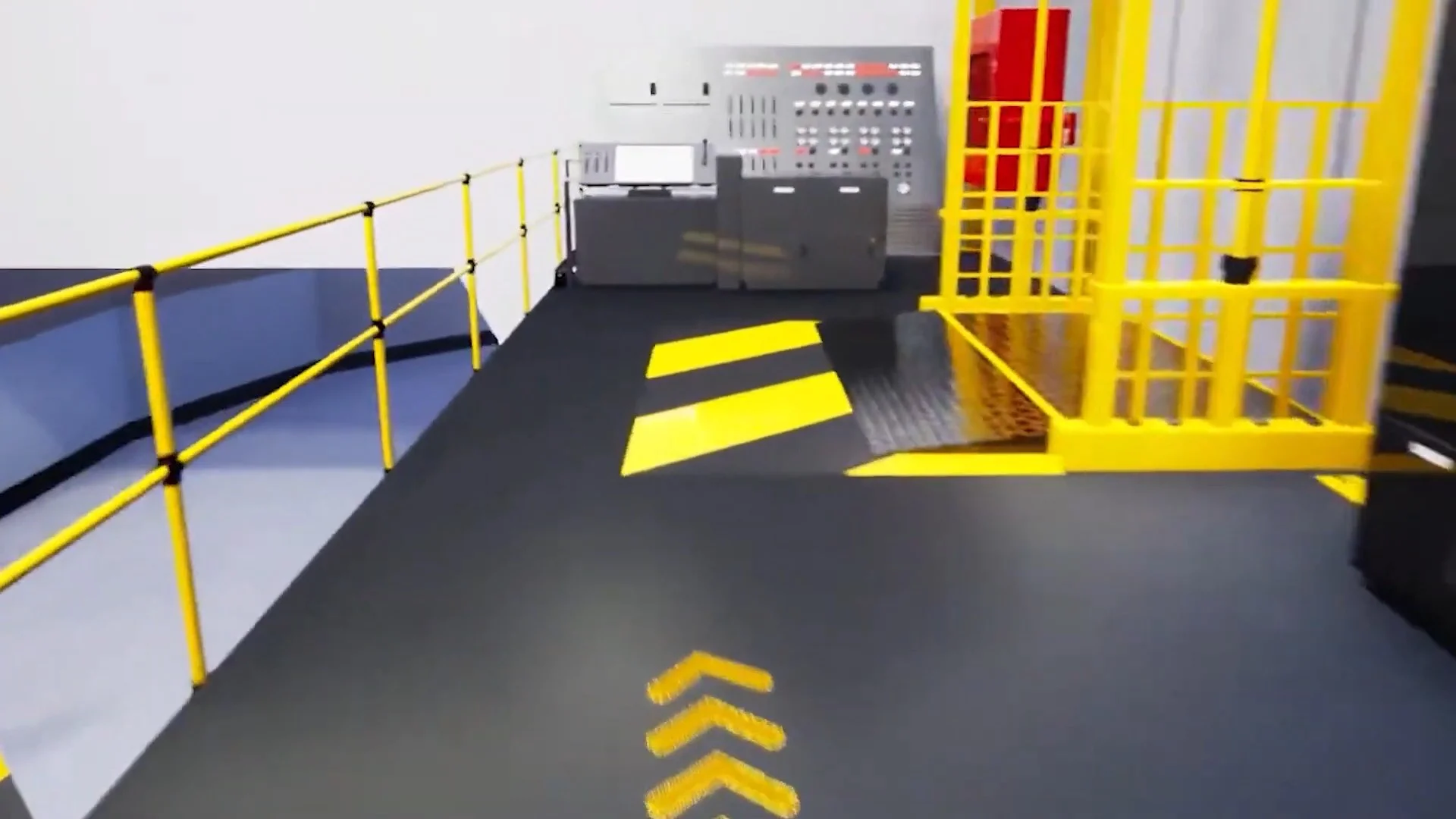
The worker enters a realistic workshop or warehouse environment where they must make decisions: properly secure a load, avoid a dangerous zone, react to an emergency.
An error in the simulator has no consequences, but leaves a vivid trace in memory — that is why correct actions stick better than when reading an instruction.
The manager sees which scenarios cause difficulties and can strengthen training for specific employees in advance. As a result, the number of violations and accidents decreases — which means fewer downtime hours and insurance payouts.
Employee Engagement
Traditional lectures and posters no longer hold attention, especially among experienced workers who believe they know everything. VR training breaks this barrier: the person controls the scenario themselves, sees the consequences of an error, and receives instant feedback. This sparks interest and a desire to complete the training rather than sit through it.
An engaged employee remembers safety procedures for a long time and willingly shares experience with newcomers. For the enterprise, this means a stronger overall safety culture without coercion or constant reminders.
Reputation Protection and Savings
Every accident means not only direct costs, but also reputational risks: it becomes harder to attract talent, customers and inspectors look more closely. An enterprise that invests in modern training methods shows that people's safety is its priority.
In the long term, VR simulators pay off through reduced payouts, downtime, and staff turnover. You get a tool that simultaneously lowers risks, raises team competence, and strengthens the image of a responsible employer.
VR Simulator Formats for Your Enterprise's Objectives
For building materials production, standard briefings do not always reflect the real hazards of the site: working with heavy loads, moving machinery, dust, and vibration. VR simulators close this gap, but only if the training format matches your objectives. That is why we offer three levels of detail — from ready-made modules to fully custom scenarios.
| Format | For Whom | What It Gives the Client |
|---|---|---|
| Standard module | Companies that need to quickly cover basic occupational safety requirements | Ready-made scenario for a standard profession or process, launch in a few days, clear reporting |
| Adapted scenario | Enterprises whose specifics are close to standard but have their own regulations | Base of a standard module with your instructions, routes, and equipment added |
| Custom simulator | Production facilities with unique risks and complex processes | Fully modeled workshop or warehouse area with your equipment, emergency situations, and action tracking |
Adapted and custom scenarios are developed based on an analysis of your occupational safety instructions and real photos and videos from the site. This lets the employee train in a familiar environment rather than an abstract one — so the skill transfers to production faster.
We help you choose the right format for your objectives and budget, and scale the simulator when processes change.
Even a standard module can be supplemented with custom elements — this is cheaper than building everything from scratch, while still delivering the required level of realism.
How VR Simulator Implementation Works: Steps for the Client
Implementing a VR simulator in building materials production is a clear six-step process. We designed it so that you always control the project's progress and understand what happens at each stage.
No surprises: only agreed tasks, transparent results, and feedback at key milestones. All steps are fixed in the plan in advance, and you know exactly what you will get at the end.
- Discussion and task audit — we review your real production risks, frequent staff errors, and occupational safety requirements. We identify which training scenarios will deliver the greatest effect and set learning objectives.
- Scenario approval — we prepare the scenario based on your regulations and instructions and show you every employee action inside the simulator. You make edits and approve the texts and logic — the training will fully match your standards.
- Prototype and testing with your specialists — we build a short version and let your employees try it. We collect feedback and adjust details before moving to full development.
- Full version development — we create all scenarios, add error tracking and hints, and build a convenient instructor dashboard. You receive intermediate versions for review and see how the project is progressing.
- Training launch — we help prepare the space and equipment, train your instructors, and run the first sessions. Immediately after launch, you see completion data: who trained and which errors repeat.
- Support and updates — after launch, we stay in touch: we update scenarios when regulations change, add new situations, and ensure stable operation. The training keeps working without your involvement.
What Is Included in the VR Simulator Delivery for the Occupational Safety Department
The complete delivery package for a VR simulator for the occupational safety department is not just a program and a headset. We hand over a system that is ready to work immediately after setup and support it throughout its service life. Below is the delivery scope your enterprise will receive.
The package includes:
- Ready-made VR scenarios for production situations typical of building materials enterprises: working at height, interacting with transport machinery, actions in case of fire and emergencies. The scenarios take your regulations and safety requirements into account.
- Methodological materials for the instructor — a detailed session script, lesson plan, evaluation criteria, and report templates. An employee can conduct training right away, without special preparation or lengthy explanations.
- Instructions and cheat sheets for workers — simple step-by-step guidance on how to complete the VR training, what it provides, and how knowledge is checked. This helps avoid questions and reduce stress before the first immersion.
- Training for your team — engineers and instructors learn on-site how to manage the system, integrate VR sessions into the training schedule, and analyze results. After a short training session, you work independently.
- Technical support for the entire service life of the simulator: consultations on any questions, scenario and software updates, troubleshooting. We stay in touch so training never stops.
- Adaptation to your production — if you have specific risks, internal instructions, or non-standard equipment, we refine scenarios to your specifics before delivery.
With this package, the occupational safety department has everything: from ready-made scenarios and methodology guides to future technical support. You get a working solution that improves production safety and reduces injuries.
Case Study: How VR Simulators Reduced Injuries at a Plant
Injuries in building materials production are not just numbers in reports — they are line stoppages, payouts, the loss of qualified employees, and reputational risks.
Briefings and posters alone are not enough: a worker may know the rules but act on autopilot in a stressful situation. That is why we approached the task differently — through practicing emergency scenarios in a virtual environment where an error costs neither health nor money.
What We Did at the Plant
We took a plant typical for the industry with active production and a high number of micro-injuries when working with equipment.
Together with engineers and occupational safety specialists, we identified the five most frequent emergency situations and turned them into VR scenarios.
The employee enters a realistic workshop environment and must make the right decision: stop the line, put on PPE, follow the procedure in case of smoke.
Every action is recorded and reviewed after the session. The worker sees their mistake immediately, not a month later at a lecture. The manager gets an objective picture — who is truly ready for an emergency and who only formally passed a knowledge check.
Results After Six Months
Over the six months following implementation, injuries at the plant decreased by 62%. The number of incidents with equipment stoppage dropped almost threefold, and repeated safety violations fell by half.
For the business, this is not mere "safety for show" but direct numbers: less downtime, fewer payouts, less time spent on investigations and staff replacement.
We separately noted the growth in engagement: employees themselves asked for additional scenarios because training had stopped being a formality.
The plant continued the partnership and expanded the program to new areas, and colleagues from neighboring production facilities came to learn from the experience.
Today we use this methodology as the foundation for projects in other high-responsibility industries as well — the results are consistently reproduced.
How to Choose a VR Simulator for Your Production?
The main criterion when choosing a VR simulator is not the number of features, but a match with the real risks of your production.
Every building materials plant has its own hazardous zones: for some it is working with a crusher, for others it is vehicle movement, for others it is furnace maintenance.
That is why the first step is to define the list of typical errors and emergency situations together with you. Based on this list, we design the scenario — not the other way around.
Once the objectives are clear, we select the format. If you need to quickly train several shifts without taking people away for long — we build short modules on standalone headsets. This format is easy to fit into the schedule, requires no separate room or complex setup.
If you need to practice actions during a serious accident — we use full immersion with an instructor who controls the scenario and reviews every action. In both cases, the simulator reflects your specific production conditions.
Custom scenarios are not a nice bonus but a necessity. Standard solutions do not account for your workshop layout, equipment specifics, or the action sequence defined in your regulations.
We take real process flow charts, site diagrams, and occupational safety instructions and turn them into a 3D environment where the employee finds themselves in familiar surroundings. This is a completely different level of retention: the person trains where they will actually work.
The availability of feedback also influences the choice. The client needs not just a simulator, but a training tool — so we build in attempt tracking, error logging, and reporting for each employee. You see who has mastered the material and who needs additional training. This data helps reduce injuries and prepare the team for inspections by supervisory authorities.
If you do not know where to start, launch a pilot project in one area. We will analyze your processes, select the highest-risk operation, and build a working scenario in a few weeks.
You will evaluate the effect without major investment and decide how to scale the project to other workshops. This approach lets you choose a simulator for the task rather than look for a task to fit a ready-made solution.
Frequent Client Questions and Concerns
Clients ordering a VR simulator for occupational safety face the same questions: is implementation too complex, will expensive equipment be required, and when will the return appear.
Below we address the main concerns — based on real projects for building materials production, not abstract promises.
Will implementation take a lot of time and stop production?
No. We handle all setup, integration, and training of your instructors. The simulator launches within a few days and requires no changes to existing processes: training takes place in a separate area without stopping the line.
Employees complete their briefing on a flexible schedule — this is even more convenient than gathering everyone on a single day.
Will we have to buy expensive equipment and hire specialists?
The equipment is a single set of VR headsets that has already proven itself in industry. Maintaining it is no more complicated than maintaining an ordinary computer, and we train your employee in a couple of hours.
One set covers training for dozens of workers per month — the hardware cost is minimal compared to the price of an error on the production floor.
How quickly will the investment pay off and what results will the company see?
The effect is visible immediately: briefing time decreases, material retention improves, and the risks of injuries and related fines and downtime go down. Workers gain the skill to act in an emergency without real danger.
Payment can be split into stages or covered through rental — this reduces the financial burden at the start and lets you evaluate the value in practice.
If you still have a question — ask us directly, we will reply within one business day and show simulator examples for your type of production.Next Steps: Request a Commercial Proposal
You can get a commercial proposal and launch a project without a complex tender. We have built a clear path: during the consultation you describe your task, and we explain how a VR simulator will cover your need.
You do not need to understand the technology — we will advise what fits your building materials production specifically.
- Request or phone call — leave your contact, we will call back within one business day.
- Scenario consultation — we review the situations: working with equipment, actions in an accident, safety standards in building materials production.
- Commercial proposal — we send a document: scope, stages, timelines, cost.
- Solution demonstration — we show VR simulator examples for industry.
- Start plan — we set the schedule, assign the team, and prepare the launch.
- Prototype and testing — you see the first scenarios right away; we adjust them before launch.
- Implementation and launch — we prepare instructors, integrate training into the employee schedule, and assist with initial sessions.
This gives you a transparent path from request to project start. Fill in the form or write to us — we will find a solution for your tasks.
After launch, we stay in touch: we refine scenarios based on testing results and help update instructions. Contact us today — we will send a preliminary proposal within two business days.