

The Textile Industry Is Choking on Fines and Injuries
Textile manufacturing is one of the most injury-prone industries. Weaving machines, chemicals, moving mechanisms, and lifting devices surround employees every day.
Workplace injuries here remain high, and supervisory authorities regularly issue fines for occupational safety violations.
The root of the problem lies in staff training. Classic safety briefings turn into a formality: instructions are read aloud, signatures are collected, but knowledge is not reinforced. The employee keeps working out of habit, ignoring the danger until an accident happens.
The consequences hit the business hard. Downtime, investigations, compensation payments, and growing fines from supervisory authorities all weigh on the company budget. Reputation suffers too: a plant with frequent injuries struggles to attract talent and maintain customer trust.
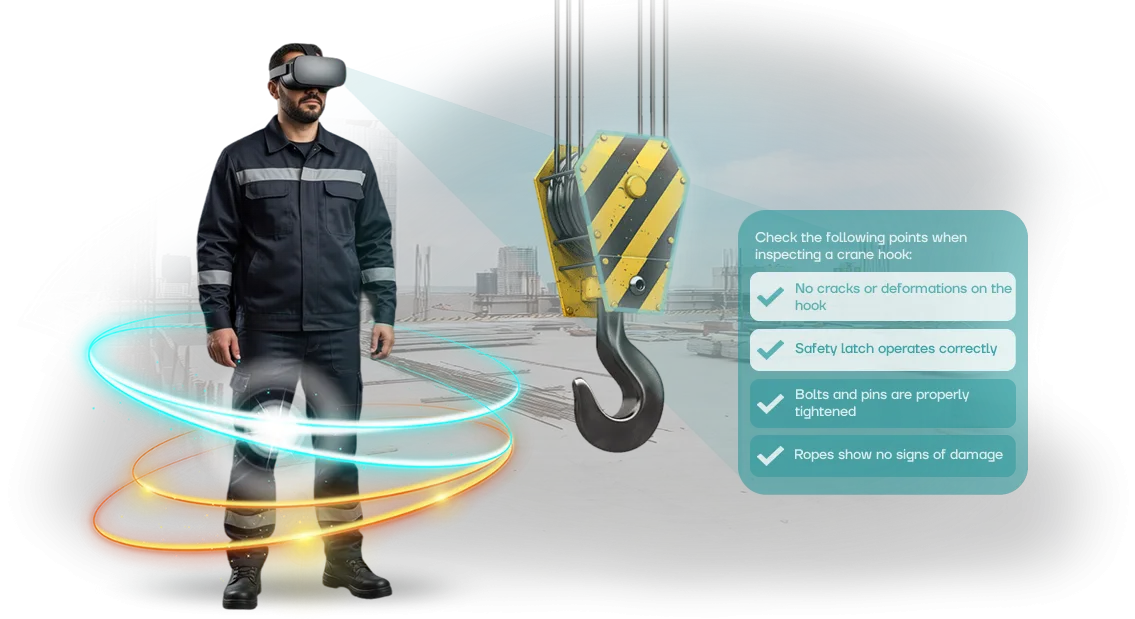
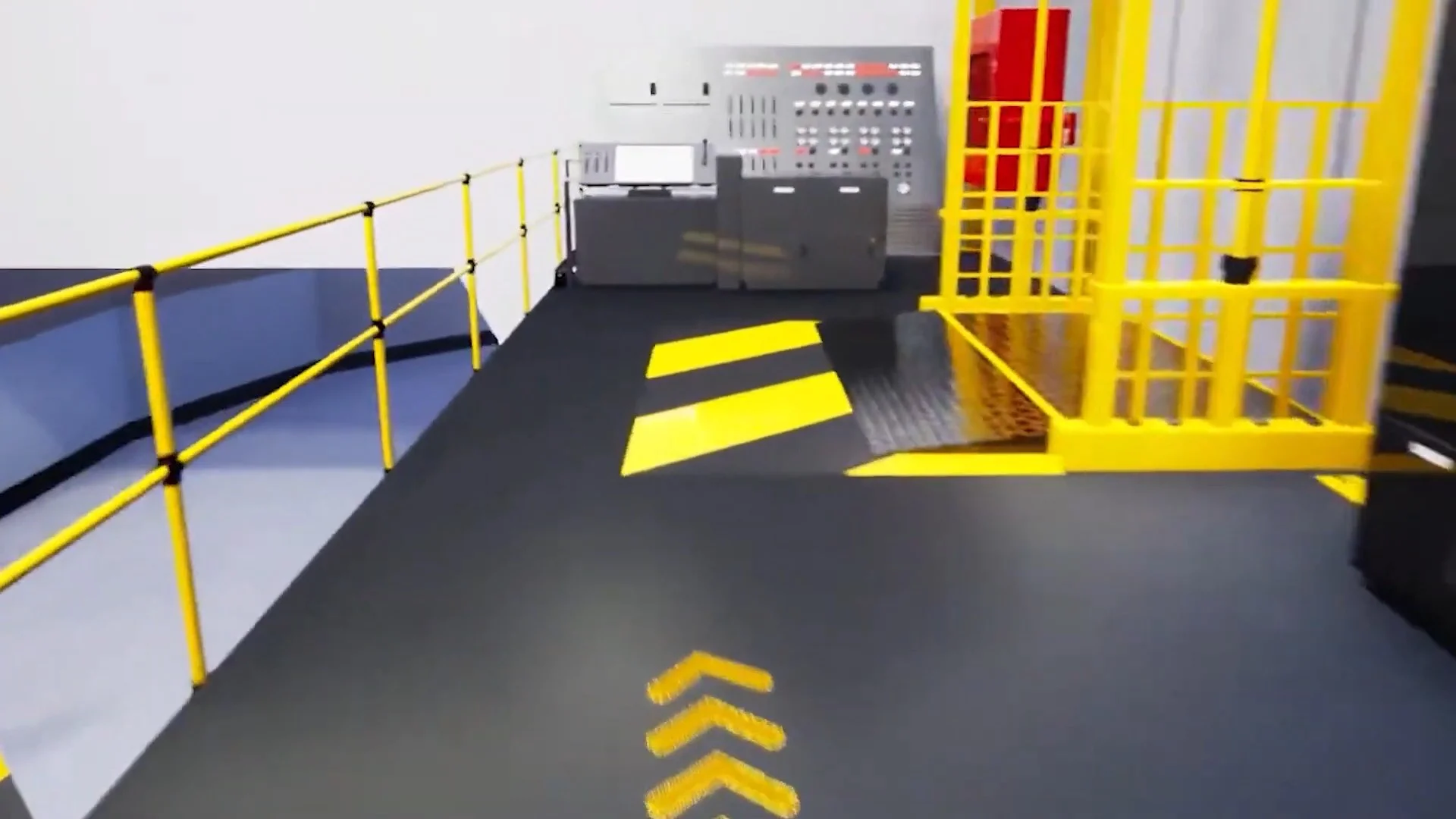
The only way to solve the problem is to train real skills in safe conditions. VR simulators model emergency situations and teach employees to act correctly without risking their lives.
These are exactly the solutions we create for the textile industry — they genuinely reduce injuries and take occupational safety to a new level.
What a VR Simulator Will Give Your Production
Textile production is a continuous stream of operations where an employee’s mistake leads to downtime and health risks. Classic briefings provide theory but do not build lasting skill: the worker knows the rules but does not know how to act in a non-standard situation.
Virtual training removes this contradiction by immersing staff in realistic scenarios with no danger to life.
The main value of a VR simulator is high knowledge retention. The employee does not just listen to a lecture but performs actions with their own hands: changing a bobbin, servicing a machine, containing a fire.
Visual, auditory, and motor memory are all engaged, so information sticks far faster than when reading an instruction manual.
At the same time, staff engagement grows: instead of a boring mandatory hour, people get an emotional experience they discuss with each other and remember for weeks.
The second effect is reduced real-world risk. A simulator can recreate an accident, equipment failure, and actions in smoky conditions without exposing the employee to danger.
A behavioral algorithm practiced to the point of automation carries over to the shop floor: the person notices an abnormal situation faster, knows where to press and whom to call.
For the company, this means fewer incidents, less downtime, and confidence that every worker is ready for a critical situation.
Finally, VR training saves resources. There is no need to stop the line, consume raw materials, or bring in instructors for every shift — the program runs at any time and for any number of people.
All shifts go through the same scenarios in the same way, which eliminates the “human factor” in teaching and makes employee safety systematic rather than dependent on a particular supervisor’s mood.
As a result, the enterprise gets a predictable level of staff preparedness without interrupting production.
VR Training Formats for the Textile Industry
In textile manufacturing, occupational safety instruction affects everyone — from new operators to experienced setup technicians. Lectures and posters provide theory but do not build lasting skills.
VR simulators transport the employee into a realistic environment where they learn to act without risk to themselves or the equipment. The key is choosing the right format for each category of employee.
We develop simulators for different training objectives. Here are the main formats:
| Format | Target audience | What it gives the client |
|---|---|---|
| Initial briefing | New employees with no experience on the equipment | Fast immersion in safety rules, reduced risk of mistakes in the first weeks of work |
| Refresher briefing | Experienced staff undergoing scheduled knowledge checks | Updating knowledge in an interactive form, growing engagement instead of a formal test |
| Emergency scenarios | Operators, setup technicians, maintenance staff | Practicing actions in fire, smoke, and equipment damage situations — without stopping production |
Formats can be combined: for example, start with an initial briefing, then conduct an emergency drill six months later. We will help you choose a scenario based on your objectives and employee work schedule — from a few people to an entire workshop.
How a VR Simulator Is Implemented
Implementing a VR simulator for the textile industry is not just installing equipment; it is a structured process that accounts for the specifics of your workshops and work schedules.
We guide you from the first brief to the point where employee training begins delivering measurable results — without downtime or unnecessary burden on staff.
- Brief and production audit. We study your sites, typical risks, and current regulations — from spinning shops to warehouses. This allows us to design a simulator that addresses the real threats of your particular enterprise, not abstract examples.
- Training program approval. We select scenarios based on your occupational safety instructions and show them to your specialists before development begins. You know in advance what employees will learn and what skills you will get as a result.
- VR scenario development. We create virtual situations based on your production: fire response, equipment work, behavior in emergency zones. Employees enter a familiar environment, so they transfer skills to real work faster.
- Pilot testing. We launch the simulator with a small group of workers, collect feedback, and make adjustments. You get a ready-made solution that has already been tested on your people, not a “raw” product.
- Training launch. We integrate the simulator into the shift schedule and train your instructors and administrators. Training runs without interrupting production: employees complete scenarios at convenient times.
- Post-launch support. We update scenarios when regulations change and help with configuration and technical support. You see completion statistics and the preparedness level of each employee, so gaps can be closed in time.
What Is Included in the VR Simulator Delivery
The client receives not a “box with a program” but a complete solution for training textile industry employees — from installation to result monitoring.
The full delivery package covers everything needed to launch occupational safety training in the first week, without external contractors.
The package includes:
- VR simulator software adapted to textile production conditions: work with spinning and weaving equipment, dust protection, actions in emergency situations.
- Methodological materials for the instructor: training scenarios, evaluation criteria, knowledge check questions, and analysis of common mistakes.
- Administration and access rights: creating user accounts, assigning courses to specific employees, a completion log, and group statistics.
- Training sessions for your specialists — instructors learn the system and then work independently.
- Operating and maintenance instructions, including workplace preparation and basic equipment care.
- Technical support and software updates for the entire period of use.
This approach addresses the client’s main fear — that the simulator will become “buy and forget.” With guidelines and administration, training runs according to plan, and the person responsible for occupational safety can see who has completed the course and who has not.
All documentation and access rights are finalized at delivery. After implementation, you receive a working training system that integrates into your existing occupational safety processes.
Results of VR Training in Real Production
In textile manufacturing, injuries most often happen not because of equipment complexity but because of haste and unpracticed actions in an emergency. Newcomers do not have time to master safe techniques, and experienced employees eventually start neglecting regulations.
Classic briefings and posters do not provide the required level of engagement, so management looks for tools that actually change staff behavior.
A telling case is the implementation at the spinning and weaving mill TekstilPro with about 400 employees. Before the project, up to four accidents per year were recorded; the main risk was clothing being caught by rotating mechanisms.
We developed a set of three VR scenarios: equipment start and stop, thread break elimination, and fire response. Each employee practiced dangerous situations in a virtual environment without health risks.
The results were measured after six months: injuries dropped by 42%, and safety violations fell by half.
The time for initial instruction for new workers was reduced from eight hours to two, while material retention improved: employees accurately name the sequence of actions in an emergency.
They also noted a one-third reduction in equipment downtime due to the human factor — this provided direct economic benefit.
After the pilot project ended, the mill ordered additional scenarios for maintenance staff and extended the practice to all shifts. The main outcome is that safety became part of production culture, not just a set of instructions.
If you want to achieve equally measurable results, start with a workplace audit and scenario selection based on your risks.
How to Choose the Right VR Simulator Format?
Choosing a VR simulator format starts not with technology but with production objectives.
In the textile industry, different areas require different approaches: a spinning equipment operator needs to practice actions when thread tangles, a setup technician needs a safe machine shutdown algorithm, and all personnel need quick evacuation in smoke.
There is no universal simulator, so the first step is to identify where the greatest number of violations occurs and which skills need to be reinforced.
The key criterion is the type of production. In high-injury areas (cutting, finishing, work with chemical compounds), detailed scenarios with a full cycle of actions and consequences for mistakes are justified.
For mass training of a large flow of employees, short immersive modules of 10–15 minutes are more effective and can be embedded into regular briefings without stopping work.
Shift schedules also matter: if staff work in three shifts, simulators are better deployed in a format available at any time, with automatic result recording.
Training goals also determine the format. If the task is initial instruction for newcomers, tour-style scenarios for exploring safety zones and typical hazards work well.
For periodic knowledge checks, interactive simulations are used, where the employee makes decisions in an emergency and the system records errors and produces a report.
When muscle memory needs to be developed — for example, the correct way to grip fabric rolls or fire response — training cycles are built with algorithm repetition until automatic.
The right approach is to start with a pilot in one area. Choose the department with the highest number of incidents or the most frequent violation, launch a short scenario with a group of employees, and measure the speed of material retention and the reduction in errors.
Use this data to scale the solution to other workshops, adding new variables and difficulty levels. This way, you get a format that actually reduces risk, not one that merely follows a trend.
We help you select the right format for your objectives: we analyze production specifics, assess the audience and training goals, and propose a specific simulator configuration with an implementation plan. Contact us — we will advise where to start and how to get measurable results quickly.
Common Doubts When Ordering a VR Simulator
Ordering a VR simulator for occupational safety in the textile industry is a step that often raises questions. Managers worry that the technology will be complex, expensive, or require stopping production. Let us look at typical doubts and show how they are resolved in practice.
Is it difficult to integrate a VR simulator into an existing training system?
Implementation does not require restructuring processes. It is enough to allocate a few square meters in a training room, and we will bring the equipment, configure scenarios to match your occupational safety instructions, and train the instructors. Usually, everything takes from several days to a week, and production does not stop.
Will employees be able to use VR right away if they are not familiar with technology?
The interface is designed so that anyone can use it — even someone who has never worn a VR headset. Large prompts, voice guidance, and simple logic make it easy to get oriented in 10–15 minutes. We have tested this with people of different ages and digital skill levels.
What does it cost and is it more expensive than a regular course?
The cost of a VR simulator is comparable to a full training course, but unlike one-time lectures, the simulator can be used repeatedly and for any number of employees. Savings on consumables and the reduced risk of injuries pay back the investment after the first few groups.
Who will support and update the simulator?
We take on technical support and content updates. If occupational safety rules change, we add new scenarios. You get a working tool, not a “box” that you must maintain yourself.
We understand that the decision to order a VR simulator is made carefully. Therefore, we are ready to answer all questions, show a demo, and calculate the implementation for your objectives. Contact us — let us discuss how to make occupational safety at your production site more effective and safer.Order a VR Simulator for Your Enterprise
Occupational safety in the textile industry is not a formal briefing but real protection for people and reduced risk for the business. Regular lectures and posters are poorly remembered: employees get distracted, and knowledge fades by the end of the shift.
A VR simulator immerses the worker in a realistic workshop situation — they learn to act correctly without risk to health or equipment.
To get started, you do not need to understand technical details. Leave a request — we will provide an expert consultation, clarify your enterprise’s objectives, and calculate the development cost for your scenario.
Turnkey implementation saves you from looking for contractors piece by piece: we handle everything — from scenario to launch.
What you get after contacting us:
- Expert consultation — we will analyze which situations your employees need to practice: from working with weaving machines to fire or accident response.
- Get a cost estimate — we will prepare a transparent cost calculation for your scale, number of people, and timelines, with no hidden charges.
- Order VR simulator development — we will create a scenario based on your regulations and the real risks of textile production.
- Turnkey implementation — we will set up the equipment, train the instructors, and help integrate the training into the schedule so nothing is left unfinished.
- A demonstration — we will show what the training looks like at your site or in an online format before the work starts.
Call or write to us — we will respond within one business day and advise where it is best to start. The sooner you launch VR training, the faster you will reduce injuries and confirm compliance with occupational safety requirements before supervisory authorities.