

Why Armies Are Moving to Military Training Simulation
Classic exercises are expensive and risky. A training ground, equipment, fuel, and dozens of instructors are all needed for a single scenario that is difficult to replicate in detail.
Weather, safety, and limited territory make it impossible to practice every possible situation, and every mistake costs time and resources.
That is why armies are moving to military training simulation. Digital training grounds provide realistic exercises without moving equipment or risking lives—soldiers operate in an environment as close to combat as possible and can make mistakes with no consequences. The same scenario can be run repeatedly with different inputs and difficulty levels.
Combat training effectiveness increases: every simulator session is recorded, the instructor sees errors and corrects skills immediately. Rare and dangerous situations—from ambushes to equipment failure—can be practiced dozens of times until the actions become automatic. Training safety remains the top priority: no soldier is injured and no equipment breaks down.
The experience of NATO armies shows that a digital training ground pays for itself through reduced spending on fuel, ammunition, and depreciation. At the same time, training quality does not drop—it grows, thanks to repeatability and detailed analytics.
We develop VR simulators tailored to a specific unit’s tasks: from practicing tactical techniques to operating in extreme conditions. We handle design, implementation, and support so you get a tool that works for results, not just a technology demonstration.
What Military Training Gives a Unit: 5 Key Benefits
Modern combat training requires constant scenario practice, but real exercises are expensive and risky. A military training simulator (military training simulation) solves this problem: personnel gain experience without danger, and commanders get objective data for decisions.
Safe practice of any scenario. Soldiers operate in conditions close to real ones: urban environments, equipment, and a simulated enemy. A mistake does not lead to injury or loss of equipment—but it is remembered as if it were real.
Combat training analytics. The system records every action: reaction time, accuracy, coordination. Instead of subjective debriefing, you get numbers that reveal the weak points of an individual soldier and of the unit as a whole.
Resource savings. The simulator replaces part of real exercises: ammunition, fuel, and equipment stay in storage. Training costs decrease while the number of repeated drills increases.
High engagement and better retention. The immersive format holds attention, and the competitive element motivates skill improvement. Practiced skills are retained longer than with standard instruction.
Constant personnel readiness. A unit can train anytime and anywhere without waiting for a training ground. Readiness stays high even with limited funding.
This approach helps achieve unit cohesion faster and maintain skills at the required level.
Implementation Formats: Which Simulator to Choose for Your Task
Implementation formats differ not by technology but by training scope: from practicing a single scenario to a full training center. This lets you choose a volume that solves your problem without overpaying for extras.
We have prepared three levels—compact, extended, and full training ground—for different goals, team sizes, and budgets.
| Format | Who it’s for | What the client gets |
|---|---|---|
| Compact scenario | Small groups, initial training, one-time briefings | Quick deployment, minimal investment, practice of the key action algorithm |
| Extended package | Regular departmental training, staff rotation | Multiple scenarios, statistics for each trainee, skill monitoring |
| Full training ground | Training centers, large enterprises, military units | Realistic condition simulation, team actions, all-weather scenarios, complete analytics |
How to choose? If you need to quickly practice one scenario with one group, the compact format is sufficient. The extended package fits when you need to regularly train different departments and compare results.
A full training ground is built when training is an ongoing process and realism plus team coordination matter.
All formats are scalable: start with a pilot scenario, then expand to a full training ground without replacing equipment. This protects your budget and delivers results from the first stage.
Simulator Development Stages: From Brief to Launch
We organize the process so you see results at every stage and know when the simulator will enter the training process. Below is the standard project path from the first discussion to launch.
-
Brief and task analysis. We collect goals and constraints: how many people will be trained, what skills need practice, and which scenario is critical for your field. You get a clear understanding of the scope of work and an estimated cost.
-
Scenario design. Our specialists describe training situations and adapt them to your industry’s realities and the simulator format. You approve the storyline and logic before development begins—this eliminates rework at the final stage.
-
Project approval. We formalize the technical specification, simulator configuration, stages, and implementation timeline. You know exactly when each part will be ready and what results you will get at the finish—without surprises or hidden costs.
-
Simulator implementation. Engineers build a working prototype and fill it with scenarios and interactive elements. Within a few days you see the first version and can make changes while the project is still easy to adjust.
-
Testing and refinement. We check scenarios for stability, ease of use, and alignment with training goals. By launch, you get a polished product, not a raw demo you would have to finish on your own.
-
Launch and support. We install hardware or software and train instructors on how to use the simulator. After launch, we stay in touch: we quickly update content, refine scenarios, and answer questions so training runs without downtime.
This sequence reduces time from brief to launch and makes the process transparent for everyone involved. You control every stage and get a simulator that truly solves your employee training challenges.
What’s Included in Delivery: Launch Kit
You receive not just a program but a ready-to-launch delivery kit. Everything needed is already configured: scenarios, controls, reports, and documentation. All that remains is to assign an instructor—we handle the rest.
- Ready-made training scenarios. Typical situations from your industry are modeled—from scheduled checks to emergency response. If necessary, we supplement scenarios to match your regulations.
- Instructor interface. A simple session control panel: launch, pause, real-time comments. No need to understand technical details—every action is intuitive.
- Automatic reporting. The system collects data on each participant: completion time, errors, reaction speed. Reports are generated with one click—for certification and monitoring.
- Documentation and training materials. Regulations, system manuals, and built-in hints. Everything is adapted to occupational safety training requirements and internal standards.
- Instructor training. We conduct remote or in-person sessions: we teach your staff to work confidently with the system and correctly interpret results.
- Launch support. During implementation, we accompany your team, help fine-tune the process, and answer questions—until steady-state operation.
As a result, you get a working training process without downtime. Employees master safety skills faster, and you have documents for inspections plus analytics to improve programs.
Implementation Example: Unit Readiness Increased by 40%
A training center that prepares operators of complex equipment faced a typical industry problem: practicing emergency situations on real facilities is expensive and involves risk to people and equipment.
Time per trainee is limited, and instructors have to spend up to two weeks on a full training cycle. Some skills, especially emergency response actions, trainees had only seen in diagrams and theory.
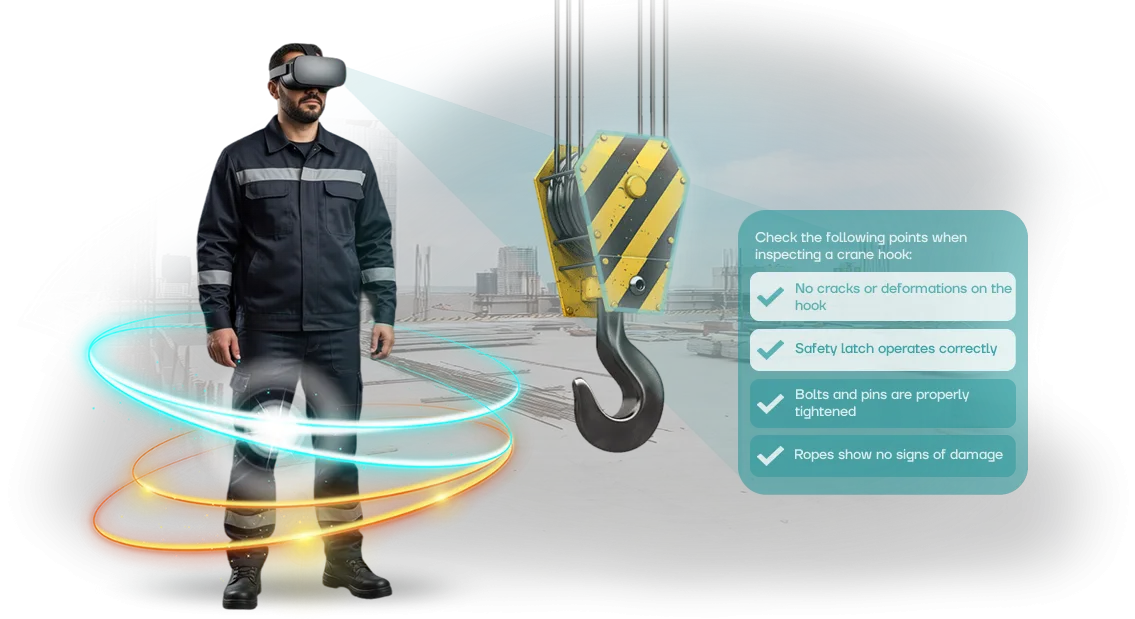
We offered a compact VR simulator that replaces part of the field exercises while delivering measurable results.
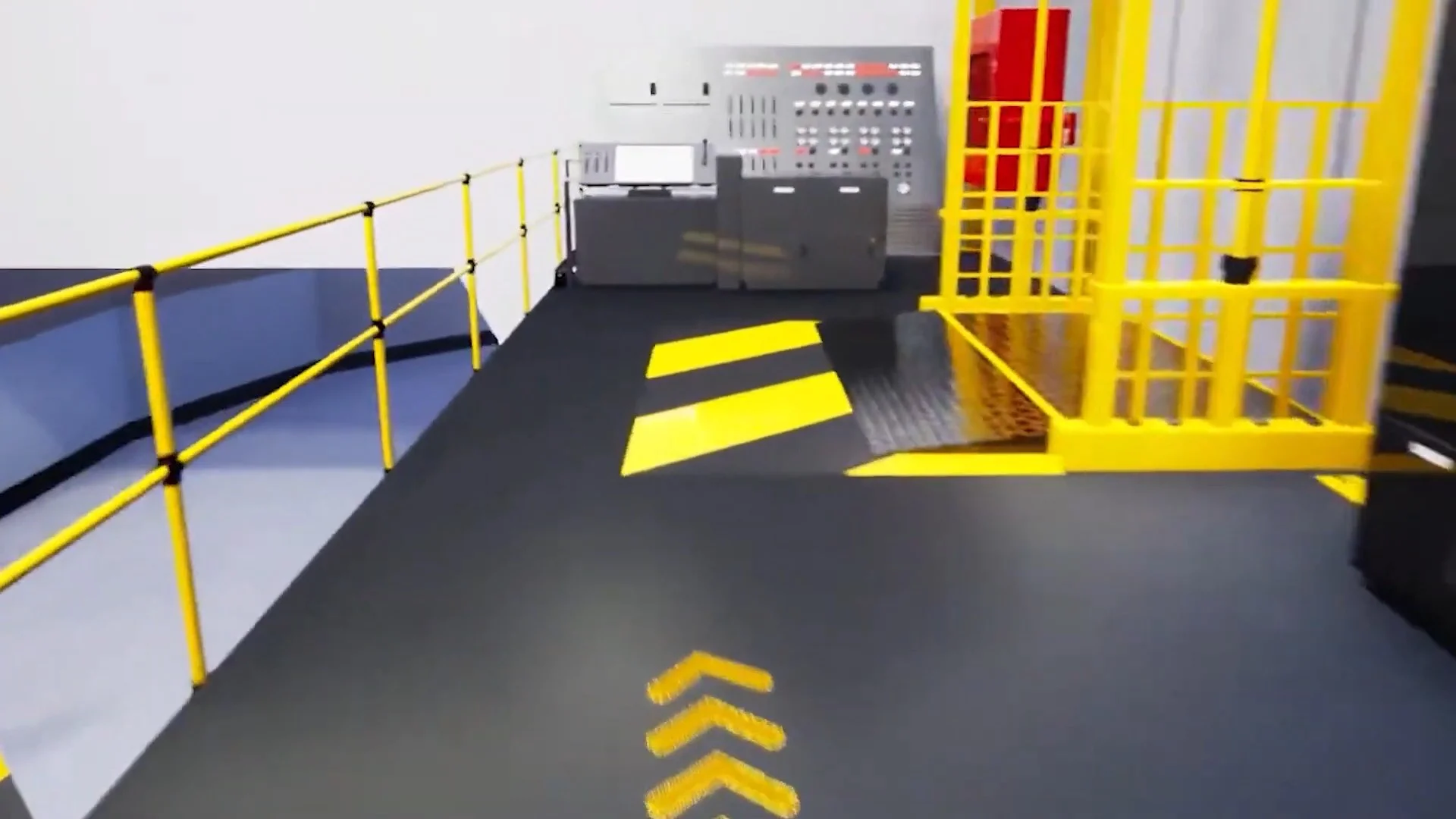
In four months, our engineers designed and deployed a solution on the professional engine Unreal Engine: it models typical accidents, operations in limited visibility, and coordinated crew action scenarios.
The simulator does not require building a separate training ground—a room with a 3×3 meter area and standard VR equipment is enough.
The simulator’s results exceeded the client’s expectations. Average trainee preparation time was cut in half: a full cycle now takes one week instead of two. Unit readiness, based on verification checks, increased by 40%.
Instructors got a dashboard with objective data—number of correctly performed actions, reaction time, and typical errors. This made it possible to move from an “average program” to targeted practice of each soldier’s weak points.
The training center appreciated the effect so much that a month after launch it ordered scenario expansions for two more specialties and the addition of a second VR equipment kit.
For us, this is the best indicator: the implementation example shows that VR training pays off not as a one-off experiment but as a reliable working tool that a manager can scale to other areas.
How to Choose the Simulator Format for Your Task?
To choose a simulator format, answer three questions: how many people need training, how often sessions are held, and what budget you have. These parameters determine what suits you: a compact solution for one platoon or a full training center.
There is no universal simulator. For practicing basic military skills with a small unit, a single station is enough, while mass personnel training requires a complex with multiple scenarios and automatic result monitoring. A wrong choice leads to overpaying for unused capabilities or to a queue of trainees.
| Format | Scale | Who it covers | Budget guidance |
|---|---|---|---|
| Compact station | Single room | 10–30 people | Cost calculated after audit |
| VR class with multiple stations | Unit, company | 100–500 people | Cost calculated after audit |
| Full-scale training center | Base, training center | 1,000+ people | Cost calculated after audit |
How to decide? If you train individual specialists and change scenarios once a quarter, a compact station will cover the task without unnecessary costs. When it comes to regular training of hundreds of people with progress monitoring, choose a class or center.
Estimate peak load: how many trainees must complete a session per month—and it will become clear which format pays off.
The budget guidance includes equipment, basic scenarios, and training for your instructors. The final cost depends on the number of scenarios and the depth of detail.
We calculate the load for free, select the configuration, and show how to save without losing quality—you pay only for what you actually use.
Frequently Asked Questions About Implementation and Guarantees
Any implementation of military training simulators raises questions: will we meet the deadlines, will scenarios be adapted to our regulations and standards, what happens if equipment breaks down, and how quickly will staff master the new system.
We remove these risks at the proposal stage: we put deadlines in the contract, guarantee the equipment, and include instructor training in the cost.
We start with an audit of your training program and preparation requirements. Based on that, we adapt scenarios: patrolling, emergency response, practicing standards—everything defined by your regulations.
We rely on the experience of military educational institutions and training centers, so typical changes are made in 2–3 weeks, and complex ones within a month.
What are the actual implementation timelines?
A standard project takes 4 to 8 weeks: from contract signing to simulator readiness. This includes audit, scenario adaptation, equipment delivery, and staff training.
What if the equipment fails?
We guarantee all simulator components and respond within 48 hours: we bring a backup kit or replace the part on-site. Simulator downtime does not exceed a few days, so the training process does not stop.
Is the simulator compatible with our training program?
Yes. We start by analyzing your program and tactical-technical requirements, then adjust scenarios, difficulty levels, and evaluation metrics. You get a simulator that fits into the class schedule without reworking training materials.
How does staff training work?
Instructor training is included in the cost: two or three days of practice at your site. Staff learn to work with the system, modify scenarios, and review results. After launch, we stay in touch and provide additional sessions if needed.
Let’s Discuss Your Task: Implementation Calculation and Demo in 2 Days
Submit a request for a simulator—and in two days you will have the full picture: how much the solution costs, what it looks like, and how to implement it. We don’t create bureaucracy; we go straight to your task.
We meet this deadline because we have dozens of projects behind us and a proven “audit—prototype—calculation” workflow.
- We audit your training program and identify the scenarios where VR is truly needed.
- We prepare a scenario prototype using your industry as an example—you see how an employee works with the simulator.
- We calculate the cost based on your number of employees, types of hazards, and required training level.
- We prepare a commercial proposal: development, equipment, support, updates—no hidden payments.
- We create an implementation plan with stages, timelines, and areas of responsibility for your team and ours.
- We show a demo online or at your site so that everyone involved in the procurement can see the solution.
You make a decision without risk: the price, the simulator logic, and measurable training outcomes are clear. If the project fits, we start work; if not, you receive an audit and calculation that will help with budget planning and let you compare proposals from other contractors.