


Finishing Materials Catalogs Lose Sales Without AR Print
When a customer opens a finishing materials catalog, they see flat photographs that convey neither the texture of stone, nor the depth of wood, nor how light plays across the surface.
The purchase decision gets postponed — the client is not sure how the material will look in a real interior, and the manager spends hours on additional consultations and explanations.
Meanwhile, competitors are already showing the same collection in three-dimensional projection right on the catalog page, and the customer chooses them — faster and with less risk.
The cost of falling behind is clear: a static catalog lengthens the sales cycle, increases customer acquisition cost, and forces reprints of editions that still fail to solve the core problem — showing the material "in real life." AR print transforms an ordinary finishing materials catalog into an interactive sales tool: the customer points their smartphone at the page and sees the sample in volume, with texture and scale relative to the real space.
This is exactly the solution that closes the problem of lost deals and makes your catalog the reason to choose you over a competitor.
What Will Change in Sales After Implementing AR Print
Right now, a client opening a finishing materials catalog sees flat images and has to imagine for themselves how the texture or color will look in a real interior. This creates doubt, delays the decision, and often leads to the potential buyer leaving for a competitor.
AR print removes this barrier: by pointing their smartphone camera at the catalog page, the client sees the material in volume, can "try it on" in their space, and makes the decision faster.
The first thing you will notice after implementation is a significant increase in engagement. Clients stop flipping through the catalog casually: they spend time examining materials, moving their smartphone, trying different colors and angles.
The average time spent interacting with the catalog increases several times over, which means the likelihood that a person settles on your product also grows.
The second effect is increased brand loyalty. A company that uses modern tools is perceived as a reliable partner keeping pace with the times. This is especially important in the finishing materials segment, where choice is largely based on trust.
The client remembers the experience and returns for the next order, and also recommends you to colleagues and partners.
The third component is new leads. Scenarios built into the AR application allow you not only to show the material but also to invite the client to leave their contact details, get a consultation, or order a sample.
You receive a database of interested people to work with after the first meeting: send commercial proposals, invite them to the showroom, or inform them about new arrivals.
Each such lead is already "warm," because the person has seen the product in action with their own eyes.
In the end, AR print turns an ordinary catalog from a passive information carrier into an active sales tool. Engagement, trust, repeat inquiries, and a collected contact database — all of this directly affects revenue.
We have already helped companies in the finishing industry implement such solutions and know how to adapt them to specific business tasks — from showcasing samples to collecting inquiries at exhibitions and in showrooms.
AR Print Formats for Your Task
A finishing materials catalog is more than a list of items. From a photograph, it is hard to understand how tile or laminate will behave in an interior: you cannot see the texture, depth, or color under different lighting.
That is why ordinary catalogs often remain unopened, and presentations end with the words "see for yourself."
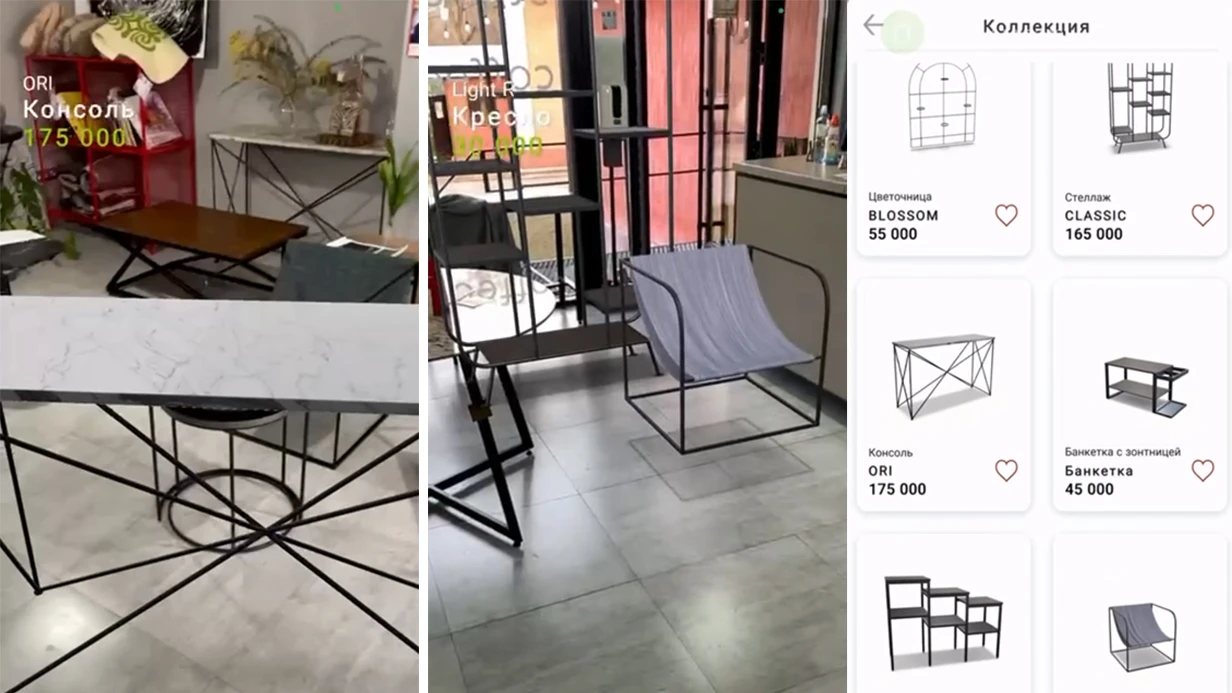
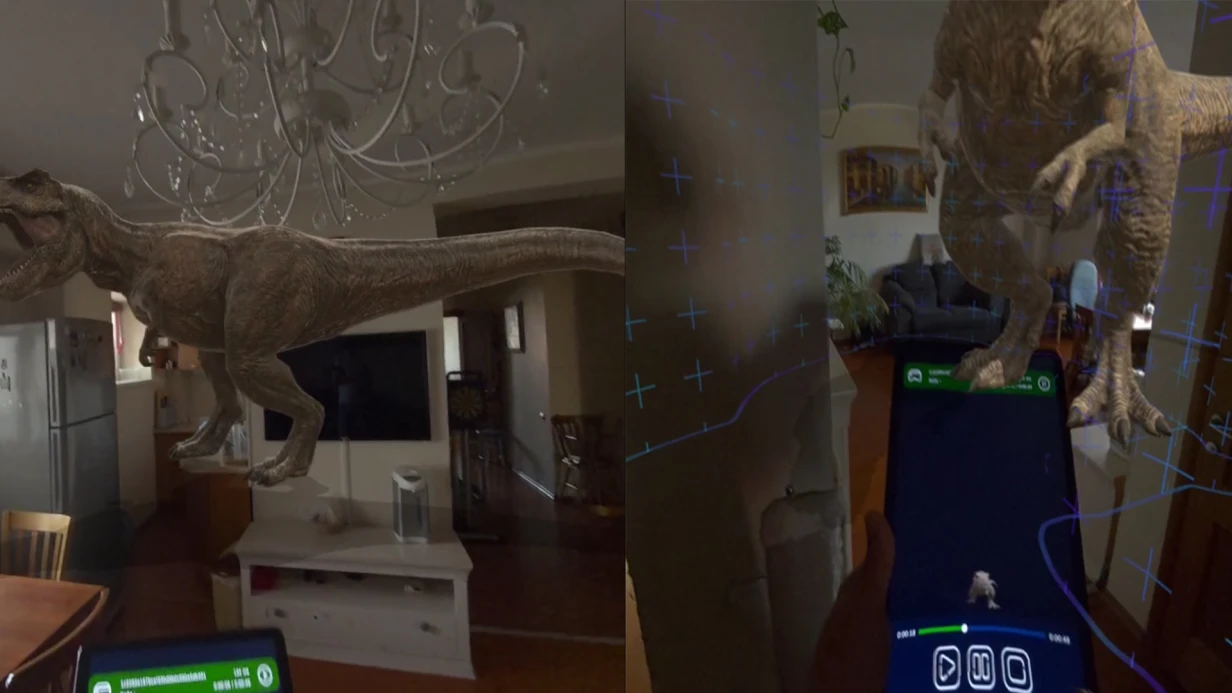
AR print brings print to life: the buyer points their smartphone camera at the page and sees not a static image but a 3D model, video, or a button leading to the website.
In this way, the catalog becomes a standalone sales tool that helps select a material and speeds up the purchase decision.
Below are three proven formats of interactive print. We will select the right one for your task or combine them in a single print run.
| Format | Who It's For | What It Gives the Client |
|---|---|---|
| 3D models in the catalog | Manufacturers and sellers of tile, laminate, facades | The buyer sees the material in volume, its texture and color under different light — decisions are made faster, fewer returns |
| Video in print | Brands that want to show production, installation, finished interiors | A video launches right from the page — the manager doesn't need to explain, and the designer remembers your brand |
| Interactive elements | Companies that collect inquiries from the catalog | Area calculator, link to the website, "leave your contact" form — the catalog becomes a sales channel |
All three formats work without installing applications: all that is needed is a smartphone camera and a marker on the page. We will prepare the files, adapt them to your layout, and hand over instructions for the print shop.
You get interactive print that keeps selling for you — even after the print run has been sent to clients.
How Work on Your Project Proceeds
Work on an AR catalog for finishing materials is a clear process in which you always know what is happening. We have completed dozens of similar projects and refined each stage so that you don't have to dive into technical details — you simply get the result on time.
- Brief and goals — we discuss where the catalog will be used: at an exhibition, in a showroom, or in a client presentation. We record the list of materials, the number of AR markers, and the print format so nothing gets lost when handing off to the designer.
- Concept and sample layout — we show how the samples will come to life: volumetric texture, color switching, or video installation instructions. We create a demo version on one material so you can see the result before full development.
- Layout approval — you receive a layout with marker placement and recommendations for the print shop. At this stage, we make edits without unnecessary costs and verify that the catalog is print-friendly and does not interfere with viewing the samples.
- Production and setup — we link AR content to each page and test it on different smartphones. In parallel, we prepare files for printing and give advice on materials so the print run turns out vibrant and neat.
- Launch and training — we hand over the finished catalog, a short instruction for your managers, and a guide for clients. We check everything on your devices so that on presentation day, it all starts up on the first try.
- Support and development — after launch, we stay in touch: we will fix linking, add new materials, or update content if the collection changes.
In the end, you get a tool that helps sell samples faster and stays in clients' memory — and we handle all the technical matters.
What You Get in the Delivery Package
The development of AR print for finishing materials catalogs is delivered as a complete package. Below is the full scope of delivery: everything is already configured, tested, and documented.
- Digitized catalog pages — precise color reproduction and geometry so virtual objects align accurately with the printed spread, without distortion.
- Application under your brand — with your logo and corporate style. The user launches it via a QR code from the page or a link from an email.
- Control panel with analytics — see how many times AR was activated and which materials were viewed most often. Content updates without rebuilding the application.
- Staff training — a short training session for managers and consultants: how to demonstrate the technology to buyers and answer their questions. A video guide for new employees remains on record.
- Instructions for end users — built into the application and provided as a separate document. A client with no special training points the camera and immediately sees a volumetric material sample in the interior.
- Source files and documentation — we hand over all project materials: processed images, content database, technical description. You remain the owner of the development and can expand it with other contractors or in-house.
- Support during the launch phase — during the first weeks after delivery, we stay in touch: we help install the application on devices, resolve technical issues, and make minor edits if needed.
The entire package is already included in the cost — you don't need to purchase or refine anything. Simply take the finished tool and use it in your sales.
Case Study: Tile Manufacturer Received 2x More Inquiries
A tile manufacturer came with a typical pain point: sample catalogs get picked up and flipped through, but only a few people reach the sales department.
Managers spent hours explaining "what it will look like in an interior," and the client still couldn't picture the result.
Weproposed bringing the catalog to life with AR print: point your smartphone camera at the page — and the sample "stands up" inside a three-dimensional room.
Within two weeks, we developed an interactive version of the catalog: each page with tile became an entry point into an AR scene. No apps to download — everything works in the browser, which matters for buyers who are not willing to install extra software.
The client's designers uploaded their own textures, and we adjusted lighting and scale so that the color and texture on screen matched the real sample.
What the Client Saw
Instead of a flat image, a volumetric interior where the tile is already installed: on the bathroom floor, as a kitchen backsplash, or in the hallway.
The buyer immediately understands whether the color and texture will work, and the manager doesn't need to paint a picture with words. The average time spent viewing a page grew several times over, and most importantly — the number of inquiries doubled.
Case Results
Following the launch, the sales department began receiving twice as many inquiries from the catalog, with some requests coming in the evening — when the client was flipping through the catalog at home.
The client's dealers asked for augmented reality print runs for their showrooms, and the manufacturer itself placed an order for the development of AR versions of two more collections.
Key figures for those evaluating effectiveness: a twofold increase in inquiries, zero advertising spend, and a repeat order for new collections.
For us, this is confirmation that AR print pays off not as a "nice gimmick" but as a working sales tool that delivers measurable results.
How to Choose an AR Format for Your Catalog?
Choosing an AR format starts not with technology but with the task the catalog needs to solve. For a client flipping through pages, one thing matters: understanding how the material looks in a real interior without leaving home.
For your sales department, it's another thing: reducing time spent on consultations and moving the client toward a decision faster. So the first criterion is the usage scenario: does the catalog work as a standalone sales tool or as a supplement to the showroom and negotiations?
The second criterion is the volume of items and content type. If the catalog has hundreds of samples, formats with quick activation work best: point the camera at the page — and you immediately see the material in 3D or in a finished interior.
For premium-segment collections, formats with an "immersion effect" work better: video texture reviews, lighting changes, combinations with different furniture styles.
The more complex the product, the more sense it makes to invest in an interactive presentation rather than a simple link to a video.
The third criterion is where the catalog will be used: at an exhibition, in a salon, at a dealer, or in online sales.
For an exhibition, visual impact and speed of demonstration matter; for remote work, ease of activation from a smartphone and stability without special applications.
A universal option is AR markers that launch directly from the browser: the client doesn't need to download anything, and you don't need to train staff.
Finally, decide what result you want to measure. One goal is to increase engagement and time spent with the catalog. Another is to get data on which materials are viewed most often in order to adjust assortment and warehouse stock.
Both the format and the reporting structure are adapted to this. We will help you choose the option for your catalog: we will analyze the assortment, audience, and sales channels, then propose a solution that pays off through increased conversion and a shortened sales cycle.
Frequently Asked Questions About Implementing AR Print
When AR markers appear in a finishing materials catalog, the first thought is "this is complicated and expensive." In practice, implementation takes about the same time as preparing an ordinary print run and does not require redesigning the layout. Below, we address typical client concerns and show how we resolve them.
Won't we have to redo the catalog design?
No. AR markers are applied on top of the existing layout — all that is needed is a mockup and access to the materials. Our designer will prepare the triggers by the time of printing, and the entire interactive part is created in the background. You get a catalog in which textures and samples come to life.
What devices does this work with?
Any smartphone on iOS or Android without installing an application. The guest opens the catalog, points the camera — and sees a 3D image or video. We test on different models, so the result will be consistent for most of your clients.
What makes up the implementation budget?
Cost depends on the number of AR pages and the content format — from a simple photograph to a full 3D model. We select the option that fits the catalog's tasks and provide a transparent estimate before work begins.
This way, you understand what you are paying for and can compare it with the effect of ordinary paper printing.
Who is responsible for AR after launch?
We stay in touch: we update content, check markers on new firmware versions, and resolve issues promptly. If you release a new print run or change materials, just send us the mockup — we will integrate the changes.
Technical complexities are our part of the work; yours is growing sales and attention to the catalog. Leave a request — we'll show you on your own mockup how it looks.Leave a Request for a Consultation on AR Print
Leave a request for AR print, and we will show you how to bring a finishing materials catalog to life. Clients will be able to point their smartphone camera at the page and see the material in an interior, change colors, and examine textures — right from the catalog page.
This format increases interest in your products and helps customers choose a material faster.
That means shortening the path from "looking" to "ordering." To help you evaluate the effect on your own product, there's no need to launch the entire print run right away.
What you get after your request:
- a personal consultation with a specialist — we will review your goals and show examples of AR catalogs in your niche;
- cost calculated after audit of your print run and integration complexity — no hidden fees or fine-print disclaimers;
- a pilot version — we bring 2-3 pages to life so you can see the result on a real mockup;
- recommendations for marker placement and printing — we fit into your production without unnecessary expenses;
- support at every stage — from layout to usage analytics;
- a clear implementation plan and precise timelines for each step.
Leave a request for a consultation on AR print — it comes with no obligation. You will receive a working pilot sample and an understanding of how the technology will increase sales from your catalog.