

Why do guests walk past without location-based AR web?
Visitors walk past exhibits and don't linger at display cases and stands. Even bright design doesn't help: without interaction, attention scatters within seconds.
For a museum, this is a lost opportunity to tell a story; for a brand, it's a lost audience you didn't manage to engage and stay memorable to.
The reason is that a static exhibition offers the guest the role of a spectator, not a participant. They look, read the labels, take photos, and leave without entering into a dialogue with your content.
As a result, you get neither an emotional response nor a measurable outcome — neither time spent at the venue, nor repeat visits, nor the desire to share the experience.
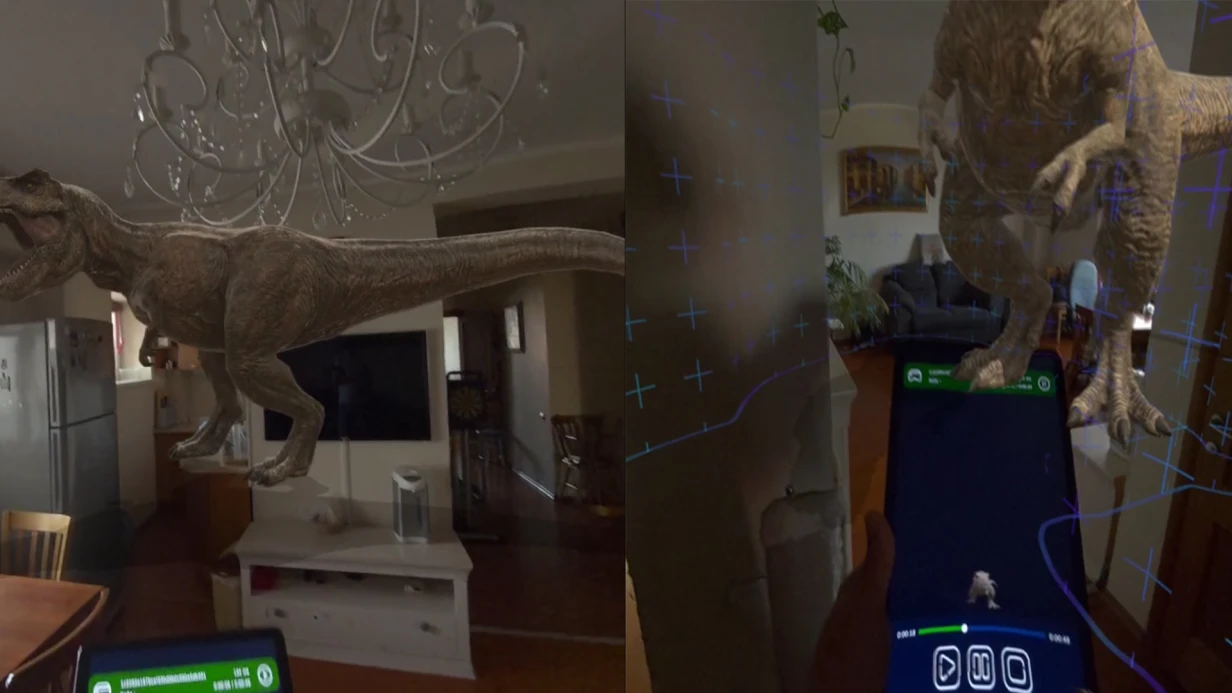
Location-based AR web changes this dynamic. The guest points the camera at the right spot and sees the space come alive: the exhibit tells a story, the brand turns into a game, and the museum becomes a space for exploration.
Such an interactive installation doesn't require installing apps and works right in the browser, so guest engagement begins from the first step and doesn't let go until the very exit.
We know how to turn this technical capability into a working scenario for your task. We help design the storyline, choose anchor points, and launch AR for a museum or event — so visitors don't just see your content, they experience it. No more passing-by audiences — only involvement, interest, and measurable return.
What benefits does an interactive installation bring to a brand
Brand awareness and reach
An interactive AR installation turns a guest from a spectator into a participant: they interact with the brand, create a unique story, and get a shot worth sharing.
At the Geek Picnic festival, such a quest collected hundreds of social media posts within the first hours — each participant brought the brand another 2-3 mentions for free.
This multiplies event reach several times over relative to the number of guests on site, and brand awareness stays with the audience for weeks after the event.
Attracting guests to the venue
An unusual mechanic becomes a news hook in its own right.
"Here you can find a treasure using a map on your phone" or "try on a hero's look" sounds more compelling than a standard invitation, so city publications and bloggers are more willing to run the announcements.
As a result, the installation attracts new visitors: people come specifically for the experience, stay longer, and bring friends along. For the venue, this means higher attendance and additional revenue from cafés, souvenirs, and related services.
Leads and a database for future sales
"Claim a bonus" at the end of the scenario is a natural point to exchange contact information with an interested guest. This is how the interactive experience builds a hot database for newsletters and personalized offers — without cold calls or intrusive advertising.
Plus, anonymized statistics remain: how many guests completed the scenario, where they lingered, which mechanic worked best. These numbers help plan future campaigns and accurately measure the activation's contribution to sales.
Interactive installation formats for your tasks
Each installation format solves its own task: keep visitors engaged, increase sales, or make the brand recognizable.
Geolocation web-AR allows "bringing objects to life" right on the user's smartphone without installing apps — just point the camera at a spot, building, or display window.
We match the installation type to the venue and business goal. The table below shows typical scenarios that have already delivered results in our projects.
| Format | For whom | What the client gets |
|---|---|---|
| Street installation | Brands, city events, tourist routes | Attracts passers-by, creates a news hook, increases time at the location and the number of social media posts |
| Shopping mall installation | Shopping malls, stores, landlords | Increases foot traffic, holds visitors at the window display, stimulates impulse purchases |
| Museum installation | Museums, exhibitions, cultural spaces | Makes the exhibition interactive, holds the attention of the tour group, attracts a younger audience |
| Event installation | Event agencies, conference and festival organizers | Builds a queue at the stand, gives guests a vivid experience, and creates an association between the brand and an emotion |
Geolocation scenarios work even without special markers: the object is "anchored" to coordinates — a monument, a mall entrance, a stand at an exhibition.
For the guest, it looks like magic; for the client, it's a clear, measurable marketing tool: we see the number of launches, session duration, and repeat visits.
All formats adapt to the task: from a single point of attraction to a route of several objects. Tell us where you plan to set up — we'll propose a solution that pays off and works toward your result.
How we create an installation: project stages
We know that predictability matters to the client: when every stage is clear, it's easier to plan budget and timelines. That's why the process of creating an interactive solution is structured so you see results at an early stage and can influence the project before launch.
- Brief and task immersion — we discuss event goals, audience, and the expected effect: engage guests, tell the product story, or collect contacts.
- Concept and scenario — we propose an interactive installation idea that connects your task with the format: virtual reality, geolocation AR, or a hybrid option.
- Design and prototype — we present the visual style and interaction logic so you can picture in advance how the installation will look and work.
- Development and testing — we build a working solution on professional equipment and test it in real conditions: at the location, accounting for load and guest scenarios.
- Installation launch — we go to the venue, assemble and configure everything, and run a rehearsal so that on the event day everything works without a hitch.
- Support and analytics — we stay in touch during operation, collect interaction statistics, and help evaluate the result.
Each stage ends with a clear deliverable: you see how the project is developing and avoid unexpected changes at the final stage.
This approach allows you to launch the installation on time and achieve the desired effect — vivid guest impressions, higher brand awareness, or new customer contacts.
What's included in a turnkey installation: the full package
When we hand over the installation, you get not just an app but a complete turnkey solution. The package includes everything you need to launch it on the event day and get measurable results without any technical staff on your side.
- Installation kit: unique AR scenarios developed for your task — from an educational program to an entertainment quest with geolocation anchoring.
- Equipment and assembly: we select professional devices, configure them for the venue, and handle installation within the agreed timelines.
- Staff training: we provide hands-on instruction for your team — after it, employees will be able to launch the installation and assist guests without any technical background.
- Installation support: during the event, we assign a support specialist who monitors stability and promptly resolves any issues.
- Attendance analytics: you get clear data on visitor numbers, peak hours, and interest in different scenarios — this helps you evaluate return on investment and improve the next activations.
- Warranty and updates: we formalize warranty obligations and, when needed, adapt the content for a new season, a different venue, or a changed brand goal.
Case study: how we brought a museum to life and doubled attendance
Our client — Museum of Urban Legends — came to us with a pain point: the classic exhibition no longer holds attention, visitors go through the halls in 20 minutes and don't come back.
We proposed a geolocation web-AR route: without installing apps, right from their smartphone, guests "brought exhibits to life" and interacted with the story through their own phone.
The result was a full-fledged installation case that changed visitor behavior. Average dwell time grew from 20 minutes to an hour and a half, and the share of repeat visits tripled.
In the first months of the interactive installation's operation, museum attendance doubled — with the same advertising budget, driven solely by word of mouth and guests' social media posts.
The interactive installation's results speak for themselves: 9 out of 10 visitors reached the final point of the route, and after completing the quest, they left reviews and tagged the museum in Stories.
For the museum, that's free reach: each participant brought an average of two additional new guests.
The museum director summed it up: "For the first time, we felt that technology works for us: people don't just look — they play, take photos, and come back with friends." A month later, the museum ordered a second route for the seasonal exhibition, and six months after that, it expanded the project to its branches.
This is an installation case where the metrics are clear: attendance growth, deep engagement, and a repeat order. If visitors are also "walking past" your venue — let's discuss how to replicate this story.
How do I choose a format for my tasks?
Choosing a format is always about answering the question "what should the guest feel and do?" If the goal is broad reach without installing apps and anchoring augmented reality to a specific place, location-based AR web is right for you: a person simply points their smartphone camera at the space or object and gets interactivity right in the browser.
This scenario works great outdoors, in a waiting area, or in a food court — where there's no point in putting on a headset.
For museums and exhibitions, the geolocation web option often becomes the primary one: the visitor walks along the route, and exhibits come alive on the screen — historical layers, 3D models, and quest hints appear.
Guests don't wait in line, don't download an app, and choose their own depth of interaction. This reduces the load on staff and increases the average time spent in the project.
If, however, the task is to create a multi-hour, controlled impression — a new product presentation, a corporate stand, a showroom — a VR installation is the more logical choice.
It delivers full immersion, emotional engagement, and a strong "wow effect," but it requires a service zone and is limited by throughput. So the main selection criterion is how many people you want to reach per hour and what level of immersion they need.
We don't sell technology for technology's sake.
At the start, we analyze the audience, location, budget, and expected visitor numbers, then propose a solution — sometimes it's a combination of "a central VR zone plus AR around the entire perimeter." You get a format selection tailored to a measurable result: reach, engagement, repeat visits, and brand awareness growth.
Addressing common client concerns
Before launching a VR/AR installation, any decision-maker has the same concerns: will the equipment break down on the event day, who will service it, and will the project pay off. That's normal — we hear these questions at every brief and have turned the answers into clear terms.
Over the past 10 years, we've launched more than 80 interactive projects for museums, events, and brands. We are a team with ten years of experience in digital installations. Each project is delivered with a warranty and support, and the working terms are fixed in the contract. Below are answers to common questions.
What happens if the installation breaks down in the middle of an event?
Any equipment can fail, but we've accounted for that. All projects come with an installation warranty: for the duration of the event, we provide backup equipment, and an on-duty engineer is available by phone or on site. A failure won't stop your event.
Is it difficult for regular employees to operate the installation?
Operation is built on simple scenarios: turn it on, select the mode, launch. We provide a short training session for your team and leave instructions in Russian. Installation support is available by phone and messengers — we'll help at any moment.
How quickly will the installation pay off?
We calculate the economics together at the start: growth in visitor dwell time, new customers, repeat visits. For brands, the installation becomes a news hook and increases awareness.
Within the first months, you see the result — not just emotions, but a measurable effect on the business.
Order an installation that will amaze your guests
Guests remember events that draw them into the brand's story. Geolocation web-AR is an installation that works through a smartphone camera and anchors digital content to a real place: a visitor points their phone at the venue and watches the space come alive.
This format increases guest dwell time, creates a reason for photos and posts, and gives you measurable reach and repeat mentions.
To get this result, you don't need to understand the technology. We take on the entire development — from concept to launch, including testing on different devices.
Just leave a request, and within a day you'll receive a consultation on installations with a format calculation tailored to your venue and budget.
After you get in touch, you'll receive:
- Installation options assessment — we'll advise which format will deliver the maximum effect for your event or exhibition.
- A preliminary estimate within 1-2 days — no hidden fees or complex technical documentation.
- A demonstration of similar projects — we'll show how a completed solution worked live.
- Timeline assessment and launch plan — we'll give you realistic dates and outline the stages.
- Clear actions on your side — venue preparation, approvals, content.
- Support at every stage — from brief to launch and the final report.
Take the first step: order an installation — leave a request for development. We'll get in touch, discuss your task, and propose a solution that will amaze your guests and deliver measurable results.