

Why Competency Development Programs Don't Deliver Results
Companies invest in competency development programs, but a couple of months later everything returns to square one: employees report completing courses, while real skills remain unchanged. Does this sound familiar?
The issue is not the training content itself, but how it is delivered. When material is presented as dull lectures and tests, the brain never engages, and the information simply does not stick.
Employee engagement is the key factor that turns training into a working tool. Without it, even a strong program remains just a checkbox in a report: learners mechanically go through modules without applying the knowledge to their own work.
The result is that the business spends budget but sees neither a change in behavior nor growth in metrics. Skills remain theory that never reaches real processes.
The reason is that classic formats don't let employees experience a situation, make a decision, and see the consequences. Yet it is precisely this kind of practice that builds lasting skill.
When emotions and healthy competition are not involved, interest fades by the third module, and training becomes background noise.
This is where gamification of business processes comes in: it shifts learning from passive consumption to active participation. Employees solve tasks, work through scenarios, receive feedback — and do it with enthusiasm.
This approach increases engagement in competency development programs, which means knowledge turns into skills, and skills into measurable results for the business. We help you build that.
What Will Change After Gamification Is Implemented
Gamification turns training from an obligatory chore into a game people want to return to. When a competency development program is built on clear rules, rewards, and visible progress, engagement stops being a problem: employees join voluntarily and consistently. Along with engagement, course completion rates and depth of material mastery grow as well.
Game mechanics compress the path from theory to practice. Employees try things immediately, make mistakes in a safe environment, and receive instant feedback — learning accelerates and requires less external supervision.
Skills are practiced here and now rather than put off "for later," so results appear within the first weeks of the system running.
The changes are also visible in HR metrics. Managers get a transparent picture: who completed the modules, how simulation results improved, which common mistakes disappeared.
This data supports fact-based decisions about rotations, promotions, and training planning — instead of intuition and word of mouth. The company spots talent faster and supports those who are falling behind in time.
There is a separate effect on loyalty. Employees feel that the business is investing in their development, and the process itself is enjoyable — this reduces turnover.
A gamified program becomes part of the employer brand that people tell their colleagues about, strengthening candidate inflow without additional spend on job advertising.
In the end, you get not just a "course completed," but measurable growth in engagement, learning speed, and the quality of your team's work.
Transparent HR metrics and sustained loyalty turn training from a cost item into an investment that pays off through employee performance.
Gamification Formats for Business Tasks
Gamification formats differ not only in mechanics but also in business impact. If the goal is to immerse employees in corporate culture, a virtual world is enough. If you need to practice sales or negotiation skills, a simulator works better.
Understanding this difference lets you choose the right tool for a specific task rather than pursuing "gamification for the sake of the game."
Here is how we approach format selection:
| Format | Target Audience | What It Delivers to the Client |
|---|---|---|
| Company 3D world | New employees, frontline staff, mass hiring | Fast onboarding: a person gets acquainted with the brand, office, colleagues, and processes in an interactive environment. The load on the HR team decreases, and onboarding takes 2–3 sessions instead of a week of lectures. |
| Quest | Project teams, middle managers | Develops communication and coordination. Participants solve business cases in a game format, learn to negotiate and make decisions. The result is team spirit and ready-made behavior models for non-standard situations. |
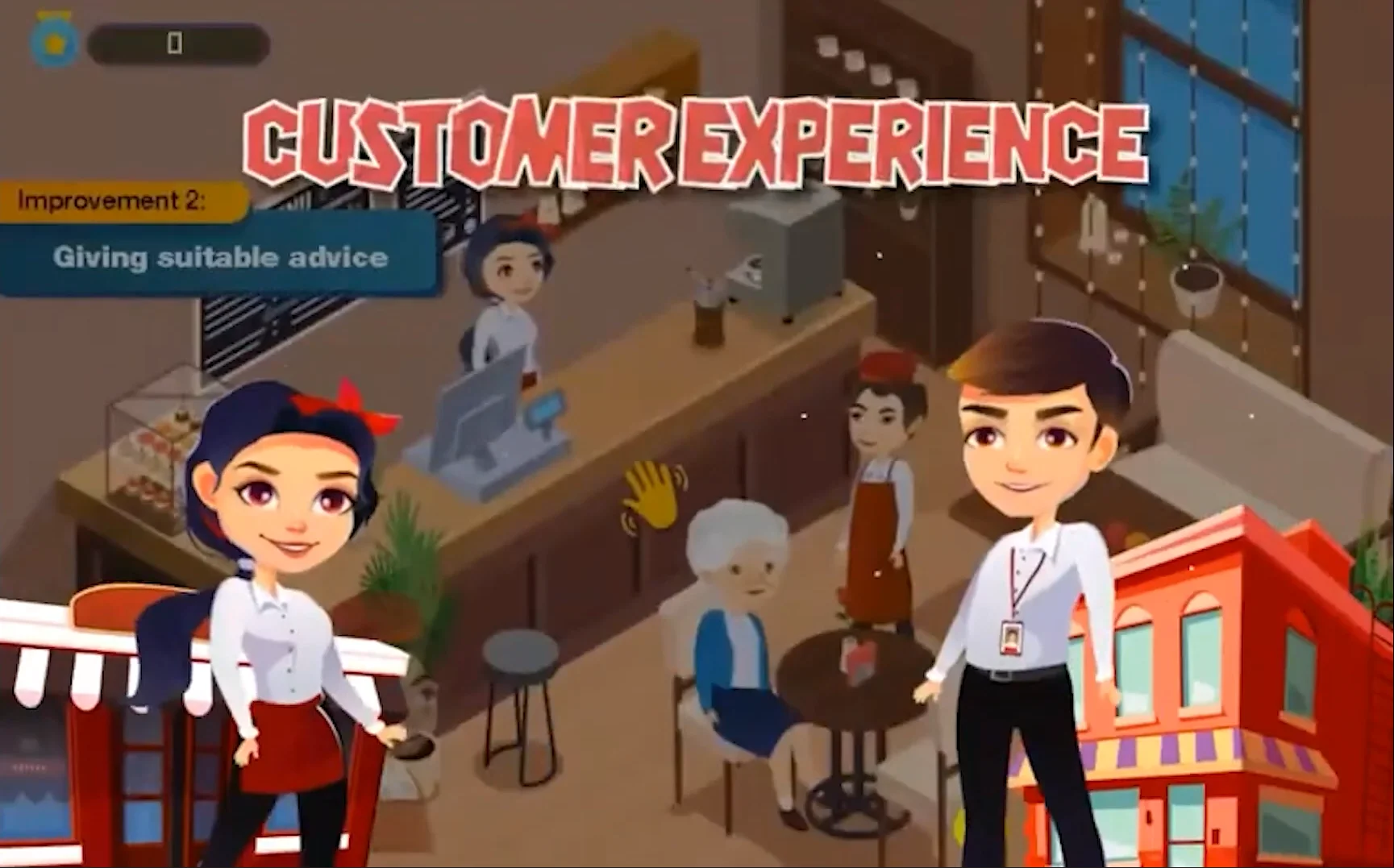
| Simulator | Sales departments, customer service, operations staff | Practicing real scenarios without risking the client base. Employees train scripts, objection handling, and dialogues in a safe environment. Measurable outcome — higher conversion and shorter onboarding time for new hires. |
Importantly, all formats use a unified system of 3D avatars. Employees create a digital copy of themselves and move through the company's virtual world — this boosts engagement and recognition.
And the client gets not a one-off trainer but a platform that can be developed: add quests, change simulator scenarios, expand virtual office zones.
In a single project, we combine formats: a 3D world for immersion, quests for teamwork, and simulators for skill practice. This way you cover three business goals at once — onboarding, team building, and training — in one unified environment without scattered tools.
How We Build Gamification: 6 Steps
We structure our work so that you see results at every stage and can influence them. No surprises at the end — only clear agreements, approved timelines, and a defined finish with post-launch support.
-
Brief and task immersion. We review your competency development program: what skills need to be strengthened, who the audience is, and which behavior scenarios you want to reinforce. The outcome is a document with goals, success metrics, and project boundaries.
-
Game mechanics prototype. We show how employee interaction with gamification elements will look: tasks, levels, rewards, feedback. At this stage, you see the "skeleton" of the future product and can make edits before the main development begins.
-
Design and scenario approval. We prepare the visual style, task texts, and participant progression logic. You approve how the product looks and sounds, and we lock in all decisions so nothing needs to be redone later.
-
Development and assembly. We build the full product: interface, backend, and integration with your learning system. You receive a test version where you can check the user journey and make targeted adjustments.
-
Launch and team training. We onboard employees, test load capacity, and configure administrator roles. We help your HR and internal communications teams prepare the announcement so gamification gets the right reception right away.
-
Support and evolution. After launch, we monitor stability, gather feedback, update content, and refine mechanics as needed. You can order a new set of tasks or extend the program to another department.
The entire process takes 4 to 8 weeks depending on scope. You receive regular readiness reports and understand at every step what is happening and what decisions are needed from you.
What You Get as a Result of the Project
For competency development programs, the platform itself is not what matters — the results are: employees engage, complete scenarios, build skills, and show growth in metrics.
We deliver a complete package that covers the entire cycle — from an employee entering the company 3D world to a report on competency dynamics.
Here is what the project delivers:
- Company 3D world — a virtual space in your brand style: office, production site, or training ground. Employees immediately enter a familiar environment, which lowers the barrier to learning.
- Avatar characters — heroes, including mentors and colleagues, that help act out dialogues and situations. These scenarios are hard to replicate in a standard course.
- Training scenarios — storylines tailored to your business processes: objection handling, sales techniques, new hire onboarding, service standards. Each scenario is tied to a specific competency.
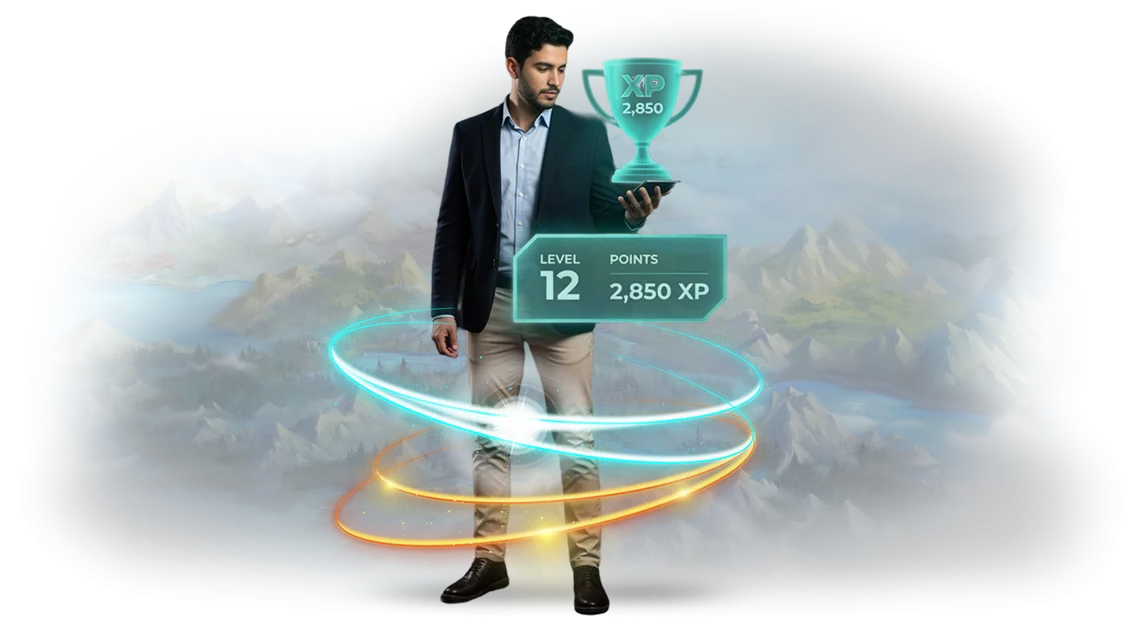
- Motivation system — points, levels, rewards, and an achievements showcase inside the world. Employees see their progress and want to complete the next scenario, while managers get an engagement tool.
- LMS integration — automatic synchronization of learning results with your learning management system. No manual duplication or data transfer needed.
- Competency analytics — a report showing who completed which scenario, what skills improved, where employees get stuck, and which topics need reinforcement. These are clear numbers for managers, not raw logs.
- Methodological support — instructions for launch and administration, plus brief training for your team on working with the platform.
Within a couple of weeks after launch, you get not an abstract prototype but a working tool: employees learn in the corporate world, and HR and managers see measurable progress.
Case Study: How We Increased Engagement by 40%
A major retailer came to us: the training department had invested in employee courses, but fewer than a third were completing them. Retention was falling, and the HR brand was suffering — internal programs were perceived as an obligation rather than development.
We knew that employees only remember what interests them. So we, our team, proposed turning training into a game with 3D avatars and a shared company world.
What We Did
Instead of dull lectures — an interactive quest. Employees entered a virtual office and worked through scenarios, from objection handling to service standards.
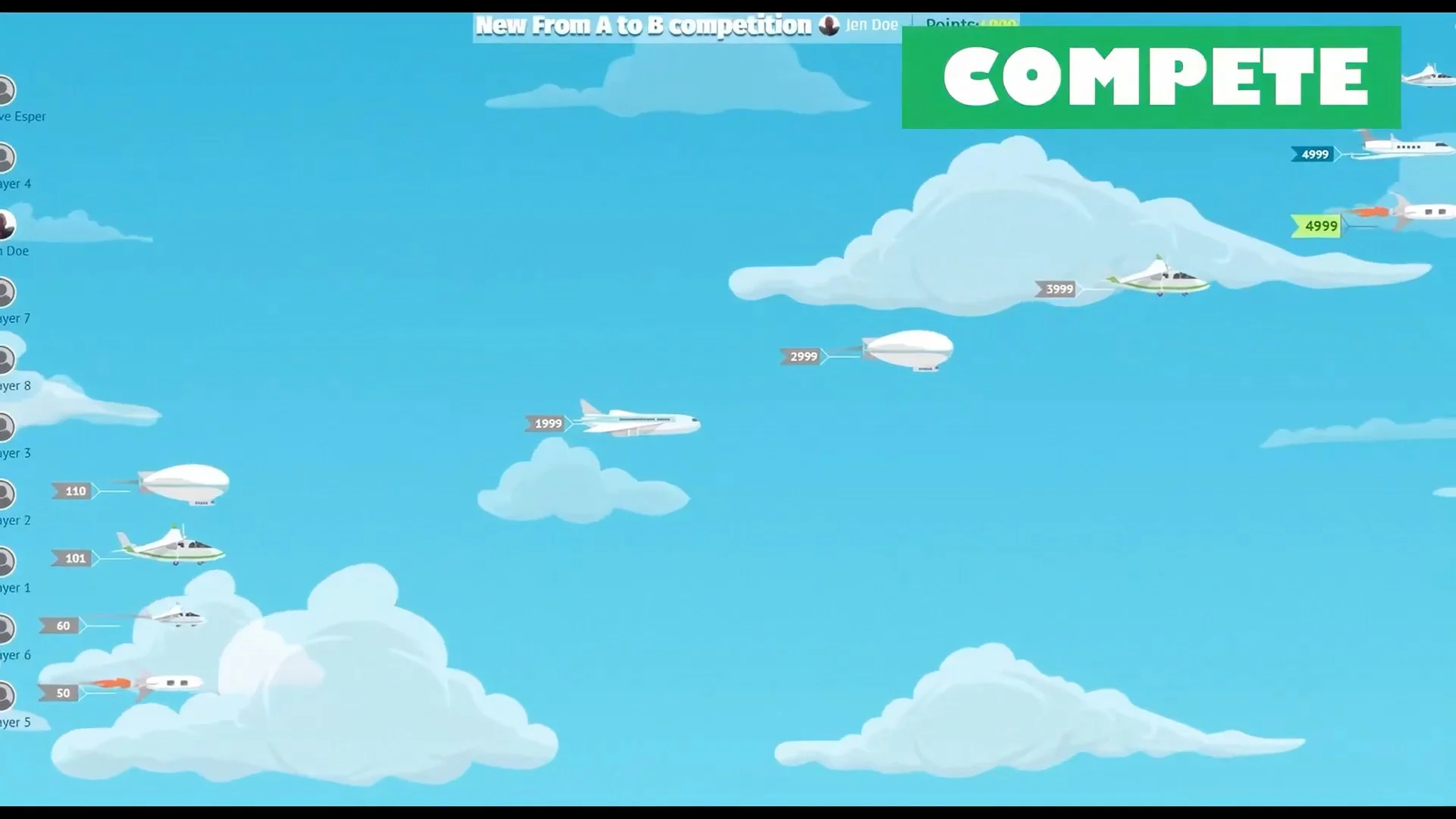
Tasks awarded not abstract points but progress scores, and a real-time leaderboard added healthy competition between stores.
The Result
The pilot involved 500 employees across three regions. Over three months, the share of those completing the programs grew by 40%. Employees also returned to courses for repeat attempts — the average repeat completion rate doubled.
The project itself became a source of internal posts and photos, which unexpectedly strengthened the HR brand and raised interest in learning.
For the business, the key outcome was transparent data. The HR director could see who was genuinely developing competencies and who needed support. After the pilot, the retailer scaled the solution to all regions — now as a permanent staff development system.
How to Choose a Gamification Format for Competency Development?
Choosing a gamification format starts not with technology but with learning goals. Competency development can mean practicing a specific skill, forming new habits, changing attitudes toward a process, or building team cohesion.
Each of these tasks requires its own scenario: what motivates newcomers brilliantly may not suit practicing complex actions for experienced employees.
If the goal is for a person to learn how to make decisions in non-standard situations, simulations and interactive scenarios with branching logic are optimal. If you need to quickly introduce a team to new values or a product, a quest in a virtual space works better.
And for developing managerial competencies and team coordination — business games with a competitive element. The rule is simple: the format must let participants do what the real job requires, but without risks to the business.
Before choosing a format, you should define how you will know a competency has been developed. For negotiations, that might be the number of successful deals; for service, the customer satisfaction index; for managers, the regularity of feedback given to subordinates. When the criteria are clear, it becomes obvious what scenario and level of immersion are needed.
In our practice, we always start with goals and audience — this lets us choose between lightweight browser games and full-scale virtual worlds. We build solutions on the professional Unity engine, but technology is just a means.
What matters more is that the mechanics train the right competency and deliver measurable results. If you have a similar task, tell us about it — we will help you choose a format that works for your business metrics.
Common Concerns: What If Gamification Doesn't Work?
Every responsible manager asks the same question before commissioning gamification: "What if it doesn't work?" This is normal — a new format involves budget, team time, and expectations.
We mitigate the main risks at the design stage rather than after launch, so you don't need to fear the typical pre-order worries.
What if employees are not engaged?
Engagement does not appear on its own. We design mechanics specifically for your audience: we study the team's motivation, challenges, and habits, then test the scenario on a small group. If we see that something is not resonating, we adjust before the full launch. You get not a game for the sake of a game but a tool employees use with genuine interest.
What if there are technical failures?
Technical stability is our area of responsibility. We use professional equipment and server architecture built to handle high loads. Before launch, we conduct full testing, and during active days we bring in support if needed. Failures are rare, and even they are resolved quickly without loss of results for you.
How do we know the project pays off?
We don't work "blind." At the start, we define the metrics that matter to you: speed of program adoption, share of those who complete the training, repeat completions.
Results appear in the analytics from the earliest stages, and if necessary, we help adjust the scenario to hit target values. The return on investment is ensured by the fact that gamification solves a specific business problem rather than merely entertaining.
What happens after launch?
Launch is not the finish line. We stay in touch: we analyze collected data, suggest improvements, and refine mechanics as your needs evolve.
If scaling or a new program phase is required, it won't be "starting from scratch" but an evolution of a system that is already working. That way you get a long-term tool, not a one-off initiative.
Gamification stops being a risky experiment when it has clear logic, pre-launch testing, and post-launch support. Everything we listed is already built into our process — so you can make your decision without fear of the outcome.Book a Gamification Consultation
Implementing gamification into competency development programs begins with a short consultation. We analyze your task together: what skills need to be strengthened, who will participate, and what result you expect from the game.
This makes it immediately clear which format fits — from lightweight mechanics to a full company 3D world.
The consultation is not a lecture but a working conversation. We ask questions, listen, and offer options based on your experience and goals. You get a concrete picture: what is realistically possible, what the cost would be, and how quickly it will deliver value to the business.
What you get from the consultation:
- Analysis of your task and scenarios for using gamification in training;
- A format proposal — game mechanics, storyline, 3D avatars, or a hybrid approach;
- A preliminary cost estimate calculated after audit of your requirements;
- Examples of solutions for similar tasks from our practice;
- Recommendations for implementation without disrupting current programs;
- A clear plan of next steps and expected timelines.
How the consultation works:
- You leave a request — we get back to you within one business day.
- We hold an online meeting: we clarify goals, audience, and constraints.
- We analyze your processes and propose suitable game mechanics.
- We prepare a commercial proposal with implementation options and budget.
- After the meeting, we send the summary and lock in the implementation plan.
This approach lets you make a decision without unnecessary risk: you see both the format and the cost before work begins. Leave a request, and we will get in touch to discuss your task and estimate the budget.