

Gamification for Pharmaceutical Companies: How to Retain Customers
Every year, competition in pharmaceuticals intensifies: pharmacies, distributors, and manufacturers fight for the same customer, and customer loyalty becomes the most valuable asset.
Patients easily switch to other brands and chains if they don't feel a difference, and partners — doctors, pharmacists, managers — lose engagement without visible motivation.
In this battle, standard bonus programs and discounts no longer work: customers get used to them, and they stop influencing choice.
To retain attention and trust, you need not just to offer benefits but to create engagement. Game mechanics turn routine actions — making a purchase, recommending a medication, completing professional training — into an engaging process with a clear goal and reward.
This works on two levels: patients get emotions and value, while pharmaceutical companies get clear loyalty metrics and growth in repeat sales.
Gamification solves the core business challenge — motivating partners and retaining customers. For medical representatives and pharmacists, it becomes a competition system where everyone's results are visible and healthy rivalry for key metrics takes shape.
For patients, it's loyalty programs that encourage regular medication adherence and health self-care, turning purchase into a habit.
As a result, the company gets not a one-time spike but steady momentum: higher conversion, repeat visits, and recommendations.
Well-designed game mechanics in pharma help build long-term relationships with key audiences — both with decision-makers and with those who work with patients every day. We help implement such systems so they deliver measurable business results from the first month.
What Gamification Brings to Your Business
In pharma, results are driven by people: medical representatives, distributors, pharmacy staff. Routine reports and sales plans provide weak motivation, but a competition with clear rules and a transparent ranking taps into excitement and healthy competition.
Webuild such game systems so you get measurable business results, not just an "interesting project".
Here's what gamification delivers specifically to your company:
- Employee engagement. Medical representatives begin striving for the plan on their own: rankings, points, and statuses are visible to everyone. The team sees who the leader is and helps close the gap — without orders or pressure.
- Higher sales. The system rewards not only volume but also repeat orders, expanding pharmacy product ranges, and staff training. As a result, average order value and purchase frequency grow.
- Distributor motivation. Partners get a transparent race with prizes for hitting quarterly targets. It pays off for them to work with your portfolio — competition among distributors drives your revenue.
- Competitive advantage. While competitors rely on standard KPIs, you build loyalty through emotion and play. Doctors and pharmacies remember your brand — which translates into prescriptions and purchases.
- Measurable results. Every element — from points to leaderboards — is tied to business metrics. You see which actions pay off and can adjust the rules of the game in real time.
Gamification doesn't require changing processes — it layers on top of them. Your employees keep working as usual, but with an added driver: status, recognition, and a clear path to the goal. This is a fast way to improve team efficiency without increasing the motivation budget.
Gamification Formats for Pharmaceutical Companies
Each task of a pharmaceutical company — training, motivation, partner retention — requires its own approach. Rankings boost sales team activity, quizzes help absorb product knowledge, and loyalty programs make cooperation with pharmacies long-term.
That's why we don't offer a one-size-fits-all template but select a format for a specific business goal.
Below are the main formats already working in our projects for pharma. In each case, the mechanics are tuned so the result is measurable and clear for the client.
| Format | For Whom | What It Delivers to the Client |
|---|---|---|
| Rankings and leaderboards | Medical representatives, sales teams | Transparent competition, higher metrics, healthy team dynamics |
| Quizzes and educational games | Staff, pharmacy chains, physician partners | Fast product knowledge absorption, high training engagement |
| Loyalty programs | Pharmacies, distributors, key partners | Repeat orders, long-term collaboration, stable sales volume |
| Team competitions | Regional teams, entire departments | Activity boost, experience sharing, short-term sales growth |
| Mixed marathons | All process participants | Comprehensive long-distance motivation, combining learning and sales |
The format is chosen not for the sake of the game itself — we lock in the target metric before launch: growth in repeat orders, increase in completed training, sales plan attainment.
Upon completion, you get a report with numbers and an understanding of which format performed best. This lets you scale successful mechanics to future periods.
Stages of Implementing a Game System into Operations
We know that in pharma you can't act blindly: changes touch processes, regulations, and people. That's why we structure the implementation of a game system as a transparent project with clear stages and timelines — you see what's happening at every step.
We start with a brief: we analyze what problems the game solves, who will participate, and which metrics matter to you. Then we move to design — describing the scenario, rules, and ranking mechanics tailored to your business processes.
- Brief: we define goals, audience, and the expected outcome.
- Design: we create a game scenario for the company's specific processes and regulations.
- Prototype: we demonstrate the mechanics on real department data — you see how it works before full development.
- Development: we build the game with a clear interface, CRM integration, and access rights for managers.
- Pilot launch with one team: we check how employees receive the game and adjust it.
- Full launch and handover to teams: we train, provide instructions, and show how to read the rankings.
- Ongoing support: we track engagement, update the scenario, and make sure the system solves your task.
We don't disappear after launch — we stay in touch and help when questions come up. Ongoing support includes activity monitoring, mechanics refinement, and consultations for managers. The result: you get a working tool, not a work report.
One example is a pharmaceutical distributor's sales department: after introducing rankings, plan attainment grew by a third, and the repeat order confirmed that the system works.
What's Included in the Delivery: Launch Kit
You receive a ready-to-use gamification launch kit — no long ramp-up or building the system from scratch. Everything is adapted to pharmaceutical companies' needs: from competition mechanics to materials that are clear to staff in the field.
Here's what's included in the delivery:
- Game scenario. A well-developed competition mechanic aligned with your goals — sales growth, product knowledge, activity with physicians, or plan attainment. Not a game for the game's sake: every element drives a specific business result.
- Ranking configuration. Flexible leaderboards: participants can be ranked by region, product line, role, or overall results. You choose what to show the team and what to keep for internal analytics.
- Administrator guide. A step-by-step manual on launching a competition, setting the period, adding participants, and announcing winners. A manager who has never worked with gamification can handle it.
- Training materials for the team. Short guides and videos explaining the rules, timing, and benefits of participation. Employees understand what's expected and get involved faster.
- Ready-to-use internal communications. Pre-written announcements and message templates for messengers and the corporate portal. All you need to do is hit "send" — no writing from scratch.
- Launch checklist. Every stage — from preparation to awards — is laid out in a single document. You see timelines and areas of responsibility, and the team knows what happens at each step.
This kit addresses the key business questions: how to launch quickly, who will handle it, and how to communicate the rules to employees. Everything else is covered by our support at the start.
Case Study: Real Results for a Pharmaceutical Manufacturer
When a pharmaceutical company invests in promoting its medications, the key question is how to turn pharmacy attention into regular orders. Ordinary loyalty programs quickly grow stale: pharmacists participate for a couple of weeks and lose interest.
Gamification solves this problem — it creates healthy competition and visible progress for every participant.
Implementation Example
For the pharmaceutical manufacturer MedTrust, we developed a game system of competitions and rankings among pharmacies.
The company needed to increase partner network activity: more frequent program participation, more orders for specific product lines, and better product knowledge among pharmacists.
We built leaderboards where each pharmacy could see its position, current tasks, and rewards, while network managers saw region-by-region statistics in a clear format.
Results and Business Value
After the system launch, the number of active pharmacies grew by 37%, and repeat orders for promoted products increased by 28% within the first two months. Participation frequency nearly doubled: instead of one-off purchases, pharmacies entered a regular cycle.
For the company, this means predictable demand, faster launch of new medications, and savings on manual oversight.
This successful case demonstrates how game mechanics strengthen sales and marketing in pharma. Properly configured rankings boost activity not through discounts but through interest and recognition.
Our experience confirms: this approach works consistently across different regions and partner network segments.
How to Choose the Right Format for Your Task?
There is no universal gamification format — what motivates one team perfectly may deliver nothing for another.
So the first step isn't choosing a "fancy mechanic" but clearly understanding the business goal: whether you need to increase medical representatives' regular activity, speed up a new medication's market entry, or strengthen teamwork in a region.
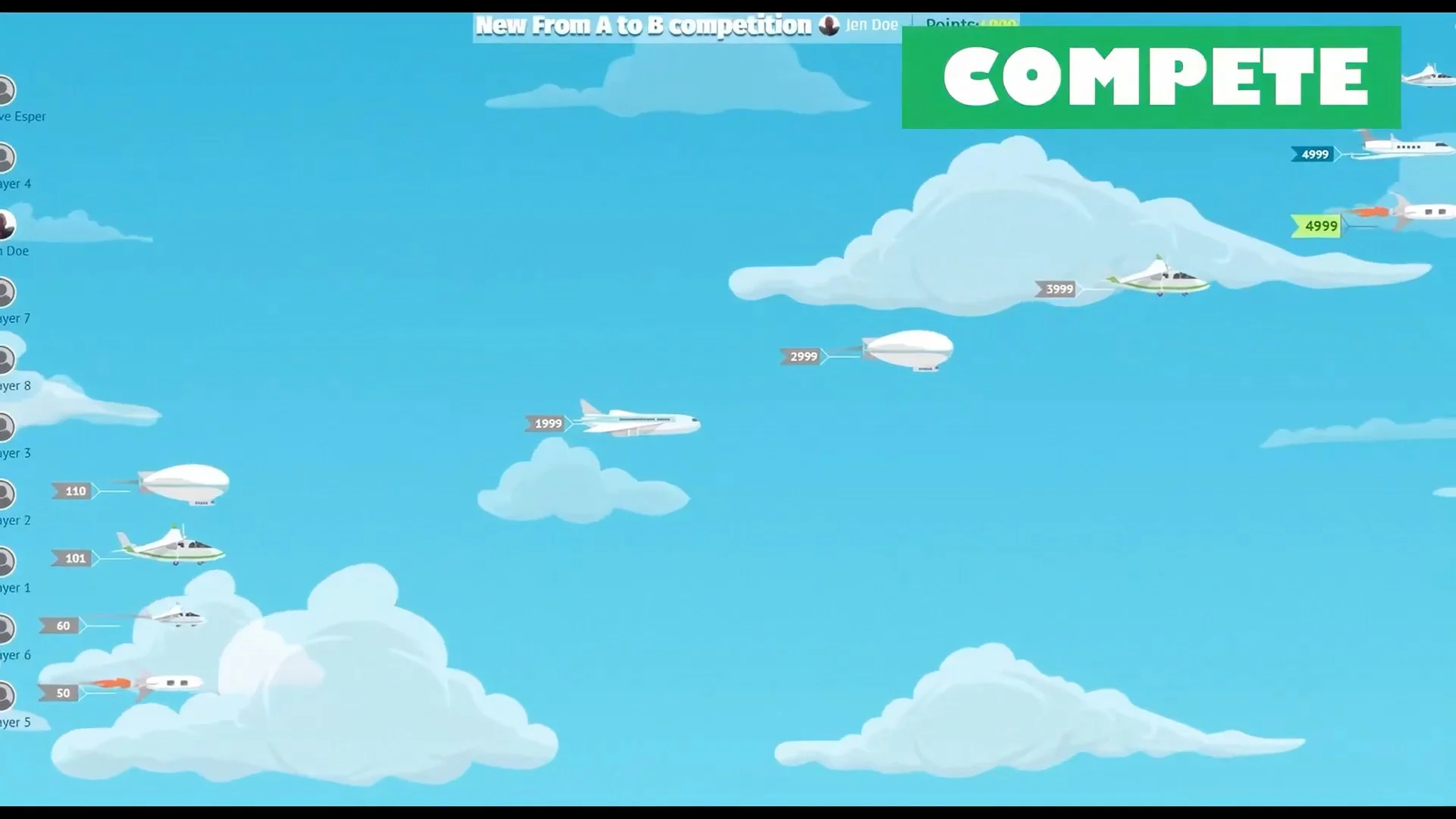
A competition with a public ranking works best where transparent competition and fast feedback matter. This mechanic suits situations where you need to increase employees' daily activity, such as the number of visits or completed plan-vs-actual targets.
Players see their positions in real time, understand who to benchmark against, and get a thrill from the race for leadership — this directly impacts sales team KPIs.
If the goal is to encourage specific actions rather than just overall activity, a game with prizes and cumulative points will work more effectively. It helps reinforce desired behaviors: timely reporting, completing training modules on a new product, or participating in surveys.
In this case, the mechanic gently nudges employees toward target actions instead of turning work into a race for first place.
For long-term engagement and team development, mixed scenarios work well: a ranking as the foundation plus team challenges with bonuses. This is especially relevant for pharmaceutical companies where both individual results and regional team cohesion matter.
A properly chosen mechanic not only improves metrics but also reduces turnover, making routine tasks more meaningful.
We start with diagnostics: we analyze your task, study the audience, current processes, and the motivation system you already use. Only then do we propose a specific format — a competition, ranking, quiz, or prize game — and implement it for your goals.
If you're unsure which mechanic will deliver the most for your situation, reach out for a consultation — together we'll determine the optimal option and launch it quickly.
Frequently Asked Questions About Process Gamification
When it comes to gamification at a pharmaceutical company, more questions arise than generic promises. Managers want to understand: won't we miss deadlines, will we have to restructure processes, and could the new system create data risks? Below are answers to the most common questions we hear during discussions.
How long does launch take?
Timelines depend on scope: a simple ranking system launches in 3-4 weeks, a full program with game scenarios in 6-8 weeks. We set timelines, stages, and checkpoints in advance, so you see progress at every step.
How to integrate into existing processes?
There's no need to restructure the team's work. We adapt the solution to your current tools: CRM, pharma rep training, internal portal. Integration happens without stopping business processes or involving your developers.
What about data security?
We work in line with pharmaceutical industry requirements: access control, personal data protection, and user action logging. You get reporting for internal audits and full control over information.
Will employee training be required?
Employees understand the system intuitively — the interface is designed around user tasks with no unnecessary elements. We hold a short session for administrators and stay in touch after launch to support the team.
If you still have questions, let's discuss them in a short consultation. We'll show examples for pharmaceutical companies and calculate timelines for your task.Launch a Game System and Get Results
Submit a development request — and within three business days we'll prepare an individual project estimate: timelines, format, scope of work. You'll receive a clear plan tied to your business goal, not an abstract "everything will be fine".
The initial free consultation helps you articulate your goals precisely, even if you're not yet sure where to start.
After launch, you get not "just another program" but a working motivation tool:
- Transparent employee ranking — everyone sees their contribution to the overall result, and arguments about "unfair bonuses" become a thing of the past.
- Higher sales and activity — game mechanics nudge managers to take the right actions: more meetings, calls, and completed plans.
- Lower turnover — an engaging competition system retains strong employees, and newcomers get involved faster.
- Quick launch without downtime — we implement in parallel with current work; CRM and the customer base keep running.
- Manager control — you see real-time statistics and understand who's driving results and who needs support.
- Reusability — after the pilot, the format easily scales to new departments, regions, or product teams.
We've been working with pharmaceutical companies for over 10 years, so we account for the industry's specifics: medical representatives, pharmacy chains, distribution. You don't need to explain your processes to us.
Submit a development request, get a free consultation and an accurate project estimate. In a month, your employees will be discussing not boring reports but their ranking positions and new records.