

The Problem of Low Employee Engagement in Business Processes
Routine inevitably eats away at interest in work: the same tasks, reports, approvals. After just a few years, even a qualified specialist performs duties on autopilot — initiative disappears, attention wanders, results become mediocre.
Low employee engagement in business processes is not a matter of mood but a direct loss of productivity and profit.
When motivation is lost, the entire business suffers: turnover grows, the costs of recruiting and training new people increase, service quality and response speed to customer requests drop. The company spends resources on control instead of developing.
That is why gamification of business processes is no longer an experiment — it has become an engagement management tool.
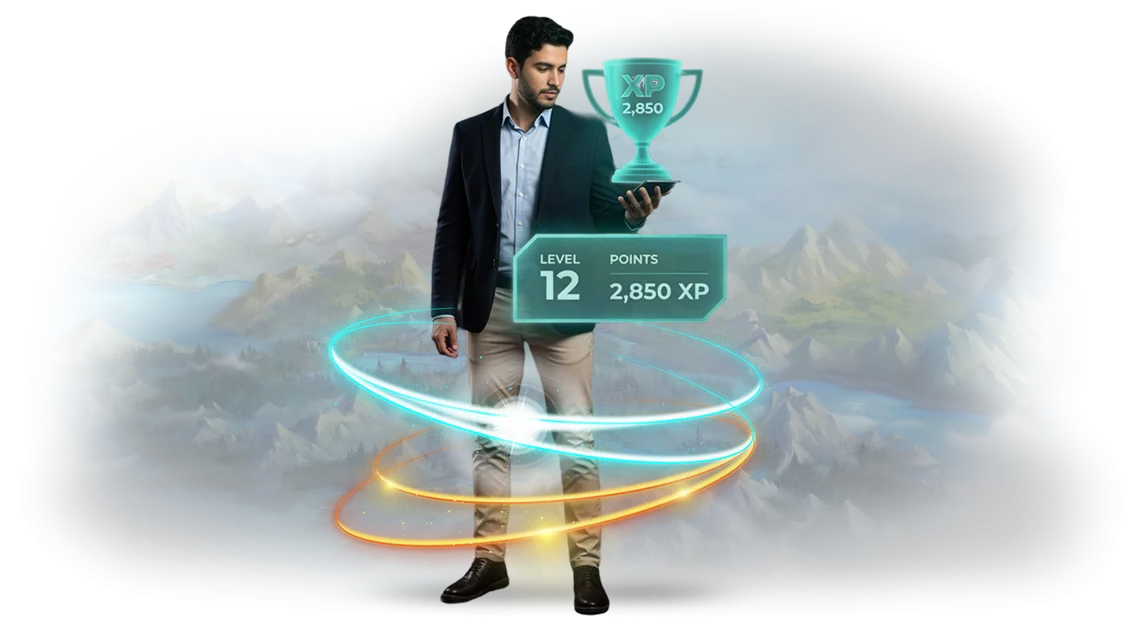
Game mechanics bring excitement and meaning back to familiar actions. An employee sees progress, receives quick feedback, and understands how their personal contribution affects the overall result.
This works not through coercion, but through the natural desire to win — something that is inherent in every person.
We have been implementing such solutions for over 10 years and see how team behavior changes.
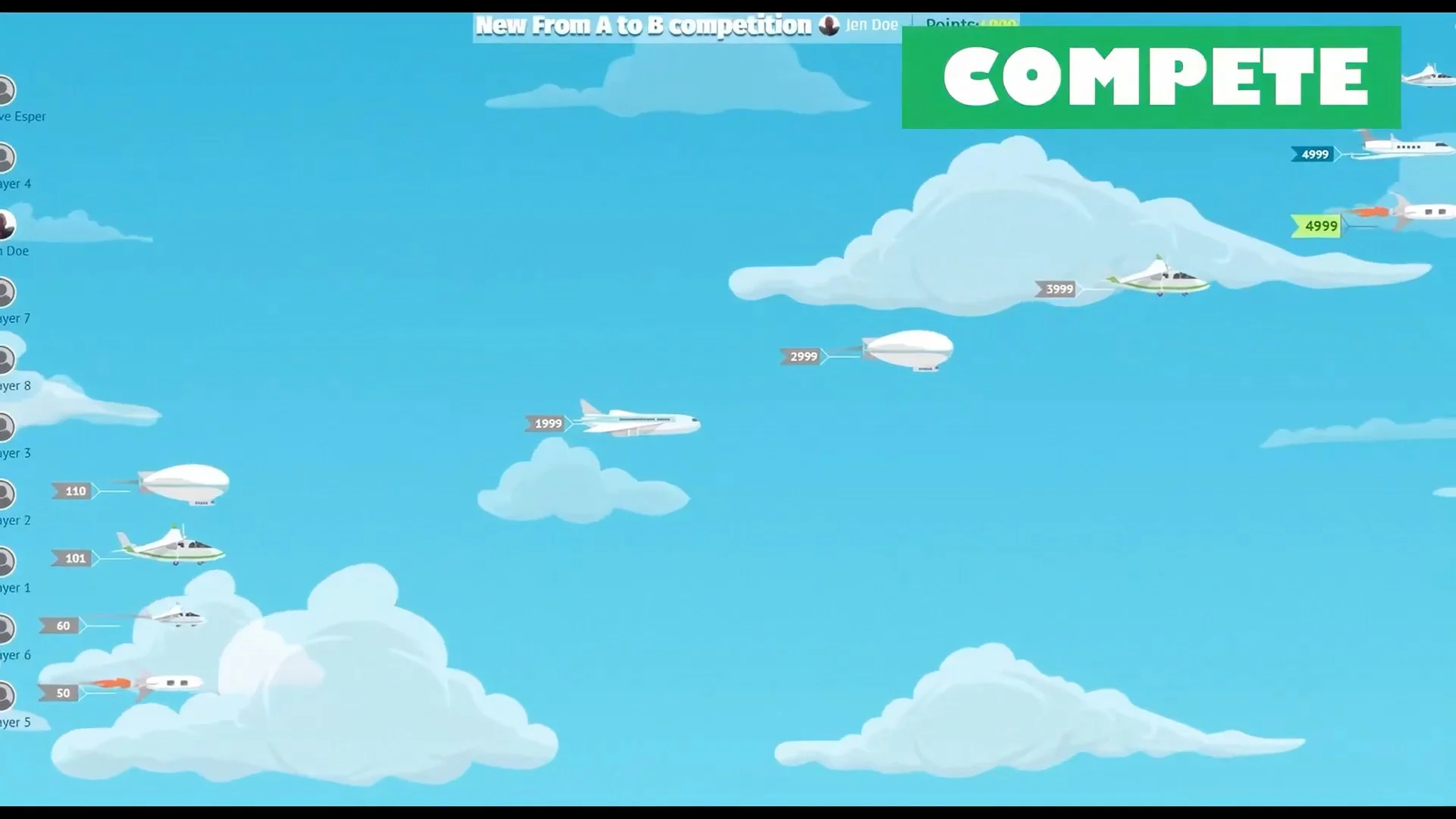
For example, a points system for completing planned operations increases the frequency of desired actions, and competitive mechanics in sales departments increase plan fulfillment without increasing the payroll. Employee engagement returns within the first weeks, and the effect lasts long.
What Gamification of Business Processes Gives a Company
Gamification of business processes is a way to turn routine tasks into an engaging system with goals, levels, and rewards. Employees stop working under duress and begin to engage with the process on their own.
This is the main advantage of gamification: it relies on the natural human drive for competition, development, and achievement.
Employee efficiency grows not through stricter control, but through a clear motivation system. When everyone sees their progress and understands what they contribute to the overall result, productivity rises naturally.
The productivity gain is visible within the first weeks, and sustained interest lasts throughout the entire work cycle — giving the company stable results without constant reminders and checks.
Personnel loyalty is another important effect. Gamification creates a positive atmosphere, reduces stress levels, and makes working days more interesting.
The team burns out less often, staff turnover decreases, and the company gets a cohesive team ready to achieve ambitious goals. A transparent reward and rating system makes every employee's contribution visible — people feel fairness and the value of their work.
From a business perspective, these changes directly affect revenue: engaged employees process requests faster, serve customers better, and more often suggest improvements.
By implementing gamification, we help achieve measurable results: you can see who is engaged and where support is needed. You get not just a game, but a working team management tool that pays for itself through increased efficiency and lower recruiting costs. We support the project from idea to launch and adapt the mechanics to your goals.
Gamification Formats for Employee Engagement
Different gamification formats address different tasks: some boost sales, others accelerate training or reduce turnover. The key is not to “just add a game” but to choose mechanics that work toward a specific business metric. Below are typical scenarios we encounter most often.
| Format | For whom | What it gives the business |
|---|---|---|
| Department competition | Sales, support, production teams | KPI growth through healthy competition and public recognition |
| Personal achievement tracker | Remote employees, newcomers | Transparent progress picture, lower turnover during probation |
| Team quests | Project groups, cross-functional teams | Improved communication and speed of task resolution |
| Training with game mechanics | Onboarding, regular professional development | Higher knowledge retention, less time to full proficiency |
| Long-term role-playing game (levels, ranks) | Entire team | Sustained engagement, corporate culture formation |
The choice of format depends on the team's maturity and the current task. For example, a young team may be enough with light competitions, while an experienced department needs deep mechanics with levels and hidden bonuses, otherwise interest quickly fades.
We don't “bolt on a game for the sake of the game”; we design a scenario around your business metrics.
At the start, we define exactly what needs improvement: conversion, request processing speed, engagement in internal activities — and choose a format that delivers measurable results within the first months.
Stages of Launching a Gamification Project in a Company
Launching gamification is not a one-time event but a change in employees' work habits.
For the project to deliver measurable results rather than turn into a “game for the sake of the game”, it is important to go through all implementation stages — from a motivation audit to regular evolution of the mechanics.
We have structured the process so that every step produces a clear outcome and is aligned with your side at a convenient pace.
- Brief and audit of the current process. We document the company's goals, collect employee feedback, and identify the point at which ordinary routine loses engagement.
- Project plan and success criteria. We outline implementation stages, timelines, and metrics: activity, task quality, return to training. We align the plan with you before the work begins.
- Designing game mechanics. We choose a scenario for the task: competition, character development, team challenge. We define exactly how an employee will see their own progress.
- Prototype and approval. We show a working sample of the mechanics on your real processes. We make changes before launch, not after.
- Development and integration. We build a solution that embeds into current tools — portal, CRM, mobile app. Employees don't have to relearn.
- Launch, training, and support. We announce the program together with you, answer the team's questions, and monitor early results. We don't leave employees alone with a new format.
- Analytics and development. Based on the first months, we collect data, adjust difficulty, and add new mechanics to keep interest alive.
This sequence eliminates the main risk — when gamification hangs separately from real tasks and doesn't affect metrics. Every stage has a checkpoint, and the project outcome is a clear action plan and measurable growth in employee engagement.
What's Included in the Delivery: Solution Package
After the project is completed, you get not just program code, but a ready-made tool that changes employee behavior and delivers measurable business results.
The delivery package includes everything needed to launch, use, and develop the system — from working mechanics to team training.
Here is what you get in the end:
- A working engagement mechanic — a tool configured to your business processes that increases employee activity, reduces turnover, and makes routine tasks clear and motivating.
- Results of the trial launch — analytics from the first weeks: which mechanics worked, how engagement changed, and which areas need refinement. This is the basis for quick improvements.
- Complete documentation package — administration guides, usage scenarios, and regulations for managers and employees. Everything is written in business language, not developer language.
- Training for your team — hands-on sessions for administrators and managers: how to set tasks, track progress, and adjust mechanics without involving developers.
- Warranty support — support for an agreed period, prompt resolution of issues, and consultations on system development.
- Development plan — a roadmap for the next iterations: which mechanics to strengthen and which new scenarios to connect in six months.
- Access to updates — you receive platform improvements within your chosen plan, including new templates and analytics tools.
This package covers the main client risk: you are not left alone with an unclear system. After project handover, your team can manage gamification independently, while we remain available for enhancements and new tasks.
Case: Team Productivity Growth After Gamification
We'll share a real example. A distributor came to us with a pain point: 28 managers in the sales department were fulfilling only half the plan, and turnover was growing. We developed process gamification — employees received personal goals, team seasons, and an open rating. Instead of dreary reports, a visual game with clear rules and quick wins appeared.
Results after four months
| Metric | Before implementation | After implementation | Change |
|---|---|---|---|
| Plan fulfillment | 52% | 84% | +32 p.p. |
| Tasks per employee per month | 118 | 161 | +36% |
| Engagement index | 3.1 out of 5 | 4.2 out of 5 | +22% |
| Quarterly turnover | 8% | 3% | −62% |
The results were pulled from the CRM and internal surveys — these are not subjective feelings, but working metrics.
The productivity growth proved not to be one-off: the team quickly mastered the mechanics, and the manager stopped spending time on reminders like “don't forget the plan.” Managers track progress themselves and show newcomers how to move up the rating.
Six months later, the client returned with a request to scale gamification to the logistics and call center departments. A repeat order is the best indicator of trust: the solution really changed the workflow and delivered measurable results for the business.
How to Choose a Gamification Format for Your Team?
Choosing a gamification format does not start with searching for trendy mechanics, but with the question of what problem the project should solve.
If you need to speed up onboarding for newcomers, that's one mechanic; if you need to boost sales or reduce time on routine operations, it's a completely different one. So the first step is to define the goal: engagement, learning, competition, or recognition.
The more precisely the outcome is formulated, the easier it is to choose a format that the team will accept and actually use.
The second criterion is the profile of your team. Young teams respond well to ratings, quick challenges, and public praise, while mature experts more often value calm point systems, mentoring, and the ability to choose tasks themselves.
Observe how employees interact with each other, what tools they already use, and what motivates them — external recognition or professional growth. This will help avoid the situation where the game exists but there is no interest.
The third factor is regularity and scale. If the task is one-off, like launching a new product or a corporate event, a short quiz or contest is enough.
For a long-term program, such as improving service quality or building a sales habit, phased missions with levels and intermediate rewards work well. It's also important to assess how much time employees can realistically devote to the game without compromising their core work.
Also consider the team resources for support: who will moderate, provide feedback, and resolve disputes. The gameplay should not add chaos but fit into existing regulations.
We help you make this choice systematically: we gather requirements, analyze the audience, select two or three suitable formats, and test them on a small group. Based on the results, we keep only what delivers measurable results and scale it to the entire team.
Thus, you get not an abstract “gamification for gamification's sake,” but a working tool that employees use with interest while you see growth in engagement and the desired metrics. We handle the selection and configuration of the format; everything else stays in your rhythm.
Frequently Asked Questions About Implementing Gamification
Before implementing gamification, managers ask the same questions: won't it distract from work, how long will it take, and will it justify the investment. We give straight answers to help you make a balanced decision.
How quickly will the effect appear?
The first improvements are visible within 2–4 weeks: employees miss deadlines less often and get involved in tasks faster. Lasting results come within a quarter, and analytics immediately shows the impact on metrics.
No “points for the sake of points” — only mechanics tied to goals.
What if employees don't want to participate?
Not everyone joins right away, which is why we use different scenarios: for competitive, pragmatic, and skeptical people. Before launch, we run a pilot on one team and adapt the mechanics to their reaction.
How long does implementation take?
A standard project takes from 3 weeks to 2 months. During the brief, we define exact timelines and stages. Implementation runs parallel to work processes; business doesn't stop.
How is the cost calculated?
Cost is calculated after an audit and depends on the number of processes, format, and analytics. After the brief, we provide a transparent estimate: design, development, launch, and support are included.
Gamification is a working tool, not “toys.” Still have doubts? Ask them at the consultation and get a solution tailored to your task.Discuss Your Task and Get a Gamification Plan
Standard motivation methods stop resonating, and engaging employees in routine becomes increasingly difficult. Instead of abstract promises, offer your team a clear game with transparent rules and rewards — and you'll see productivity grow.
For gamification to truly work, you need a plan tailored to your specific situation. Leave a request — we'll have a short consultation, estimate the scope of work, and propose a solution that fits your processes and budget.
What you get after your request:
- We clarify the task and the business goal for which gamification is being implemented.
- We conduct a consultation with your team and gather employee preferences.
- We calculate the scope of work, timelines, and a clear result — with no hidden conditions.
- We prepare a personal plan: scenario, game elements, engagement mechanics.
- We propose launch stages and performance evaluation criteria.
A personal plan is not an abstract presentation but concrete steps: what changes in processes, how employees get points and rewards, and how you see progress.
Leave a request now — we'll respond within one business day and show you how gamification will work specifically in your team.