

Migrating to Facebook Instant Games: How Not to Lose Your Audience and Revenue
Moving a game to a new platform is always stressful for a business. Especially when it comes to Facebook Instant Games: publication rules, technical requirements, and audience behavior all change.
If you migrate the game incorrectly, you can lose not only your established player base, but also the recurring revenue from purchases and advertising.
For the owner of a gamified product, players are the main asset. They have already become accustomed to the mechanics and invested time and money into their progress. Any mistake during migration—such as losing saved data or a long downtime—drives people to competitors. After that, winning the audience back costs many times more than a careful transfer.
Our team specializes in migrating games to Facebook Instant Games while preserving all accumulated audience and monetization.
We analyze risks in advance, transfer player data and game progress without losses, and configure payments and advertising tools to meet platform requirements.
The transition is seamless for users: they continue playing from exactly where they left off and never notice the technical complexities.
We have carried out more than one such migration and know where problems usually arise. That is why we take on all stages—from audit to launch—so you get a stable, smoothly running game without downtime or lost revenue.
As a result, migration becomes not a risk but a growth point: you keep your players and gain access to Facebook's huge audience, and therefore to additional income.
What Placing Your Product in a Messenger Gives Your Business
Placing your product in a messenger removes the main barrier between the client and your service—the need to download and install something.
The user is already in an app they are familiar with, where they chat with loved ones and handle work matters, so switching to your product takes one click.
This is critical for impulse demand: while a user hesitates, opens the app store, and waits for the download, they often change their mind. A messenger shortens this path to seconds, and conversion to the first action increases.
The second advantage is viral growth through social mechanics. In a messenger, every user action—a result, a record, an invitation—naturally turns into a message they want to share with a friend.
This format works better than classic advertising: people trust personal recommendations more than banners. Each active client brings in several new ones, and audience acquisition stops depending on an ever-increasing advertising budget.
Messengers also hold attention better than a website or a standalone app. The user returns to chat dozens of times a day, and your product is always right there—in the list of conversations.
This increases interaction frequency and engagement: clients complete targeted actions more often, come back for new levels, and stay with the brand longer.
For business, this means a measurable result: growth in active audience, more repeat interactions, and lower acquisition costs.
The product starts working as a communication channel that simultaneously sells, retains, and expands reach—without complex technical preparation on the client's side and with clear performance metrics for you.
Placing your product in a messenger removes the main barrier between the client and your service—the need to download and install something.
The user is already in an app they are familiar with, where they chat with loved ones and handle work matters, so switching to your product takes one click.
This is critical for impulse demand: while a user hesitates, opens the app store, and waits for the download, they often change their mind. A messenger shortens this path to seconds, and conversion to the first action increases.
The second advantage is viral growth through social mechanics. In a messenger, every user action—a result, a record, an invitation—naturally turns into a message they want to share with a friend.
This format works better than classic advertising: people trust personal recommendations more than banners. Each active client brings in several new ones, and audience acquisition stops depending on an ever-increasing advertising budget.
Messengers also hold attention better than a website or a standalone app. The user returns to chat dozens of times a day, and your product is always right there—in the list of conversations.
This increases interaction frequency and engagement: clients complete targeted actions more often, come back for new levels, and stay with the brand longer.
Project Formats: Which Option Fits Your Task
Migrating a game to Facebook Instant Games is not just a technical transfer; it is a matter of preserving audience and revenue. Players are used to your product, and any delays during the move affect your earnings.
That is why we offer three work formats, so you pay only for the result you need and don't overpay for unnecessary extras. The choice depends on how quickly you need to launch, the amount of refinements, and how willing you are to change existing processes.
| Format | Who It's For | What It Gives the Client |
|---|---|---|
| Full Transfer | Businesses that already have a game and need to move to a new platform quickly | Turnkey launch: adaptation, payment setup, testing. The game is live within a month, audience is not lost |
| Hybrid Launch | Companies that want to test demand on a new platform without stopping current projects | Two versions run in parallel. You get data on player interest and willingness to pay before the full move |
| Long-Term Support | Projects that need regular updates and development of mechanics | A dedicated team continuously improves the game: seasonal events, new levels, balance. You don't worry about technical details |
Each format starts with a short questionnaire: we study your game, target audience, and deadline constraints. Then we propose a plan and set the cost and launch date. If you simply need to transfer the game without changes, we go with a full transfer.
If you want to test demand, we start with a hybrid launch. At this stage, you can switch formats after seeing the first results. We stay in touch at every stage, so you always understand what is happening with the project.
How Your Project's Transfer Works: Stages and Timeline
A transparent migration process to Facebook Instant Games consists of six steps, each with agreed timelines. You see the scope of work, control points, and the end result in advance—instead of getting a "black box" with unexpected delays.
- Brief: we capture the project goals, audience, and functionality that must be preserved after the move.
- Plan: we create a detailed migration schedule, break it into stages, and set timelines.
- Approval: you approve the plan and budget—we do not start work without your go-ahead.
- Implementation: we transfer the game, preserving logic, design, and integrations with the necessary services.
- Launch: we test on real devices, publish the update, and monitor initial metrics.
- Support: after launch we stay in touch—helping, fixing, and refining.
Each stage ends with a clear result: a document, a finished version, a launch, or a report. So you always know where the project stands and what comes next.
Migration timelines depend on project complexity, but we state a time range in advance and keep you informed. On average, the move takes from a few days to a month—and you don't get distracted by technical details, instead focusing on the business outcome.
What's Included in the Delivery: A Package for Launch and Growth
Turnkey Project: From Game Adaptation to Analytics
We hand over not "code on a flash drive" but a working tool that is immediately integrated into your business processes.
Everything needed for launch and growth is bundled into one package: an adapted game, configuration for your audience, team training, and an analytics dashboard.
- Game adapted to your task — mechanics, design, and narrative are tuned to a specific goal: customer acquisition, employee training, or increasing loyalty.
- Setup and integration — we connect the game to your accounting systems and social media, so results immediately enter your funnel. No downtime and no "fix it later."
- Training for your team — we run a short hands-on workshop: administrators will be able to change prizes, levels, and texts without involving developers.
- Performance analytics — we set up a dashboard: how many people played, what percentage returned, how many completed a target action. You see results in numbers, not in "everything is fine" reports.
- Support after launch — we formalize a maintenance schedule: updates, failure protection, and consultations, so the game keeps working and delivering value for years.
This eliminates the client's main fear—"we bought a game, so what now?" You get not an artifact but a manageable communication channel with a measurable contribution to profit.
Case Study: How We Increased User Retention 3x
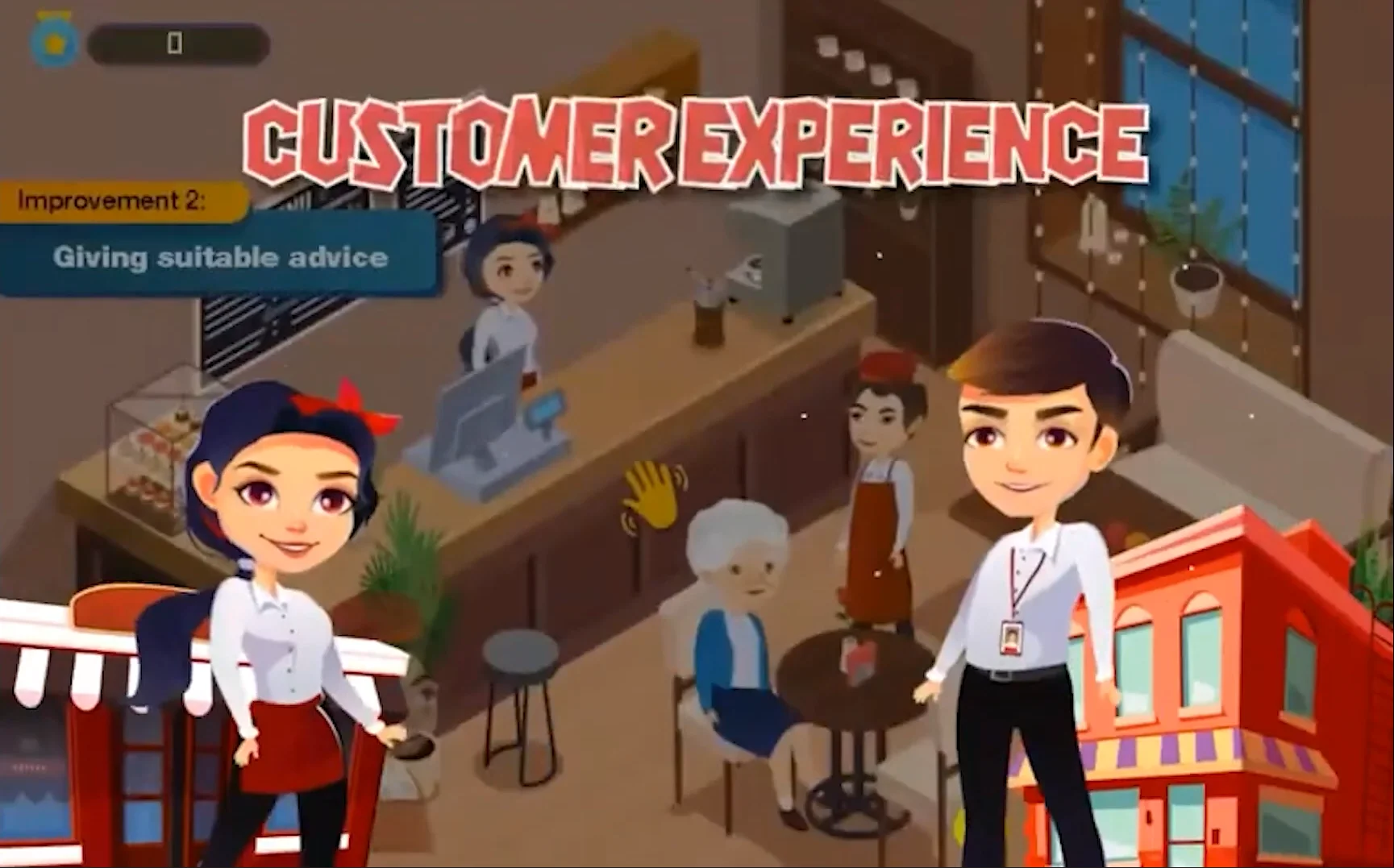
For a coffee shop chain, we developed a quest game that trained new employees in service standards. Participants completed levels, earned points, and competed with colleagues—but the game opened via a link in the browser.
Because of this, progress was lost, newcomers forgot about the training, and only a third of the team made it to the end.
We migrated the game to Facebook Instant Games—a format that runs right in the messenger, with no install and no repeated login. Now an employee receives an invitation, clicks one button, and continues from where they left off. Team leads see progress in real time and can send reminders to those who have fallen behind.
Project Results
Two months after migration, user retention grew 3x: participants returned to the game almost daily instead of visiting rarely.
Average session time increased from 4 to 7 minutes, the number of monthly active players grew by 60%, and the share of those reaching the final level rose from 31% to 78%.
The increase in engagement immediately affected the business: new employees reached a stable level of service faster, and turnover during the probationary period dropped by a quarter. Training that used to take a month was completed in a week and a half.
This case confirms that moving gamification into the familiar messenger environment boosts metrics without changing the game mechanics. The client was pleased and ordered the next quest—this time for regular customers, with bonuses for completing tasks.
How to Choose the Right Transfer Format for Your Task?
There is no one-size-fits-all answer—the choice of transfer format depends on four parameters: the size of the game, the target audience, the budget, and the desired timeline.
These criteria are interconnected: the more mechanics and data there are, the more complex and expensive the migration, but also the higher the value for users.
The size of the game determines how many features need to be transferred without losses. If the project is light, for example a simple arcade game, it's enough to adapt the core mechanics and launch them on the new platform quickly.
The audience also matters: if users are used to progression, rewards, and competition, you must keep those elements—otherwise they will leave.
Budget and deadlines set the boundaries. With a limited budget, it's wise to do a staged transfer—first launch the core value, then add features. When time is tight, we choose a format that reuses existing logic and doesn't require rewriting from scratch. This way you get a working product on time, without unnecessary costs.
We select a format individually: we analyze the game, player profile, and your constraints, then propose an optimal migration plan—from quick adaptation to full migration with preservation of progress and payments. Before starting, you receive a clear estimate and timeline.
If you're unsure, start with a consultation—we'll help you choose a format and answer all your questions.
Frequently Asked Questions About Moving to a New Platform
Moving to a new platform is always a step into the unknown: it feels like you'll have to redo the game, lose data, and overpay. In reality, migrating to Facebook Instant Games is a manageable process that we handle entirely. Here are answers to four main questions we hear most often before the start.
Will the game break after the transfer?
No. We transfer the entire game, including mechanics, progress, and purchases. Engineers adapt the code for the new platform and test all scenarios on real devices. If anything goes wrong, we fix it before launch.
How long will the transfer take?
Usually from two weeks to two months, depending on the game's complexity. At the start, we create a plan with control points and fixed deadlines. You can always see the current stage of the process and when the final result will be ready.
What will happen to player data?
The data won't go anywhere. We carefully transfer profiles, achievements, and virtual items. We set up protection so that information remains accessible only to authorized players and is not available to outsiders.
How much does migration cost?
The budget depends on the game's scale and the amount of refinements, but it is almost always 2–3 times cheaper than building from scratch. After a short brief, we give you the exact cost—with no hidden fees or forced work. If the task fits within the scope, you receive a fixed estimate.
Our team has already migrated dozens of games to different platforms and knows all the pitfalls. Our work is backed by a guarantee: three months of free support after launch. Submit a request for a short audit—within one day we'll tell you what is needed for the transfer and how long it will take.Get an Individual Plan for Moving to a New Platform
Migrating a game to Facebook Instant Games opens access to a huge audience, but without a clear plan you can easily lose players' hard-earned progress and the connection to business processes. Deadlines slip, budgets grow, and users leave for competitors.
We help you avoid this—by ordering a migration from us, you get not just code, but a well-thought-out transition plan.
First, we consult for free, study your project, and tell you how complex the move is. Then we prepare an individual action plan: what to transfer first, how to preserve player progress and data, which stages will take the most time, and what it will cost. You make your decision with the full picture in hand, not "by eye."
After your request, you will receive:
- an analysis of the current project: audience, key mechanics, growth points;
- a step-by-step migration plan to the new platform, tailored to your business goals;
- an estimate with the scope of work, timeline, and cost—without hidden extras;
- recommendations for preserving player progress and ensuring a smooth transition;
- integration options with your business processes and accounting systems;
- answers to your team's questions and suggestions for optimization;
- a clear understanding of which features can be improved during the move.
This is free and non-binding. You'll get a clear action plan, an estimate, and a timeline, and then you decide—move forward with us or do it yourself. Leave a request for a free consultation, and in just a few days you'll have a clear migration route.
Ordering a transfer is simple: fill out the form below, and we'll get back to you within one business day.