

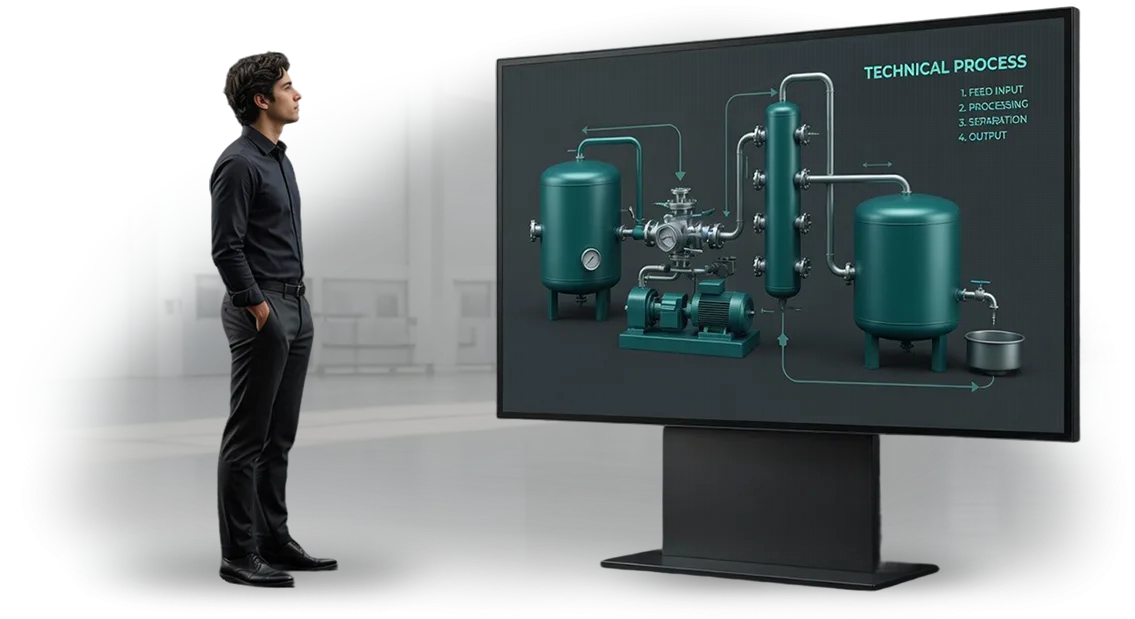
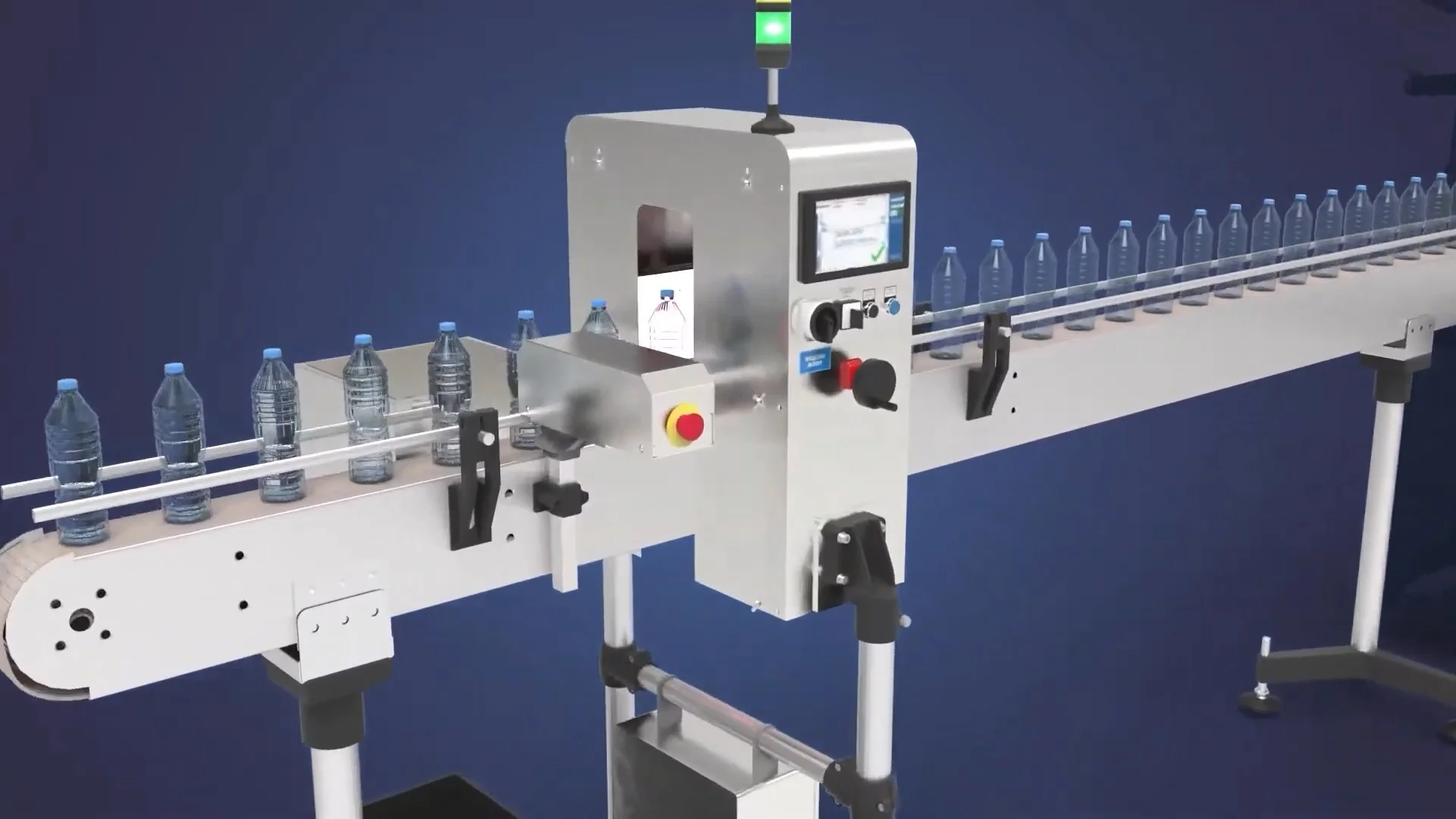
Why don't instructions for water treatment equipment work?
Water treatment equipment is complex machinery on which the uninterrupted operation of an entire enterprise depends.
Operating errors lead to breakdowns, production downtime, and serious financial losses — which is why quality employee training becomes a matter of business survival, not a formality.
The problem is that traditional text manuals and flat diagrams don't work. An employee, especially a new one, cannot mentally assemble the units or understand how parts interact inside the housing.
They act at random, make mistakes during assembly and maintenance — and expensive equipment fails at the worst possible moment.
As a result, the enterprise gets caught in a vicious cycle: breakdown → downtime → emergency repair → retraining → another error. Each cycle costs money and nerves, and above all — time, which production never has enough of.
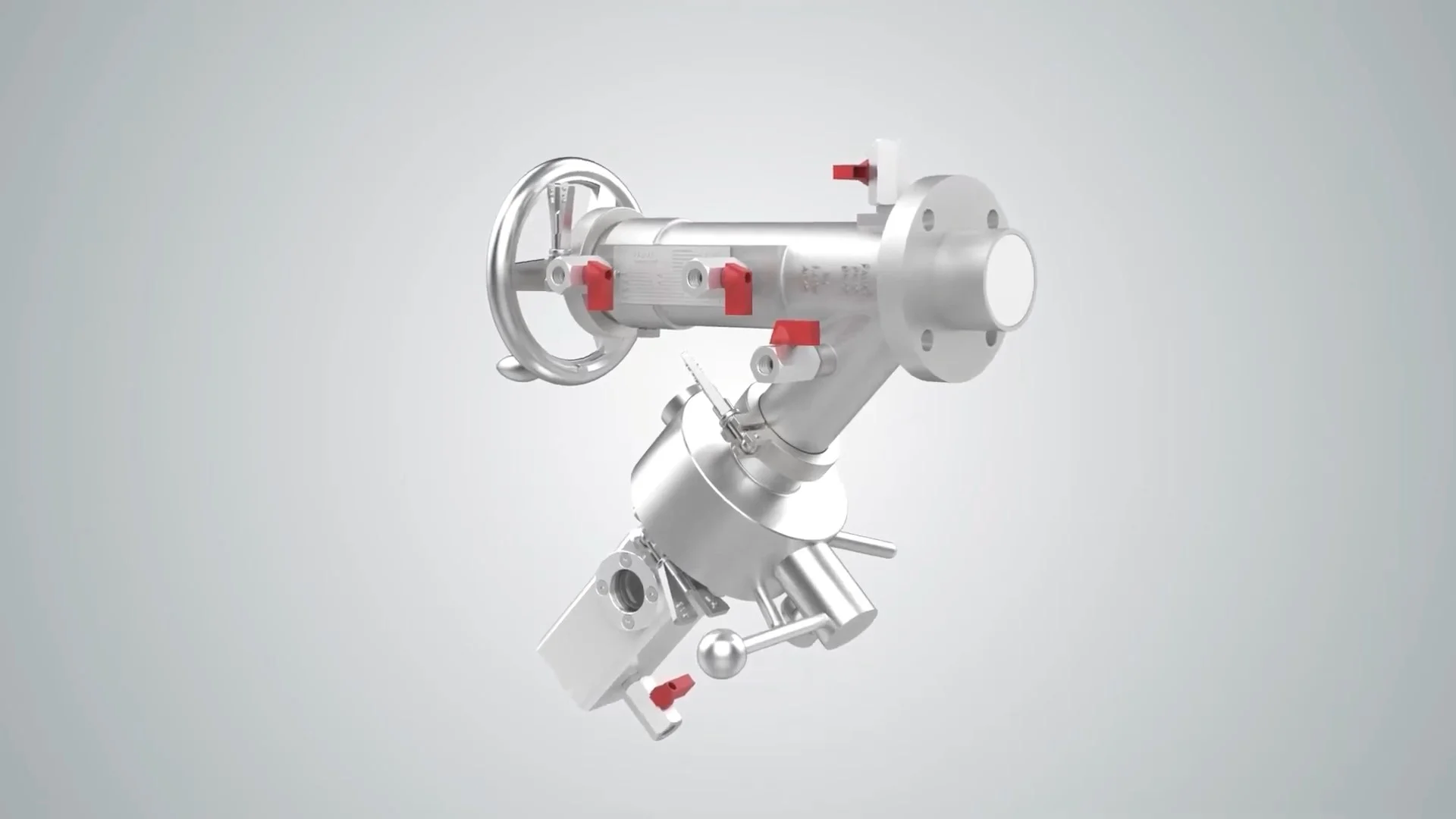
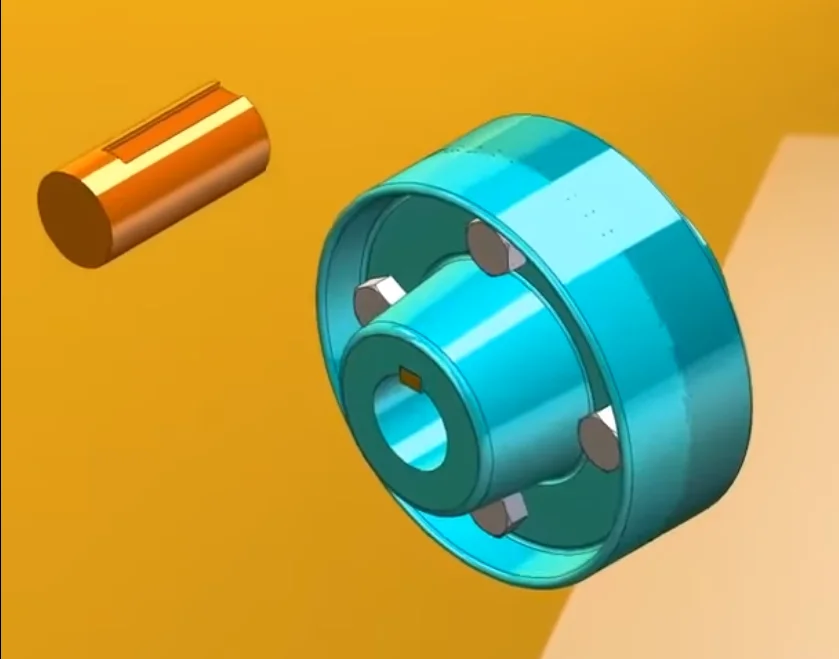
We solve this problem by creating 3D video instructions with an explosion-diagram effect. The employee sees the equipment from the inside: how a unit is removed, in what order the fasteners are unscrewed, how to correctly replace a filter or gasket.
This eliminates ambiguity and makes the training process clear even for a newcomer without a technical background.
3D instructions: 5 benefits for production and reputation
Training employees to work with water treatment equipment usually takes weeks and requires an experienced mentor. If an employee makes a mistake, the result is a risk of expensive equipment failure or a disrupted production process.
At our team we develop 3D video instructions with an explosion-diagram effect: any mechanism is taken apart, and the employee sees how it is built and what needs to be done. This covers five key production needs:
- Fast staff training. A newcomer masters the procedure in a couple of days instead of weeks, and an experienced employee can refresh their knowledge in 15 minutes.
- Lower breakdown risks. Clear diagrams eliminate incorrect action sequences during disassembly and assembly — the main cause of unit damage.
- Equipment protection. The employee understands which parts are sensitive to loads and handles them carefully, extending service life.
- Higher competency levels. Staff gain a deeper understanding of how the equipment works, make decisions faster in abnormal situations, and become less dependent on the "golden employee".
- Company image. Modern training materials boost the employer's status and make it easier to attract qualified personnel.
According to our data, after implementing such instructions, onboarding time drops by 30–40%, and the frequency of service calls caused by operator errors is cut in half. That is a measurable effect on both the budget and the reputation of a production facility.
3D instruction formats for water treatment equipment
For a video instruction to deliver results, the format must match the task. For water treatment equipment, we use three main formats: 3D process animation, explosion diagrams, and interactive guides.
Each has its own purpose and audience — understanding this helps you choose the optimal solution for employee training. Companies often try to get by with a single format, but that slows down onboarding and increases the number of errors.
| Format | For whom | What it gives the client |
|---|---|---|
| 3D process animation | Operators and installers | Visually shows how the entire system works, speeds up startup, and reduces errors |
| Equipment explosion diagram | Service engineers and repair crews | Shows how units are disassembled and where parts are located, enabling faster repair and maintenance |
| Interactive guide | New employees and the technical department | Step-by-step reference that can be revisited, fewer questions for mentors |
The choice depends on the goal. Animation is for showing processes in motion, an explosion diagram is for explaining the structure, and an interactive guide is for building a knowledge base.
We combine formats within a single project: this gives employees a clear path — from general understanding to specific details. This approach accelerates training and reduces the number of support requests.
How we create a video instruction: stages of work
We have structured the process so that you see the result at every step and can influence it before the final render.
This removes the risk of "building the wrong thing" and helps us stay within the agreed project timeline — typically 2–4 weeks from brief to finished video.
Stages of video instruction development
-
Brief and documentation audit. We study the equipment, drawings, and procedures. We clarify who the video is for — new employees or a repair crew — because the level of detail depends on it.
-
Data collection. If necessary, we visit the site, take photos and videos of the units, and talk with the technologists. This way the 3D model replicates every connection.
-
Script approval. We script the shots, the narrator's text, and the explosion-diagram logic. We get everything approved before 3D modeling begins — edits at this stage are made quickly.
-
3D video creation. We model the units in the Autodesk environment, which guarantees accuracy against the drawings. Then we animate the disassembly and assembly and add labels.
-
Intermediate approval. We share a draft version of the key scenes. You provide feedback: camera angles, speed, emphasis.
-
Render and editing. We render the frames and compose the animation with voiceover, subtitles, and graphics. The result is a finished file in the required formats.
-
Launch. We hand over the video, source files, and a methodology guide. We also help upload the video to your learning management system and update it when procedures change.
What is included in the video instruction delivery
We deliver not just a video file, but a working package that allows your team to train new employees without involving the developers. Everything needed for launch and updates is ready to use — all you have to do is upload the materials into your training system.
-
Finished video instruction — the final video with voiceover, subtitles, and emphasis on key operations. You can upload it straight into a learning management system, show it on a tablet right next to the equipment, or include it in a presentation for the service team.
-
Project source files — all the materials from which the video was assembled: scenes, layers, settings, and graphic elements. This lets your own designer make edits — change the logo, replace a department name, or adjust colors — without commissioning new work from scratch.
-
User guide — a short operator manual: how to open the video, from which device, how to navigate between sections, and what to do if the audio does not play. It works both in print and as an attachment to an electronic procedure document.
-
Update recommendations — a documented procedure for what to do when the equipment model changes, parts are replaced, or procedures are revised.
It specifies the types of edits, from a minor frame replacement to a full reassembly of the explosion diagram, plus approximate timelines for each option.
-
Implementation consultation — for a month after delivery, we answer your specialists' questions, help set up playback on site, and check that the instruction is actually being used rather than sitting in an archive.
This package removes the main risk — dependence on the contractor. You get not a one-off file, but an asset you can develop and maintain on your own.
Case study: how a 3D instruction accelerated equipment launch
The client is a manufacturer of water treatment equipment in the industrial solutions segment, AquaStandard. Launching a new model required training installers and service engineers: previously this took three full days, and even the first startups still involved errors. Paper instructions did not help — employees lost time, and the client lost money on downtime.
We proposed replacing the text manuals with a 3D video instruction using explosion diagrams. Instead of flat drawings, the installer saw a complete disassembly of the equipment: how the units are removed, in what order the parts are connected, and where precision is critical. Training became visual, and complex operations became understandable on the first viewing.
Training results
One month after implementation, we compared the new group's results with the previous one. Training time dropped from three days to one — employees were ready to work much faster.
The number of installation errors fell by 60%, and the company now spends half as much time on retraining and fixing mistakes.
Client experience
The head of the service division noted that equipment startup at the first customers went without a single engineer visit for recalibration.
Because the instruction reproduces the real assembly down to the smallest detail, even new employees achieve consistent results after a short introduction to the material. The company continued ordering such videos for the next models — which shows that the format pays off.
For a production facility, this is not just "nice animation" but a tool that accelerates equipment commissioning and reduces training costs. When every day of downtime costs real money, a clear 3D instruction becomes a competitive advantage.
How to choose the right 3D instruction format for your task?
Choosing a 3D instruction format starts not with the visuals, but with a question: what exactly should the employee be able to do after watching it — understand the general structure of a unit, perform scheduled maintenance, or fix an unexpected breakdown?
The more complex the equipment and the higher the cost of a mistake, the more detailed the presentation needs to be: for water treatment systems with many filters, valves, and sensors, step-by-step disassemblies work better than a general overview.
The second criterion is the skill level of the staff.
A newcomer needs a calm, sequential walkthrough with emphasis on the order of operations and typical mistakes; an experienced employee needs quick navigation through units and explosion diagrams to refresh knowledge before a shift.
That is why in a single project we often produce two videos: a full training version and a short reference version — this covers both initial training and ongoing support.
The third factor is the way the instruction will be used: for self-study, for group training, or for access from a tablet right at the equipment.
If employees work in a noisy shop floor, subtitles and emphasis on visual details become essential; if training is remote, we add checkpoint questions.
For each scenario, we match the appropriate presentation format — from animated diagrams to detailed disassemblies with highlighting of the relevant unit.
The main rule is: the more complex the equipment and the higher the qualification requirements, the more levels of detail need to be built in.
We help determine the optimal format during a free briefing: we analyze your procedures, typical staff errors, and maintenance frequency, then propose a video structure tailored to the specific task.
This way you get an instruction that genuinely reduces onboarding time and lowers the number of emergency callouts.
Frequently asked questions about creating video instructions
We have collected answers to the questions most commonly asked before ordering a video instruction. If your situation is not covered here — write to us, and we will help assess the task and choose the right format.
How long does it take to develop a video instruction?
The timeline depends on the complexity of the equipment and the number of scenes. Typically, a standard video with unit disassembly and assembly is ready in 2–4 weeks including approvals.
At the start, we set a calendar plan and control points. You see intermediate versions and make edits — which allows us to deliver the project on time and without surprises.
How much does it cost to create and update instructions?
The cost is calculated after audit — based on the number of operations, graphics complexity, and timelines. After the brief, we provide an exact price that does not change during the process.
Updating a video costs significantly less than full development. If a single part or unit changes — just send us the new drawings or photos, and we will make the changes and deliver the updated version.
Do we need to prepare a technical specification?
Not necessarily. We gather all the necessary information ourselves: drawings, photographs, work procedures, and videos of real maintenance. Based on that, we create the script and storyboard.
If you already have a ready technical specification — great, that will shorten the timeline. If not — we will help you draft one for free, and you approve the final version before we start.
Is it difficult to integrate video instructions into training?
No. You receive ready-made files in popular formats — they can be used in learning management systems, on tablets, in applications, or simply in shared access for employees.
If needed, we adapt the videos to your platform: we produce the required resolution, add subtitles, or split the content into short modules for knowledge testing.
Order a 3D instruction for your equipment
Submit a request for a 3D video instruction — and on the same day you will receive a free consultation on water treatment equipment.
A manager will analyze your task, recommend the optimal format, and agree on the timeline so you can launch employee training without downtime and unnecessary back-and-forth.
How the order process works — from request to finished instruction:
- Request and consultation. You submit a request on the website — a manager contacts you within 15 minutes and answers all your questions.
- Cost calculation. We prepare a transparent estimate based on your scope and equipment complexity. You know exactly what you are paying for.
- Work examples. We show real 3D instruction projects — you see the quality level and choose the style that fits.
- Structure recommendations. We propose a script, scene breakdown, and key emphasis points so employees quickly remember the sequence of actions.
- Personal manager. One point of contact for the entire project — you do not waste time corresponding with several different people.
- Contract and launch. We lock in the timeline and format, then take over production. We show the first version for approval ahead of the deadline.
This process lets you order a video instruction without risks: you control every stage and know exactly what you will receive. To start, simply submit a request — we will handle the rest.
Submit your request right now — it takes two minutes. A free consultation, cost calculation, and recommendations for your specific tasks are available today.