

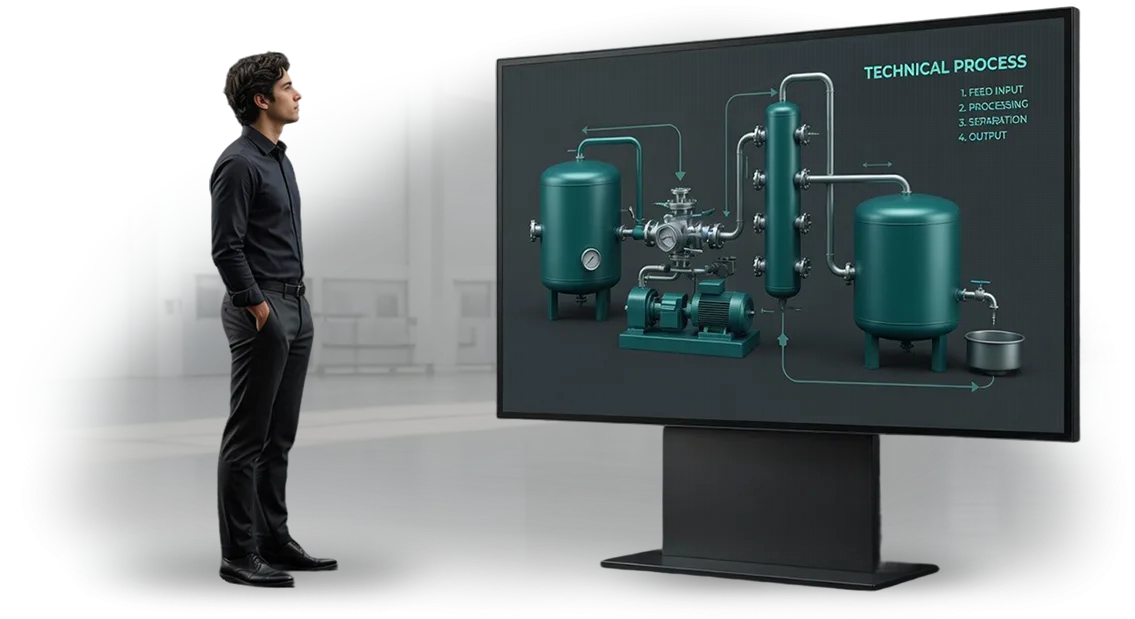
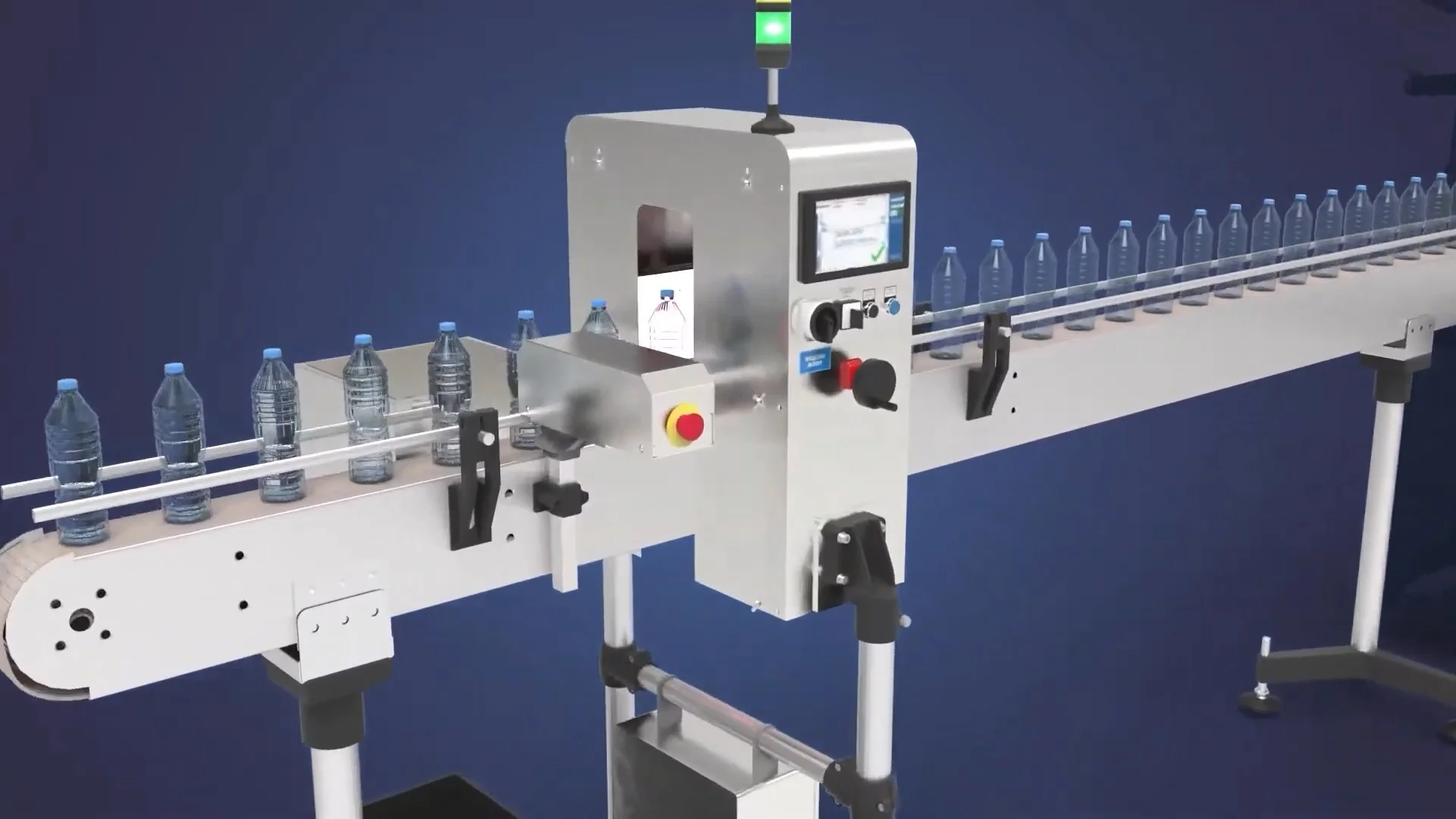
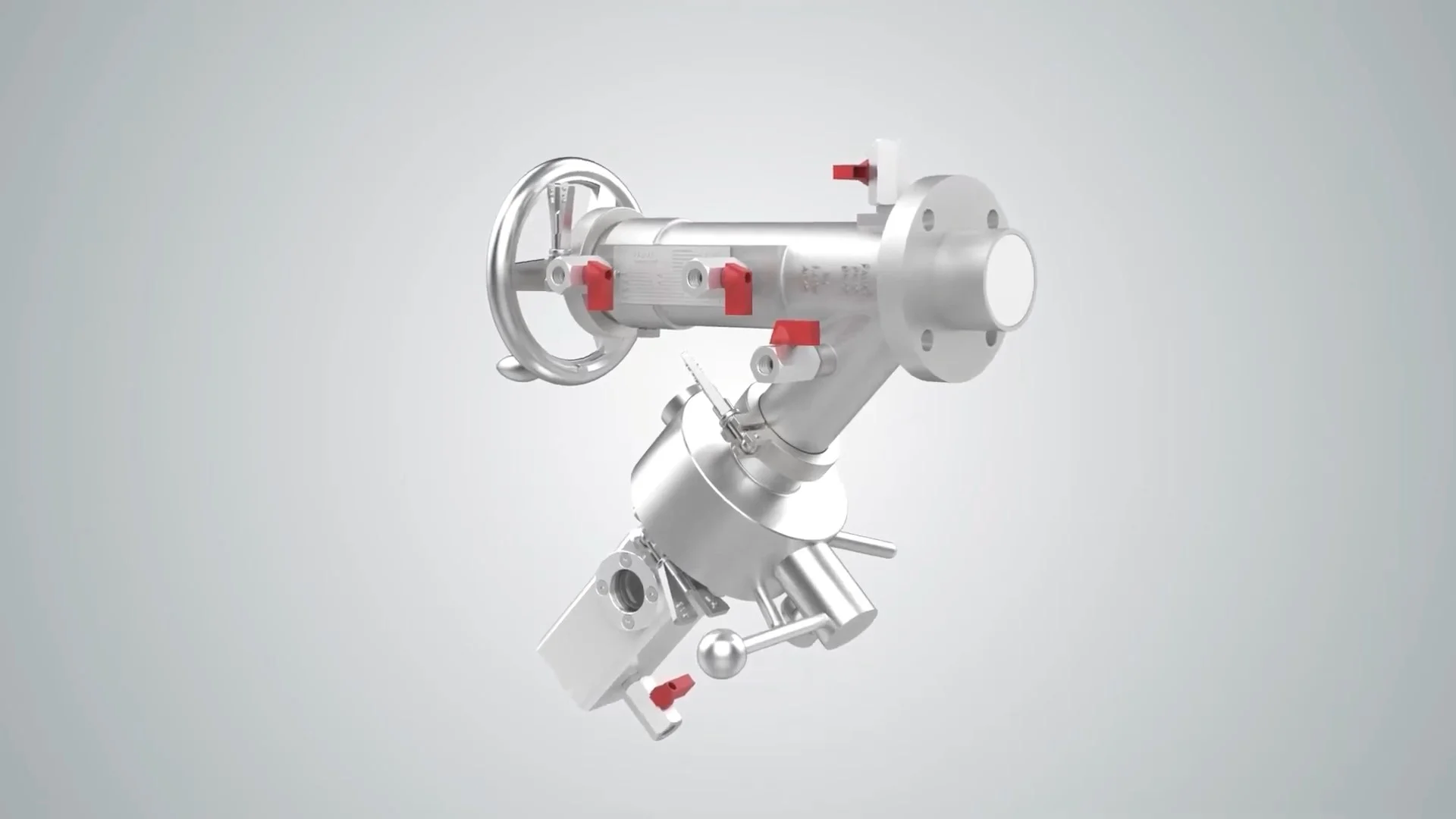
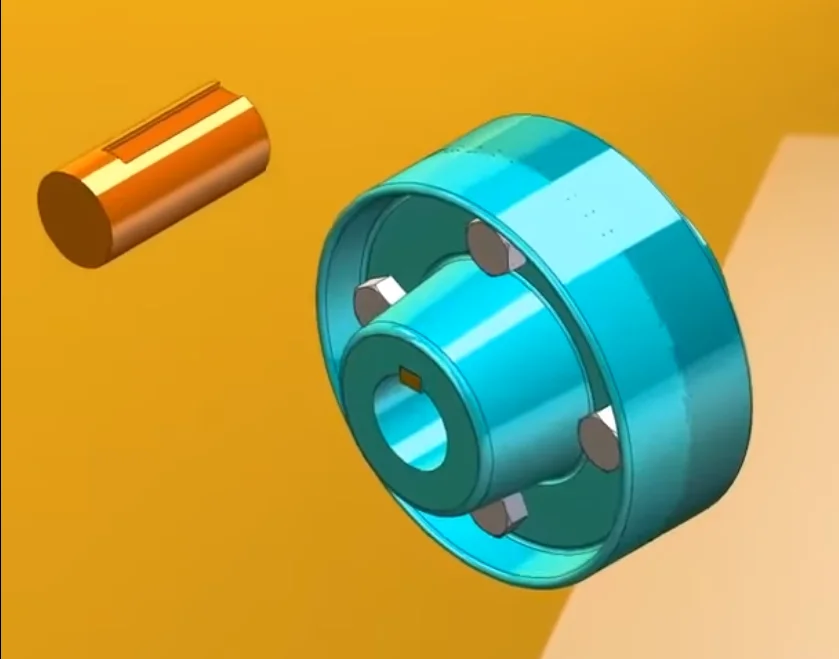
Why employees make mistakes when assembling pump stations
Assembly and maintenance of pump stations is a process where the cost of even a small mistake is too high. An incorrectly installed component, a broken sequence of operations, or a missed step leads to failures, rapid wear, and unscheduled downtime.
Assembly errors occur most often among new employees and those who work with a pump station irregularly — precisely when precision is needed.
Most companies still rely on text instructions and static drawings. But these lack visual clarity: the employee has to mentally reconstruct a three-dimensional picture from flat diagrams, spend time deciphering terms, and guess whether they understood the action correctly.
Staff training becomes long and inefficient — the result depends heavily on the individual's abilities rather than the quality of the instruction.
The cost of such errors consists not only of repair and parts replacement expenses. It also includes missed project deadlines, safety risks, and loss of customer trust.
When servicing pump stations, errors are often discovered only on site — at the worst possible moment, when redoing anything is difficult and expensive, and influencing production processes is no longer possible.
That's why we develop 3D video instructions for pump station assembly and maintenance. Instead of abstract drawings, employees get a visual process they can launch on any device and repeat step by step at a real pace.
Such staff training takes far less time and delivers consistent results: fewer assembly errors, faster onboarding, and higher confidence in staff actions. The instruction is always at hand rather than stored on a shelf in a single copy.
What a 3D video instruction for pump station assembly and maintenance provides
An employee encountering a pump station for the first time acts by trial and error — this means time lost, damaged components, and the risk of breaking expensive equipment.
A 3D video instruction removes this uncertainty: instead of reading drawings and instructions, a person sees every assembly and maintenance step in three dimensions, with the correct sequence of actions.
Fewer errors — the main economic benefit. When installation and service follow a visual reference, the defect rate and repeat callouts drop significantly. Faster training — a newcomer gets up to speed in days rather than weeks and starts adding value sooner.
3D animation makes it possible to show internal components and working mechanics in a way no flat diagram or photograph can convey.
For the enterprise, this is also a unified standard. All employees — across all branches and shifts — train on the same visual model. Knowledge no longer depends on a mentor's personal experience, and work quality stops being a lottery.
Technology compliance control becomes simpler, and the HR department gets a ready-made tool for assessing staff readiness.
Thus, a 3D instruction created once works as an ongoing digital asset: it cuts training costs, reduces accident rates and insurance risks, and increases customer loyalty. This is an investment that pays off on the very first major project.
Video instruction formats: 3D animation, diagrams, combined
Corporate video instructions for pump stations solve various tasks: from initial training of newcomers to speeding up field repairs. The format determines how quickly an employee finds the right component and performs the operation correctly. We compared three approaches so you can choose the optimal one for your team.
3D animation shows the station's structure in cross-section: fluid movement, valve operation, internal components. It helps understand the working principle and diagnose non-standard failures.
Assembly diagrams provide a clear sequence of actions with emphasis on mounting, tightening, and connecting. They are indispensable for routine maintenance. Combined videos merge both approaches: animation handles the mechanics, while operations are shown schematically.
| Format | Who it's for | What it gives the customer |
|---|---|---|
| 3D animation | Engineers, service staff, newcomers | Fast understanding of the structure and working principles, fewer errors with non-standard failures |
| Assembly diagrams | Installers, operators, maintenance staff | Clear action algorithm, reduced assembly and maintenance time, unified quality standard |
| Combined videos | Mixed teams, training without a mentor | Versatility: the employee sees the big picture, then moves to a specific action |
The choice of format depends on how often the instruction is referenced. If the operation is weekly and requires a precise sequence — diagrams are sufficient.
If the station is complex and a failure is critical, animation and the combined format reduce downtime and repeat service callouts.
We have already made such instructions for pump equipment manufacturers: technician onboarding time dropped by a third, and the number of repeat callouts decreased noticeably. We'll help you choose the right format for your task and show a sample on your station model.
How video instruction development for an enterprise works
At the start of work on a video instruction, we capture all the input data: which operations need to be shown, who will watch the video, and on which devices.
This lets us set the right scope and format upfront so you don't overpay for unnecessary scenes or wait longer than needed for the video. The process is structured so you control every stage and make decisions only when it truly matters.
- Brief and equipment audit — a short questionnaire and a call where we clarify the objectives, station configuration, and typical employee errors.
- Script and storyboard development — we describe every scene in text and diagrams: what happens on screen, which actions are narrated, and which warnings are displayed.
- Script approval — you make edits to the text and logic, and we refine the document to a level any new employee can understand.
- Video production — we create 3D scenes, assembly and maintenance animation, and add voiceover, subtitles, and emphasis on critical components.
- Preview — we send a draft video with a watermark, and you collect feedback from mentors and line staff.
- Final edits and delivery — we make the changes, export the final file in the required formats, and hand over the source files for future updates.
At every stage you receive a concrete artifact: brief, script, draft, and final video. This lets you see progress and understand what you're paying for. On average, development takes two to four weeks — the exact timeline is fixed in the contract after script approval.
This approach eliminates the situation where the finished video is "not about that." You approve the logic and text in advance, and the production stage is purely about visual execution.
That's why the result meets expectations from the first try, and your employees get a clear instruction that reduces errors and speeds up onboarding.
What's included in the delivery and what you pay for
At first glance, it may seem that the customer is getting just a video. In reality, it's a package that supports your training system for years and doesn't require rework for each new employee or each equipment model.
To help you understand what the budget consists of and what remains at your disposal after project completion, here's the full delivery scope:
- Detailed training script. A step-by-step script you approve before production begins. This is your control document: you see every frame and every instruction stage in advance and make edits before rendering starts.
- A set of 3D models of your pump station. The internal structure of your equipment in exact digital form. This isn't just a picture for one video — the models remain your asset. You can use them for future instructions, client presentations, or the sales department.
- A ready-made training video in high quality. The final file that can be uploaded to a corporate portal, a distance learning system, or simply sent via messenger. The video is adapted for different screen formats.
- Text version of the instruction ("quick reference"). A short summary of key steps that an employee can keep in front of them at the machine or on a tablet. This solves the "watched and forgot" problem — the material is always at hand.
- Post-delivery support. We don't just "deliver the file and disappear"; we work with you until full implementation. If employees have questions while watching or something needs adjusting in the logic, we're available and make edits quickly.
This package addresses the main training pain point: scattered materials and instructions that everyone interprets differently. You get a unified standard of explanation that's easy to replicate — without overpaying to "shoot the film all over again" with each new task.
We guarantee quality: you approve the script, review intermediate model versions, and receive the final video only after your confirmation. You pay for a result you've already verified at every stage, not for "a pig in a poke."
Case study: cutting assembly errors by 40% at a pump station
The customer is a manufacturer of industrial pump stations. Before the project, training for assemblers and service engineers relied on text regulations and two-dimensional diagrams.
That wasn't enough for complex components: employees made errors in the assembly sequence, which increased downtime, raised the number of warranty repairs, and kept new specialists from reaching full capacity for months.
Wedeveloped a series of 3D video instructions for pump station assembly and maintenance. Instead of static drawings, each employee sees every component in three dimensions and the exact operation sequence — at the right pace, with emphasis on critical points.
It works like a personal mentor nearby, but without the mentor having to repeat the same thing over and over.
The customer saw results within three months. Assembly errors dropped by 40% — a key metric for production. The average time for a new employee to become independent fell by 1.5 times.
The number of service support inquiries on typical issues decreased by a third: specialists stopped being distracted by repetitive explanations.
The production manager noted that the 3D format is remembered faster than text: workers are more willing to rewatch short videos on a tablet than to flip through multi-page instructions.
So the customer didn't stop at a one-time launch — six months later, we produced additional video instructions for other assembly line areas. The repeat order was the best proof of the format's value.
Such video instructions pay off through less scrap, reduced downtime, and faster onboarding of newcomers.
If you have a similar challenge — on production lines, during complex equipment installation, or in service maintenance — we'll match the video instruction format to your specifics and help you estimate the expected impact.
How to choose the video instruction format for your task?
There's no one-size-fits-all format: what works for a short introductory instruction is useless for training on complex assembly. So first define the task — and only then choose the format. The main criteria are equipment type and staff skill level.
For pump stations and other complex equipment, 3D video instructions are almost always more effective than flat diagrams or photo reports. They show internal structure, assembly order, and maintenance rules without the risk of damaging a real unit.
The employee sees the process "from the inside" — this accelerates understanding and dramatically reduces errors during independent work.
| Format | When to choose | What it gives the customer |
|---|---|---|
| Simple video instruction with live footage | For simple operations: power-on, filter replacement, daily inspection | Fast launch, minimal production costs |
| 2D animation with diagrams | For teaching basic operating principles and standard procedures | Clear presentation, easy to update when procedures change |
| 3D video instruction | For assembly, disassembly, and maintenance of complex equipment — pump stations, mechanisms with enclosed components | Visibility of internal parts, fewer installation errors, faster path to independent work for newcomers |
| Interactive trainer based on a 3D model | For practicing skills in a safe environment and staff certification | The employee trains as many times as needed, without risk of equipment damage |
To choose, answer three questions: how often employees perform the operation, how long the sequence of actions is, and what the cost of an error is. If the operation repeats daily — a short 2D video is enough.
If it's a rare but complex pump station assembly — a 3D instruction is needed, showing every component and installation step in detail.
We'll help you pick the right format for your tasks and equipment type. Our specialists will analyze your processes, propose an optimal scenario, and create an instruction your employees will truly understand and remember.
You get exactly the format that solves your business challenge: fast staff competency without production downtime.
Frequently asked questions and customer concerns
Before ordering a 3D video instruction for pump stations, customers usually hesitate about three things: how quickly everything will be done, what happens when the equipment is updated, and whether employees will stop watching the video after the first month. These are understandable questions — the answers determine the budget decision.
Below we address the most common concerns. If your question isn't here — write to us, and we'll share details about your project.
How long does it take to develop a video instruction for a pump station?
A standard project takes 2–4 weeks. The timeline depends on equipment complexity and the number of scenes: an assembly instruction for 20 components is faster to produce than a service maintenance video covering every part in detail.
We agree on a calendar plan at the start and set checkpoints. You always see where the project stands and know the completion date.
What happens when you change the pump station design? Will we have to reorder everything from scratch?
No. We structure the project so edits can be made without a full reshoot. If one component or mount changes, we update only that fragment — faster and cheaper than creating a video from zero.
In most projects, we include up to three rounds of updates within a year after delivery. That's enough to bring the video in line with a new modification.
Employees will watch the video once and forget it. How do we keep their attention?
People perceive 3D video instructions better than flat drawings or text regulations. Thanks to the visual demonstration of each action, the risk of errors during pump station assembly and maintenance is reduced.
The video can be embedded in a distance learning system: after watching, the employee answers a few questions, and the results are saved in the report. This turns training from a formality into a verifiable process.
If you'd like us to prepare a commercial proposal with an exact timeline and scope of work — send us a description of your pump station, and we'll get back to you with the cost calculated after audit within one business day.Order 3D video instruction development for your production
After you reach out, you receive not just a commercial proposal but a concrete plan: cost and timeline estimate, examples of our 3D video instructions, and a clear route to launch at your production site.
We analyze your pump station or similar equipment, define the scenario for your employees, and immediately show what the result will look like.
What's included in the ordering process:
- Estimate for your task — video scope, number of scenes, assembly complexity, and ways to integrate into your training system.
- Example demonstrations — relevant work on pump stations, assembly, and maintenance so you can evaluate the style and level of detail.
- Script and video structure — the sequence of operations for each role: assemblers, operators, repair crews.
- 3D video instruction development — we create animation with precise component detailing, without complex drawings or long texts.
- Approval and edits — you provide feedback at every stage until the final version is approved.
- Project launch — we deliver the finished files, instructions for integrating into the training process, and if needed, help update the video when equipment changes.
This approach removes risks: you see examples before the start, control the script, and understand the timeline. 3D video instruction development begins after a short brief — typically one business day for document preparation and plan approval.
As a result, your employees master pump station work faster, make fewer mistakes, and need a mentor only in the initial stages. Leave a request — we'll send the estimate and examples, then quickly launch the project to match your needs.