

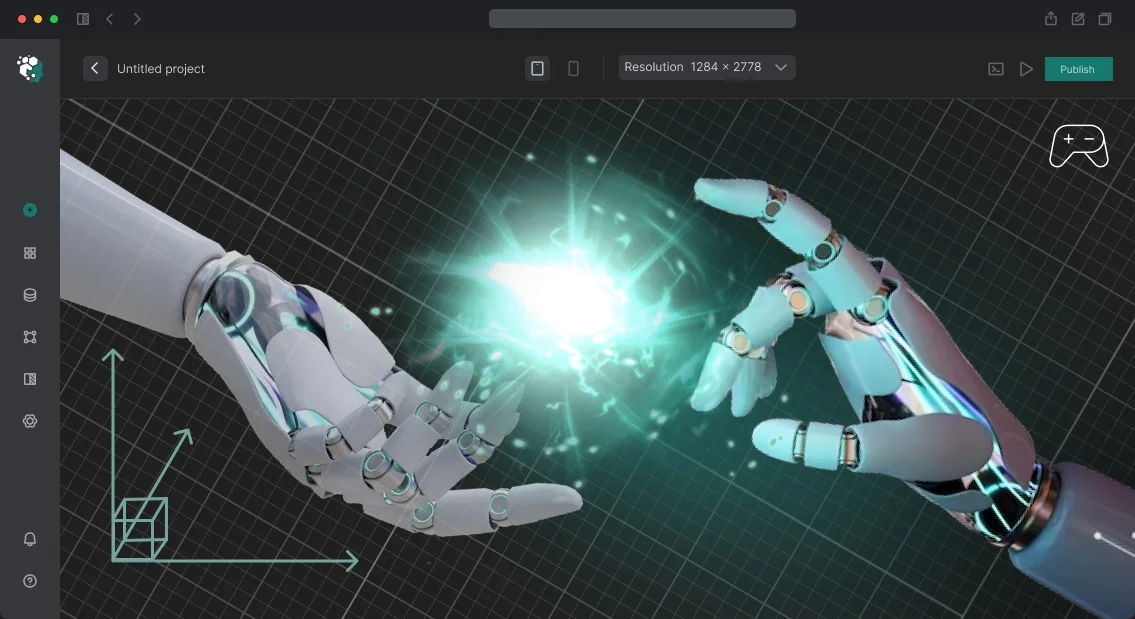
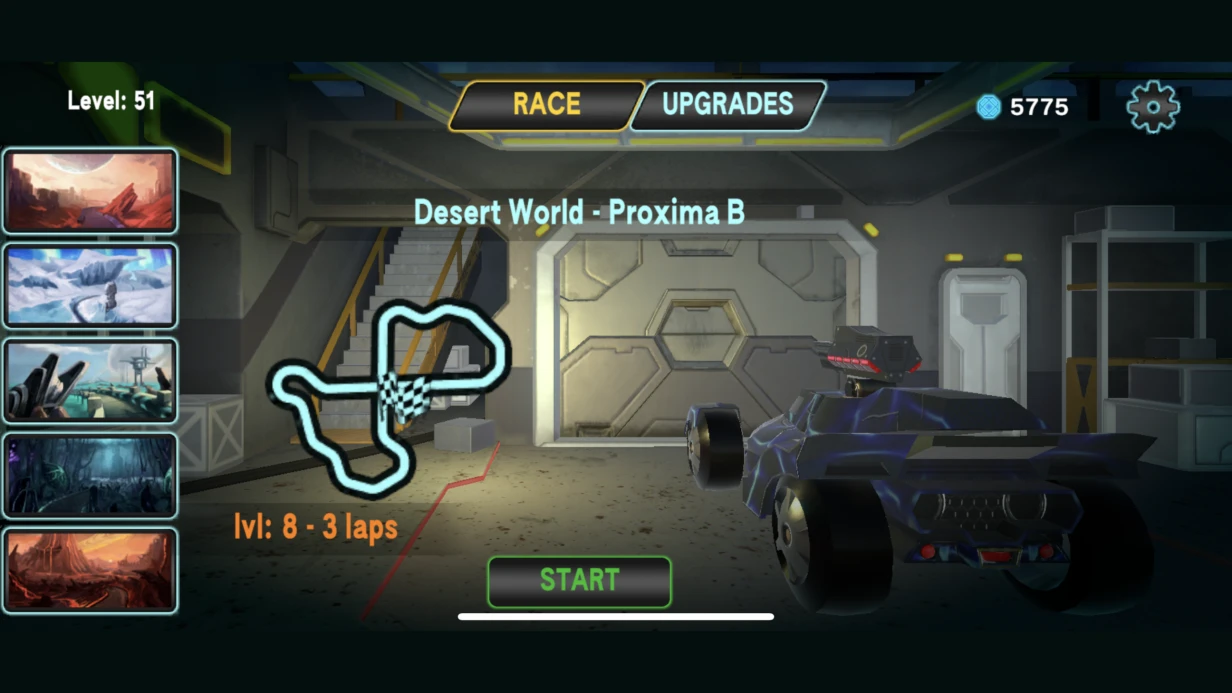
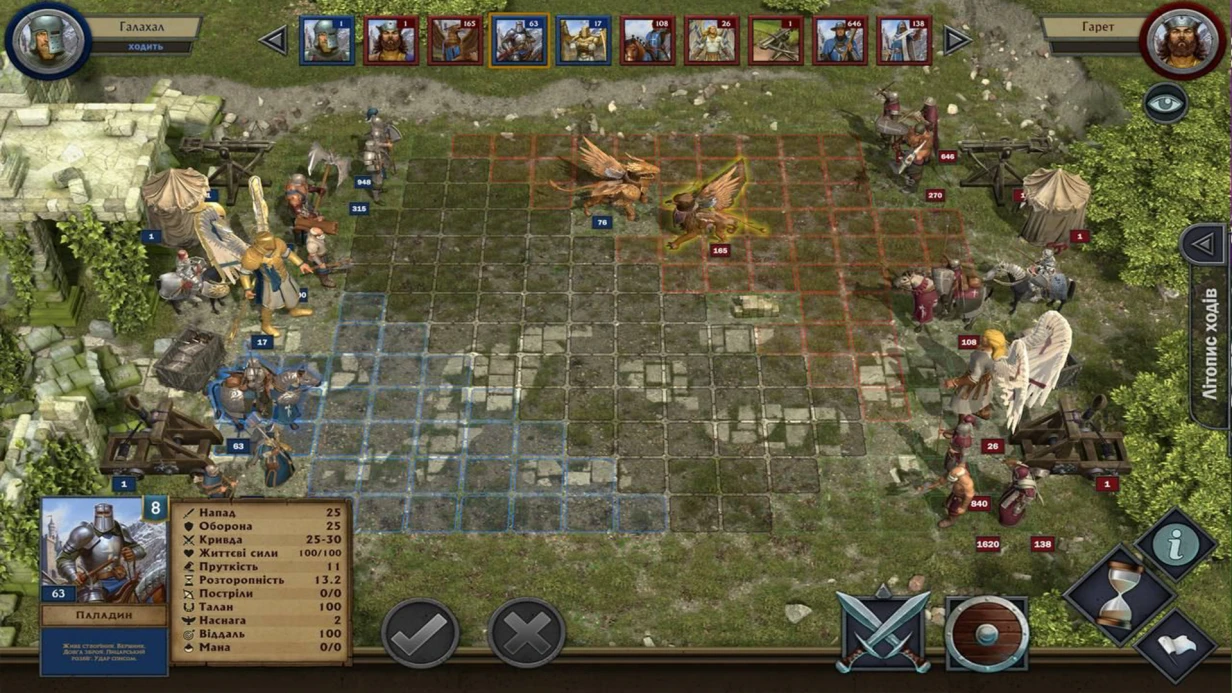
Clients aren't engaging — a WebGL game is the answer
Visitors come to the site, browse a couple of pages and leave — a standard situation for most companies. Even high-quality content and bright banners don't hold attention for more than a few seconds, and a person who doesn't engage doesn't become a customer.
A game on the site changes that dynamic. A person doesn't just read about the product — they interact with the brand, complete levels, and learn the company's story through the plot.
This is no longer passive viewing but active participation: in 3–5 minutes of game time, the user spends tens of times longer on the site and remembers your company through emotions.
WebGL development makes it possible to run a full-fledged RPG right in the browser, without installing apps or registering. The client enters the game world via a link from any device — computer, tablet, smartphone. No barriers that usually kill interest.
Customer engagement happens naturally: through the plot, tasks and rewards that lead the player to the desired action — a request, purchase, or subscription.
We use this approach as part of our marketing strategy: a game on the site solves specific business tasks. Inside the RPG, you place quests about your products, mini-quizzes with useful materials, and scenario choices that reveal user preferences.
This data helps segment the audience more precisely and improve the conversion of subsequent campaigns.
By ordering the development of an RPG on Unity for WebGL, you get not just a game but a tool that increases time on site, collects contacts, boosts brand awareness, and sets you apart from competitors.
Professional WebGL development tailored to your goals and audience is a working engagement channel whose results are measurable in business metrics, not game points.
What the game brings: leads, reach, and brand awareness growth
An RPG game placed directly on the site turns a visitor from an observer into a participant. Instead of static advertising, a person experiences a mini-story connected to your product — and this changes their attitude to the brand. This format delivers measurable results across several business areas at once.
Lead collection happens naturally: built-in mechanics — quests, quizzes, character choices — ask for a contact in exchange for bonuses or the continuation of the story. The user leaves data willingly because they want to get the result, not because they are forced to.
As a result, you get a warm database with an understanding of at what stage the player became interested in the product.
Time spent on the site grows: a high-quality RPG holds attention for 10–15 minutes, and built-in levels and rewards bring players back.
For marketing, this means more contacts with the brand, better recall, and higher conversion to the target action — a request, subscription, or purchase.
Audience reach increases through competitive elements and social mechanics. Leaderboards, achievements, invitations to friends, and share-result buttons encourage players to tell others about your brand on social media.
Each participant brings 2–3 new visitors, and mentions continue to work long after the game's release.
Brand awareness is built through the plot, visual style, and characters that are associated with your product. A game that is fun to play becomes a carrier of the company's identity itself: it is completed, discussed, and bookmarked.
As a result, one marketing tool simultaneously covers the tasks of lead generation, increasing engagement, expanding reach, and building brand loyalty — without an additional advertising budget.
WebGL game development formats for your task
Each task has its own scale: for some, a light game is enough to revive a newsletter, while others build an entire RPG with character progression and a bonus system.
So we have identified three collaboration formats: urgent mini-game development, a balanced project, and a full-fledged RPG product on Unity in WebGL.
We work with professional tools — games are built in WebGL and open in the browser without installation. This removes barriers: the client doesn't need to download anything, just click a link.
Users appreciate the ability to log in from any device — laptop, tablet, or smartphone — and this directly affects engagement.
| Format | For whom | What it gives the client |
|---|---|---|
| Urgent mini-game | Promotion, exhibition, promo newsletter | Launch in 2–3 weeks, viral reach, contact collection |
| Turnkey project | Corporate event, training, loyalty program | Several game mechanics, deep engagement, clear statistics |
| Full-fledged RPG | Brand portal, standalone digital product | Deep story, regular updates, monetization |
The full-fledged format is developed as a separate product from scratch: heroes, quests, dialogues, and a progression system. Thanks to WebGL, it runs on any platform, and the client gets not a one-off promotion but a constantly working channel of interaction with the audience. Such a game holds attention longer and brings users back — through new levels and events.
Whichever format you choose, it is always turnkey development: we handle the idea, scenario, visuals, programming, and testing. At the output, you get a finished game with a link for embedding on the site or for sending directly to participants. If necessary, we refine the game after launch: we add mechanics, levels, and analytics.
How the work on a game for your business goes
Creating a game for business is a process in which you remain in charge. We have broken the work into transparent development stages: you always know what is happening, what the deadlines are, and when you need to make a decision. Each step ends with an approval — this eliminates surprises and unnecessary revisions.
-
Brief and work plan. You tell us about the task: who your audience is, what the game should give the business. We record the work plan, deadlines and budget — a document we use to check at all stages.
-
Concept approval. We show what the game will be like: mechanics, visual style, story. You make edits before development starts — this saves time and money.
-
Development of the game scenario and interface. We build the main version. Every 1–2 weeks you get a working demo: you see progress and can check whether everything meets expectations.
-
Testing and optimization. We test the game in the browser on different devices, removing errors and delays. This is especially important for WebGL because users log in from phones, laptops, and tablets.
-
Launch. We place the game on your website, landing page, or social media. We provide instructions on how to connect it to an advertising campaign and analytics so that you immediately see the result.
-
Support and development. We stay in touch: we update content, add new levels, and monitor statistics. If the game becomes popular, we will suggest how to scale it and increase reach.
What's included in the game project delivery
When you order game development, it's important to understand what you get in the end — not just a "finished program" but a working business tool.
We hand over the entire project: with clear logic, interface, configuration, and instructions, so that you can launch and use the game without a developer's help.
Here's what's included in the delivery:
- Ready game logic. Fully implemented scenario, mechanics and levels — the game works and brings results: it holds visitors' attention, trains employees, or entertains clients.
- Design and content. Creation of interface, characters, animations and texts — all in the unified style of your brand, so the game looks professional and inspires trust.
- Integration with your systems. We will set up the game launch on the required platform and connect it to your data collection services — from simple player counting to transferring results to a CRM.
- Instructions for launching and use. A clear guide for your employees: how to launch the game, what to do in an unusual situation, how to update content.
- Post-delivery support. We stay in touch: we fix errors, monitor stable operation, and advise on project development. Technical support is a guarantee that your investment works.
- Results analytics. We will set up tracking of key actions — how many people played, how long they were retained, which scenes they completed. You see the game's effectiveness and understand what pays off.
Each item is not a "checkbox feature" but a solution to a specific business task. Along with the game, you get a tool that can be used immediately and developed further: change scenarios, add levels, adapt to new audiences. We make sure the game lives and brings value not just for one month.
Case study: how a game brought leads in a month
At the beginning of the project, the client struggled with expensive lead generation: classic banners provided traffic, but leads cost too much, and the sales department was idle. A format was needed that would attract attention itself and smoothly lead to leaving contacts.
We suggested abandoning static advertising in favor of a browser-based RPG game, where the user gets to know the product in a few minutes and, in the end, leaves a request.
For the marketing agency, we developed a quest game: story, characters, several levels, and prizes for completing it. Everything works in the browser — no need to download anything, just open a link from social media, a newsletter, or a QR code at events.
This is exactly what lowered the entry barrier and made it possible to reach an audience that usually ignores ordinary ads.
Result numbers
In the first month, several thousand people played the game, and the company received 120+ leads. The main thing is that the cost per lead decreased by half compared to the previous advertising campaign.
Such return on investment became possible because the game holds attention for 3–5 minutes and during that time manages to warm up the participant better than a static banner.
Why the client came back
The game can be reused: a month later, the client ordered a second episode for a new promotion. We updated the story, tasks, and prizes — and got a new wave of leads without developing from scratch. For the business, this means a predictable result and reduced costs for every subsequent campaign.
Want a similar case in your niche? Send us a short brief — we'll show how the game fits into your funnel and what numbers we can achieve.
How to choose the right format for your task?
Choosing a game format is not a technical question but a matter of achieving your goal. The same scenario can be packaged in different ways: from a light promo to a full-fledged RPG with a story and progression. To avoid overpaying and missing your audience, rely on three criteria: goal, timeline, and budget.
If the task is to quickly engage visitors without installing apps, the browser-based WebGL format is optimal. It runs on any device and works directly on the promotion or event page, requiring no downloads or waiting.
This format is perfect for promo campaigns, corporate games, employee training, and interactive areas at exhibitions.
When deep mechanics, character progression, and long game sessions are needed, we enhance the browser version or offer a combined solution: a WebGL part for maximum reach and an extended version for regular players.
This makes it possible to create a broad interest funnel and retain those who are ready to dive deeper.
At the consultation, we analyze your task, timeline, and budget — and offer a suitable format with a clear scope of work.
You will receive several scenarios: from a basic version in a couple of weeks to a full RPG experience with progression, quests, and meta-progression over several months.
We will transparently discuss what can really be done within the given framework and help you choose a solution that delivers maximum results with reasonable investment.
Answers to questions before starting the project
Before starting game development for your brand, every client asks the same questions: what if the result isn't satisfactory, how long will it take, and who will support the game after launch.
We answer the main ones briefly and to the point — so you can make a decision without hidden risks or unexpected surprises.
What if I'm not satisfied with the result?
You don't accept the work "blindly." We move in stages: after each key block, we show the intermediate result and make edits before moving on. You personally approve the final version — the game is considered complete only after your "approved."
How long will development take?
Timelines depend on the complexity of the mechanics and the amount of content: a simple RPG for a promo campaign takes about 3–4 weeks, a project with a full story and progression takes from two months.
Before we start, we create a plan with milestones so you can see the progress and understand when you'll get the finished game.
What revisions are included in the cost?
The estimate includes two rounds of revisions at each stage — enough to polish the game without overpaying. If something beyond the agreed specification needs to be changed, we will notify you in advance about the work involved and only start after your consent.
What about support after launch?
The game is placed on your website or in an advertising campaign — and keeps working. We guarantee stability for a month after the release and stay in touch to quickly fix any failure and help with enhancements if you decide to add new levels or characters.
If you still have doubts about timelines, guarantees, or game content, write to us. We'll tell you what your project will look like, show examples of similar tasks, and together determine the format that will bring results within the next month.Order a game — get a finished product on time
To order game development, you don't need to understand technologies or write a technical specification. Just leave an online request — a manager will contact you within 24 hours, answer your questions, and help you formulate the task.
We'll provide a free consultation and prepare an estimate — you'll know exactly the cost and timelines before work begins. No hidden payments or "surprises" at the final stage.
What you get when you contact us:
- Free consultation — we analyze your idea and suggest a game format that will solve your business task.
- Estimate and timelines — an exact calculation of costs and work schedule before the project starts.
- Clear plan — we record the stages, results of each step, and control points so you can see progress.
- Fixed cost — the price will not change during the process unless you change the task specification.
- Finished product on time — you get a tested game optimized for the chosen platform.
- Support after launch — we help with publication and fix errors during the warranty period.
Leave a request on the site — the consultation is not binding. You'll learn how a game will strengthen your marketing or help train employees, and you'll make an informed decision.