

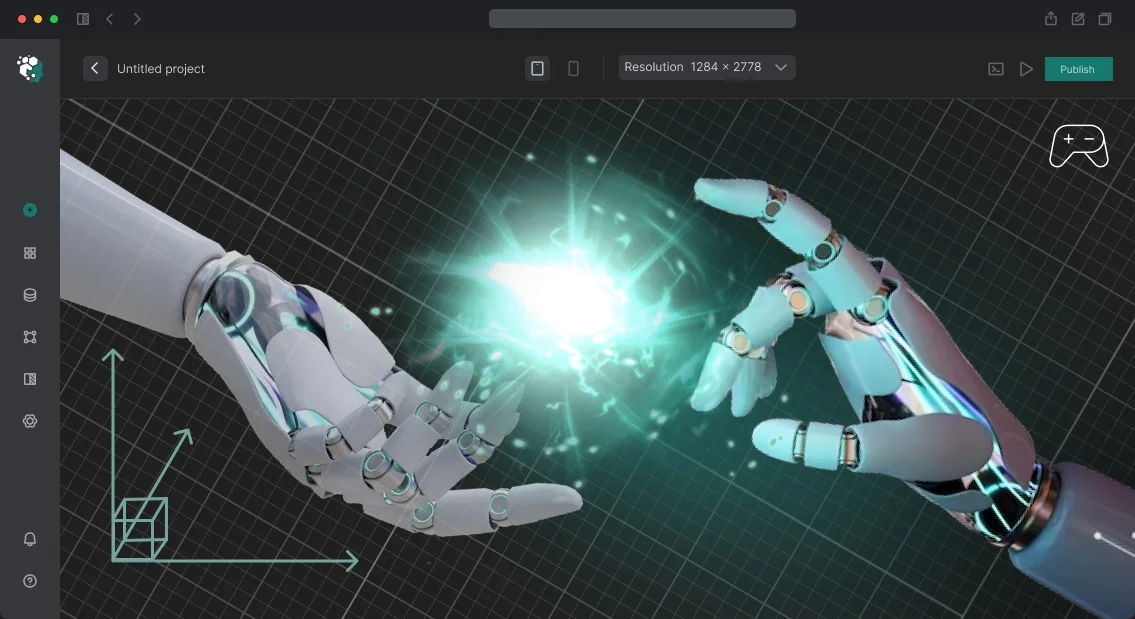
We configure server-side synchronization of VR avatars — from basic transforms to complex collisions. Hand and head positions update 72–120 times per second; without optimization, traffic for 8 players reaches 50–100 KB/s for positions alone. Achieving smooth synchronization without network overload is possible with key techniques: Dead Reckoning, quantization, authoritative server. Our certified Photon Fusion VR experts with 10+ years of experience and 50+ realized VR projects guarantee smooth synchronization. Typical implementation costs range from $5,000 to $20,000 depending on complexity.
How Does Dead Reckoning Work for Hands?
The Dead Reckoning technique comes from marine navigation and flight simulators. For VR avatars, it works like this: instead of position every frame, the client sends position + velocity + angular velocity. The receiver extrapolates the next position based on the last known state and a physical motion model. When the next packet arrives, we compare with the predicted position and correct. Dead Reckoning reduces packet rate by 10x compared to sending every frame.
In Photon Fusion VR, this is implemented via a custom NetworkBehaviour with [Networked] properties for position, rotation, and derivatives. Interpolation and Extrapolation are configured in NetworkTransform VR through InterpolationDataSource:
-
Predicted— client-authoritative prediction, minimal perceived latency for the local player -
Interpolated— delayed but smooth for remote players -
Auto— Fusion chooses depending on State Authority
For VR hands, it's crucial that Predicted mode applies only to the StateAuthority object. Remote hands are always interpolated, and latency is inevitable — the question is how smoothly it is hidden.
What Is Quantization and Delta Encoding?
A VR hand position takes 3 × float32 = 12 bytes. Rotation as a quaternion — 4 × float32 = 16 bytes. Total 28 bytes per hand, 56 for two plus 28 for the head = 84 bytes per player excluding headers. Quantization reduces this to 15–20 bytes per player — 4–5 times smaller than the original size. Quantization is up to 5x more efficient than full float transmissions. Position in the VR working area (3×3×3 m) with 1 mm accuracy encodes in 15 bits per axis. Rotation via compressed quaternion (three components, fourth restored) — 10 bits per component.
In Photon Fusion VR, quantization is enabled through NetworkTransform.Precision and RotationPrecision. For custom data, we use INetworkStruct with manual quantization via BitStream.
Delta encoding is the next level: we only transmit the change relative to the previous state. A hand that hasn't moved (player holding an object still) sends almost zero delta, compressed to a few bits. In practice for VR, this gives 30–60% traffic reduction compared to full positions every tick. Delta encoding provides 30-60% additional savings compared to quantization alone.
Client or Server Authority: Which to Choose?
This is an architectural choice with direct gameplay consequences. Client authority for hands — the position is taken as-is from the client — minimal latency, maximum responsiveness. But it opens the possibility for cheats: a client can send a "hand" to a position physically unreachable.
Server authority (Authoritative Server VR) — the server validates every hand movement against physical limits (max speed, reach zone from torso) — cheat-resistant, but requires RTT compensation for responsiveness. For VR games without competitive elements (cooperative experiences, co-op), client authority with basic server validation of anomalies is sufficient. For competitive VR — server authority with aggressive client prediction and rollback.
| Parameter | Client Authority | Server Authority |
|---|---|---|
| Latency | Minimal | Higher, requires compensation |
| Cheat protection | Low | High |
| Where to use | Co-op, singleplayer | Competitive, PvP |
Quantization implementation details in Photon Fusion VR
For manual quantization, use `INetworkStruct` with fields of type `byte`, `short` or custom structures. For example, position can be packed into three `short` (15 bits + sign) and unpacked via `BitStream.Read/Write`. Rotation — through three `ushort` of 10 bits, restoring the fourth component. This approach gives maximum control over precision and traffic.How We Solved the Handshake Desynchronization Problem: A Case Study
Our client — a studio developing a social VR space — encountered an issue: players "shake hands," but with RTT 80–120 ms, positions diverged by 5–12 cm. The handshake looked like an empty gesture in the air.
Solution: a custom snap protocol. When one hand enters the collider of another (checked on the server), the server notifies both clients of the capture event. Both clients switch to anchor mode: one becomes the leader, the other the follower. The follower interpolates its position toward the leader with Lerp over 80 ms. Visually — smooth connection without teleportation. Contact us for implementation details.
What Is Included in the Work?
We deliver a full package:
- Analysis of current network architecture and identification of bottlenecks
- Design of custom NetworkBehaviour for your mechanics
- Implementation using quantization and delta encoding
- Load testing with simulation of 100+ players
- Documentation for maintenance and future improvements
- One month of post-deployment support
- Training session for your development team
- Access to example code and best practices guide
Work Process: Step by Step
- Analysis — study the current network solution, measure traffic, determine requirements for precision and latency.
- Design — choose architecture (client/server authority), define compression scheme.
- Implementation — write code: custom NetworkBehaviour, quantization, delta coding, snap protocol if needed.
- Testing — verify at different RTT (20–200 ms), measure FPS budget, server load.
- Deployment — roll out to production, configure monitoring (logging of delays, sync errors).
Estimated Timelines
| Task Type | Timeline |
|---|---|
| Basic transform synchronization (Photon Fusion / Netcode) | 1–2 weeks |
| Traffic optimization (quantization + delta) | +3–5 days |
| Authoritative server with rollback | 3–6 weeks |
| Custom interactions (grabs, handshakes) | +1–3 weeks |
Cost is calculated individually after an audit of your architecture and requirements. Get a consultation — and we will find the optimal solution.