

Front-End Loader Operator Errors — The Main Source of Losses
Every hour of front-end loader downtime means schedule shifts, unfulfilled orders, and tense negotiations with the customer.
But the main cause of downtime isn't equipment fatigue — it's the human factor: inexperienced operators overload the bucket, don't sense the machine's dimensions, enter turns at speed, and hit racks and nearby vehicles.
Outwardly, this looks like an accidental breakdown, but in reality, it's the predictable result of improper actions.
Breakdowns hit the entire enterprise: shipments are delayed, the warehouse sits idle, and mechanics are pulled from planned maintenance into emergency repairs. The longer an employee works in the same style, the more expensive each mistake becomes.
Direct parts costs are compounded by enterprise losses: overtime, penalties for missed deadlines, mentors being pulled away from their current tasks, and loss of contractor trust.
Retraining on real equipment is difficult and dangerous: any incorrect move by a beginner can damage cargo or cause injury. Experience is passed from mentor to student, but only across a limited number of situations, and emergency scenarios are never specifically practiced.
As a result, the lack of practice shows up on the production floor, when the cost of a mistake is at its highest.
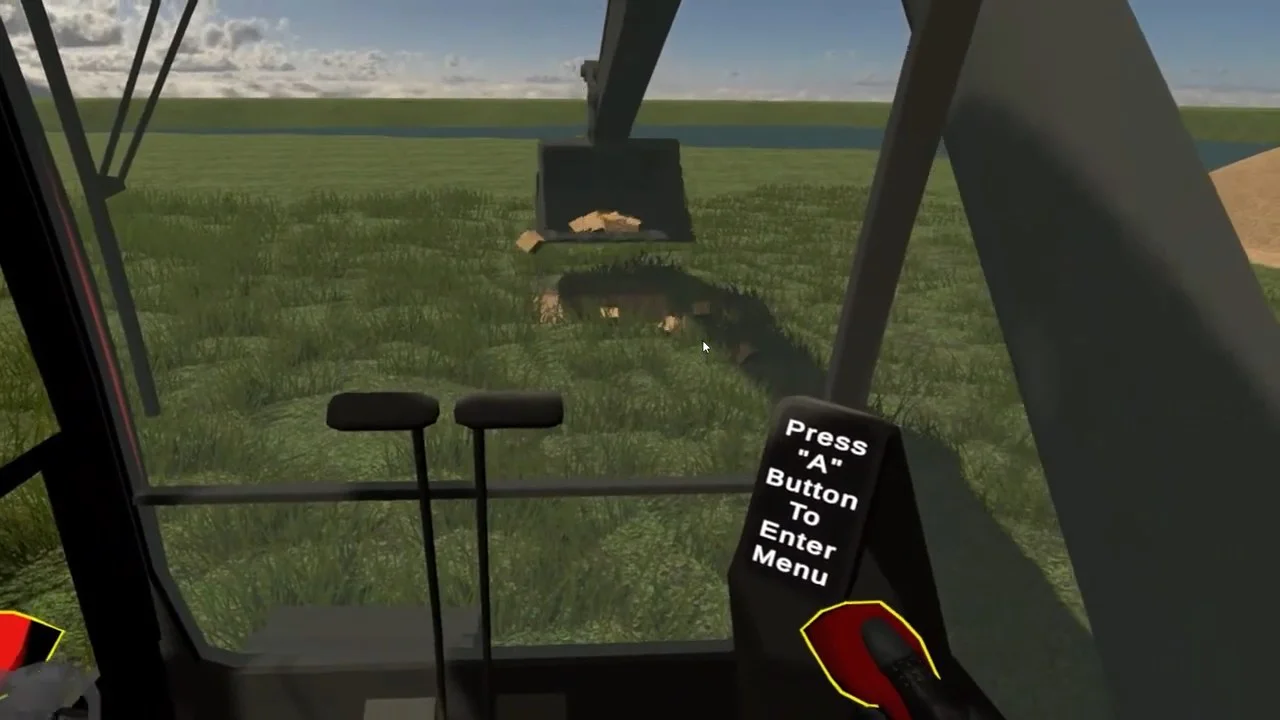
We solve this problem with a VR simulator for front-end loader operators.
It allows trainees to practice standard and emergency situations without risk to people or equipment, build muscle memory, and objectively assess an employee's readiness before they get behind real machinery.
This turns staff training from a source of danger into a controlled process that protects equipment and work schedules.
Five Reasons to Implement a VR Simulator Instead of Instruction
Traditional instruction doesn't answer the key question: is the operator really ready to work? Theory and a couple of hours at the controls don't provide confidence, and a beginner's mistakes result in downtime and risk to people.
A VR simulator closes this gap — our team helps industrial enterprises move operator training into the format of measurable skills rather than formal lectures.
Five Reasons to Implement a VR Simulator Instead of Instruction
1. Training speed is 3–5 times higher. Training in a virtual environment takes days, not weeks. An operator practices loading cycles dozens of times per shift instead of waiting in line for real equipment.
2. Reduced accident rate on the production floor. Beginners learn from mistakes without consequences for equipment or people. Each incorrect maneuver is analyzed immediately, and the skill is reinforced safely.
3. Precision of skills, not "general familiarization." The simulator records every operator action: bucket trajectory, load control, compliance with regulations. As a result, you get an objective assessment of each employee's readiness.
4. Workplace safety — without downtime. Practicing actions in abnormal situations happens in a safe environment, without blocking the work process or creating risks on the floor.
5. Measurable training effectiveness. You get data: how many cycles were completed, which errors are typical, who is ready for real machinery. Decisions about work authorization are made based on numbers, not intuition.
VR Simulator Formats for Enterprise Objectives
Enterprises approach personnel training differently: some need to train beginners from scratch, others need to confirm the qualifications of experienced operators. We select a VR simulator format for each task.
This allows you to avoid paying extra for unnecessary functionality and get results precisely aligned with your goals.
| VR Simulator Format | For Which Task | What It Gives the Enterprise |
|---|---|---|
| Basic simulator | Training beginners from scratch | Safe practice of front-end loader operation, minimal errors when moving to real machinery |
| Scenarios for standard operations | Skills enhancement | Faster work cycles, practice of loading, unloading, and working in confined spaces without equipment downtime |
| Certification module | Operator skills verification | Objective assessment, recorded results, and protocols for the HR department |
| Special scenarios | Preparation for emergency situations | Reduced accident rate, ability to act during failures and in difficult conditions |
Depending on the training stage, one format can be used or combined into a program. For example, a beginner first gets familiar with the basic simulator, then works through standard operation scenarios, and finally takes a certification exam.
This approach pays off: new employees start working independently faster, and experienced operators confirm their qualifications without leaving production and without renting a training ground.
Need a suitable simulator type — we'll help you select and implement one to match your training regulations.
Developing a VR Front-End Loader Simulator: Stages and Timelines
Industrial enterprises rarely switch from traditional training to VR all at once — they need a clear process where they can see what they're paying for and when the finished result will be ready.
That's why developing a VR trainer for a front-end loader is built as a transparent chain of seven stages: you know the timelines in advance, participate in approvals, and receive a working tool rather than an abstract "demo version."
How the VR Simulator Is Created
- Brief and task audit. We record who we're teaching and what: basic operation, standard bucket work, rare or emergency situations. We agree on goals and success criteria — this is the foundation of the future schedule.
- Planning and design. We define the exercise set, level of detail, number of training stations, and equipment requirements. We approve a plan with calendar deadlines and a detailed work schedule.
- Prototype and scenario development. We create a working version with key exercises: engine start, bucket raise and lower, load movement, actions in an emergency situation. You can already see how the training will flow.
- Approval of intermediate results. We show the prototype to instructors and future operators, collect feedback, and make revisions. All changes are recorded in a protocol — this protects project timelines and prevents endless "improvements."
- Final build and on-site configuration. We calibrate the controls and load parameters to match the customer's real front-end loader characteristics and test the simulator on a control group of trainees.
- Simulator implementation and handover. We train the instructors, hand over documentation and access rights, and help conduct the first sessions. We sign the acceptance certificate — from this point on, the simulator works for your training.
- Support and development. After launch, we support the project: updates, consultations, and scenario refinements for new enterprise objectives.
Timelines depend on the scope and complexity of the scenarios — usually from several weeks to two or three months.
The key point is that you go through the entire process of creating the VR front-end loader simulator together with us: no hidden stages, no long pauses, no surprises at the finish.
This is how VR simulator implementation becomes a controlled process where timelines, approval procedures, and the scope of work are fixed before the start — and the result is a reliable operator training tool.
What's Included in the VR Simulator Delivery and Within What Timelines
Before the start, we fix the delivery scope and timelines — you know in advance what you'll receive and when. Everything arrives in one package: equipment, scenarios, documents, and training.
- Turnkey VR front-end loader simulator: headset, controllers, operator seat or working configuration — your choice.
- Scenario library: basic operation, safety procedures, standard work cycles — loading, unloading, working in confined spaces.
- Results tracking system: automatic training reports, error statistics, operator progress dynamics.
- Full documentation: simulator passport, operating manual, methodological guidelines for the instructor.
- Warranty and support: equipment maintenance, free scenario updates for the first year.
- Installation, setup, and instructor training at your site.
A typical project takes 6–8 weeks. The first two weeks — task analysis and scenario preparation, then development and approval of intermediate versions, finishing with delivery, installation, and acceptance. The exact schedule is fixed in the contract and synchronized with the production calendar.
The simulator warranty is from 12 months, followed by post-warranty support. During this time, you'll train your first operators and understand which scenarios to add — without revising the project or making additional payments. Everything for regular sessions and certification is already included in the delivery.
Case Study: How a VR Simulator Reduced Warehouse Accidents
We implemented a VR simulator for front-end loader operators at one warehouse complex. The goal — reduce warehouse accidents, product losses, and equipment downtime.
Traditional instruction sessions had no effect: operators knew the rules, but under stress they acted the same way as before.
What We Did
Based on the customer's warehouse layout, we recreated a virtual training ground: racks, receiving and shipping zones, narrow aisles, and typical locations where damage occurred.
The VR simulator was implemented without stopping operations: employees trained for 40 minutes a day over two weeks.
Training Results
Within a month of launch, warehouse accidents dropped by 37%, and packaging damage dropped by 42% compared to the quarter before implementation. Operators became more careful on turns, stopped hitting racks, and unscheduled loader repairs decreased.
Customer Feedback
The warehouse manager called this case proof for industry that VR delivers a measurable economic effect.
Their words: "Operators themselves ask for extra training time — that never happened with regular drills." Six months later, the company ordered a second simulator to train new hires.
Result: the project paid for itself in three months — faster than we predicted. This isn't a one-off campaign but a working training system.
We're ready to give you a demonstration on your scenarios and show how a VR simulator reduces accident rates specifically at your warehouse.
How to Choose the Right VR Simulator Format for Your Task?
Choosing a VR simulator format for a front-end loader starts not with technical specifications but with the task: who we're teaching and what.
Beginners from scratch, retraining experienced operators, practicing rare situations — each scenario needs its own configuration, and a mistake costs time and money.
Start with two questions: who will train (beginners or experienced operators) and where the sessions will take place (training room, training ground, on-site).
If the course is needed for practice before operating real machinery, a full-scale simulator with a cab and visibility matching the loader is optimal.
If the goal is to maintain skills and assess performance, a compact VR setup that can be deployed in a regular classroom is sufficient.
The next step is estimating session frequency and the number of trainees. When dozens of people go through the equipment each month, reliability and ease of session startup matter most; for rare sessions — a mobile system that can be set up in half a day.
Don't overpay for options that aren't used, but don't skimp on what affects safety and control realism.
Separately, look at which VR equipment suits your facility and occupational safety requirements. For open areas — protected controllers and portable power supplies; for a fixed classroom — a station calibrated to operator height.
We help select a VR simulator that fits your budget and are ready to show it in action on a test scenario.
For the customer, the takeaway is simple: choosing a VR simulator isn't buying "hardware" — it's choosing a solution for a business result. Come with a description of your task — we'll advise which format will cover it faster and what you need for launch.
FAQ: Customer Questions About VR Simulators
Before ordering a VR simulator for a front-end loader, every manager asks the same questions: will the simulator work with existing equipment, who is responsible for uptime, how often are scenarios updated. This is normal — the simulator should fit into the training process, not create new problems.
We've been developing VR simulators for industrial enterprises for a long time and don't divide questions into "simple" and "complex." We give an honest answer to each — with timelines, areas of responsibility, and update terms. Below are the most frequent ones; we'll send the full list after clarifying the details.
What warranties do you provide for VR simulator functionality?
We are responsible for stability: after launch, the simulator runs on the customer's equipment without failures. We perform commissioning, train instructors, and provide an official warranty on all modifications.
Scenario updates are available on request. If a technological map changes, we add new exercises and reflect the changes in reports. Equipment requirements are defined in advance and verified on your hardware before operation begins.
Let's Discuss Developing a VR Simulator for Your Enterprise
Let's discuss how a VR simulator will fit into your production and which tasks it will cover. Start with a free audit of your training system — we'll review current processes, growth points, and show where a simulator will deliver fast results.
What you get when you contact us:
- Free training audit: we identify where employees lose time and make mistakes.
- Implementation consultation: we'll advise which VR training format suits your enterprise.
- Project costing: a transparent estimate tailored to your tasks and number of employees — no hidden payments.
- Capability demonstration: examples of simulators for front-end loaders and related specialties.
- Benefit calculation: we explain what a VR simulator saves on — less downtime, fewer accidents, and less waste.
- Clear work plan: timelines, stages, and responsible parties — you know what you receive and when.
- Support at all stages: from the first call to launch and ongoing support.
We work remotely across the country and have been creating simulators for industrial enterprises for over 10 years. During this time, we've refined the process so you get results predictably — without missed deadlines or launch surprises. We use professional equipment, so the simulator will run stably in your conditions.
Leave a request on the website — we'll get back to you within one business day, answer your questions, and propose concrete next steps.
We'll discuss your project, calculate the budget, and help you decide whether to start with a pilot simulator or implement a comprehensive solution for the entire equipment lineup.