

Why does tractor operator training require a VR simulator?
Traditional tractor operator training on real equipment is always a compromise between safety and training time. A beginner behind the wheel means a risk of damage to expensive machinery, accidents on the yard or in the field.
Every hour of practice means fuel consumption, component wear, and instructor fees, so a full course costs the enterprise significant sums.
But even after such training, the operator starts work without experience of emergency situations: hydraulic failure, difficult weather conditions, waterlogged soil. All of this has to be mastered during actual operation, which leads to downtime and additional costs.
Industrial simulators allow such scenarios to be practiced in advance — in a safe virtual environment where a mistake doesn't cost money.
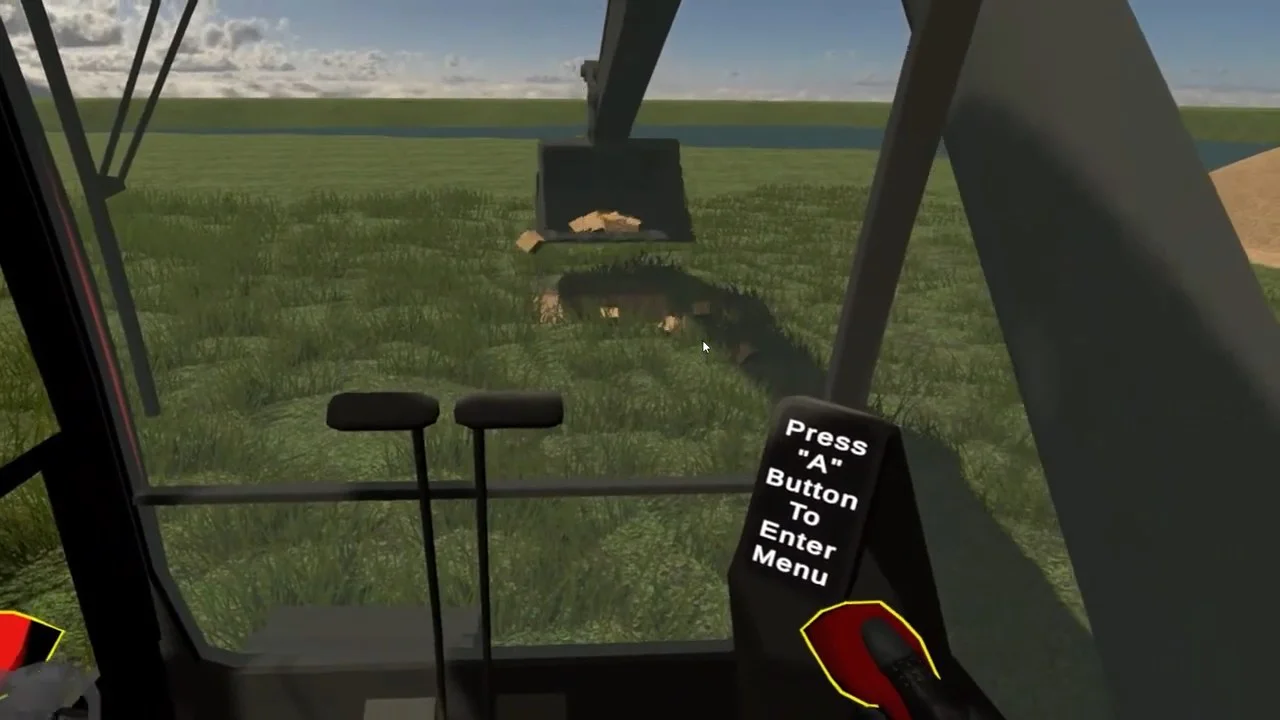
A VR tractor simulator creates full immersion: a realistic cab, controls, landscape, and machine reactions. The operator gains muscle memory and confidence before the first trip on real equipment. This cuts the commissioning time several times over and reduces fuel and repair costs.
We develop such solutions for the specific tasks of each enterprise — from standard training to practicing rare emergency scenarios.
Find out how a VR tractor simulator can reduce your production costs: leave a request, and we will send you a cost calculation for your equipment fleet.
What benefits does an enterprise get from a VR simulator?
Implementing a VR simulator pays off not as a "toy" but as a cost-reduction tool. When an operator trains on a virtual copy of real equipment, the enterprise gets measurable results: fewer accidents, higher output, lower fuel consumption.
Below are the key effects noticed by operations departments and financial divisions of industrial companies.
| Benefit | How it shows | What the enterprise gets |
|---|---|---|
| Fewer accidents | Emergency situations practiced without risk to people or equipment | Less downtime, fewer repairs and insurance claims |
| Higher productivity | Skills are honed to automaticity before heading to a real site | Faster ramp-up to target KPIs, stable shift performance |
| Savings on fuel and equipment | Training happens without fuel consumption or machine wear | Lower variable costs for staff training |
| Skills standardization | All operators practice the same scenarios and assessment criteria | Consistent training level, predictable results |
Proven in practice: enterprises using VR training cut the time to bring a new employee up to speed by 30–40%, and the number of equipment-handling errors drops by half.
That is why the benefits of VR simulators are measured not by "wow effect" but by payback periods and reduced operating costs.
To get such a result, the simulator needs to be tailored to your equipment and procedures. We build a VR tractor simulator around your work scenarios and assessment criteria — that is what makes training effective, not just a demonstration of capabilities.
VR tractor simulator formats: for any task
Every plant faces different operator training needs and different learning objectives. Some need to introduce a newcomer to the tractor cab; others need to refine responses to emergency situations.
That is why we offer several VR simulator formats: from a compact solution to a full complex with automated skills assessment.
| Format | For whom | What the client gets |
|---|---|---|
| Compact VR simulator | For training classrooms and CPE programs | Quick familiarization with controls, low entry threshold, mobility |
| Stationary simulator with operator cab | For regular operator training | Full immersion, muscle memory, scenario practice without risk or equipment downtime |
| Complex with skills assessment system | For certification and quality control | Objective reports on each student, transparent statistics, less time spent on checks |
We help you choose the format for your tasks — from one-off training to a permanent training center. Implementation takes from two weeks, and training materials and support are included. We work on professional VR equipment, so results are stable.
By contacting our team, you will get a simulator that fits into your current training process and pays for itself through fewer accidents, lower fuel consumption, and less equipment downtime.
How VR simulator development works: stages and control
Developing a VR simulator for your tasks is not buying a "box" but a collaborative effort with a clear plan. We have refined the process so you can see results at every step and understand what you are paying for.
Stages and control
- Brief — we break down your task: who we are training, which operations to practice, which production mistakes cost the most.
- Scenario design — methodologists and 3D graphics specialists create the concept for the future simulator: scenarios, interface, difficulty levels.
- Mockup approval — we show how the simulator will look and operate. All edits are made before the main stage starts — that's faster and cheaper.
- Development — we build the graphics, logic, and integration with professional equipment. You receive intermediate versions and see progress.
- Testing — we run the simulator for bugs together with your specialists. We check usability and scenario completion times.
- Launch and training — we install the system, configure it, and train instructors.
- Support — we stay in touch: update scenarios, adapt to changes in your processes.
Simulator development timelines
Timelines and costs are fixed at the brief stage and don't change afterwards. The base version of a VR simulator takes 6–8 weeks — the exact timeframe depends on the complexity of the scenarios and the equipment that needs to be modeled. You always get short reports and clear milestones instead of endless calls.
What is included in a VR simulator delivery
When you order a VR simulator for tractor operator training, it's important to understand that the package includes not just a program but a fully ready-to-use solution.
The delivery includes everything needed to launch training from day one: from equipment to training for your instructors. Here is exactly what you get.
- Professional VR equipment — headsets, controllers, and stations assembled into a single integrated complex. It arrives configured and tested, so your staff don't waste time on setup and calibration.
- Simulator license — perpetual right to use with updates to working scenarios. You're not tied to a subscription and can train an unlimited number of operators without extra fees.
- Training materials — ready-made training programs, instructions, and assessment sheets. The instructor doesn't have to build scenarios from scratch — just open the material and run the session.
- Instructor training — we teach your specialists to work with the system: how to launch lessons, track results, and review student errors. This removes dependence on the developer.
- Warranty and technical support — equipment maintenance and software updates during the warranty period. If anything needs adjustment, you get help remotely or via a scheduled service visit.
This delivery package lets you launch training immediately after installation. The simulator package covers everything from first power-on to skills assessment — you don't need to find contractors for individual pieces.
The key point: delivery is not a "box with a headset" but a complete training tool. The manual, license, and support ensure transparent operations: you know who trained for how long and which skills have been practiced.
If you later need to add a new scenario or model your own site — that can be done separately, but the base will already be ready for expansion.
Case study: how a VR simulator cut operator training costs
At one agricultural holding in the Volga region, seasonal operator training took up to two weeks. Each newcomer worked on real equipment, consuming fuel and risking damage to expensive tractors.
Training depended on the weather and the availability of a free machine — schedules slipped, and inexperienced operators came to the sowing season.
We proposed a VR simulator for practicing core operations instead. AgroProm agreed to a pilot project: four modules (driving, hitch, turns, emergency situations) and five workstations.
Results were measured after two months. Operator training time dropped by 30%: basic skills were practiced in VR, and trainees moved to real equipment with a steady hand. Fuel consumption at the training stage fell by 20% — the tractor was used only for final run-in.
Safety also improved: incidents involving newcomers dropped to zero because dangerous scenarios were practiced without risk.
The client's management also appreciated that the simulator trains several people at once and keeps objective progress statistics. That sped up certification and simplified quality control.
Six months later, the agricultural holding ordered an expansion of the complex for other equipment — the follow-up project was launched with minimal adaptation.
This case shows: a VR simulator pays off not "someday" but in the very first season. You cut fuel and depreciation costs, speed up staff onboarding, and reduce risks. That is why enterprises that have tried this format rarely go back to traditional schemes.
How to choose the right VR simulator format?
Choosing a VR simulator format for tractor training starts with two questions: how many people need to be trained and how specific the equipment is.
For a few operators, a single workstation with a professional headset is enough — it pays for itself by practicing key skills without fuel consumption or breakdown risk.
For regular training of dozens of employees, it makes more sense to build a VR classroom with several modules: this allows groups to run without downtime and quickly repeat the program for new workers.
Equipment specifics also shape the format. Modern tractors differ in controls, attachments, and digital systems, so the scenario needs to replicate your actual machine. If you have multiple models, choose a universal simulator with switchable configurations.
If you train on one product line, build a specialized simulator that reproduces your exact controls. In both cases, the main criterion is practical value: after training, the operator should confidently get into a real tractor.
A third factor is training goals. For initial training and certification, you need a system with error tracking and a final report for each student.
For advanced training of experienced drivers, modules with emergency scenarios work better: hydraulic failure, difficult weather conditions, emergency braking. The more realistic the scenarios, the faster the employee transfers skills to everyday work.
We help you choose a format before development starts: we analyze the number of trainees, your equipment fleet, and the training program, then propose a solution that delivers maximum results in your conditions.
Come with these inputs — we'll match you with a simulator that pays off and won't need rework six months down the line.
Frequently asked questions about VR simulator implementation
Implementing a VR tractor simulator often raises the same questions — from cost to integration complexity. That's normal: any new equipment must deliver measurable results. Here are answers to the main objections we hear from enterprise managers.
How much does it cost and when will it pay off?
The cost is comparable to a few hours of equipment downtime or one repair operation. At the same time, a VR simulator reduces fuel consumption, machine wear, and the risk of accidents — savings show up in these line items within the first season. In most projects, payback comes in under a year.
Is it difficult to integrate the simulator into current training?
No production restructuring is required. You need a standard computer and a headset — everything else is included in the package. Instructors learn the system in a couple of days, and we handle scenario configuration for your needs. The simulator can be used for both initial training and annual skills checks.
Is it safe for employees to work in VR?
On the contrary, a VR simulator makes training safer. Practicing emergency situations, difficult weather conditions, or extreme maneuvers happens without risk to people or equipment.
No trips to the field and no downtime — the worker gains experience that in reality would be expensive or impossible.
If you have remaining questions about timelines, facility requirements, or adapting the program to a specific tractor model — send a request, and we will prepare a cost calculation for your conditions. The consultation is free and comes with no obligation.Order VR simulator development for your enterprise
Every production task is unique: one enterprise has its own equipment and procedures, another has its own risks and training regulations. That is why a ready-made "off-the-shelf" solution often doesn't work the way you need.
We offer custom VR simulator development that replicates your exact processes and equipment — from tractors to complex production machinery.
How does the work start? After your request, you get a clear roadmap with no hidden stages:
- Free consultation — we discuss your task, training goals, and constraints.
- Workflow audit — we identify which skills need to be practiced first.
- Project estimate — timelines, simulator scope, and budget, without unexpected extra charges.
- Solution presentation — we show the scenario, simulator appearance, and training methodology.
- Approval and phased development — you see results at every stage.
- Testing with your employees — we verify usability, realism, and effectiveness.
- Launch and support — we integrate the simulator into your training schedule, train instructors, and stay in touch.
This way, you make a decision based on a concrete plan, not abstract promises. You know in advance what you will get, in what timeframe, and how it will affect staff training speed and accident rates.
Submit a request — and after a short conversation you'll understand whether this format fits your needs.