

VR Training for Customer Service: Why Do Clients Leave?
Every fifth client leaves not because of the price or product quality, but because of how employees talk to them. An uncertain answer, a long pause, an inability to handle an objection—and the person is already looking for an alternative from competitors.
For a business, this is a direct loss of revenue, often an invisible one: everything seems fine, but sales are falling.
The problem is that classic training (lectures, presentations, tests) does not build a skill. You can know the rules but act differently in a stressful situation: get flustered, interrupt the client, offer a template solution instead of real help.
Theory is forgotten in a few weeks, and the skill of communicating with a real client remains unpracticed.
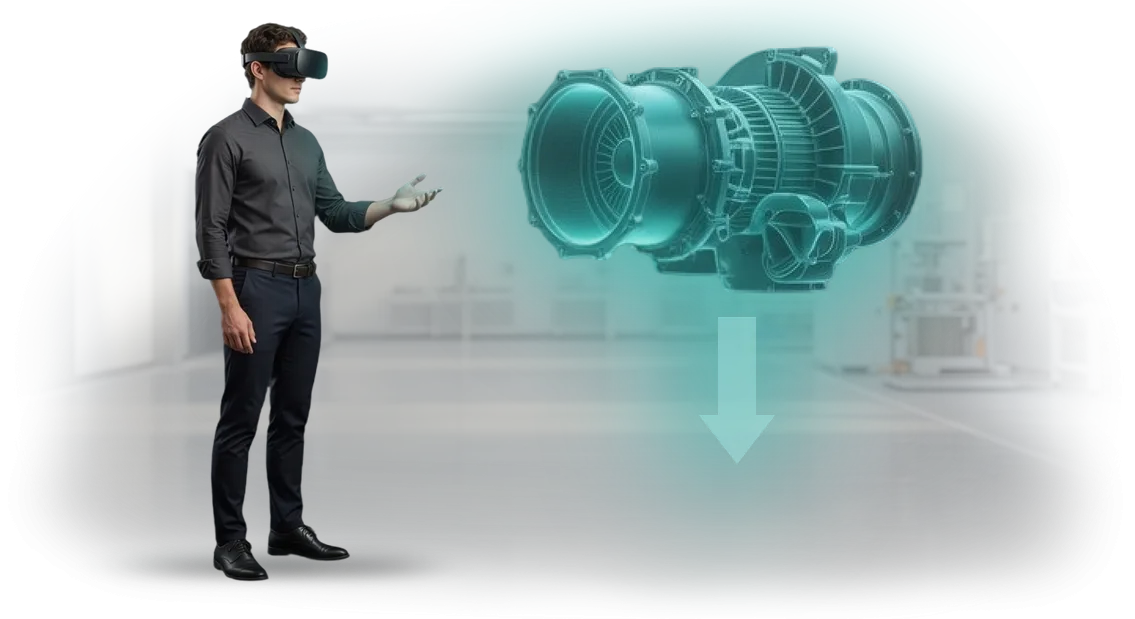
VR simulators change the approach: an employee enters a realistic dialogue with a virtual client and learns to react correctly in a safe environment. A mistake does not cost the loss of a real client—it can be calmly analyzed and corrected right away.
Scenarios can be adjusted to a specific business: an aggressive client, a doubting one, a talkative one, a client with a complaint—everything is practiced until it becomes automatic.
As a result, an employee comes to the real line with an already formed skill, not with abstract knowledge. This leads to higher repeat sales, increased loyalty, and fewer missed orders.
These are exactly the simulators we develop for customer service teams—we analyze your real cases, put them into scenarios, and refine the solution to meet revenue and service-level goals.
What the Immersive Format Delivers: Reaction Speed, Loyalty, and Larger Tickets
An employee who faces a conflict client for the first time gets lost: while they recall the script, the customer gets annoyed and leaves.
In regular training, the situation is played out with roles, but without real stress and responsibility for the result—so the skill is not cemented.
Immersive training solves this: the employee practices handling objections, urgent requests, and difficult negotiations as if it were happening for real.
After 3–4 short sessions, the scenario becomes automatic: reaction speed increases, mistakes become fewer, and clients feel cared for. Below is what exactly changes in the business and what results this format delivers.
Customer Loyalty and Repeat Inquiries
A negative experience with an employee costs the business not only the current purchase but also future ones—the client goes to competitors and shares their impressions.
An employee who has completed VR training is more confident in defusing emotional tension and solving the problem on the spot. A satisfied customer leaves more repeat orders and brings acquaintances—this is direct savings on advertising and acquisition.
Larger Ticket Size and Service Quality
Immersive training makes it easy to practice upselling and courteous service: offer an additional service, replace a product with a more suitable one, set up a loyalty program. This skill directly increases the average ticket. Bonus: fewer returns and conflicts that take up a manager's time or require compensation.
Speed of Onboarding for New Employees
Newcomers do not need to listen to lectures and read regulations for months. A few immersions into key scenarios are enough to start on real tasks without losing quality. This cuts the time to full productivity from weeks to days.
As a result, vacancies are filled faster, the load on mentors is lower, and staff turnover decreases.
A Realistic Format Employees Like
Employees are more willing to take training that requires action instead of note-taking. Because of the sense of presence, the material is remembered more deeply than when watching videos or scripted games.
Also, this format requires no special skills—just a standard VR headset, and our experts create instructions tailored to your business area.
Our engineers use modern development environments and professional equipment—this ensures stable scenario performance on any device the client already has.
Would you like to discuss implementing VR training in your company? Leave a request—within 2–3 days we will prepare scenarios for your tasks and calculate the cost.
Immersive Training Formats: From Onboarding to Complex Negotiations
Immersive formats solve what lectures cannot: the employee does not read an instruction but experiences the situation from the inside.
VR training immerses them in a dialogue with a virtual client; AR training brings hints directly into the work area—the skill is cemented in days, not months.
We use three format groups—from a newcomer's first day to complex negotiations. The table shows typical scenarios.
| Format | For Whom | What It Delivers to the Client |
|---|---|---|
| VR Onboarding | New employees | Quick entry into service standards without a mentor |
| VR Dialogues | Line staff and managers | Practice with difficult clients without risking reputation |
| AR Instructions | Production and warehouse staff | Fewer errors when working with equipment |
| Mass VR Training | Branches and hundreds of employees | A single quality standard across all locations |
For example, for the Vygoda hypermarket chain we implemented VR training on handling conflict customers: within two weeks, employees from all key stores completed it, and the number of repeat service inquiries fell by a third.
The same scenario can be scaled to negotiations with contractors, product presentations, and work under stress.
Importantly, the client does not need to understand the technology. We select professional equipment for the task, write scenarios with methodologists, and support the launch.
After that, the training works autonomously: when a regulation or product changes, you simply ask for the scenario to be updated—no new purchases required.
How We Implement Training: Stages from Brief to Launch and Support
We have structured the VR training implementation process so that it is transparent at every step: you always know where the project stands, what comes next, and when results will appear. No surprises and no long pauses—from the first conversation to launch, we follow an agreed plan.
- Brief and task immersion. We discuss what skills need to be trained, in which situations employees most often struggle, and what result you expect from the training. At this stage, we find the points where service speed and customer loyalty are currently being lost.
- Plan and approval. Based on the brief, we put together a plan: scenarios, timelines, cost, and delivery milestones. You receive a clear estimate and schedule—no hidden work or unexpected extra payments.
- Scenario and content development. Together with your experts, we create realistic dialogues and situations: from standard inquiries to complex conflicts. Employees learn to act correctly in a safe environment without risking relationships with real clients.
- Pilot build and testing. We show the working version to your employees—they go through the scenario and give feedback. We make edits before the training goes into broad use.
- Training launch. We connect the required number of employees and provide a short briefing. Training starts at a convenient time and does not interrupt work processes.
- Support and evolution. After launch, we monitor results: we see where employees succeed and where they make mistakes. On request, we update scenarios for new products, regulations, or types of objections.
This approach has already proven itself: teams complete training on time, and managers get a measurable result—fewer communication errors, faster reaction speed, and more confident employees. We stay with you after launch, so the training evolves together with your business.
What the Project Includes: A Kit for Quick Start and Growth
When you order VR training for customer service, you get not a “box” with code but a working tool that can be implemented immediately. The kit includes everything needed to launch training in the first weeks and scale it without constant involvement from the contractor.
- Ready-made training scenarios. A library of dialogues for typical situations: handling objections, difficult clients, upselling. The scenarios are already adapted for VR—launch them right away or use them as a basis for your own.
- Access to the VR platform. Employees take trainings on any compatible device—no need to buy expensive equipment or hire a separate administrator. The platform manages sessions and updates on its own.
- Training analytics. You see how many people have completed the course, which skills are polished, and which cause difficulties. Data is collected into convenient reports: by group, branch, or individual employee.
- Instructions for launch. Step-by-step guides for administrators and users: how to start, what to do in an unusual situation, how to read results. Implementation requires no technical background.
- Admin training. An online session with your team: scenario setup, adding new employees, working with reports. After that, you fully manage the process yourself.
- Support at the start. For the first weeks, we assign an engineer who helps with launch and answers questions. You are not left alone with a new system.
In the end, you get not just a VR application but a system that pays off quickly: employees reach quality service faster, clients stay satisfied, and you save time and budget on constant work with developers.
Result: How a Hotel Chain Reduced Service Losses
The main thing in staff training is not the number of hours but the change in behavior at the front desk. Errors in service standards result not only in dissatisfied guests but also in real write-offs: compensations, discounts, lost repeat bookings.
That is why we measure training results in money and repeat visits, not in the number of lectures attended.
Case Study: The Oasis Hotel Chain
The hotel chain Oasis approached us with the task of reducing service losses.
After an audit, it turned out that employees knew the standards but acted on their own in stressful situations—they handled complaints incorrectly, forgot about additional services, and lost up to 15% of the potential ticket on each check-in.
We developed VR training based on real front-office scenarios: a conflict guest, check-in with an overcrowded parking lot, a request to upgrade the room category. Each employee went through the scenarios in a safe environment and received error analysis.
After a month, the company saw the first results: the number of service complaints fell by 38%, and the share of repeat bookings increased by 12%.
The service department head noted: “We used to spend months on mentoring and still ended up with inconsistent standards at the reception desk.
VR training gave everyone, even newcomers, the same high level of service, and preparation time was cut in half.” In addition, the program’s return exceeded its costs within four months: guest compensations decreased, and upsales of excursions and business breakfasts grew.
For us, this case is a benchmark: we do not simply hand over technology—we design training around the client’s task. Guests do not know that the staff trained in VR, but they return and recommend the hotel—which was exactly the client’s goal.
How to Choose a Training Format for a Specific Task?
The training format is dictated not by technology but by the business task you are solving. If an employee needs to practice behavior in a stressful situation—for example, a conversation with an unhappy client or actions during an emergency—they need to be inside the scenario.
This is exactly what VR provides: a person is immersed in a realistic environment and acts as they would in real life, not according to a paper instruction.
For other tasks, augmented reality is more effective, when information is overlaid on the real world.
This helps employees get up to speed faster on new equipment, maintain merchandising standards, or follow a procedure directly in the workflow—without turning to notes and diagrams. AR is convenient for on-the-job support where every step matters.
In our practice, the choice of format always starts with an audit of the task. We look at what exactly needs to change in employee behavior: teach them to make decisions faster, practice difficult dialogues, or memorize long procedures.
Based on that, we propose a training format that will deliver results faster and cheaper than classic trainings. This allows you not to spend your budget on flashy but non-working technologies.
We select the scenario so that it solves a specific task—whether it is increasing conversion, reducing the number of errors, or raising engagement in learning.
So the choice is not about what is trendier but about what is more effective. Come with a task, not with a request to “implement VR.” Tell us where your customer service most often fails—together we will determine the right format that pays off and takes root with the team.
Common Doubts and Answers Before Launching a Project
Before launching VR training, managers tend to have the same doubts: how much it costs, how to integrate it into current processes, and whether employees will refuse to work with new technology. We answer the main questions—briefly and to the point.
How expensive is it to implement VR training, and when will it pay off?
The cost consists of scenario development and equipment selection. We offer options for different budgets: use existing devices, rent kits, or start with a pilot project on one team.
Payback comes from reducing errors in customer communication and accelerating newcomers’ path to full results—usually in 3–6 months.
How can VR trainings be integrated into the existing training program?
VR does not replace current training; it adds the practical part that is difficult to practice in a classroom. We integrate the module into your learning management system or launch it as a separate block—employees go through the scenario at a convenient time. The dialogue content is aligned with your customer service standards.
Is it difficult for employees to work in a headset, and is ongoing support needed?
The interface is designed for people with no experience: put on the headset, listen to a short instruction, and start the dialogue. We configure the equipment in advance, and our engineers support the first sessions if needed. After that, employees work independently, and technical support remains available.
What if the equipment breaks down and training stops?
We work with proven equipment and provide a replacement kit for the repair period so the training process is not interrupted. We also give recommendations on storage and maintenance—this extends the devices’ service life and minimizes downtime.
Text update: if necessary, change the wording to better reflect the specifics of your field. The ready-made block can be placed on the page as is.
Ready to Get Results? What Happens After Your Request
Leave a request for the service, and we will contact you the very next day to discuss your task.
The first conversation is free and non-binding: you briefly tell us about your current training, we clarify your goals and point out where VR and AR will have the maximum impact on service, sales, and employee onboarding speed. Right after the conversation, you will receive a cost estimate and a plan for next steps.
We do not “sell a picture.” Over the years, we have completed dozens of implementations, so we speak honestly: what will really pay off in your case, and where you can save. If the project is not right for you, we will say so directly.
If it is right, we will prepare a solution for your timeline and budget, without breaking agreements.
After your request, you receive:
- a consultation with our training expert—no technical jargon, in the language of your business metrics;
- an analysis of your current training program and growth points: where customer service quality is lost, and where employees take too long to learn;
- a preliminary cost and timeline estimate—a clear range, not a “price on request”;
- examples of similar projects and their results, which you can immediately apply to your task;
- a plan of next steps: what is needed from you, what we take on, and when the first results will appear;
- support at all stages—from the pilot launch to scaling across all branches or teams.
You can start with a short call or email—that is enough to see the project’s potential. Leave a request for the service, and within one business day we will prepare an estimate and concrete solution options. Then you decide: we start together or stay in touch until a better moment.