


VR STEM Training: When You Need Simulators but Can't Afford Risk
Every wrong step on real equipment costs dearly: spoiled raw materials, broken machinery, injuries, and emergency shutdowns. In such conditions, employees are afraid to act independently and learn from others' mistakes, which cost the company significant sums.
Classic lectures and safety briefings, meanwhile, don't provide the most important thing—experience in decision-making under stress when the cost of an error is high.
Lack of practice is especially noticeable in STEM fields: chemistry, physics, electronics, engineering. There, every exercise demands precision, and the consequences of carelessness can be measured not only in money but in people's health.
Managers face a choice: let newcomers near expensive equipment at the risk of losses, or endlessly postpone real tasks, losing momentum and team motivation. In the end, both safety and productivity suffer.
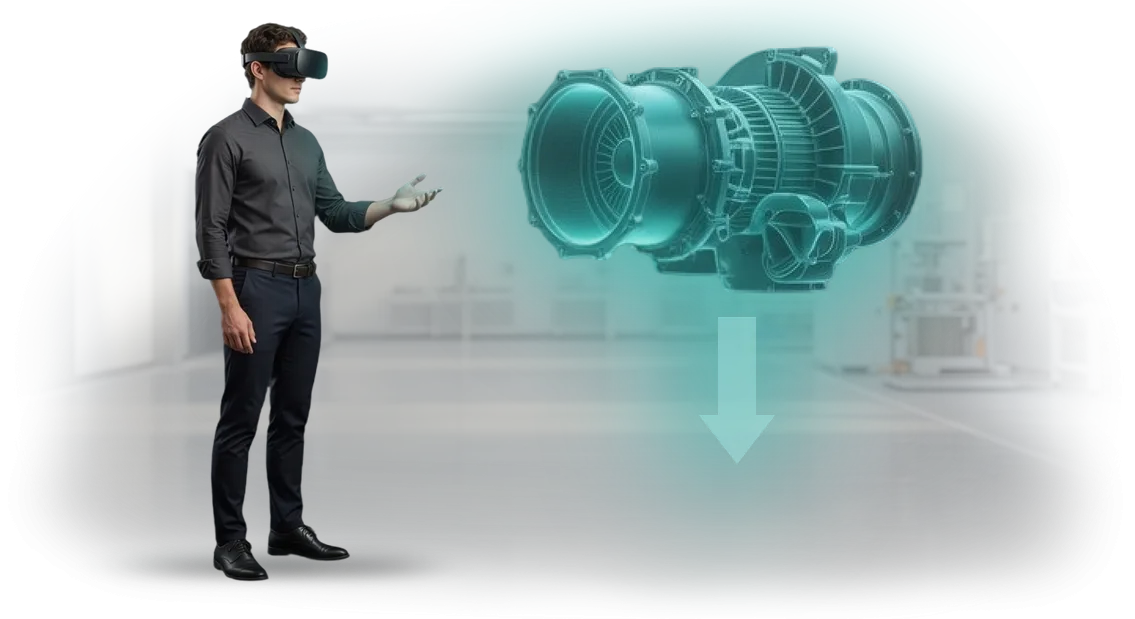
VR STEM training closes this gap. Virtual laboratories allow employees to practice complex scenarios as many times as needed—without risk to people, materials, or equipment.
An employee gets hands-on practice in a safe environment and then confidently transfers those skills to real work. Mistakes become part of employee training rather than a cause of losses and downtime.
That's why VR STEM training is becoming a corporate standard: it combines safe practice with realism unattainable for ordinary screen-based simulators. The company reduces costs on rework and equipment repair, while people reach the target skill level faster.
Managers get predictable work quality and peace of mind about every process, knowing the team acts confidently and deliberately.
What VR and AR Training Brings to Business
Employees learn faster when they can immediately apply a skill in practice rather than just listen to theory. VR and AR let them practice actions in an environment as close to reality as possible—up to 2–3 times faster than classic training.
This means a newcomer reaches the required level of readiness in weeks, not months, and starts delivering value to the business sooner.
Companies save on materials, consumables, and organizing training sites. Errors no longer lead to spoiled raw materials or equipment downtime: an employee trains in a virtual environment where the cost of an error is simply another attempt.
After launching a VR program, training costs per person drop by 30–50%, while the quality of preparation remains stable regardless of the instructor's experience.
Employee engagement is another growth area. An interactive format holds attention better than lectures, and gamification adds healthy excitement: employees themselves strive to perfect a scenario.
High engagement directly affects retention—up to 80–90% of the material stays in memory after several months, whereas after passive formats that figure usually doesn't exceed 20–30%.
Another plus is reproducibility of results. All employees go through identical scenarios, so skill quality levels across the team, and the training process becomes predictable and measurable. A manager always sees who is ready to work independently and who needs more practice.
Additionally, VR solutions support brand recognition: a modern approach to training makes the company more attractive to new employees and partners.
We implement such programs turnkey—from scenario design to launch and support—so you get a ready-made tool, not a "raw" technology.
VR STEM Training Formats for Your Task
There is no universal VR solution for every task: one thing is practicing actions in a virtual laboratory, another is getting a hint right on real equipment.
The choice of format determines how quickly employees begin using skills and how much you save on errors, consumables, and downtime. We design training around your specific task—from a short AR briefing to a full immersive virtual course.
The table below shows three basic formats that cover almost all typical tasks when creating VR STEM training. They differ in immersion level and venue: simulator practice, in-the-moment guidance, or a combination of both.
| Format | Who it's for | What it gives the client |
|---|---|---|
| Full immersion (VR) | Employees who need to practice rare, dangerous, or expensive operations | Safe practice without risk or downtime—the skill is drilled to automation before working with real equipment |
| Augmented reality (AR) | Field staff, repair technicians, line operators | Step-by-step instructions directly on the object: the employee sees prompts and acts without errors, reducing task time |
| Mixed format (VR + AR) | Teams that need to link theory with practice | A unified system: theory in a virtual environment, then application on real equipment with AR prompts |
The choice of format is driven by business results: employee speed to full productivity, defect reduction, safety, or lower material costs.
At a consultation, we'll show which VR STEM training scenarios suit your situation and offer a pilot—a module for a test group—so you can see the effect before scaling.
How We Create VR STEM Training: From Brief to Launch
We've structured the development process so that the client feels at ease at every stage. You always know what's happening, what the deadlines are, and what you'll get in the end.
No "magic": first we agree on the scenario, then we develop it, and only after successful testing with your employees do we launch the simulator.
- Brief and goals. We break down your task: who we're training, which skills employees should practice, and what metrics define success.
- Scenario and methodology. We turn goals into a learning storyline: modules, exercises, difficulty levels, and evaluation criteria. You see exactly how training will unfold.
- Project approval. We present a detailed plan and interface mockup before development starts. We make changes while changes are still inexpensive.
- VR simulator development. We build a working prototype and improve it iteratively. Every few days you receive an updated version and see progress.
- Pilot testing. We run the simulator with a group of your employees. We collect feedback, measure completion time and errors, and refine the scenario.
- Launch and deployment. We hand over the finished simulator, connect instructors, and integrate training into the workflow. Employees start without delays.
- Support and growth. We train your team, update scenarios for new tasks, and support the simulator after launch. You're never left alone with the technology.
On average, a project takes 6 to 10 weeks—exact deadlines are fixed in the contract. At the end, you get not a "raw demo" but a working training tool that delivers results immediately.
What's Included in the VR STEM Training Delivery
We deliver not just a VR program but a complete working package for launching employee training.
Everything is tailored to your tasks: scenarios, content, documentation, and rights—so after delivery, your team can immediately run sessions and continue supporting them without our constant involvement.
- VR scenarios tailored to your tasks—practice of production operations, safety procedures, quality standards, or customer service. The scenarios model real situations in which an employee trains skills without risk or spending on consumables.
- A complete set of training materials—methodological guides for instructors, handouts for employees, and result assessment checklists. You get not a "bare" program but a training course with built-in knowledge-control logic.
- Integration with your learning platform—completion results and statistics for each employee flow into your records system. A manager sees progress, and the training department sees bottlenecks without manual data collection.
- Instructions and documentation—a simple startup guide, content update procedures, and descriptions of standard troubleshooting actions. All technical information is written for a manager, not only for an engineer.
- Training for your team—we run a session with administrators and instructors: how to launch sessions, work with reports, and embed VR training into the existing schedule.
- Unlimited-time usage rights—you receive a perpetual license for the created scenarios and content. No rental with monthly fees and no risk of losing access to materials.
- Support at the start and fast launch—we help set up equipment, run the first pilot groups, and collect feedback. After launch you work independently, and we remain available for consultations.
Case Study: How VR STEM Training Reduced Chemical Production Costs—Annual Savings Calculated After Audit
In chemical production, the cost of an error is high: a lab assistant's or technologist's incorrect actions lead to line downtime, spoiled raw materials, and sometimes even an accident.
Training, meanwhile, stretches over months—trainees work under supervision, and some tasks are simply not entrusted to them until they gain experience.
We changed this approach for a regional chemical manufacturer—let's call it KhimProm.
Instead of briefings and working with real reactors, we launched a VR STEM training program: a technologist wearing a headset practices the full cycle of a laboratory workshop—from sample preparation to responding to an emergency.
An error in VR doesn't cause a loss, but it stays in the statistics and lets the trainer work on weak points.
We measured the results a year later. Training costs for process personnel decreased by cost calculated after audit per year—thanks to reduced scrap and downtime among newcomers.
The number of human-factor incidents fell by half, and the average time for a technologist to reach full competency dropped from three months to three weeks.
Why the Project Paid Off
The key is scenario repeatability. An employee repeats a complex process until it becomes automatic, without risk and without consuming reagents, while the system accumulates data on which operations are the most difficult.
This isn't a one-off simulator but a retraining tool: it works for newcomers and for experienced technologists alike.
The client has already expanded the program to three adjacent workshops and plans to scale it across the entire site. The savings were recalculated conservatively—the actual effect turned out to be higher.
Common Doubts Before Starting a VR STEM Training Project
Doubts before starting VR STEM training are normal: it seems you'll need to invest heavily, restructure processes, and convince employees. In practice, it's simpler—especially when you have a team nearby that has already delivered dozens of such projects.
Below, we address the most common fears—briefly and to the point. If your question isn't here, just contact us: we'll show calculations and examples from similar fields.
Won't it be too expensive?
The budget depends on scope: you can start with a pilot on a single scenario and evaluate the effect before full deployment. The investment pays off quickly—VR replaces off-site trainings, venue rentals, and consumables, and training happens without interrupting work.
Savings often reach a cost calculated after audit per year already with a group of 50–100 employees. Plus, we match the format to your budget: from ready-made scenarios to custom development.
Is it difficult to integrate VR into current processes?
Integration doesn't require changing work procedures or halting production. Our engineers connect the equipment, configure scenarios for your tasks, and support the launch—this usually takes from a couple of weeks to a month.
Employees train right on site or during breaks between shifts. For a manager, this is simply a new item in the staff development plan, not a separate IT project.
What if employees can't handle VR equipment?
VR training is intuitive: a person puts on the headset and follows prompts like in a familiar computer game. Most people get the hang of it in 5–10 minutes, and supporting materials plus a short introductory session help even those who have never worked with such devices.
We also prepare internal mentors who quickly bring newcomers up to speed and answer questions—you don't need to hire additional staff.
What if the equipment breaks down?
We provide a warranty on equipment and support throughout its entire service life. In case of a breakdown, we promptly replace the device so training doesn't stop, while setup and maintenance are handled on our side.
For large teams, administrator support is available: one of your employees receives brief training and resolves typical issues themselves, while we remain on standby for complex situations.
How to Choose the Right VR STEM Training Format for Your Industry
Industry requirements for competencies differ: in manufacturing, practicing actions on expensive equipment matters; in medicine, it's the criticality of error; in retail, it's the speed of staff adaptation.
That's why choosing a VR format starts not with technology but with questions: what problem does the training solve, what level of risk do employees face, and what annual training budget is allocated.
Business specifics determine whether maximum realism is needed or short interactive scenarios are sufficient. For mass safety training, lightweight formats that run on any computer without a VR headset work well.
For practicing rare emergency situations, a full-fidelity simulator is required—it's more expensive, but it's exactly what reduces the risk of costly mistakes.
The audience also affects the solution: if employees have no experience with technology, it's worth choosing intuitive interfaces and built-in prompts. If you're training experienced specialists, focus on scenario variety and action analysis.
We help you decide through a short diagnostic: we study your processes, competency model, and budget, then propose 2–3 formats with an estimate of cost and expected impact. We launch a pilot module so you can see the result with your own employees before scaling.
In the end, choosing the right VR format means saving budget, getting employees to productivity faster, and reducing the number of errors. Our experience shows that even a simple training format delivers measurable gains when it's matched to your industry's specifics.
Order VR STEM Training—Get a Ready-Made Turnkey Simulator
Ordering VR training from us means getting not a "raw" technology but a ready-made tool that works toward your business goal.
We handle the entire cycle—from scenario to implementation and support—so you know exactly that you'll get measurable results: faster employee adaptation, fewer errors, and clear reporting for managers.
Leave a request—and within one business day we'll prepare a clear proposal. Then you'll receive a complete decision-making package:
- Expert consultation—we analyze your task and show where a VR simulator will deliver the greatest impact.
- Cost and timeline estimate—a transparent quote without hidden payments, fixed after the brief.
- VR demo for your task—you clearly see how the simulator will look and work on your scenario.
- Implementation plan—stages, roles, deadlines, and acceptance criteria so the entire process is predictable.
- Fixed turnkey quote—the price doesn't change during development as long as the initial task remains the same.
- Post-launch support—updates, analytics, and refinements based on employee feedback.
Every item is recorded in the contract, so you won't encounter any "surprises" in the middle of the project. In the end, you get a working simulator that pays off through lower training costs and higher team efficiency.
Order a consultation—we'll start with a free analysis of your situation and show how VR training solves exactly your task.