



Mistakes in traumatology cost reputations — VR training fixes this
In traumatology, the cost of a mistake is not just wasted time — it's the patient's health and the clinic's reputation. Every wrong decision in a complex fracture or combined trauma comes back as complications, repeat surgeries, and patient complaints.
And a single negative outcome can erase years of flawless work and drive away even the most loyal patients.
Traditional continuing medical education for doctors often comes down to lectures and occasional practice on mannequins — that is catastrophically little for training confident action in a non-standard situation.
Skills that aren't practiced regularly are lost, and the surgeon's confidence gives way to stress in the real operating room.
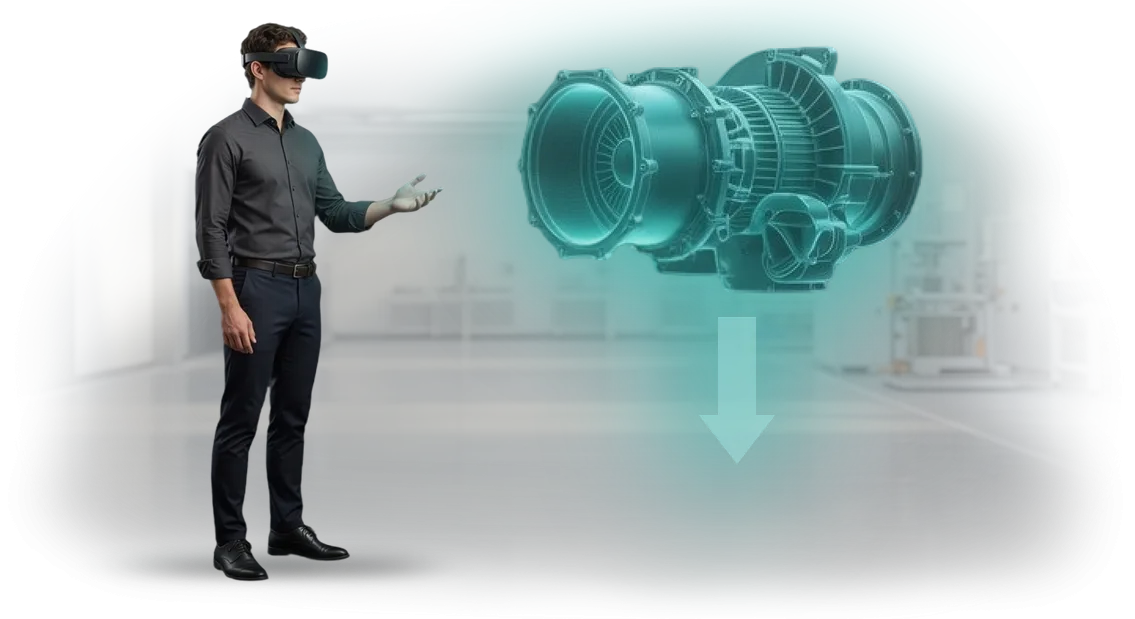
This is exactly where VR training in medicine addresses a key need: it gives the doctor a safe environment to practice rare and complex cases with no risk to the patient.
The virtual reality traumatology trainer can model the full cycle — from diagnosis to completion of the procedure — with realistic anatomy and unexpected complications.
Unlike old-generation simulators, the staff member works with their hands here, not mouse clicks, so muscle memory forms naturally. This is especially important in traumatology, where every instrument movement must be practiced to automaticity.
We don't just implement the technology — we build the training around the clinic's objectives: practicing exactly the scenarios your doctors encounter most often and where they make the most mistakes.
The result is professional development for doctors without pulling them away from work, fewer medical errors, and greater patient trust.
VR training pays for itself quickly: one prevented mistake covers the cost of implementation, and the consistent result is visible to both surgeons and management.
What you get from implementing VR and AR trainers
Traumatology is a field where the cost of a mistake is measured in the patient's health. Even an experienced doctor sometimes faces a complex fracture, a rare combination of injuries, or an atypical response to treatment.
Ordinary lectures and seminars don't provide safe practice: you can't replay a mistake on a patient. That's why clinics that want to reduce risks and raise the level of their team are switching to training in a virtual environment.
VR trainers allow a doctor to practice diagnosis and treatment tactics across dozens of realistic scenarios — from a typical radius fracture to combined trauma with internal bleeding.
Each scenario can be repeated, the decision reviewed, and the consequences of your actions seen immediately, without waiting. This builds a stable skill that carries over into the real operating room.
That is the effectiveness of VR trainers: the doctor learns from their own mistakes in a safe environment, and the patient gets a more confident specialist.
AR support during real procedures completes the picture. The surgeon sees hints on anatomy, key landmarks, and operation steps right in the field of view, without being distracted by a monitor or paper protocols.
For young doctors, this is insurance at difficult stages; for experienced ones, a way to reduce operation time and the number of unforeseen situations. In the end, the clinic gets not just a "trendy technology" but a working tool for improving the quality of care.
Measurable results appear quickly: doctor training is accelerated 2–3 times through intensive practice, diagnostic errors in complex cases decrease, and staff are more confident when working with severely injured patients. For a manager, this means predictable quality of the team's work and fewer patient complaints.
Wehave already helped clinics implement such trainers aligned with their real treatment protocols, and every project ended with diagnostic accuracy growing by 30–40% on average. Leave a request to discuss which scenarios will benefit your clinic specifically.
VR training formats for different clinic tasks
Training doctors and staff in a clinic solves different tasks: some need to quickly master a basic procedure, while others need to practice a non-routine situation in the operating room.
There is no universal format, so we split the program into four scenarios: individual VR trainer, group VR session, AR hints at the workplace, and a virtual traumatology simulator.
Each format covers its own pain point — from onboarding new staff to the coordination of a surgical team.
At the same time, all options are easy to combine: for example, a doctor first completes an individual VR scenario and then practices the action together with colleagues in a group session.
| Format | For whom | What it gives the clinic |
|---|---|---|
| Individual VR trainers | Residents, new staff | Quick practice of basic skills, objective assessment without an instructor |
| Group VR scenarios | Medical teams, departments | Team coordination, practice of rare and non-routine situations |
| AR training with hints | Nurses, office staff | Fewer errors when following algorithms, faster workplace onboarding |
| Virtual traumatology simulators | Surgeons, traumatologists | Practice of operations and procedures without risks or consumables, repeatable until a confident result |
The result for the clinic is a single standard of actions that is easy to measure and repeat for the next wave of staff. The manager sees each doctor's progress: number of attempts, completion time, key errors. This allows precise adjustment of training instead of relying on generic lectures.
The formats fit easily into the current schedule: an individual VR session takes 15–20 minutes, a group session takes an hour.
This approach doesn't pull doctors away from work and quickly pays off through fewer errors and faster transition of staff to seeing patients independently.
How implementation goes from zero to launch
Implementing VR training for traumatology is not a "technical project" but a clear sequence of steps, at each of which you participate and control the result. We take on development and coordination; you provide medical expertise and assess the benefit for your staff. Here's what this looks like in practice.
-
Development brief. We meet and discuss which skills the doctors and nurses need to practice: diagnosis, actions in acute trauma, and the order of care delivery. We record the training goals, target audience, and expected outcome.
-
Training plan and approval. Based on the brief, we propose the trainer's structure: scenarios, number of exercises, and action evaluation criteria. We agree on the stages and deadlines — you see the full plan and can make changes before development starts.
-
Medical content creation. Together with your traumatologists and instructors, we develop clinical cases, algorithms, and typical mistakes. Your experts verify the accuracy of the scenarios, so we eliminate the risk of training an error.
-
Prototype and test run. At an early stage, we show what the trainer looks like and how it is operated. You give feedback, and we quickly change the interface, task difficulty, and information delivery speed.
-
VR trainer launch. We prepare the equipment, set up workstations, and conduct briefings for administrators and staff. After the pilot launch, we collect feedback and fine-tune scenarios to your specifics.
-
Post-implementation support. We continue to support the project: updating clinical cases, adding exercises, and monitoring stable operation. If new requirements appear, we develop the program together with you.
In the end, you get training that is implemented without missing deadlines, and your staff master skills in a safe, controlled environment. The next step is a short conversation to assess your case and propose a specific implementation plan.
What's included in the delivery and support package
The clinic gets not just a virtual trainer but a complete solution for training traumatologists: from scenarios to instructions and access to a closed platform.
Nothing needs to be figured out or configured — the package is assembled so that the person responsible for training can launch the program within the first days.
The standard package includes:
- Scenario pack — situations developed together with practicing traumatologists: from typical fractures to emergency cases. Each scenario is adapted to your care delivery protocols.
- Full content license — perpetual right to use all materials within the clinic, with no limits on the number of staff or sessions. No hidden fees and no tie to a single workstation.
- Training documentation — implementation regulations, administrator checklists, and quick reference guides for staff: how to run sessions, evaluate results, and fit the trainer into the shift schedule.
- Methodological materials for instructors — ready-made training programs, skill assessment criteria, and error review scenarios. The instructor doesn't need to figure out how to work with staff on their own.
- Doctor's guide — a short reference for participants: how to put on the headset, which gestures to use, and how a session is structured. It is adapted for people without virtual reality experience, so the first minutes aren't spent on technical questions.
- Access to the management platform — a personal account where you see completion statistics, each employee's progress, and automatic reports for management. The module runs on the our team server architecture — we take care of hosting and updates.
After the launch, we don't disappear: support is active for the entire period of use — updating scenarios to new clinical recommendations, technical support, and methodologist consultations. If care standards change, we make edits to the trainer and send you the finished version.
This way, purchasing a VR solution becomes a manageable process: you get a full package — from the first scenario to reporting — and control the quality of training without diving into technology.
Case study: how a VR trainer improved treatment in traumatology
The main pain point of a traumatology clinic is the high cost of a mistake: an incorrectly identified fracture delays treatment and adds risks for the patient. Young doctors gain this experience over years, and rare cases may never come up in an entire career. That's why the clinic commissioned a VR training case for residents and interns.
Our team developed a virtual trainer where a doctor "receives" a patient: reviews complaints, examines the injured limb, selects diagnostic tests, and makes a diagnosis.
The scenarios are built on real clinical cases, including complex and non-obvious fractures. The trainer analyzes every incorrect step immediately — this noticeably accelerates learning.
What the VR implementation results showed
After the first two months of training, diagnostic accuracy on VR scenarios among interns grew by almost a third. The speed of making a preliminary diagnosis doubled, and the number of errors in reading X-ray images decreased.
Experienced doctors also started using the trainer — for rare injuries that almost never appear in regular practice.
Clinic feedback
The head of the center noted that the main result of VR implementation is its systematic nature: the skill is practiced to the point of automaticity without risk to the patient.
The adaptation period for new staff became shorter, and within a few months the clinic returned with a new order — a module on treating complications after fractures. For us, that is the main indicator of value.
How to choose the right VR training format for your task?
Choosing a VR training format starts not with technology but with the clinic's specific task. In traumatology, it's important to practice rare or complex cases — non-standard fractures, combined injuries, actions during complications, where the cost of a mistake is high.
So first we determine which skill we're training: speed of decision-making, sequence of actions, or coordination within a team. The depth of immersion, session duration, and number of repetitions needed for reinforcement depend on this.
The right format adapts to your clinic's specific requirements — care protocols, internal algorithms for receiving emergency patients, and the specifics of operating room equipment.
We integrate VR exercises into the existing training program: as a separate module for practicing complex injuries, or as a preparatory stage before practice on real simulators.
Virtual simulation complements rather than replaces other forms of training, so the result fits into the overall system without restructuring processes.
Short interactive scenarios work well for learning the protocols; multi-step simulations with detailed error analysis after each session work well for deep practice. A good practice is to start with several short modules and then move on to longer ones.
But there is no one-size-fits-all solution: we select the format based on the number of staff, their schedules, and current skill levels.
The key criterion is how easily the format integrates into the schedule. Our VR solutions run in an office or meeting room and don't require days away from work.
We support the implementation, adjust scenarios after the first sessions, and tailor the training to your clinic's real situations. This way, format selection becomes a tool that increases staff confidence and reduces risks on the job.
Answers to common questions about VR training for doctors
Most often, clients considering VR training for traumatologists ask similar questions: will doctors master the new format, can the clinic handle the equipment, will the content become outdated. We answer the main concerns — this makes it easier to decide on implementation.
Can doctors with no VR experience handle the trainer?
The scenario is designed so that the system guides the user through the first steps. Setup takes a couple of minutes, after which the doctor simply completes tasks and gets hints like a navigation system.
From the very first session, the traumatologist works confidently, and repeated runs bring the skill to automaticity.
What are the technical requirements of the solution?
We use professional standalone headsets that don't need a powerful computer or server room. A few square meters of free space and a regular power outlet are enough.
We'll select a solution for the clinic's or training center's space, and if needed, provide equipment for rent — without lengthy approvals with the IT department.
Will the trainer be compatible with our devices if we already have them?
We'll check your equipment for free, and if the models support corporate VR mode, we'll adapt the scenario to them. If not, we'll offer the best option among proven headsets.
The key is that the hardware doesn't distract from learning: the doctor puts on the device and immediately enters the training.
Will the content become outdated in a year?
Clinical protocols and methods change, so we make content updates part of the support service. You send the updated protocol — we adapt the scenario and update the trainer remotely.
No need to purchase again: the clinic gets an evolving tool that grows together with your expertise.
If your question isn't among these, just contact us: we'll tell you about completed implementations, help you estimate timelines and a training format for your task. The final answer always relies on the clinic's specific situation and the profile of its specialists.Get demo access to the VR trainer for your clinic
To help you make a decision without risk, we provide demo access to the VR trainer for your clinic. In just a few days, you'll see how residents and doctors practice trauma algorithms — from examination to emergency actions. It's a convenient way to order VR training without changing your current training process.
Here's how it works:
- You leave a request on the website or in a messenger, and we contact you within one business day to clarify the task.
- We hold a VR consultation: we review your scenarios, the number of staff, and requirements for safe training.
- We open demo access to the trainer for your key specialists — they complete the scenario on their own devices or on our equipment.
- Together we review the demo outcomes: results, errors, and completion time. You see exactly which skills each employee trains.
- We prepare the training cost estimate and an implementation plan tailored to your department's work schedule.
- After launch, we provide ongoing support: updating scenarios to new clinical recommendations and helping onboard new staff.
Mention "demo access" in your request, and we'll prepare a scenario for your specialty and show how the trainer will fit into the staff training process. It will take no more than 15 minutes of conversation and one test scenario.