



Electrician Errors in Manufacturing: What They Cost
Every electrician mistake in manufacturing is not just a malfunction but a chain of costs. Defects, line stoppages, missed deadlines, and risk to human life.
The cost of a single error far exceeds the investment in training, yet preparing a worker for rare emergency situations on real equipment is impossible — it is dangerous, expensive, and halts operations.
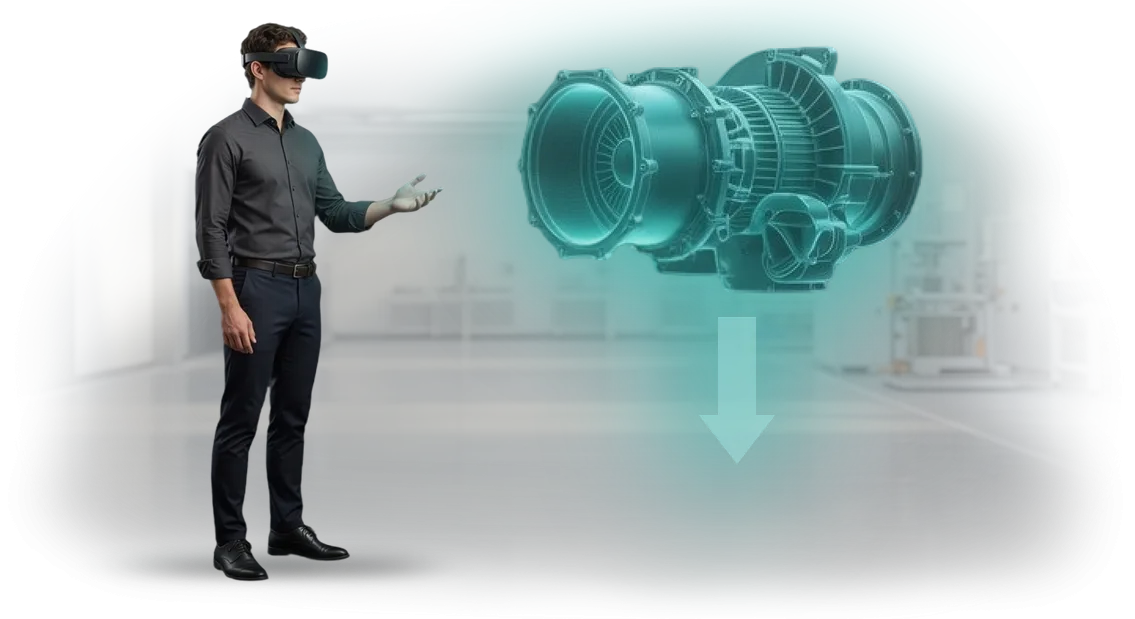
Virtual reality training simulators solve exactly this problem. The employee rehearses dangerous scenarios again and again until the actions become automatic, but without risk to themselves or the equipment.
In this way, electrician errors stop being “tuition paid in experience” — experience comes before working on a real site, not after an incident.
We have been building VR training for industry for ten years and know how to turn a simulator into a tool for reducing production risks.
We analyze the client's real incidents, transfer them into a virtual environment, and teach the team to act correctly in the most stressful situations.
The result is a noticeable reduction in defects, fewer downtimes, and a confident electrician who is not afraid of responsibility. For a manager, it means predictable processes and peace of mind about site safety.
What VR Training Delivers: 5 Key Business Outcomes
Electrician training is one of the most expensive and risky areas of personnel preparation. Mistakes in manufacturing are costly: from equipment failure to employee injuries.
At the same time, traditional lectures and mentoring do not provide the opportunity to “touch” dangerous situations without consequences.
Five key outcomes you get from VR training:
- Complete training safety. The employee practices working under voltage, short circuits, and other emergency scenarios in a virtual environment. No risk to people, equipment, or production — everything happens in safe conditions.
- Multi-fold acceleration of training. A new electrician moves from beginner to independent work noticeably faster than with a classic program. No need to wait for a mentor to become free or a training area to open up — training proceeds at a pace that suits you.
- Lower training costs. A VR simulator requires no consumables, no training ground rental, and no diverting experienced specialists from their current tasks. The more employees you train, the more cost-effective the investment in a virtual simulator becomes.
- Objective skill quality assessment. The system records every electrician action: correctness of operation sequence, reaction time, compliance with regulations. Managers see each employee's skill level in reports and know who is ready to work.
- Durable skills that don't fade after a week. An immersive environment engages muscle memory and attention more strongly than videos or instructions. Actions practiced in VR are repeated more confidently and accurately in real conditions.
We develop VR simulators tailored to production tasks: from an electrician's first steps to qualification checks during certification. The ready solution integrates into your training program and works as a measurable skill management tool.
VR Training Formats for Your Company's Needs
VR training is effective only when the format matches the task. A beginner needs to safely master the basics; an experienced electrician needs to refine rare skills; a manager needs to objectively verify an employee's readiness.
A one-size-fits-all program fails here: the same simulator is either too simple or too difficult, and training becomes a formality.
So we build VR training around three typical tasks: induction into the profession, professional development, and examination. This lets every employee learn at an appropriate pace while the company gets measurable results without downtime or risks.
| Format | For Whom | What It Gives the Client |
|---|---|---|
| Induction training | Beginners without experience | Fast immersion into the profession without risk to equipment. The employee practices basic operations in VR until they become automatic. |
| Scenarios for experienced staff | Experienced electricians | Practice of rare and emergency situations that are hard to set up on a real site. Advanced training without stopping production and without dangerous consequences. |
| VR exam | All categories | Objective skills assessment against uniform criteria. The manager sees each employee's result and makes personnel decisions based on facts, not impressions. |
The format selection starts with a short analysis of your goals. We look at who needs training, what the group's current skill level is, and which skills are critical for your production.
Then we propose a specific scenario — from a single simulator to a full program covering all three formats.
This way you get training that covers all scenarios: beginners reach a working level faster, experienced staff refresh their knowledge, and examinations become transparent and indisputable.
Choose the format or combination you need — and we will adapt the VR training to your specifics and help implement it without stopping operations.
How the Project Proceeds: From Brief to Launch
Developing a VR simulator for electrician training is a manageable process where you see every step in advance and influence the outcome.
We don't spring surprises at the final handover: you get a phased plan, approve the scenario, and watch the concept turn into a finished product. The typical development stages look like this:
-
VR brief: immersion in the task. We meet with you and identify which electrician skills need to be practiced: working under voltage, typical mistakes, actions in an emergency. We determine the number of employees and how to measure progress.
-
Project plan and approval. We prepare the scenario, simulator structure, and timeline. You see the modules and evaluation criteria for employees — we fix them in the contract before the start.
-
Development of the virtual environment and tasks. We create a realistic working environment: electrical panels, tools, emergency situations. At this stage you get a draft for review and can make changes — this is cheaper than any rework after launch.
-
Testing with your electricians. We invite two or three employees to run the scenario to check the clarity of instructions and realism. We collect feedback and refine details to a comfortable level.
-
Equipment installation and setup. We deliver the hardware, set it up in your training room or office, and train instructors. Everything is ready to go — no need for you to deal with the technical side.
-
Simulator launch. We launch training for the first group, monitor stability, and show how to read the statistics. You immediately see each employee's results and overall progress.
-
Support and further development. We stay in touch after launch: update scenarios, add new inputs, and assist with any questions. On request, we prepare reports on completion and knowledge retention.
What Is Included in the Delivery of a VR Simulator for Electricians
Ordering a VR simulator for electricians gives you not a standalone program but a complete kit for launching training. Everything needed for operation is already built in: scenarios, instructions, reporting, and support. All you have to do is assign a group of employees and start the classes.
The standard package includes:
- VR modules for key electrician tasks — from circuit assembly to fault finding in the switchboard room. Each module simulates a real working environment, so the employee practices actions they will later perform on site.
- Training scenarios of varying difficulty levels — from novice to experienced master. The course is structured so the employee first practices basic operations, then moves to emergency situations and complex cases.
- Instructor guides and methodology materials — ready-made lesson plans, checklists, and recommendations for reviewing mistakes. The instructor does not need to develop anything from scratch.
- Individual employee reporting system — you see who completed the scenario, which mistakes recur, and who is ready to work on site. Reports are generated automatically and can be exported for certification.
- Staff training on the simulator — we run sessions for your instructors so they can confidently organize classes and assist employees. Support continues after launch.
- Technical support and updates — the simulator adapts to changes in regulatory requirements and your internal rules, so training remains relevant.
This package covers the entire cycle: installation, running classes, monitoring results, and program development. You don't spend time searching for contractors for each stage — everything is bundled into one solution. If needed, we additionally customize scenarios to the specifics of your enterprise.
Case Study: How We Accelerated Staff Training by 40%
The client is a regional grid operator. New electricians were trained the old way: lectures, then on-site internships. In the first months, newcomers worked slowly and made mistakes — emergency shutdowns, rework, missed deadlines. They needed a tool to quickly bring an employee to safe, independent work.
We proposed a VR simulator for electrician training: the newcomer enters a digital substation and practices operations at a real pace. The system immediately records errors and prompts the correct sequence of actions. Training no longer depended on mentor schedules or available sites.
What changed:
- Training time decreased by 40%: instead of 10 weeks, an employee is ready for the line in 6.
- First-attempt test pass rate rose from 62% to 94%.
- Newcomer errors in the first months fell by nearly half; emergency shutdowns fell by a third.
The client's training center head: “For the first time, we saw employees arriving on site with real experience. An electrician who has completed VR scenarios works more calmly and no longer asks the same questions a hundred times.”
The secret to success: we studied the company's regulations and real emergency situations, then built scenarios that replicate work orders and contingencies. The simulator is embedded in the training plan, not added as a mere checkbox.
That is why this case is easily replicable for other specialties — from dispatchers to repair crews.
How to Choose the Right VR Training Format for Your Task?
Start with the question of what the employee should be able to do after training — that is the main criterion for choosing a VR format.
For electricians, practicing actions in non-standard situations is key: working under voltage, actions during a fire, the sequence for shutting down equipment.
If the goal is to make algorithms automatic and reduce the risk of mistakes in real conditions, choose full immersion with a simulated working environment and realistic scenarios.
If you only need to introduce beginners to the equipment or safety rules, a short orientation module is enough.
The second criterion is training scale. The choice of VR format depends on how many employees need training and how often standards are updated.
For a small electrician team, an individual scenario on a single headset fits, where each person completes the course at their convenience.
For a workshop or a branch network, a centralized solution with a shared scenario library and automatic result tracking is more cost-effective — you can see who has already passed the standards and who has just started.
The third factor is the specific requirements of your production: equipment type, regulations, access levels.
A VR simulator for electrical fitters differs from a scenario for operations engineers: different complexity, different emergency situations, different evaluation criteria.
It is important that the program reflects your exact instructions and operation sequences rather than generic diagrams. Then training becomes part of the mentoring system, not a one-off event.
We do not sell a one-size-fits-all format. On a consultation, we break down your task, review regulations and typical staff errors, then propose a suitable type of VR training and refine it to the specifics of your electricians.
Describe your situation — we will advise what is more beneficial: a quick induction scenario, a full course with certification, or a hybrid option with skill verification at the workplace.
Frequently Asked Questions from Clients About VR Simulators
Clients usually ask the same things: how quickly they can get a ready simulator, what they need to buy, whether employees will refuse to work in virtual reality, and what happens if something goes wrong.
We answer based on our experience with industrial projects — no technical details, only what matters for business.
How long does VR simulator development take?
A basic electrician training simulator is ready in 4–6 weeks. Complex full-immersion scenarios take up to 8 weeks. Within 2–3 weeks, we show a working prototype: you evaluate the scenario and make changes while there is still time.
What equipment is needed to get started?
One VR headset and a regular office computer or laptop are enough — that is a standard kit for a group of up to 10 people. We select equipment for your tasks, help with purchasing, or provide it for rent during training.
Will employees quickly get used to VR?
Practice shows that even those who have never worn a headset get used to it in 10–15 minutes. The simulator interface is designed to keep users focused on the task, not the technology.
Before training starts, we provide a short briefing, and we offer technical support during business hours in case of questions.
What guarantees do you provide?
We do not hand over the project until the scenario has eliminated all errors and is comfortable for your employees. After launch, we support the simulator: update it to new regulations, add scenarios, and train your instructors. If you want to change the training logic, we will make edits within the warranty period.
We work with professional equipment and proven tools, so the result is stable at every stage. We answer questions in detail during a consultation — send us your cases and training requirements.Order VR Simulator Development for Your Employees
Electrician training requires practice: working through circuit layouts, emergency responses, and safety procedures. In real conditions, this is slow, expensive, and risky.
A VR simulator moves practice into a safe virtual environment — employees build skills without endangering themselves or equipment. But the most important thing is that you get a tool that is easy to integrate into your current training program.
When you submit a development request, we don't just “make a simulator.” You get a transparent process with clear stages, each one bringing you closer to the result. After your request, we proceed like this:
- Expert consultation: we discuss your training goals, the specifics of electrician work, typical mistakes, and scenarios.
- Cost calculation: we prepare an accurate estimate based on your request — no hidden fees or unexpected surcharges.
- Prototype: we create an interactive simulator model that you can view and evaluate before final development.
- Launch plan: we define timelines, scope of work, and implementation sequence so you can control every step.
- Development and handover: we build the full version, fine-tune it to your training program, and deliver it to your team.
- Support: we update content, add new scenarios, and assist with operation after launch.
This approach lets you order a VR simulator without risk: you see the prototype and know the cost and timeline before work begins. Leave a request — and get an expert consultation, a cost estimate, and a prototype. We work remotely, so we can implement the solution in any region. Your electricians can start honing their skills in a safe environment within a few weeks.