

Cashier errors when working with customers: how VR reduces losses
The cashier is the face of the store, and the most frequent retail losses are directly tied to them.
Mistakes when giving change, not knowing current promotions, slow service, or uncertainty in a conflict situation — each miss like this costs not just the transaction but also customer loyalty.
A dissatisfied customer goes to a competitor, leaves a negative review, and the store loses revenue and reputation.
The problem is that classic training does not prepare employees for real stress. Theory and tests provide knowledge but do not build the skill to act quickly and correctly when there is a line behind you and an irritated customer in front of you. Mistakes repeat within the first weeks of work, and each such failure hits revenue.
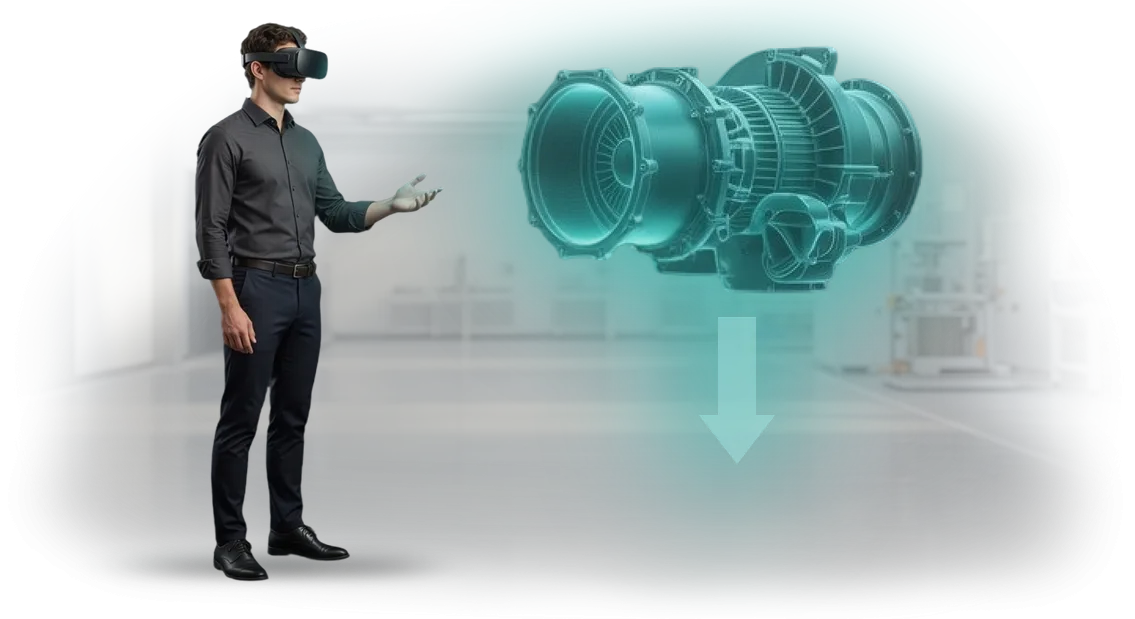
Virtual reality closes this gap. A VR simulator immerses the cashier in a realistic checkout scene: a customer with a complaint, a non-standard situation with bonuses or misgraded goods — everything that happens during peak hours.
The employee practices their response without risk to the store's reputation, and the system immediately shows where they lose pace and how to correct the mistake. This is how a skill is reinforced through practice, not by memorizing instructions.
For business, this means a predictable result: cashiers reach the required service speed faster, make fewer calculation errors, and handle conflicts more confidently. Fewer losses, satisfied customers, higher average ticket, and repeat visits.
These are exactly the tasks we solve when developing VR simulators for retail chains — and we do it based on real retail experience, not abstract scenarios.
What VR employee training gives business
Fast cashier onboarding
A newcomer spends 2-3 times less time learning checkout operations. They immediately enter a virtual store and train on realistic checkout layouts instead of reading regulations. Our team create scenarios around your checkout processes, so onboarding takes minimal time.
The result: a new employee starts working at full capacity faster, and the company saves mentor hours.
Engagement in training
VR holds attention better than lectures and presentations. The employee controls the scenario themselves, reacts to customers, and sees the result of their actions.
In our projects, 9 out of 10 employees complete this format, while about one in three drops out of regular e-courses.
Reducing errors on the real checkout
Complex situations — returns, promotions, dissatisfied customers — are practiced in a safe environment. The cashier gains experience before standing behind a real checkout. This significantly reduces the number of errors and speeds up service.
After completing the simulator, the cashier confidently handles returns and loyalty programs — this reduces the number of conflicts at the checkout.
A uniform quality standard
All employees go through the same scenarios and receive an objective readiness assessment. The manager sees who is ready to work independently and who needs additional training. This reduces the burden on mentors and makes training predictable for the business.
The business gets a consistent result: every cashier starts a shift with the same level of preparation.
VR simulator formats for cashier training
Cashiers face different tasks: some need to be brought up to speed quickly, others need to learn how to deal with difficult customers, and others need to be checked for readiness to work independently.
We match the VR simulator format to a specific goal — this way training solves a business task and pays off faster.
| Simulator format | Who it is for | What it gives the client |
|---|---|---|
| Cashier workstation simulation | New employees during onboarding | Reduces time to full efficiency: the newcomer learns the interface and operations without stress and without affecting real revenue. |
| Dialogue scenarios with customers | The entire shift, including experienced cashiers | Practices communication with difficult customers, promotion and return questions — the cashier calmly manages the conversation instead of getting lost. |
| Emergency scenario simulations | Cashiers and shift supervisors | Increases confidence during receipt errors, recounts, or conflicts — reduces the number of complaints and losses. |
| Certification module | Employees before being allowed to work independently | Objective skills assessment without an examiner and without the possibility of cheating — you know exactly who is ready to work at the checkout. |
This division lets you avoid paying for universal “training tools” — you choose exactly the format that solves your current need: speed up onboarding, reduce errors, or prepare the shift for certification.
How we develop a VR simulator for your task
A clear process is the key to project success. Our team have structured the development stages so that you see results at every step and understand what is happening. No surprises: from the brief to launch, the work follows a transparent plan.
- Brief and immersion. We analyze which skills cashiers need to practice and what mistakes occur. We collect regulations and requirements — and get a goal that we approve together.
- Scenario design. We create situations, dialogue lines, and cashier actions. We approve the scenario before development — this way changes do not require reworking everything.
- Layout and logic approval. We show the interface and the flow logic. After confirmation, we finalize the technical specification and move to implementation.
- Simulator development. We build the VR environment and configure the action assessment system. You receive intermediate builds and see how everything comes to life.
- Testing. We test the scenario with your employees: usability, clarity, compliance with regulations. We make final adjustments.
- Launch and team training. We hand over the solution, help set up the equipment, and show how to use the system.
- Post-launch support. We stay in touch: we update scenarios, expand content, and quickly resolve issues.
The result is a working VR simulator for cashier training that easily integrates into processes. At each stage, you get a clear result: from an approved scenario to a finished product with support.
What is included in the delivery of a VR training solution
When you buy VR training, you get a complete system, not a “try-it algorithm.” If the kit does not work on the first day, we have failed at our task. That is why the delivery is assembled as a turnkey solution: it contains everything needed for launch, and nothing extra.
Here is what is included in the delivery of a VR cashier training solution:
- Equipment. Professional VR headsets in the quantity needed for your training group — no renting, no hunting for compatible devices, no surprise additional payments.
- Training content. Interactive scenarios: working with customers, checkout operations, conflict situations, and actions during failures. The simulator analyzes mistakes and suggests the correct procedure.
- Manager’s dashboard. You see each employee’s progress: number of attempts, results, and areas where they hesitate. This way training does not become a mere “attendance mark.”
- Methodological materials. Instructor instructions, lesson plan, assessment checklist — your trainers do not need to build the program from scratch.
- Equipment instructions. Clear guides: turn on, charge, launch the training session. An employee can start training without a technician’s help.
- Content updates. Scenarios are extended to match regulation changes: new products, a new POS program, a new service standard. Training does not become outdated after a month.
Each item is not an “optional paid extra” but part of the standard package. We check the equipment and content integration in advance, so you get a predictable result: launch on time, quick transition of employees to independent work. All you have to do is set the start date — we take care of the rest.
Case study: how a retail chain accelerated employee training
When a cashier learns from paper instructions, the first weeks of work are one mistake after another. Lines, returns, dissatisfied customers.
The retail chain "Быстрые покупки" faced this head-on: preparing a newcomer took up to three weeks, and every fifth employee quit without handling the stress.
We proposed replacing part of the theory with a VR simulator that models a cashier’s real day: working at the checkout, promotional products, difficult customers, and issuing loyalty cards.
The employee hones skills in a safe environment — without risk to the store’s revenue or reputation. Training takes place right at the workplace, and the store does not stop for a minute. The implementation result: preparation time was cut by four times, from three weeks to five days.
The numbers confirm the effectiveness of the implementation case. After switching to VR training, the number of errors at the checkout dropped by 40%, and the rate of successful additional product sales grew — the average ticket increased by 15%.
This brought the chain additional revenue already in the first month after launch, and the share of repeat customers grew by 10%.
The key point is that investments in VR training pay off not only through faster preparation. The simulator standardizes service quality across all stores in the chain, and cashier turnover almost halved — employees feel more confident and stay with the company longer.
Store managers see each newcomer’s progress in the dashboard and adjust the program without waiting for problems at the checkout.
How to choose the right VR training format for a business task?
Choosing a VR training format is not a question of technology trends but a question of which business problem you are solving.
For cashiers, for example, the critical thing is not so much the theoretical base as practicing actions in non-standard situations: product returns, aggressive customers, system failures at the checkout.
This is where a VR simulator gives what no presentation or briefing can — the opportunity to safely experience a stressful situation and train the correct reaction to the point of automation.
The guideline when choosing a format is the specifics of your business.
If the company has high turnover and every new employee must come up to the same quality standard, VR training makes it possible to build a uniform standard and verify skills before a person stands behind a real checkout.
You do not get a “familiarization course” but a measurable result: training time decreases, newcomers’ mistakes stop costing money, and trainers spend time on those who actually need support.
Another case is when the specifics of the business require working with real equipment or physical space. Here, augmented reality, which overlays hints onto the physical object, is more appropriate.
But for practicing procedures, reaction speed, and behavior in conflict situations, full immersion in VR gives the “here and now” effect: the employee remembers actions through muscle memory, not by reading a manual.
That is why for cashiers we most often recommend VR scenarios — they model both the checkout area, the dialogue with the customer, and emergency situations.
To make a decision, it is important to look at the scale and frequency of training. If you have several locations and training runs constantly, a VR simulator pays off by reducing trainer costs and personnel errors.
If training is one-time and for a small group, a simpler format may be enough. But in any case, the right choice starts with analyzing the tasks, not with choosing equipment.
We help determine the appropriate format before development begins: we study your business specifics, the position profile, typical employee difficulties, and only then design the scenario.
This way you get not “training for the sake of a checkbox” but a tool that actually improves cashier performance and reduces risks associated with the human factor.
Frequently asked questions about VR simulator development
Money and time are the two main concerns a manager has when hearing the word “VR.” It feels like it must be long, complex, and unpredictable, but in practice implementing a cashier simulator takes less time than updating an internal instruction. We structure the project so that you get a working tool quickly and understand every stage.
VR integration does not mean replacing your current training system. The simulator becomes a separate practical block: you use it to practice skills, and the results are sent to your LMS or HR department. This solves the problem of mass training without stopping operational processes.
How much does it cost to develop a VR simulator for cashiers?
The cost depends on the number of scenarios, the level of detail, and the delivery format. We calculate the project for your task: one training scenario at the checkout station will cost significantly less than a suite of five different situations.
At the same time, you are not overpaying for a “virtual world” but paying for practicing specific operations.
We offer a modular model: you first launch a basic scenario, see the result, and then scale to new tasks. This lowers the entry barrier and makes the project predictable in terms of budget.
What are the real implementation timelines?
A typical project for one scenario takes from 3 to 6 weeks. This period includes analyzing cashier tasks, scenario development, assembly, and testing. After the layout is approved, you receive a working turnkey simulator.
You are never left alone with the contractor: every week we show an intermediate result and check the quality. The risk of getting the “wrong thing” is eliminated because you participate in the process from the first day to the last.
How difficult is it to integrate VR into current training?
The delivery kit is “plug-and-play”: we install the software on your equipment or provide a ready-made kit with support.
The training manager gets a clear interface and instructions, and the cashier only needs to put on the headset and follow the prompts — no special skills required.
We handle configuration and technical support at the start. A key convenience is that the format easily adapts to different shifts: training takes place without disrupting the schedule.
Any new technology raises questions — that is normal. We answer them directly, show examples, and let you test the simulator before the final decision. Tell us about your task, and we will prepare an approximate plan and timeline estimate for your scenario.Order development of a VR simulator for your employees
Training cashiers on real equipment is expensive: newcomers’ mistakes hurt revenue and service. A VR simulator for employees reproduces work situations without risk to the store — training takes place in a safe environment, and the skill immediately transfers to real life.
Order development of a VR simulator for your cashiers, and we will handle everything: scenarios, modeling, the technical part, and launch. You will get a tool that measurably improves the speed and quality of service. After you contact us, we will prepare:
- A cost estimate for development: an accurate calculation based on the number of scenarios and workstations.
- A format recommendation: a fully virtual simulator or a hybrid with a mentor and theory.
- Examples of our VR simulators for retail and services — you will see what finished solutions look like.
- A project plan with stages and timelines: you will know what is happening at every step.
- Demo access to a test scenario — you can try the product before full development.
- Post-launch support: we will update scenarios, help with implementation, and provide support.
We have been creating corporate simulators for more than 10 years and work remotely across the entire country. We handle design and development, while you only control business results: coverage, preparation speed, and reduced load on mentors.
Leave a request — within one business day we will calculate the cost and timeline and propose an implementation plan. We will adapt the program to your tasks: from a short introductory training to in-depth training for an entire store network.
This does not obligate you to order: we first show the solution, and then you decide whether it fits your needs.