

Lack of Motivation for Self-Development and Professional Growth — a Cause of Attrition
When an employee stops seeing meaning in development, the company is the first to feel the consequences. Competencies become outdated, mistakes become costlier, and the best specialists begin looking for a place where their growth is valued.
Lack of staff motivation is not a person’s “personal story” but a systemic business problem: it directly affects staff turnover and the speed of achieving goals.
Formal employee training doesn't solve the problem. Read instructions and rare seminars are quickly forgotten, don't change work habits, and don't provide a sense of development.
As a result, self-development becomes a duty that one wants to postpone, and engagement in processes declines. The company spends its budget but gains neither skill growth nor loyalty.
The key point is to turn learning into a clear and engaging part of the job. When an employee is personally interested in exploring a new topic, knowledge is absorbed much faster and applied in practice more often.
This is precisely what builds motivation for self-development and professional growth: the person sees their progress, receives feedback, and feels that the company is investing in their future.
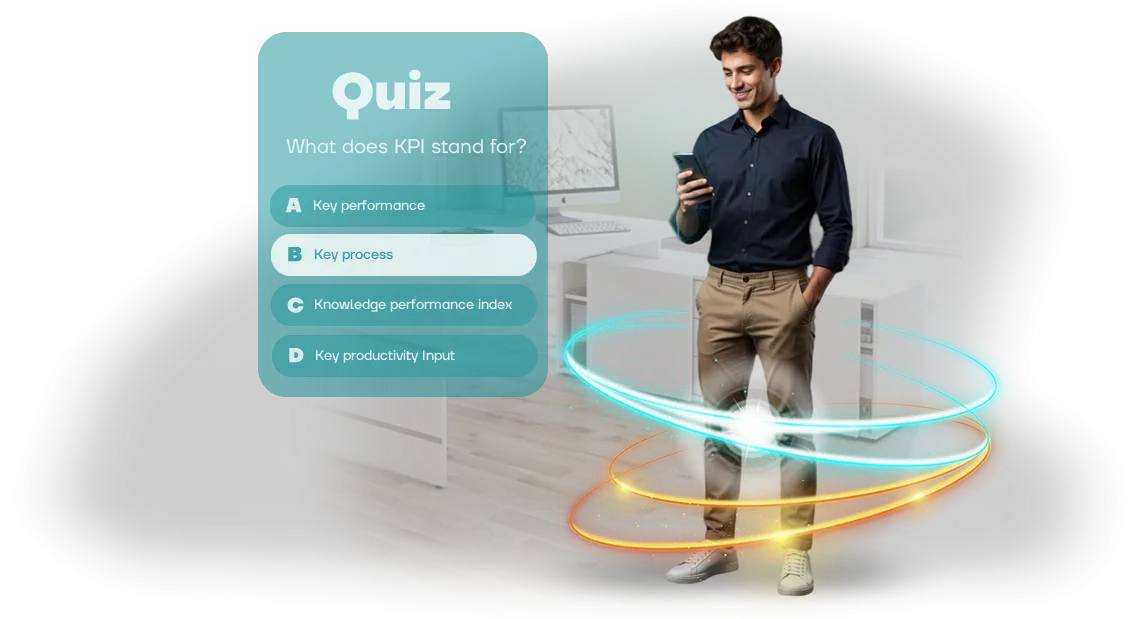
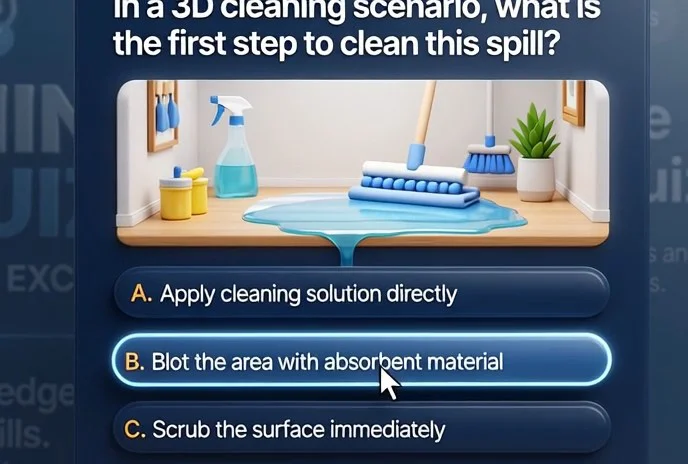
We address this need with educational quizzes—short game formats that fit into the work rhythm. They boost engagement, reduce staff turnover, and make employee learning transparent: you see who is mastering the material and who needs support.
Quizzes create healthy competition and a habit of continuous development, thereby strengthening the team and overall business results.
Why Quizzes Are an Effective Tool for Self-Development
Quizzes are not merely entertainment but a tool that turns passive learning into an active pursuit of knowledge. Employees aren't given ready-made information; they recall, analyze, and apply it—that's how a lasting skill is formed.
Gamification of learning removes the fear of making mistakes: a wrong answer becomes a growth point, not a reason for criticism. The experience of our team confirms that systematic quizzes deliver increased engagement and measurable progress in self-development.
Employee Engagement
Regular lectures lose attention within the first minutes, while a quiz sustains interest through play and competition. Participants see their results immediately, strive to do better, and become fully engaged in the learning process.
As a result, employees return to the material on their own instead of waiting for mandatory training, and this directly affects the effectiveness of learning.
Knowledge Retention
Knowledge is forgotten if it isn't applied. Quizzes make employees recall what they've learned and apply it in the context of a question, while instant feedback shows what needs review. This format improves retention and creates a systematic picture instead of scattered facts.
Learning Effectiveness
A manager sees the team's actual level of preparedness: which topics have been mastered and which haven't. Quizzes show the progress of each employee and the entire department, allowing targeted adjustments to the development program.
This makes learning a managed process, not a formal event, and provides a clear metric of skill growth.
Quiz Formats for Your Company’s Objectives
Different business objectives require different quiz formats: what works well for engaging team veterans may not suit newcomers.
A corporate quiz, a knowledge marathon, and an onboarding test solve different tasks, so before development we define the goal: boost morale, check material comprehension, or quickly introduce an employee to the company’s life.
| Format | Suitable for | What it provides the client |
|---|---|---|
| Corporate quiz | A team of 20-500+ people needing relief and team cohesion | Engages even inactive employees, creates common topics for discussion, and increases loyalty |
| Knowledge marathon | Departments or the entire company during long-term training | Sustains interest over weeks, builds the habit of returning to the material, and reinforces results |
| Newcomer onboarding | New employees in their first weeks on the job | Turns tedious study of regulations into a game, reduces entry stress, and accelerates getting up to speed |
| Team tournament | Regional branches, departments, shifts | Includes healthy competition, boosts team spirit, and creates news hooks for internal communications |
| Express knowledge check | Employees after a course or training | Quickly shows comprehension levels, allows timely gap closure, and confirms learning effectiveness |
We don't just hand out a “boxed” format—we tailor it to the corporate culture, number of participants, and project goal.
At the brief, we'll discuss what matters most to you: reaching the maximum number of people, drilling specific knowledge, or gently embedding learning into the routine—and we'll propose a format that solves exactly your task.
Stages of Turnkey Quiz Development
Turnkey quiz development is a transparent process where you control every step. We handle all the routine work, from brief to launch, and you get a ready-made learning tool without being distracted from current tasks.
-
Brief and task immersion. We record the learning goals, audience specifics, and desired outcome. We find out what knowledge to test and how the quiz will fit into the current motivation system.
-
Scenario and mechanics design. We determine the question structure, difficulty levels, and game elements that will keep employees interested. This is where the balance between ease of completion and real value for knowledge assessment is born.
-
Content review. You receive the ready-made questions and answer options for verification. We make edits and adjust wording until everything precisely matches your standards.
-
Build and configuration. We create the quiz itself: interface, scoring logic, and participant’s personal account. Everything is done on a professional platform, so the result works stably and requires no complex maintenance.
-
Testing. We run the quiz on different devices and check completion scenarios and reports. We fix any issues before employees see it—you get a finished product without surprises.
-
Launch and support. We grant access, show how employees take the quiz, and assist with the first launches. After the start, you see results in clear reports—it’s immediately obvious who has mastered the material and who needs additional training.
After launch, we stay in touch: if questions need updating or a new topic needs to be added, it can be done quickly and without reworking the entire system.
What’s Included in the Educational Quiz Delivery
We've designed the delivery package so that launching training takes minimal time for your team—with no hidden work and no need to refine anything in-house. Everything from game scenarios to reporting is provided ready-made and configured to your needs.
- Quiz scenarios tailored to your objectives. Ready-made question sets for onboarding new hires, certification, and testing knowledge of products and service standards. The scenarios account for difficulty levels so that employees progress from simple to complex without losing interest.
- Employee personal account. Participants see their results, topic progress, and ranking among colleagues. This supports healthy competition and the motivation to return to learning regularly.
- Administration without involving developers. You can change questions, add employee groups, schedule completion deadlines, and manage access through an easy-to-use admin panel. No tickets to the IT department—everything is done in a couple of clicks.
- Learning reports. The system shows who took the quiz, who is falling behind, which topics cause difficulties, and how results change across teams. Based on this data, you build employee development plans and see the real effectiveness of learning.
- Methodological materials for launch. An administrator guide, an employee memo, and recommendations for engaging teams in gamification. You don’t need to figure out how to explain the new format to employees—we’ve already taken care of it.
- Support at launch and content updates. We help configure the system to your regulations, transfer questions from existing materials, and update quizzes as needed. You can always refine the scenario when new products or standards appear.
The entire package is delivered in working order: after setup, you get administration, reporting, and a turnkey game loop. All that’s left is to invite employees—and the first results will appear within the first days.
Case: How a Quiz Increased Engagement in Retail
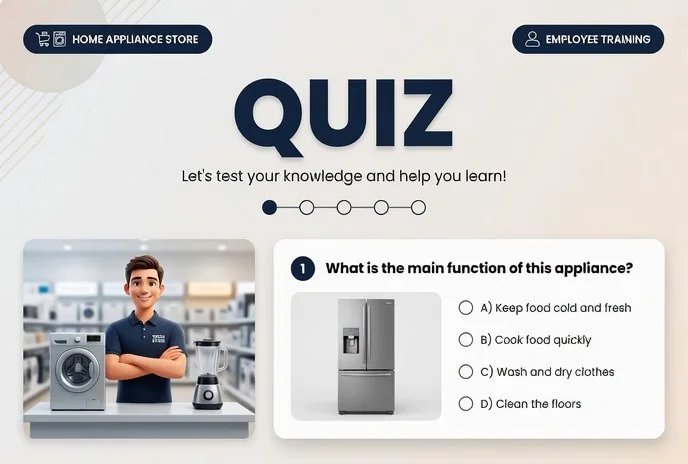
The Orion retail chain is a major retailer with 34 locations across the country. The HR department faced a challenge: how to boost employee motivation for self-development and professional growth so that sales associates could easily master new products and service standards.
Regular lectures and paper memos didn’t work—course attendance was declining, and knowledge wasn’t translating into practice.
Orion came to us for a gamification-based solution. We developed an educational quiz in the format of a meta-game on Unity: the employee enters a “shift in an ideal store,” answers questions about products and customer service scenarios, earns points, and sees the team ranking.
This turned a boring knowledge check into a competition where everyone wanted not just to complete it, but to outperform their colleagues.
The results speak for themselves. Within two weeks, 86% of sales staff completed the quiz—none of the previous programs achieved such coverage.
The average pre-test score of 62% rose to 87% on the final assessment, and the time needed to prepare an employee for a shift was cut in half. Store managers noted that new employees get up to speed faster and answer customer questions with greater confidence.
Key project metrics: the speed of knowledge acquisition increased by 40%, turnover among newcomers decreased by a quarter, and following the pilot phase, Orion ordered quiz development for all staff categories—from cashiers to administrators. For us, this is the best indicator that the system works and delivers measurable business results.
The average employee took the quiz three times a month, returning to questions on difficult topics. The level of satisfied customers in the stores participating in the project rose by 9 points according to mystery shopper results.
This proves that when employees enjoy learning, knowledge turns into skills and reflects on revenue.
How to Choose a Quiz Format for Your Company’s Objective?
There is no “correct” quiz format—there is the format that solves your task.
The question isn’t “which quiz is more interesting,” but what employee behavior you want to reinforce: onboarding a newcomer faster, teaching how to sell a product, or building a habit of regular learning.
Each goal has its own mechanics. If you need to quickly familiarize the team with regulations and products, short knowledge checks with instant feedback work well.
If the task is deep preparation of managers for customer dialogues, case-based formats are better: the employee experiences real situations and practices correct responses.
And if you want to systematically motivate self-development and professional growth, you need a long game mechanic with levels and progress—it sustains interest for weeks and months.
Key selection criteria are audience size and frequency of use. For a large distributed team, lightweight formats that can be completed in 5-10 minutes at a working pace are convenient. For a small group of experts, you can run rich game sessions with error analysis.
It’s also important how you measure results: by the number of completions or the dynamics of responses.
We choose the format for the task, not the other way around. First, we analyze your goal: who the target audience is, what knowledge needs to be reinforced, and what motivation the team already has.
Then we propose mechanics—from short quizzes to multi-stage games—that will fit the work rhythm and deliver measurable results.
A good format choice is when the quiz becomes part of the workflow rather than a distraction from it. Employees see the point in completing it, managers see a measurable change in knowledge and skills, and you get a tool that works toward business metrics.
Frequently Asked Questions About Implementing Quizzes
Implementing educational quizzes for the first time raises questions—that’s normal. Let’s address the most common concerns our clients bring us and show what the process looks like in practice.
Employees won’t take the quiz seriously. How can we make them participate?
You don’t need to force them—the key is to build the right mechanics. We design quizzes so that the competitive element and accumulating points create natural excitement. And if you add team standings or prizes for regularity, interest appears on its own.
Even at the pilot stage, we see engagement: usually 60–70% of the team joins in the first days. The rest get on board when they see their colleagues’ results in the overall ranking.
How long does implementation take?
A standard cycle is two to four weeks, depending on the number of questions and participants. We align the brief and plan in the first week, then prepare content and configure the mechanics. Launch takes one day; employee training takes no more than an hour.
We don’t drag out the process: you get a ready tool within the agreed timeline, and then we continue with support, updating questions and adding new topics.
How will the quiz actually improve qualifications rather than become just entertainment?
We build the quiz around your standards and typical work errors. The questions examine real situations that employees encounter daily. Immediately after answering, we show the correct solution with an explanation—so knowledge is reinforced, not just tested.
The manager sees topic-level statistics: which sections were mastered well and where the systemic gaps are. Based on this data, you adjust training and precisely address weak areas.
What happens after launch? Who supports the system?
We stay in touch after project delivery. As part of support, we update the question bank, add seasonal quizzes, and help analyze results. If your regulations change or new products appear, we promptly reflect that in the content.
Over years of work, we’ve refined the process so that clients don’t need to deal with technical details. You get a working tool, and we handle all the routine.
If you still have doubts, ask us directly—we’ll respond within a business day and show you quiz examples from your industry.Order a Quiz Developed to Your Specifications
Employee motivation directly affects the speed of their growth and business results. But simply forcing people to take courses is useless: learning becomes a formality, and knowledge isn’t reinforced. An educational quiz solves this problem through interest, competition, and visible results.
We develop the quiz turnkey: from scenario and questions to launch on platforms your team already uses. You get a finished tool, not a technical specification for your developers.
From there, it’s simpler: we provide instructions, train administrators, and support the first launches.
When you order a quiz from us, you get:
- A quiz tailored to your request — questions, mechanics, and design are created for your business objectives, not copied from a template.
- Clear benefits for employees — they see progress, compare results with colleagues, and receive recognition for their achievements.
- Easy launch without stress — you don’t need to learn tools or hire a dedicated specialist: everything is ready to go.
- Flexibility for updates — questions and levels can be easily changed to match new products, regulations, or seasonal campaigns.
- Feedback on results — we help interpret completion statistics and fine-tune the quiz to keep engagement growing.
- Support at every stage — we answer questions, help with launch, and promptly resolve any issues after launch.
Leave a request on the website—we’ll contact you within a business day, clarify your objectives, and propose the optimal solution. You’ll receive a consultation, a timeline estimate, and an understanding of how the quiz will fit into your learning system. We’ll start with a free discussion of your idea—we’ll handle the rest.