

Why employees forget training and how to fix it
Every manager knows the situation: employees complete mandatory training, pass tests successfully, and within a couple of weeks the material is practically unused. Mistakes repeat, processes slow down, and the money invested in preparation does not deliver the expected result. The issue is not laziness or a bad memory — it is how the training itself is built.
Traditional formats — lectures, presentations, long instructions — hold attention only for the first few minutes. Information is delivered passively: the employee listens but does not participate.
The brain does not connect the material to practice, so the knowledge fades within days. Training becomes a formality, and the business gets the same level of mistakes.
Training effectiveness directly affects the business: speed of work, quality of service, number of failures and losses. Every forgotten detail means time spent fixing it, unhappy customers, and extra expenses.
If training does not change employee behavior, it does not fulfill its main purpose — the budget is wasted.
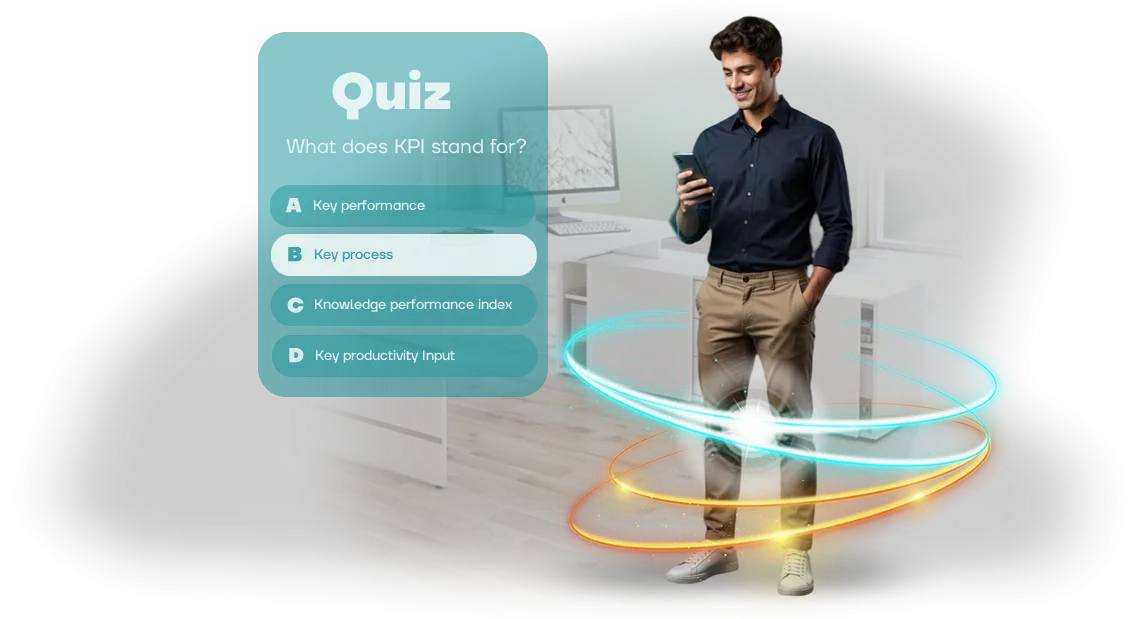
The solution is to move training from passive viewing to active action. Training quizzes with game mechanics make employees think, make decisions, and see the consequences. Knowledge sticks through their own mistakes and successes, not through scrolling slides.
This is exactly the approach we use in corporate quizzes — and it genuinely brings effectiveness back to training.
What game formats give to employee training
Regular lectures lose employee attention within 15 minutes — the material is forgotten. According to LinkedIn Learning, game formats and gamification of employee training almost double course completion rates. We build Unity quiz mechanics that turn training into an event.
Engagement instead of boredom
Points, leaderboards, and competition create healthy excitement. Employees look for the right answers themselves — that is how knowledge is remembered better.
Knowledge testing without stress
The quiz shows the real level of preparation but does not trigger fear of making a mistake. The manager sees weak topics and gives the team targeted follow-up training.
Shared team experience
The game brings departments together, introduces newcomers to the product, and creates shared emotions — training becomes team building.
We choose the format for the task:
| Format | For whom | What it gives the client |
|---|---|---|
| Team quiz | Departments and project groups | Engages the team and develops collaboration skills |
| Newcomer quiz | New employees | Quickly introduces the product and procedures |
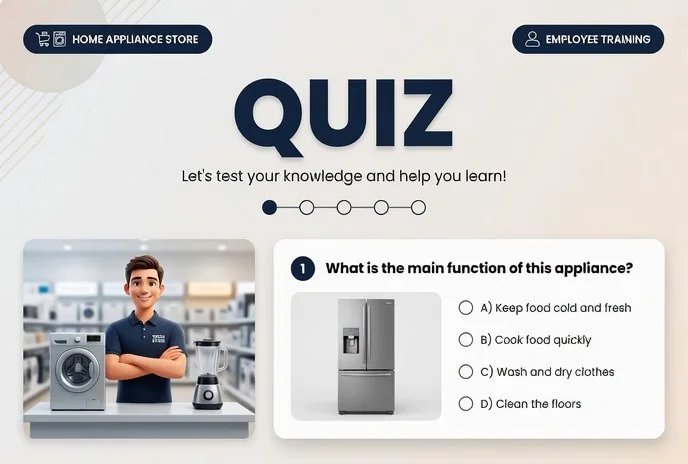
| Scenario trainer | Sales and client service | Rehearses difficult dialogues without risk to clients |
This approach increases staff engagement and reduces time spent on retraining: employees see the course through to the end and apply their knowledge at work — which means your business gets a tangible result.
Unity quiz mechanics: choosing a format for your task
Not all training quizzes are equally useful: what works for a sales department can fail on the production floor.
Unity quiz mechanics let us vary the delivery — from simple questions on a screen to interactive scenarios where an employee makes decisions in an environment close to reality.
To avoid overpaying for unnecessary functionality and to get a measurable result, we start from the goal: mass introduction to procedures, knowledge checking, or practicing complex actions. Here are the main formats we use.
| Format | For whom | What it gives the client |
|---|---|---|
| 2D quiz | For mass training, checking procedures and standards | Quick launch, simple interface, high reach, clear to any employee |
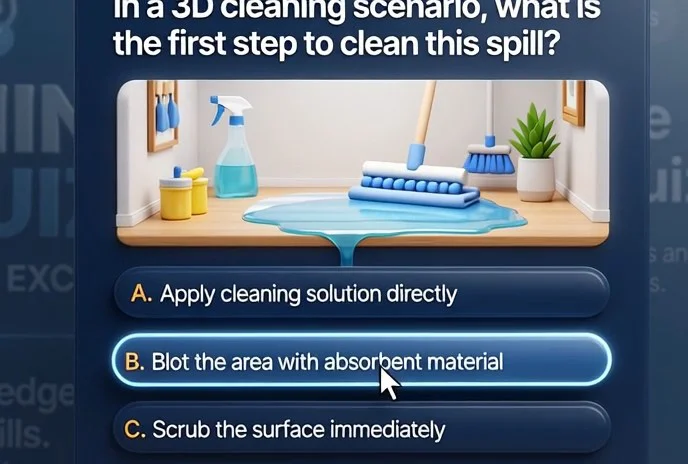
| 3D quiz | For practicing actions in an environment, simulating situations | Full immersion, risk-free skill training, emotional engagement |
| Combined | For long programs, mixed audiences | Flexibility: theory and practice in one scenario, attention retention |
We choose the mechanics together with you: we analyze the audience, timelines, and expected impact. And if needed, we combine formats within a single course so employees first get the theory and then reinforce it in practice.
How a quiz for employees is developed
Developing a quiz for employees is not just a set of questions — it is a project that must fit the timeline and solve the training task. To give you a predictable result, our team has structured clear quiz creation stages — from brief to training launch and support. At each stage, you understand what is happening and can influence the outcome.
- Brief and immersion. We discuss what knowledge needs to be checked, who the audience is, and which communication style is closer to your employees. We record success criteria — for example, completion percentage or engagement level.
- Plan and scenario. We create the quiz structure: topics, question difficulty, delivery mechanics. We agree it with you before investing time in content.
- Content and design. We write the questions, formulate answer options and explanations. We style the quiz in your corporate identity so it looks like part of an internal communications project.
- Implementation and configuration. We assemble the quiz, connect scoring logic and results display. We set up employee access — on your platform or ours.
- Testing and launch. We check it on a real device, fix inaccuracies, and deploy the final version. You receive a link and instructions for the team.
- Support and reporting. After launch, we monitor completion and adjust questions if needed. We provide a short report: who passed, which topics caused difficulties, and what should be repeated.
This process eliminates surprises: you see the scenario and design in advance, rather than getting a finished result on the last day. A typical project takes one to three weeks — we name the exact timeline after the brief.
What a training quiz project includes
A training quiz is not just an entertainment game — it is a full-fledged tool for knowledge assessment and employee engagement. We prepare everything needed for launch: from scenario to training your administrators.
The delivery package includes several key components so that you get a working module and can manage it without developers. Below is the full list of what is included in the project.
- Scenario and questions. We prepare content based on your procedures, instructions, and knowledge bases. The questions are worded to reveal real knowledge gaps, and we give explanations after each answer — this strengthens learning.
- Game mechanics. We design a system of points, difficulty levels, hints, and feedback. The right mechanics hold interest and motivate employees to complete the quiz.
- Branding. We style the quiz in your corporate identity: logo, colors, fonts. Employees immediately understand that this is an internal company tool, not a third-party game.
- Integration with your systems. We connect the quiz to the corporate portal, learning center, or messenger. Results automatically flow into your reporting — no manual collection needed.
- Access configuration. We define roles for administrators, managers, and employees, protect data, and control who sees the results.
- Training for your team. We conduct a short briefing — how to change questions, add new scenarios, and view statistics. Day-to-day management does not require technical specialists.
- Post-launch support. Throughout the support period, we answer questions, fix issues, and help develop the quiz as your tasks evolve.
Case study: how a quiz improved warehouse staff knowledge
What we did
A large warehouse complex came to us with a typical pain point: high staff turnover and varying skill levels among storekeepers and order pickers.
New employees made errors when working with equipment and violated safety standards, while retraining everyone through in-person sessions was slow and expensive.
We proposed replacing part of the instruction sessions with a training quiz.
Instead of boring lectures — an interactive quiz in a competition format: the employee goes through the scenarios "goods receiving", "rack placement", and "shipping" and immediately sees where they make mistakes.
The system remembers weak spots and shows hints, while the manager sees overall statistics by shift.
Results
Within two months, all 120 warehouse employees completed the quiz. The average score on a repeat attempt grew from 62% to 91%.
The number of errors during goods receiving dropped by a third, and newcomer onboarding time was roughly halved — they get up to speed faster and ask mentors for help less often.
The warehouse manager noted that employees themselves ask when the next quiz will be — training stopped feeling like a mandatory chore. Six months later, the client came back and asked to extend the quiz to the delivery department and drivers.
Even after the first launch, it became clear: this format works no worse than a full training session and costs significantly less preparation time.
our team — this is confirmed by other projects too: for companies with distributed teams, we build quizzes that launch from any device and require no additional software installation.
Which Unity quiz mechanics suit your industry?
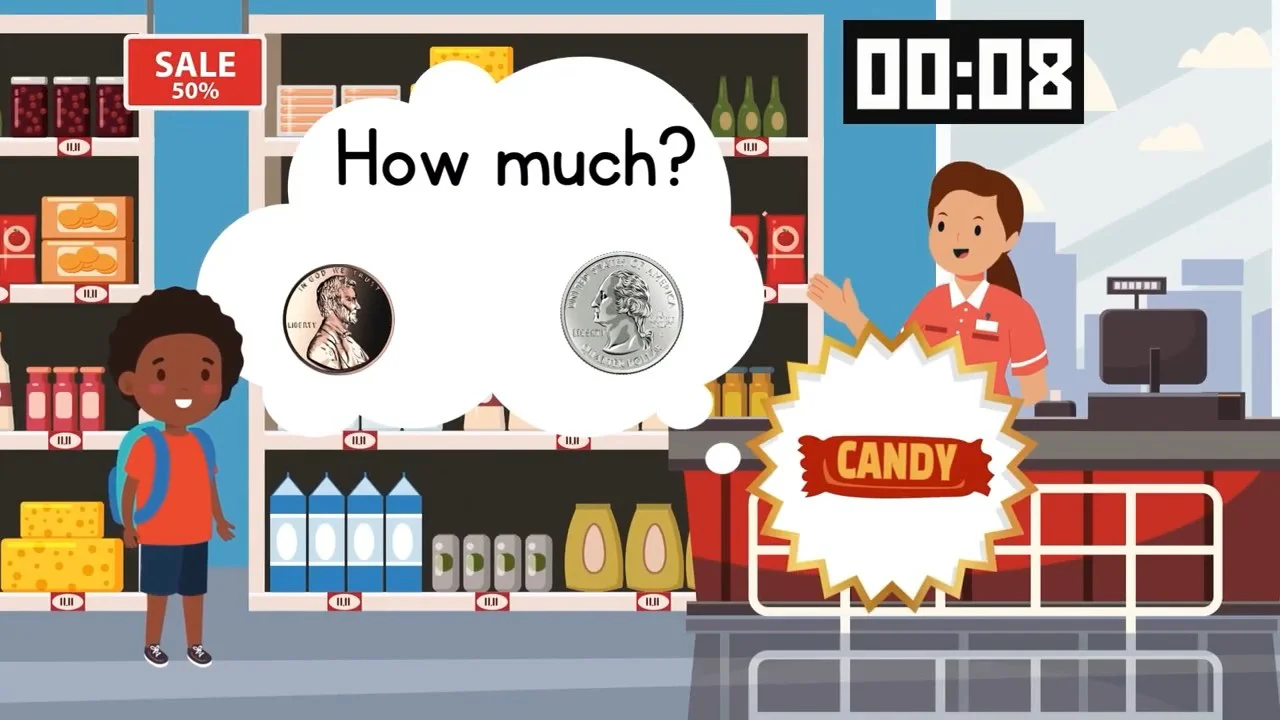
Which mechanic works depends not on passing trends, but on the specifics of your industry and audience. In retail, it is important to quickly engage sellers in learning a new product: short rounds, instant feedback, and a leaderboard work well here.
In banks and manufacturing, scenarios that simulate real work situations are more valuable: the employee experiences the mistake in a safe environment and remembers the correct procedure.
Industry quizzes must speak to employees in their own language — this is the main rule for choosing mechanics.
That is why we do not offer a universal template. At the consultation, we review your industry, headcount, how often knowledge needs refreshing, and how you plan to measure results.
The format choice depends directly on this: a mobile quiz for field staff, a team game for the office, or a long training quiz with real case analysis. In every case, the mechanics serve the business goal, not the other way around.
For example, for companies with high staff turnover, we create short introductory quizzes that can be completed in 10–15 minutes on a tablet. And for regular skill development, we build series of thematic rounds with increasing difficulty and clear analytics for each participant. This lets the manager see who has already mastered the material and who needs additional support.
Unity quiz mechanics flexibly combine simple questions, blitz rounds, and multi-step branching scenarios. Our job is to select the ones that deliver a measurable result: sales growth, fewer errors, faster newcomer adaptation.
Come to a consultation — together we will identify the best mechanics for your industry and your team.
Answers to common questions about quiz development
Clients rarely order quiz-format training every day, so before a project starts, the same questions come up. We answer directly — about timelines, cost, and guarantees — so you understand how we make turnkey quizzes.
How long does quiz development take?
Usually two to four weeks — the timeline depends on the number of questions and the complexity of the game mechanics. Specific dates are fixed in the contract and met without reminders.
How is the cost determined?
The cost is based on the volume of content, design, and the mechanics your team needs. After the brief, we name the exact cost and timeline — no hidden fees or mid-project surcharges.
What devices will the quiz work on?
We find out in advance which computers and phones employees use and adapt the game to your hardware. Nothing needs to be installed — just a browser and access via a link.
What guarantees do you give?
Before launch, we run a test session on real devices so everything works without failures. If something goes wrong on the day of the event, our specialists are on call and resolve the issue within an hour.
Order turnkey quiz development
A training quiz is a tool that pays off from the first launch: employees memorize procedures faster, and the manager sees the real level of knowledge without long reports.
Unity development lets you build a training game for your tasks — from knowledge checks to an introductory course for newcomers — and launch it on any devices your team uses.
This is not entertainment for the sake of a checkbox but a working mechanism for control and professional development.
We take over the entire process: from scenario and questions to layout and technical support.
Ordering a turnkey quiz, you get a ready-made solution, not a "semi-finished product": mechanic approval, trial operation, and administrator training are already included in the cost. You do not need to look for separate contractors, track deadlines, or redo the result.
The cost includes:
- Scenario and questions based on your materials — procedures, instructions, standards.
- Custom mechanics: single-player format, team game, timed quiz.
- Adaptation to your corporate style — logo, colors, screen design.
- Launch on laptops, tablets, and phones — without installing additional apps.
- Admin panel: you see results for each employee and by department.
- Post-launch support: question updates, refinements, technical support.
To order a quiz, leave a request on the website: we will hold a consultation, clarify your goals, and prepare a commercial proposal within one business day. Tell us about your task — we will select the optimal format, timeline, and budget without hidden extras. We will implement a training game that delivers results from the very first month.