

Business Ethics and Anti-Corruption Training: Why Lectures Don't Work
Lectures and presentations on ethics are perceived by employees as a formality: the material is recited but not experienced.
After a standard briefing, only generic phrases remain in memory, and in a real situation—a questionable gift or a dubious request—a person acts out of habit rather than according to the regulations. Business ethics and anti-corruption training requires practicing decisions, not passive listening.
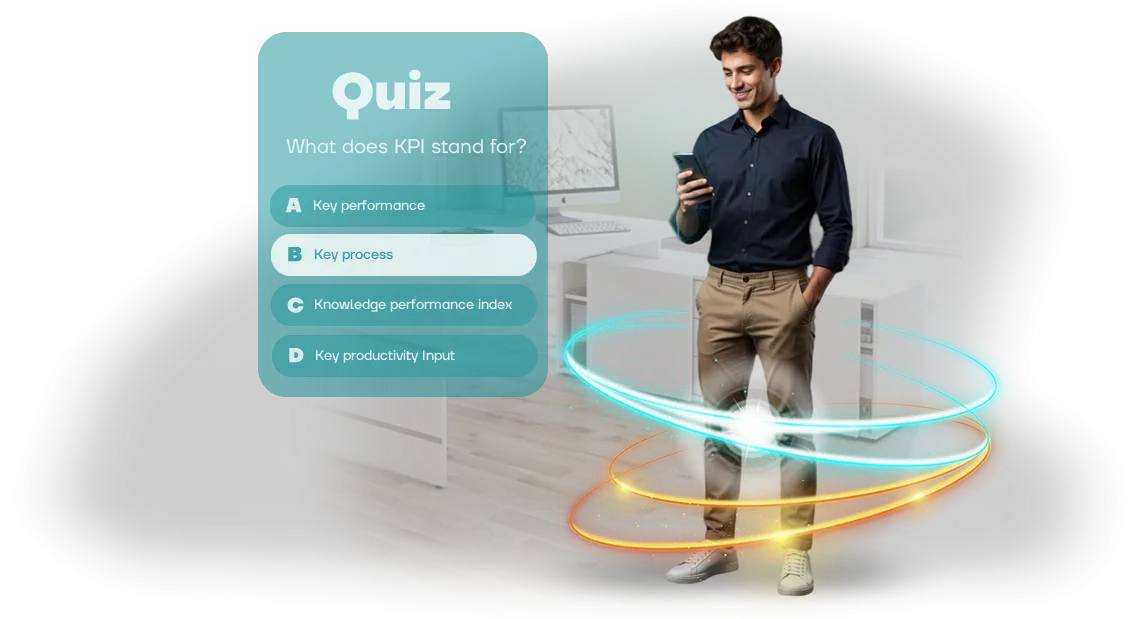
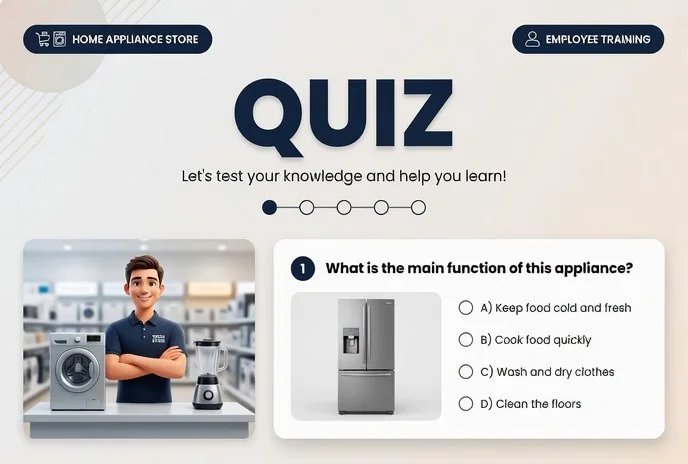
This is where an anti-corruption quiz comes in. It immerses the employee in simulated work scenarios: they need to choose how to act, see the consequences, and get an explanation.
Such ethics training turns a boring mandatory program into a live scenario where every participant is the main character.
The quiz is easily integrated into the training portal or conducted at a corporate event, and the results show managers which topics are understood and which need repetition.
Business ethics in a company is not abstract values on a website, but concrete rules of behavior in controversial situations. When an employee makes decisions in the quiz themselves, they form stable behavioral patterns before encountering real risk. This reduces the number of violations, protects reputation, and avoids costly mistakes.
We close this gap: we design training quizzes based on the client's real business scenarios, with clear mechanics and understandable results for HR and compliance.
Employees go through training with interest, and the company gets a measurable level of engagement and readiness for complex ethical situations.
What a Corporate Quiz for Employees Gives: 5 Effects
A corporate quiz is not a way to occupy employees, but a measurable learning tool. Unlike lectures and memos, the game format gives the business concrete results. Here are five effects of implementing an ethics and anti-corruption quiz.
-
Employee engagement. Game-based learning includes competition and instant feedback. Employees go through the quiz with interest: coverage reaches 80–90% versus 30% at regular lectures. We create quizzes based on Unity — this guarantees stable operation on any device and quick launch.
-
Deep knowledge absorption. Game-based learning instead of memorization — repetition through scenarios and choosing a solution. Employees pass the rules through themselves, so after a month they remember key ethical principles 2–3 times better than after a traditional course.
-
Practicing difficult situations. The quiz models real cases: gifts to partners, conflict of interest, dubious proposals. In a safe environment, the employee tries options and sees the consequences of their choice — this develops the skill of correct decisions.
-
Transparent result evaluation. You can see which topics come easily and where improvement is needed — by department and specific individuals. Based on the results, it is easy to assign additional training and show objective figures to management.
-
Increased trust and reduced risks. Uniform ethical rules reduce violations and reputational losses. Employees understand that the business operates honestly — this strengthens loyalty and attracts reliable partners. Corporate training in a game format becomes part of the employer brand.
Quiz Formats: Choose the Option for Your Task
Choosing a quiz format "by eye" is risky: what captivates young specialists will turn out to be too easy for managers. Some departments need a quick knowledge check, others need a deep exploration of ethical dilemmas, and others need team building. Therefore, we develop quizzes for a specific task rather than offering a template solution.
Below are three basic formats that cover most business ethics and anti-corruption training scenarios. In each case, you get a ready-made tool that integrates into your learning system and delivers measurable results.
| Format | For whom | What it gives the client |
|---|---|---|
| Employee test | All departments, when you need to quickly check knowledge of norms and policies | Transparent knowledge snapshot, automatic statistics by department, time savings on checking |
| Learning quiz | Young specialists, sales, frontline — where engagement matters | Increased interest in the topic, memorization through emotions, team dynamics and discussion |
| Ethics simulation game | Managers, compliance officers, risk managers | Practicing complex ethical situations, decision-making training, reduction of reputational risks |
Formats are easy to combine: for example, start with a quiz to warm up, then give a simulation for deep study, and finish with a test to reinforce.
We will select a combination for your task, number of participants, and timelines — and prepare the quiz so it fits organically into your training program.
How Quiz Development Goes: From Brief to Launch
Developing an ethics and anti-corruption quiz is a project that we at our team manage from the first meeting to launch. It is important to us that you see the result at every stage rather than receiving a "black box" after a month. Therefore, the process is structured so you participate in key decisions and control the content.
Here is how it works in practice:
-
Brief and immersion in the task. We gather input: who is learning, what risks and work situations are relevant, what format is convenient for employees. Already at this stage, we understand how to make training lively rather than formal.
-
Quiz structure and scenario. We propose a breakdown into blocks: basic rules, work situations, analysis of complex cases. We define questions, answer options, and explanations — so the employee does not just guess but remembers the correct behavior model.
-
Content approval. We hand over all questions and answers for your review. Your specialized specialists make edits, we take them into account and finalize the text. There is no room for an "author's view" — only your norms and policy.
-
Testing and preparation for launch. We assemble the quiz and test it on a small group. We fix shortcomings, adjust screens, and make sure everything works correctly on different devices.
-
Launch and invitation of employees. We give you a link and help prepare an internal announcement. The quiz starts at a convenient time, without the need to involve technical specialists on your side.
-
Support and analytics. We monitor completion: we see where employees "get stuck" and which topics cause difficulties. Based on the results, we send a report — how many people completed it, which questions were problematic, and what to focus on in the next trainings.
This approach allows not only to launch the quiz on time but also to turn it into an understandable tool for measuring knowledge. You get not a "game for the sake of a game," but a working element of the learning system with numbers and conclusions.
What's Included in the Package: We'll Put Together a Turnkey Quiz
Below is what you get in the package. Everything is already packaged and ready to use, so your team won't have to gather materials and deal with the technical part.
- Ready quiz scenarios on business ethics and anti-corruption: questions with answer options, correct solutions, and comments that explain why this is so.
- Methodological materials for the trainer or HR manager: session plan, recommendations for conducting in remote or in-person format, typical employee questions and answers to them.
- Learning analytics: for each employee and the whole group, you can see who completed it, how many attempts were made, and which topics cause difficulties. Reports are generated automatically — no manual consolidation needed.
- Launch instructions: simple steps on how to issue access, run the quiz, and collect results. An employee without technical training can handle it.
- Content updates: scenarios and questions are adjusted according to changes in legislation and your internal policies. You receive the current version without additional payment.
- Technical support: server side, platform updates, troubleshooting — we ensure the stable operation of the quiz throughout the entire period of use.
Each package item saves your team's time. Scenarios and the manual remove the need to invent content, analytics give management transparent data on training completion, and technical support eliminates "how to fix this" questions.
You launch anti-corruption and business ethics training without distracting your employees from their tasks.
Case Study: How a Quiz Increased Employee Engagement by 63%
One of our clients — a federal retail chain "Market-City" — faced a typical problem: business ethics and anti-corruption training was done "for show." Employees opened the course but did not delve into it: long lectures, tests with hints, and most importantly — no interest.
An internal audit showed: only a third of staff reach the final test, and ethics questions in real work continue to cause errors.
We proposed turning the mandatory training into a quiz with game mechanics: short scenarios from store life, choosing a solution, instant feedback, and elements of competition between departments. Implementation took a month, after which we measured the effect for two months.
The results exceeded expectations: employee engagement grew by 63%, and the share of those who completed the full course almost doubled.
| Metric | Before quiz launch | After 2 months |
|---|---|---|
| Course completion | 31% of employees | 87% of employees |
| Average training time | 24 minutes | 11 minutes |
| Post-test score | 62/100 | 91/100 |
| Complaints of boredom | 18% | 2% |
These figures mean more than just a "nice report." For business, this is a reduction in reputational risks: employees in stores recognize conflicts of interest more confidently and report violations.
And by reducing training time, the company saves more than 300 working hours of staff every six months.
The "Market-City" case shows that ethics and anti-corruption training can be effective if it engages rather than forces. That is why we develop quizzes for business tasks: with a clear storyline, realistic situations, and a measurable result.
How to Choose a Quiz Format for Your Task?
Choosing a quiz format is not a question of "what's trendier," but a question of what task the company faces.
A training quiz on business ethics and anti-corruption can be a compact test for all employees, or it can become a deep scenario with analysis of real situations for managers.
There is no universal solution, so we always start by analyzing your specifics: team size, branch geography, engagement level, and how you plan to use the results.
What do we look at when selecting a format? First of all — coverage and depth. If you need to quickly raise awareness of the entire team, a short quiz with instant feedback and clear explanations for each answer will work.
If the task is to practice complex ethical dilemmas and teach decision-making in ambiguous situations, interactive scenarios where an employee consistently chooses a line of behavior and sees the consequences work better.
We also take into account corporate culture and reporting requirements. Some companies need to track the progress of each employee and generate statistics by department, while others need to maintain anonymity and create a safe learning environment.
We offer the option that organically fits into your internal processes: from the "complete in 15 minutes in a work chat" format to a multi-stage program with final certification.
Therefore, you don't need to independently choose between tests, quizzes, and scenarios. We conduct a short brief, ask clarifying questions, and based on that, propose a solution that will address exactly your task. You get not just a quiz, but a tool that really changes employee behavior and reduces risks.
Frequently Asked Questions about Developing Quizzes for Employees
Implementing a training quiz raises the same concerns for many: employees won't understand, the system won't integrate with the internal portal, and the content will become outdated in a month. Below are answers to the questions most often asked before the start. If your scenario is not on the list, just write to us — we'll show a solution on a real example.
Employees don't like mandatory training. How can we make sure the quiz is completed rather than closed "for show"?
We design the quiz as a game: short rounds, understandable scenarios from real work situations, instant feedback, and elements of competition. The employee sees their progress and compares results with colleagues — this triggers healthy excitement.
Based on project experience, with this approach, completion reaches 90%, and training time is reduced by two to three times compared to lectures and tests.
Will the quiz be compatible with our internal LMS or corporate portal?
Yes. We make the quiz a standalone web application that opens via a link — it's easy to embed in any LMS or portal via iFrame, and also run on tablets and smartphones. Results are exported in a convenient format for your HR analytics.
If needed, we can set up single sign-on via a corporate account so the employee doesn't have to remember an extra password.
Who is responsible for the result, and what happens after launch?
We support the project after launch: we monitor correct operation, promptly fix any failures, and help with administration. You get technical support, so you don't need to keep a separate developer on staff.
Content becomes outdated quickly. How are questions and scenarios updated?
Content updating is not a new development, but a standard procedure. You send new materials, we incorporate them into the quiz and roll out an update. You can set up regular updates according to your regulations — for example, once a quarter or after changes in internal policies. This way, training always remains relevant, and you don't lose invested funds.
If you still have doubts, send us your conditions — we'll calculate the timeline and show how the quiz will look for your employees. This takes one business day and costs nothing.Order a Quiz Today — Get a Ready-Made Platform
We've structured the process so you immediately understand what happens after placing an order. You get not just development, but support from the first call to launch and first results.
- Initial consultation: we discuss your task, audience, and goals of business ethics and anti-corruption training — we suggest a solution.
- Commercial proposal: we fix the scope, timeline, and terms of cooperation — without hidden surprises.
- Implementation plan: we break the project into stages with dates and areas of responsibility, so you always know what is happening.
- Development and content: we create the platform and quiz for your scenarios and test it on a focus group of employees.
- Launch and support: we integrate the quiz into the work process and train your administrators.
- Launch guarantee: we fix deadlines and results in the contract — if something goes wrong, we bring the project to a working state.
This approach allows you to order quiz development without the risk of missing training deadlines. You get a ready-made platform, not a "raw product." An average project takes from two to four weeks depending on the volume of content.
Fill out the request form or write to us for a consultation — we'll discuss the tasks and prepare a commercial proposal within one business day. Start with a short conversation, and then we'll take the process from there.