

Why Training on New Products and Services Is Critical for Business Growth
Every launch of a new product or service is a bet on revenue growth. But even a strong product doesn't sell itself: profit comes from people who understand its value and can convey it to the client.
If employee training on new company products is left to chance, the team operates blindly — and deals are lost during negotiations.
Without a systematic approach, losses become typical: managers confuse specifications, respond to objections with generic templates, and the client doesn't get the experience they were promised in advertising.
Employee performance drops, repeat sales don't grow, and the return on development investment falls short of plan. The problem isn't the team's unwillingness to work, but the absence of a knowledge transfer structure.
Systematic training changes the picture. When the team clearly understands who needs the product and why, they find the right approach to clients faster, present with more confidence, and handle objections more precisely.
This directly accelerates sales growth: the product takes its place in the market sooner, and managers deliver better results at the same customer acquisition cost.
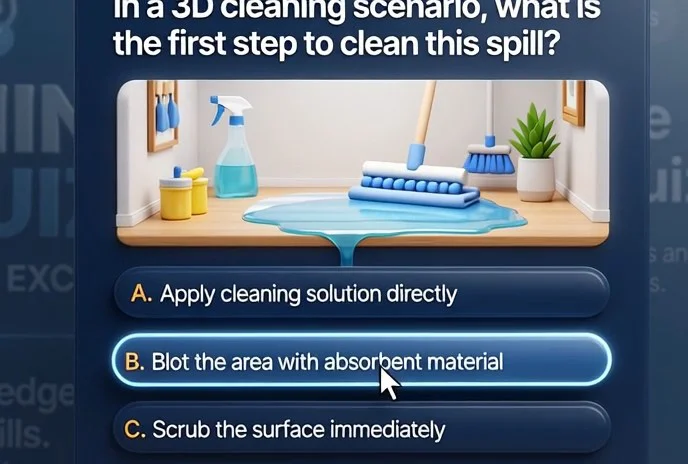
We address this need through short training quizzes embedded in the workflow. Gamification helps master the material without disrupting daily tasks, and you see the real knowledge level of your team.
This way, new products and services stop being "paper novelties" and turn into a source of steady profit.
What a Systematic Approach to Employee Development Provides
A systematic approach to employee development turns one-off trainings into an ongoing work process. Instead of forgetting half of what was learned within a month, the team reinforces knowledge in short portions and immediately applies it on the job.
This format delivers measurable results for the business: faster time-to-competency and more consistent service quality.
For new employees, the system means quick, stress-free onboarding. They don't drown in a flood of presentations and instructions but gradually master products and company standards at a comfortable pace. A newcomer starts adding value within the first weeks, not after months of trial and error.
Employee engagement grows thanks to the quiz format. Short interactive sessions, competition elements, and clear feedback hold attention better than long lectures or repetitive courses.
Employees return to the material not because they're forced to, but because the learning process becomes interesting.
A unified knowledge standard makes team performance predictable. When everyone follows the same rules and scenarios, there are fewer errors in client communication and internal operations. A manager doesn't have to double-check every detail — the team operates cohesively and confidently.
As a result, systematic training impacts several key metrics at once: fast onboarding of new hires, higher engagement, consistent skill levels, and fewer errors.
For the client, this isn't just a training expense but an investment in the predictability and efficiency of the entire team.
Training Formats for Different Team Tasks
Training on new products and services is a constant source of stress for the team: you need to remember dozens of specifications, understand client benefits, and quickly adapt to new sales scripts.
A regular presentation doesn't cut it: after a week, employees remember only a fraction of the material. A quiz forces the brain to actively process information, so knowledge sticks much longer.
But to make this work for the business, it's important to choose the right format for each specific team task.
| Format | For whom | What it delivers to the client |
|---|---|---|
| Classic test | New employees, knowledge base check | Quick control of material comprehension, automatic grading, clear statistics for each individual |
| Quiz with situational questions | Sales department, account managers | Practice handling typical objections, memorizing product benefits and differentiators, higher negotiation conversion |
| Dialogue simulation | Frontline staff, support service | Training responses to difficult questions without client risk, confidence and fewer errors in real communication |
| Gamified quest | Entire team before a product launch | Engagement, team spirit, reach: employees return to training on their own, compete, and discuss the product |
This table helps choose a format at the start, but the best results come from a combination: a short test for baseline checking, a quiz for objection handling practice, and a team quest for motivation at launch.
This way, training on new products and services becomes a systematic process rather than a one-off event.
We build such a system for your task: we analyze where the team loses knowledge, select formats, embed the quiz into the workflow, and give the manager a clear dashboard with each employee's progress. As a result, the product reaches the market faster, and the team meets clients fully prepared.
How We Launch a Training Quiz in 4 Steps
Launching a training quiz doesn't have to be long and opaque. We've packaged the process into four clear steps — you always know what's happening, who's responsible for what, and when the result will arrive.
-
Brief and scenario. We define who we're teaching and what: new products, services, service standards. We analyze what employees already know and where they most often make mistakes.
We propose a quiz structure with levels, questions, and feedback moments — you approve it before work begins.
-
Approval and branding. We show a prototype and the quiz logic, discuss the copy and tone. We integrate the logo, corporate colors, and company communication style.
As a result, the training looks like part of the internal culture rather than an external tool, so employees perceive it as their own.
-
Development and launch preparation. We build the quiz on a professional platform, configure access, and test it across different devices. You receive a link for distribution and a short instruction for employees — all that's left is to pick a convenient time.
-
Launch and technical support. On the start day, we're on call: we monitor load, quickly resolve user issues, and make adjustments as needed.
After completion, we deliver a report: who completed the quiz, which topics caused difficulties, and how much the team's knowledge level grew.
What's Included in the Delivered Quiz
When you order a quiz, you don't get scattered files but a ready-made tool for training employees on new products and services. The delivery package includes everything needed for launch, control, and further development — from content to its rights.
- Quiz content — questions, answers, and explanations tailored to your products. Everything is already loaded and verified: just send the link to employees.
- Launch instructions — short guides for the administrator and participants. It's clear how to proceed even if no one has seen the quiz before.
- Completion analytics — in the personal dashboard, you see each employee's results: time, scores, difficult questions. This is a ready-made report for the manager and a baseline for improving training.
- Game mechanics — points, levels, and leaderboards turn the test into a competition. Employees complete the quiz with pleasure, not just to tick a box.
- Content updates — if you release a new product, we make changes without reworking the entire quiz. Materials always match your current lineup.
- Rights to materials — the quiz, texts, graphics, and statistics belong to you. You can freely use them within the company and scale them to other departments.
- Post-launch support — we stay in touch and help resolve any quiz-related issues. You're never left alone with a problem.
Case Study: How a Quiz Boosted a Company's Sales
When a new product line hits the market, early sales depend on how quickly employees understand its advantages. Regular presentations don't provide the needed depth of immersion — knowledge remains passive, and managers get lost in conversations with buyers.
This was the challenge faced by TechnoLine, a major electronics distributor. The company approached us with a request: turn training on new products and services into an engaging process that would boost employee confidence.
We proposed a corporate quiz built on Unity — not just a test, but an interactive trainer with game scenes where managers practice typical customer situations.
Over four weeks, we worked with the client's team to assemble the content, mechanics, and hint system. Every quiz question was tied to a real objection or sales scenario.
Employees completed it at their own pace, and the results immediately showed which topics needed reinforcement.
The quiz's effectiveness exceeded expectations: a month after launch, the share of successful product launches grew by a third. Managers brought new products to market faster, spent less time on routine questions, and presented advantages more confidently.
The sales department head noted that training had stopped being a formality — the team itself was asking when the next quiz would arrive.
This training case demonstrates: gamification results show up not only in knowledge but also in financial metrics. When an employee is engaged in the process, they remember arguments better — and that directly converts into revenue.
What If I Have Specific Content Requirements?
Specific content requirements are actually the task we encounter most often. Every business explains its products and services in its own way, and a one-size-fits-all quiz doesn't work here.
That's why our first step is to dive into your industry: we analyze who the training is for, which work situations need to be covered, and what language your employees speak.
Industry customization starts with studying your experience and materials. If you already have a knowledge base, instructions, or presentations, we turn them into interactive scenarios — rather than the other way around, forcing live content into a ready-made template.
For banking staff, a retail chain, or field service specialists, we build different mechanics: from short quizzes with instant hints to complex case breakdowns with consequence-based choices.
How the training looks also matters. Design, tone of questions, difficulty level — everything is adjusted to your corporate culture and brand.
If needed, we use branded characters and real examples from your practice, and for non-standard formats we bring in development tools, including a meta-game on Unity, when the training needs to become a full-fledged game space.
In practice, it works like this: we propose a scenario built on your content, you see it before launch and make edits. No "black box" — every stage is approved, and you understand how the quiz teaches employees your specific rules and products.
This way, training becomes not a formality but a working tool that speeds up time-to-competency and reduces the number of errors.
So specific requirements are a plus. They mean you know exactly what result you need, and our job is to fit it into a clear, lively, and convenient mechanic.
Tell us about your content — we'll suggest a format that organically fits your training system and delivers a measurable effect.
Common Doubts When Ordering Training Programs
Before investing in training, every client asks the same questions: won't the quiz break at the most critical moment, won't the content become outdated, and who's responsible for the final result.
We address these doubts at the contract stage — we explain how we work on reliability and what we include in our guarantees.
What if a technical failure occurs during the launch?
We understand that a disrupted session means ruined training for dozens of employees.
That's why a duty technical specialist is on call on the day of the launch, and backup scenarios for the quiz are prepared: even in an unforeseen situation, participants will get access to the materials, and you'll receive a prompt report on what happened.
How is content updated if the product or service changes?
We build training quizzes so that updating information takes minimal time. You send us the new product data — we make edits to the questions, scenarios, and hints within a few business days. Employees always work with current materials, not the version you approved six months ago.
Who is responsible for employees actually completing the training?
We are. The contract specifies deadlines, format, and key metrics: number of participants, completion rate, engagement level.
If the quiz fails to launch or the metrics aren't met due to our fault, we fix it at our expense and extend the completion window so you can reach your training targets.
All terms regarding reliability, content updates, and contractor responsibility are fixed in the contract before work begins. You get not just "entertainment for employees" but a manageable training tool with clear risks. Quality guarantees and uninterrupted operation allow you to focus on business goals — quick team onboarding and growth in sales of new services.Ready to Improve Team Efficiency? Start with a Consultation
A team masters new products faster when training is built on engagement rather than boring lectures. But to launch such a program, you need to understand the business tasks, the audience, and the format.
That's why we start with a consultation — during it, we find out what results you want to achieve and how a quiz can help you get there.
Submitting a training request takes a couple of minutes. After that, you receive:
- A consultation with a gamification expert — we analyze your task and propose an approach scaled to its size.
- A cost estimate for your scope — a precise commercial proposal without hidden extras.
- A project plan with stages and timelines — you see when development starts and when the team gets the finished product.
- Quiz examples for your industry — we show what engaging training looks like in practice.
- Recommendations for employee engagement — we share mechanics that boost completion rates and material retention.
- Answers to questions about integration and support — we explain how the quiz will fit into your current processes.
Even if you're just exploring the format, the consultation will be useful: you'll get an objective view of training on new products and services in your company. Leave a request — an expert will contact you within one business day, discuss the details, and prepare an action plan. No obligations: you decide to start after you see the proposal.