

Effective Training for Operators of Industrial Equipment and Machine Tools
Every operator of industrial equipment and machine tools goes through an induction: rules, diagrams, safety procedures. Formally, this is training, but in practice it is passive listening and checkmarks in a logbook.
Complex operations and non-standard situations remain outside attention, and knowledge fades within a few weeks.
The result is mistakes that cost dearly: downtime of CNC machines, spoiled workpieces, breakdowns, and risks to employee health.
Managers see this but don't know how to hold staff attention on material that cannot be simplified to "press a button." Classic lectures and presentations create neither interest nor the habit of acting correctly.
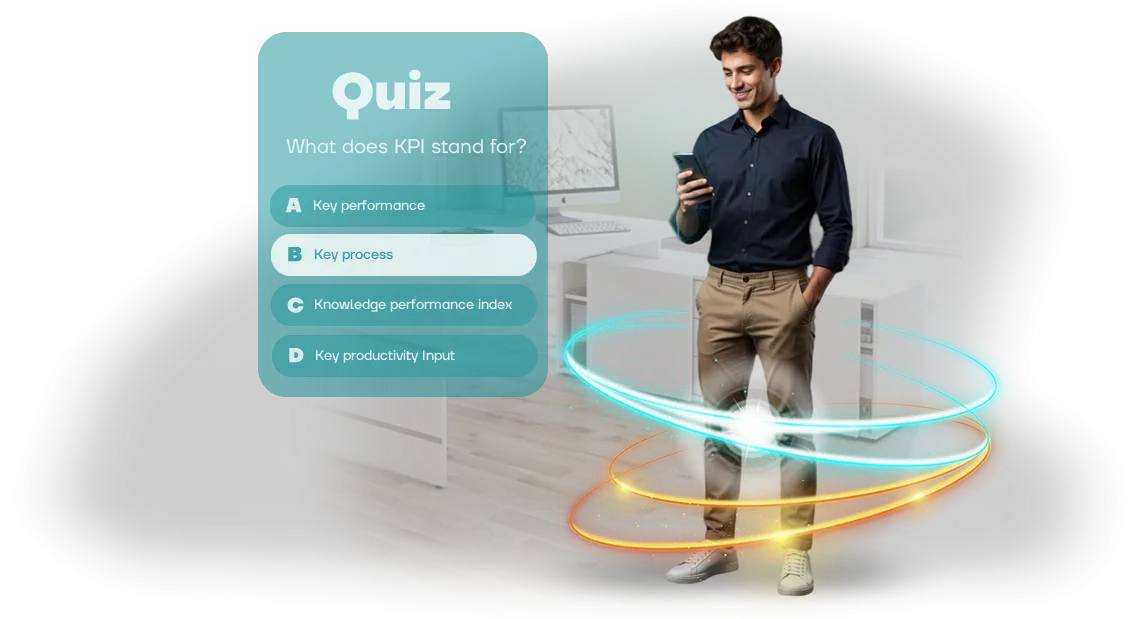
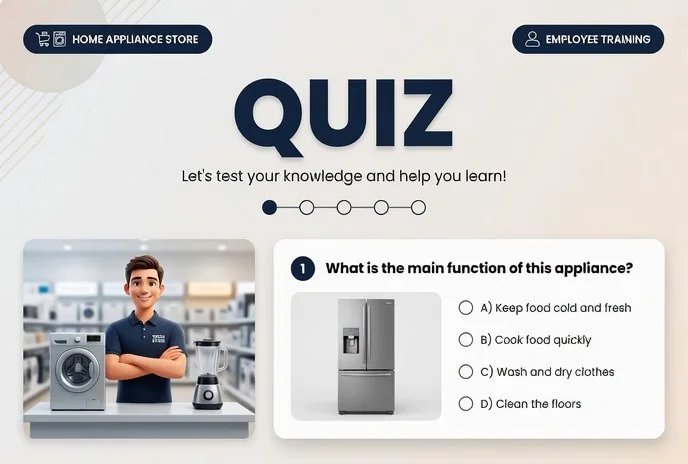
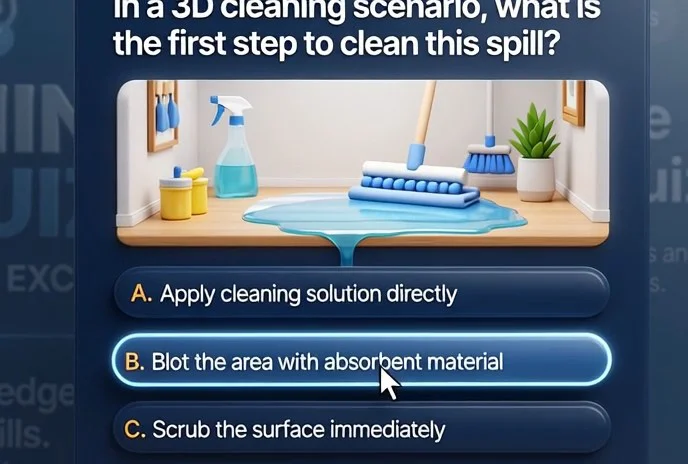
This is where a different approach is needed. When operator training turns into a live quiz with clear scenarios and instant feedback, employees engage in the process themselves.
They don't memorize by rote; they live through situations: starting the machine, setting parameters, emergency stop — and do it in a safe environment. Gamification helps reinforce algorithms through repetition, but without boredom.
We develop training quizzes for staff that work on your equipment and within your regulations.
Our platform, built on a professional game engine, allows you to quickly adapt material to specific machines and product lines, and employees can learn from a phone or computer.
You get not a "quest for entertainment" but a measurable result: fewer errors, faster onboarding of newcomers, stable quality of operations.
In the following sections, I'll show how such training works and what business metrics it improves after the first weeks.
What a Game-Based Approach Brings to Team Training
Operator training is not just about passing on instructions; it's a matter of safety, work speed, and the cost of error. On paper, an employee may know everything, but under the pressure of a real shift, they get lost and act out of habit.
A game-based approach turns knowledge into a sustainable skill: the employee lives through work situations before they happen on real equipment.
Reducing Errors and Downtime
Operator errors mean defects, machine changeover, and lost hours.
A quiz in game form makes it possible to safely simulate complex and emergency scenarios — the very cases that are hard to practice "in battle." The employee learns from their mistakes in a virtual environment and comes to the workplace already prepared for non-standard situations.
Faster Onboarding
Traditional training of a newcomer takes weeks: theory, observing a mentor, first timid steps. Gamification compresses this period: the newcomer remembers the sequence of actions faster because training is built on scenarios, not memorization. They reach independent work sooner and don't distract senior colleagues from their tasks.
Higher Engagement and Lower Turnover
A boring induction feels like an obligation, while game-based training feels like a challenge. Employees themselves strive to score more points, pass the next level, and overtake colleagues.
This is especially important for retaining new specialists: when the onboarding process is interesting, a person thinks less about quitting and faster feels like part of the team.
Gamification solves not only the task of "delivering information" but also the task of "making sure the information sticks and is applied." As a result, you get more stable equipment operation and a calmer management loop — people need less control and fewer reminders.
Formats of Quizzes and Game Modules for Staff
Operators learn algorithms, regulations, and actions in emergency situations — but everyone has their own pace and preferred format of perception.
Some need just a short quiz before a shift to refresh knowledge, while others need a story-driven game that plays out complex scenarios without risk to equipment. One universal format doesn't cover all these tasks, so we select quizzes and game modules for a specific goal.
Depending on the task, we use different mechanics: from quick checks at the start of the day to multi-step quests where the operator makes decisions and sees the consequences.
All of this is implemented in a single meta-game on a professional platform — the client gets a coherent training system rather than scattered tests. Below are the typical formats we work with most often.
| Format | For whom | What it gives the client |
|---|---|---|
| Short quizzes (5–10 questions) | For daily knowledge checks before a shift | Quick diagnosis of gaps, regular engagement without taking time away from work |
| Training quest with branching scenario | For new operators and complex topics | Deep memorization through real work situations, shortened adaptation period |
| Tournament between shifts and departments | For boosting motivation and healthy competition | Greater interest in training, team cohesion, clear reward system |
| Simulator game with machine navigation | For practicing algorithms in a safe environment | Errors on screen, not on the production floor — reduced defects and emergency situations |
| Combined track of several modules | For a comprehensive annual training program | Flexibility: change difficulty and topics to match each group's skill level |
Formats are easy to combine: for example, automatic short checks run before a shift, and a thematic quest runs at the end of the month.
We help you choose the optimal set for your specifics and budget, and after launch we refine the game to match changed regulations or new machines.
Stages of Implementing Game Mechanics in Production
Implementing quizzes in production is a process that must be predictable; otherwise training downtime costs a pretty penny. We structure the work so that you can see at every step what is happening: what has been approved, what is ready, when the launch is. We handle the technical part, and you control the content and timelines.
- Brief and audit of current training. First, we dive into your specifics: what operations operators perform, where they most often make mistakes, and how induction is currently structured. Based on this, we define goals and criteria by which we'll know the quiz is working.
- Scenario approval. We propose the question structure, number of levels, and progression logic — tied to real production situations. You make edits until the scenario is exactly what you need.
- Prototype development and demonstration. We show a working sample on one area or a typical operation. This is not a PowerPoint presentation but a live quiz that can be immediately assessed for convenience and correctness.
- Pilot testing with operators. We launch the quiz with a group of employees and collect their feedback and reactions. We find out which questions cause difficulties and which motivation works — and refine the scenario until it's ready.
- Rollout across all shifts. We deploy the quiz at workstations or via internal devices, involve mentors, and assign people responsible for completion. Training starts without disrupting the production rhythm.
- Support and development. After launch, we don't disappear: we analyze completion statistics, update questions to new standards, and help add scenarios as equipment changes. You get a tool that lives together with production.
This format removes the main fear — "what will happen in a month?" — and provides transparent control at all stages. At every step you get a clear result, not a pile of technical documents.
Scope of Delivery and System Support
We deliver not just a program, but a ready-to-use working tool that can be launched the day after implementation. The package includes everything you need — from installation and configuration to training your specialists in managing the system.
Every component has been pre-tested under working conditions, so you don't waste time searching for contractors or finishing touches.
- Installation and configuration on your equipment — nothing extra to buy or coordinate with IT.
- An intuitive admin panel: you add questions, change scenarios, and assign quizzes to employee groups yourself.
- Content updates to match your regulations: we adapt questions to company instructions and add topics as equipment changes.
- Technical support throughout the entire service life: we respond quickly, fix failures, and install updates.
- Training materials and instructions for administrators — your team will master the system in one day.
- Flexible access rights: managers see aggregated statistics, while employees see only their own results.
You get not a one-time delivery but long-term support. The system lives with production: equipment changes — quizzes are updated; new employees arrive — you simply extend access. We stay in touch so training runs smoothly and delivers measurable results.
Practical Results: Numbers and Facts
Machine-building plants lose money on every operator error: defects, downtime, changeover. Conventional training produces no measurable effect — after an induction, the employee goes to the machine and acts by intuition. A training quiz turns theory into practicing decisions before a mistake becomes expensive.
Case Study: Implementation at a Plant
We developed a quiz for operators of industrial equipment and machine tools at the Tekhnopark machine-building plant. Before this, training took three weeks, but new employees kept making mistakes in typical operations.
Instead of lectures, employees worked through emergency situations in a game format, learned to quickly assess risks, and choose the correct sequence of actions.
After two months of operation, production metrics changed. The number of errors during setup and operation fell by 40%. Reaction speed in non-standard situations nearly doubled — operators made decisions faster, and equipment downtime decreased.
What This Means for Business
Less waste means more output. Training stopped being a formality and became a tool that pays for itself within one production cycle. After the first stage, the plant expanded the program to three workshops and continues to train every new shift using the same quiz.
Now the client sees specific numbers: how many errors were eliminated and how much employee reaction speed increased. Training effectiveness is measured not by "checkmarks" in a logbook but by real production indicators.
How to Choose the Right Format for Your Task?
There is no universal format — the choice always depends on the specific task, production specifics, and employee skill level. It's one thing to run a quick knowledge check after an induction, and quite another to teach an operator to act in an emergency situation.
That's why before starting, we answer not "what quiz will we make" but "what problem should it solve."
Individual production requirements determine the mechanics and complexity. If strict regulations and safety standards are in place at the site, training should include situational tasks close to real conditions.
If the goal is to introduce new equipment, a short interactive story with questions at each step is enough. And if the goal is to reinforce a skill to the point of automation, you'll need a scenario with repeated attempts, different action options, and error analysis.
Therefore, before choosing a format, we clarify who will take the training, on what devices, how much time employees have, and how you will evaluate the result. The answers to these questions immediately eliminate unnecessary options.
For example, for line staff with limited access to computers, a short quiz on a phone works well, while engineers may need a full-fledged simulator with a step-by-step scenario.
We do this preliminary analysis for free. You send us your task — we suggest two or three suitable formats with justification, and you choose the one that fits your schedule and budget.
Only after that do we take your regulations, instructions, and real production cases so the content is as close to the actual work as possible.
The right format is not the trendiest one, but the one that solves your task without unnecessary complexity. So start with the problem, not a ready-made solution. Describe the current gap in your training, and we'll recommend the optimal option for your specifics.
Frequently Asked Questions About Implementation and Operation
Any implementation raises questions — especially when it comes to training operators of industrial equipment and machine tools. People are used to traditional inductions, and a new format can be unsettling.
So let's look at typical concerns: quiz stability, ease of use for employees, and our responsibility for the result.
We build the system so that it works even in the strictest plant conditions. Fault tolerance is built into the architecture: the quiz does not depend on external networks, and progress data is saved automatically. This means training won't be disrupted by a connection failure or an unexpected computer restart.
What happens if the internet goes out or the power fails during a session?
The quiz is designed to be independent of external connections. All materials are loaded onto the device in advance, so training continues even during network failures.
And if a session is interrupted due to equipment issues, progress is saved — the employee returns to where they left off and doesn't lose time.
Older employees haven't worked with such formats. Will it be difficult for them?
The interface follows the familiar "question — answer options" logic, like in mobile apps. Before starting, we run a short training session: 10–15 minutes and the person confidently works on their own. Additionally, hints and clear navigation are provided so that no one feels awkward.
What if employees go through the quiz formally, without engaging with the material?
We deliberately build in elements that prevent "skimming through": questions with error analysis, short cases, and repeats of difficult topics. If an employee answers incorrectly, the quiz explains the correct answer and returns to it at the end. This way knowledge is reinforced even when a person initially wasn't inclined to engage.
What do our guarantees include, and how do you support the system after launch?
We are responsible for the quiz's functionality at all stages: we test it on real devices and support the launch. After implementation, we stay in touch — we promptly fix issues and refine content.
For many clients, we provide scheduled updates so that questions always remain relevant for training operators of industrial equipment and machine tools.
Submit a Request for System Development
Training operators of industrial equipment and machine tools directly affects productivity: the faster an employee masters the regulations, the fewer defects and less downtime. But the format also matters — it must hold attention and help apply knowledge in practice.
We develop gamification systems and meta-games embedded in regular operator training. If you're unsure which option suits you, the first step is non-binding: we'll capture your task, prepare a proposal, and show how it works in a pilot project.
Submit a request for development — and after a short conversation you will receive:
- a cost calculated after audit, tailored to your tasks and team size — accurate and without hidden conditions;
- a solution presentation: quiz scenario, game mechanics, and connection to your production regulations;
- a pilot project plan: stages, timelines, success criteria, and measurable indicators;
- consultation on integrating the meta-game into your training system — we answer questions from your internal stakeholder;
- a selection of best practices in learning gamification for your industry — simple and without technical complexity.
You don't need to understand the technologies — we'll prepare everything in the language of your team and business. Submit a request to calculate the cost and get a pilot plan. The first step takes a couple of minutes.