

Training in project management and Agile/Scrum methodologies stalls
Companies annually invest significant resources in training on project management and Agile/Scrum methodologies: they order trainings, invite experts, and set aside working days.
But a month after the course, employees return to their old habits — deadlines slip, priorities get confused, tension grows in teams. Managers are baffled: why don't investments in development deliver results?
Projects stall, clients are unhappy, and employees themselves burn out from the number of new terms they can't apply.
The answer is that classic formats — lectures, webinars, multiple-choice tests — don't create staff engagement. People go through training formally, just to "check the box," and at work they act the old way.
Agile and Scrum are practice, not theory, so they can only be mastered through active actions, mistakes, and repetition. Traditional tests only check memory, but they don't build skills or offer a chance for reinforcement.
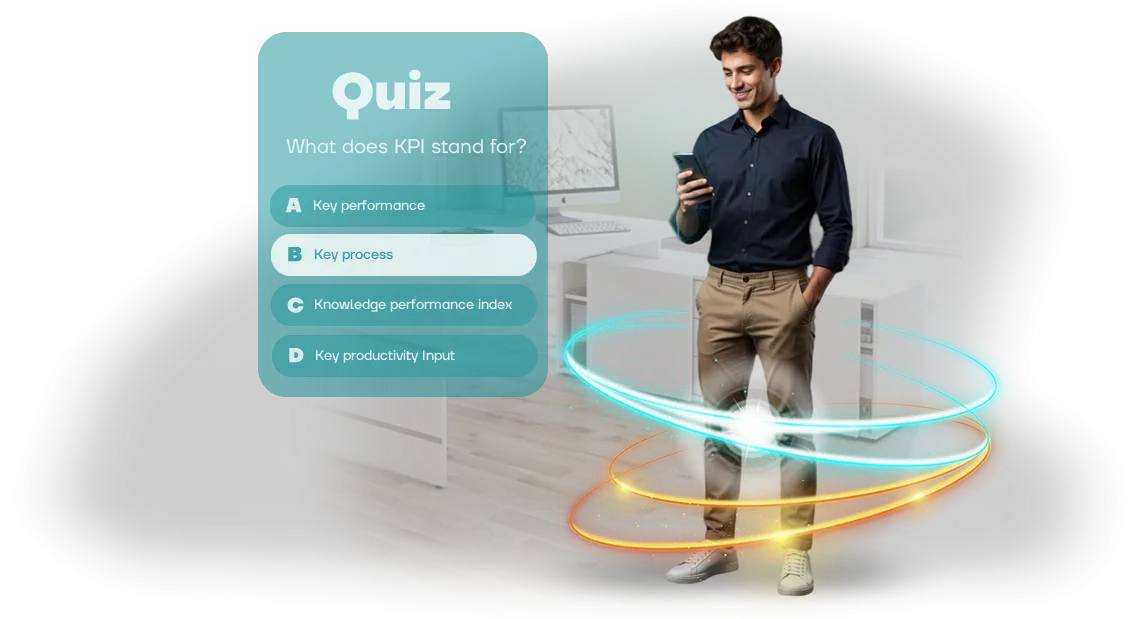
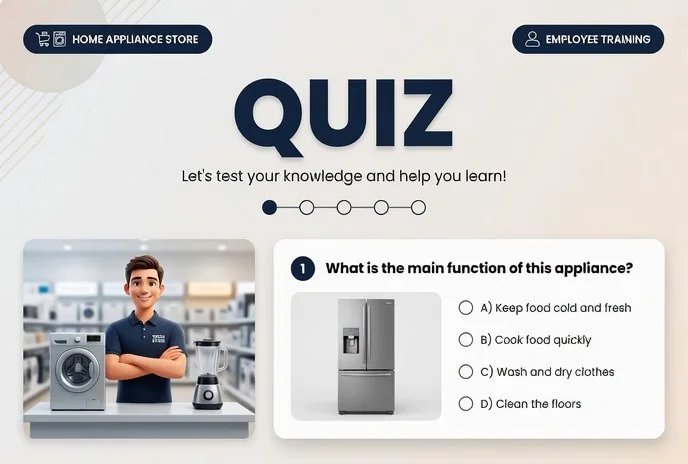
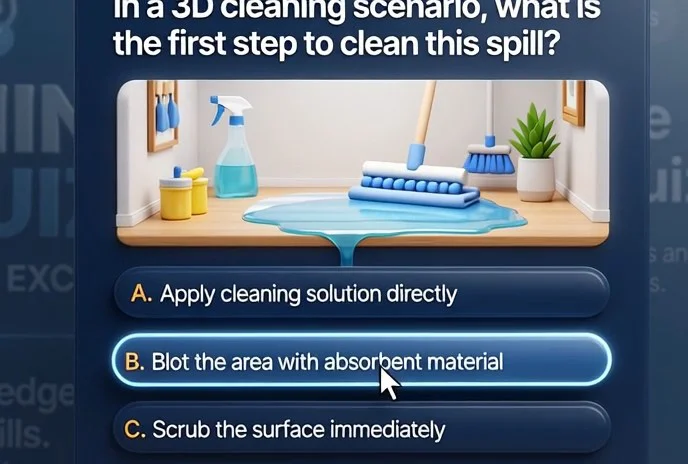
We close this gap with educational quizzes for employees. Short interactive scenarios fit into the work rhythm, require decision-making on real cases, and reinforce correct habits through game mechanics.
This way, agile scrum training stops being "cramming" and becomes part of the team's everyday practice.
Quizzes increase engagement, create healthy competition, and give the manager clear metrics of material comprehension — unlike one-off trainings where the result remains "somewhere inside."
What gamification and quizzes give employees and business
Training in project management and Agile/Scrum methodologies often turns into a mandatory formality: employees sit through lectures, and a week later they forget more than half of the material.
Corporate quizzes solve this problem — they turn training into a game where people want to win and understand the details. We develop such games on the professional Unity engine, ensuring stable operation on any device and a clear interface for participants. Here are the main benefits of training gamification for your business:
-
Team engagement. Game mechanics, points, and leaderboards create healthy excitement. Employees go through training not "for show" but with interest, returning to challenging topics on their own and helping colleagues. This strengthens team spirit and reduces turnover.
-
Hands-on practice. Quizzes are built on real project management scenarios: from goal setting to retrospectives. Participants apply their Agile/Scrum knowledge in a safe environment, learn from mistakes, and build skills until they become second nature.
-
Transparent knowledge assessment. After each quiz, the manager receives a detailed report: who has grasped the material and where the gaps are. This allows for targeted adjustments to individual employee development plans without additional tests.
-
Measurable results. You see the effect not in abstract "knowledge" but in real metrics: shorter task completion times, fewer planning errors, faster decision-making. Gamification pays off through increased project efficiency.
Quiz formats for your team's tasks
One universal format isn't always needed: onboarding, regular knowledge checks, and a long development program solve different tasks.
A quiz for a newcomer introduces the product and processes; for an experienced employee, it refreshes practice; for a manager, it shows the progress of the entire team.
We build quizzes for your scenario on Unity, so mechanics don't limit the goals: it can be a quick survey test, a live team quiz, or a series of levels for a quarter. In every case — clear analytics for you and an engaging format for employees.
| Quiz format | For whom | What it gives the client |
|---|---|---|
| Short online quiz for newcomer onboarding | New employees in their first working days | Fast immersion in regulations and methodology — the newcomer starts working without "battling documentation" |
| Regular employee knowledge test | Project teams, sales and support departments | Gaps in Agile/Scrum understanding are visible before they affect deadlines and work quality |
| Large-scale development program | All departments, including remote | Long-term engagement: employees complete levels, compete, and management sees company-wide dynamics |
Formats are easy to combine: start with an onboarding quiz, add a monthly knowledge check, and turn the results into a team leaderboard. This way, training becomes part of the work process rather than a one-off event.
How we develop quizzes: a transparent process
Developing a turnkey quiz isn't just about writing questions and answers. It's a structured process in which every stage brings you closer to the main goal: ensuring employees actually absorb the Agile/Scrum methodology and apply it in their work projects.
We handle everything — from defining the task to launch and ongoing support — and at any moment you understand what's happening and what comes next.
The key principle is transparency at every step. We document agreements, show intermediate results, and collect feedback. So the final product isn't a "surprise" for the internal client, but a system that solves your specific business task.
Quiz development stages
- Brief and context immersion. We study the training program, course materials, and employee profiles. We determine which Agile/Scrum knowledge needs to be tested first.
- Scenario and structure development. We design the quiz logic: number of topics, difficulty levels, question types. We think through how gamification will motivate completing the training. Here we also set timelines and team composition.
- Content creation. Methodologists turn dry project management theory into engaging cases. Questions are phrased in your company's language so employees recognize their own work situations.
- Implementation and assembly. Programmers build the quiz on a professional game engine and integrate it into the learning management system or launch it as a standalone application. Designers adapt the interface to your corporate style.
- Testing and launch. We verify the scoring logic, question accuracy, and operation on different devices. After your approval, we publish the quiz and grant access to employees.
- Analytics and support. We track completion results, collect error and engagement statistics. On request, we expand the quiz with new questions or adjust the scenario.
Head of training department: "It was important for me to understand what happens at each stage and when the result would be ready. The team sent clear status updates without technical details, and we approved the final quiz on the first pass. It's very convenient when you're guided from idea to a working tool."
What's included in the delivery of the ready solution
You receive a ready-made solution that doesn't require hiring developers and launches in a short time.
The package includes everything needed so that the project management and Agile/Scrum quiz fits organically into your training system and delivers results immediately after implementation.
- Ready-made Agile/Scrum quiz — questions on roles, events, artifacts, and real work situations. Employees test their knowledge in a game format, and you see an objective picture of team readiness.
- Corporate style customization — logo, brand colors, team names. The quiz feels like part of your brand, not a third-party tool, which boosts engagement.
- Reports for HR and managers — automatic statistics for each employee and department: who completed it, where they made mistakes, which topics lag. No need to manually collect results and guess who needs additional training.
- Integration with your learning management system — results sync with the LMS, employees take the quiz in their familiar environment, and HR gets all data in one window without extra effort.
- Instructions for the organizing team — a step-by-step guide for launch, timing setup, participant distribution, and final reporting. Even an employee who has never run such events can handle it.
- Support and updates — we adapt questions to changes in your processes and methodology. The solution stays relevant even after a year without requiring new development.
In the end, you get a tool that saves hours of HR work, makes training interesting for employees, and gives management a clear picture of knowledge levels. All that's left is to set a date — everything else is ready to launch.
Case study: how we implemented Agile/Scrum methodologies in a team
When the retail chain "MarketLine" approached us, its teams formally knew Scrum, but in practice continued to work the old way: decisions took weeks to approve, and sprints fell apart due to misunderstandings about roles.
Managers wanted to see real changes in employee behavior, not just a test score. We proposed not another lecture, but an educational quiz embedded in the work process.
Employees went through short scenarios from their daily routine: how to properly run a daily stand-up, what to do in a priority conflict, how to quickly adapt a sprint plan.
Each answer immediately showed which Agile/Scrum practices are applied in real work and which remained theory only. To drive engagement, we used game mechanics: points, team leaderboards, and non-judgmental error review — this removed the fear of trying something new.
Results were measured after three months. The share of teams regularly holding daily stand-ups grew from 40% to 85%, and decision approval time dropped by a third. The number of successfully completed sprints increased by 25% — without hiring new employees or changing tools.
Most importantly, there was a mindset shift: employees began proposing process improvements themselves and taking responsibility for results.
The chain was so convinced of the approach's effectiveness that it ordered additional modules for new departments and included the quiz in its onboarding program. Today, Agile/Scrum training in the company is built not on theory but on regular practice supported by our system.
How to choose a quiz format for your company's task?
Choosing a quiz format starts not with the question "which test is more interesting" but with the task the company is solving.
It's one thing to quickly introduce new employees to the basics of Agile and Scrum, another to regularly keep the team's knowledge sharp, and a third to launch large-scale training with deep immersion in the methodology over several weeks.
There is no universal solution, so we select a format based on three parameters: training goal, audience size, and check frequency. If you need to shorten time-to-productivity, a short onboarding quiz focused on key terms and processes will work.
If the task is to systematically build competencies of existing teams, we choose modular quizzes that fit into regular meetings or sprints and don't require dedicated time.
When it comes to a large-scale training program or launching a new methodology in the company, we offer a series of quizzes with increasing difficulty and scenarios from real project situations.
This format doesn't just test theoretical knowledge — it teaches applying Agile and Scrum in practice, which directly affects the speed and quality of team work.
If you're unsure between formats, we'll analyze your task for free: we'll ask who will take the training, what results you want to measure, and how much time employees can allocate to the quiz.
Based on this, we'll propose an option that delivers a measurable effect without overloading the team or incurring unnecessary development costs.
Addressing concerns before launching a development program
Questions before launching a development program are a normal stage for any manager. We hear the same concerns from clients: employees won't complete the training, the content will quickly become outdated, and the result can't be measured.
That's exactly why the employee quiz is designed to ease these fears from the start rather than create new ones.
Won't employees skip the quiz?
We design the quiz so it meets employees where they are. Short 5–7 minute rounds, clear wording without complex theory, and instant feedback — people see their progress and want to take the next step.
If someone struggles, the system offers hints and returns them to the material instead of leaving them alone with a mistake.
Will the content become outdated after launch?
Agile and Scrum methodologies evolve, so the quiz isn't a static test but a living tool. We build in the ability to quickly update questions and scenarios without reworking the entire system.
You decide when to add new cases or update existing ones — and this doesn't require developer involvement.
Isn't the result impossible to measure?
Every quiz launch gives you a transparent picture: who completed it, which topics caused difficulty, where employees make mistakes most often. You see team progress over time, by department, and by individual employee.
This data forms the basis for HR decisions and development plans — without guesswork or rough estimates.
We don't just make a quiz — we take responsibility for its operation in your learning environment. If questions arise at any stage, the support team is available. For us, the guarantee of results isn't empty words but working mechanics proven across dozens of corporate programs.Launch a program employees will complete to the end
Submitting a request for development means shortening the path from idea to a working corporate quiz. We don't ask for a ready-made technical specification: a consultation is enough to understand the task and propose a solution.
We work remotely throughout the entire process: you don't need to visit an office or coordinate contractors. All stages — from the first call to launch — follow a clear plan that you see immediately after approval.
Within one business day of receiving your request, we get in touch, schedule a short call, and clarify which development program you want to launch.
Then we prepare the project management and Agile/Scrum quiz scenario, adapt the difficulty for different roles, and agree on launch dates.
By submitting a request, you get:
- a consultation with a gamification expert: we'll help you define goals and choose a format;
- a short questionnaire instead of lengthy negotiations;
- sample quiz questions that cover the topics you need;
- a calendar plan for launching the development program — clear on what happens and when;
- a solution presentation for internal approval with management.
Typically, a few weeks pass from the first call to a working version. It depends on the number of questions and participants, but at the initial stage you see specific dates and can influence the schedule.
Submit a request on the website or write to us in a messenger — we'll start with a consultation and show a working prototype within a couple of weeks. You'll quickly start your development program, and employees will complete it to the end.