

Preparing Telecom Operator Employees for New Systems
When a telecom operator implements a new IT system — billing, CRM, internal portal — the main risk is not the technology but the people.
Employees accustomed to working the old way make mistakes in the first weeks: they fill out requests incorrectly, take a long time to find the needed function, and answer subscribers with pauses.
The customer feels the drop in service quality, gets frustrated, and can easily switch to a competitor — in telecom, switching takes just days.
The cost of unpreparedness consists of direct losses: support line downtime, increased call handling time, and repeat inquiries due to incorrectly performed operations. Fixing the consequences of errors costs several times more than timely employee training.
At the same time, classic instructions and presentations don't work: information is forgotten after a few days, and practical skills aren't reinforced without regular practice.
Properly structured staff preparation minimizes the adaptation period to a new system. An employee doesn't fear the interface, confidently performs their tasks, and the subscriber receives a fast and accurate response.
Training in the format of quizzes and game scenarios allows practicing typical situations without risk to business processes, while the competitive element holds attention and motivates returning to the material.
We help telecom operators solve this challenge: we develop training quizzes that integrate into the process of implementing new systems.
Employees memorize regulations and action algorithms through practice, and management gets a measurable result — fewer errors, compliance with service standards, and preserved subscriber loyalty.
What You Get from Training Quizzes and Gamification
Telecom operator employees learn new systems under pressure: they need to quickly understand the interface, maintain service quality, and not fall behind on current tasks. Regular lectures and instructions don't work here — information is forgotten after just a couple of days.
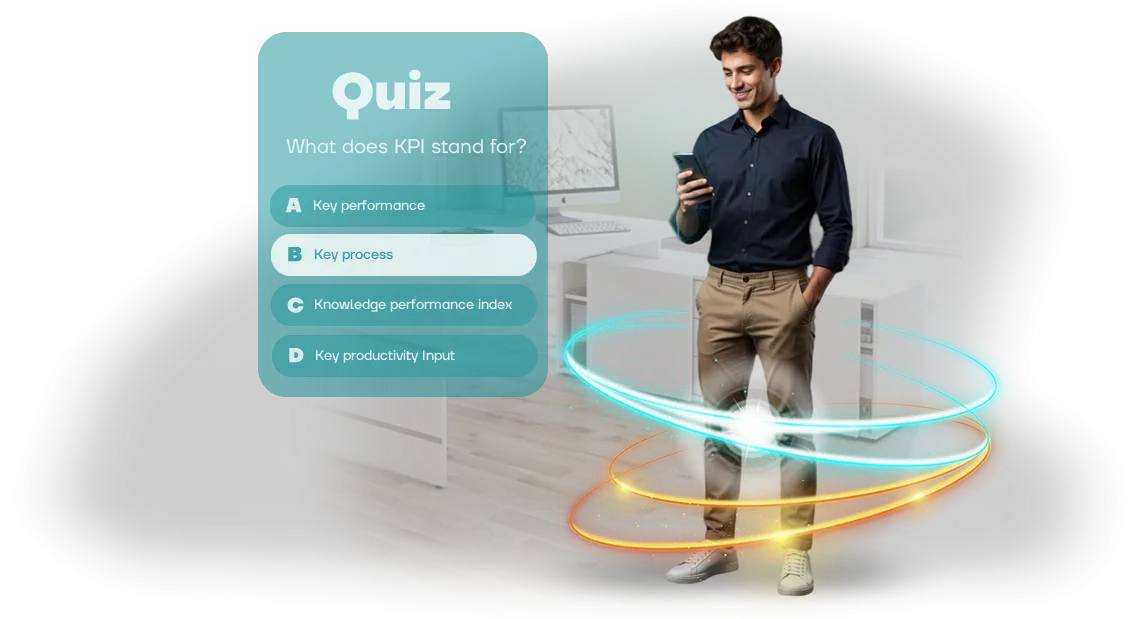
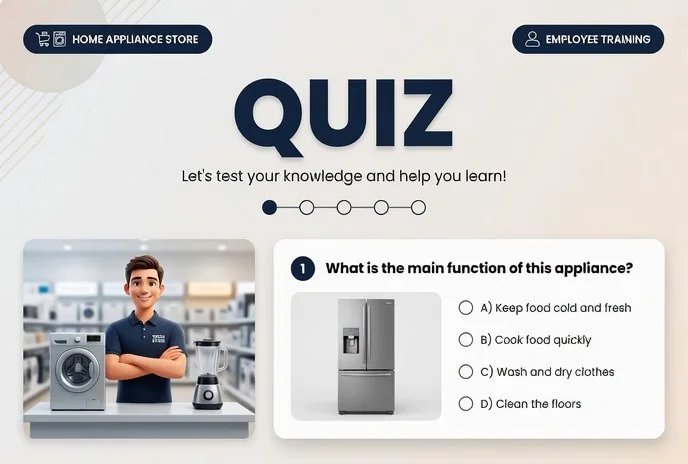
Training quizzes turn the process into short game sessions that employees complete at their own pace, while knowledge is reinforced through repetition and a competitive element.
Gamified training delivers measurable results: new employees reach working proficiency twice as fast because instead of reading regulations, they immediately practice scenarios on real cases.
Experienced employees also engage in the process — interesting questions and leaderboards motivate them to refresh their knowledge without reminders from their manager.
The manager, in turn, gets a clear picture: who has already figured things out and who needs additional support.
The main benefit is fewer errors. When an employee completes a short quiz before working with a new system, they are less likely to hit the typical situations that previously created queues and complaints.
This directly impacts service quality: customers get solutions faster, and the operator doesn't have to fix the aftermath.
In the end, you get a tool that works toward several goals at once: it accelerates adaptation, increases staff engagement, reduces the number of errors, and strengthens the company's reputation.
We tailor the mechanics to your specifics — from question content to game frequency — so that training becomes a natural part of work rather than an additional burden.
Training Program Formats for Your Task
A new system at a telecom operator means dozens of regulations, interfaces, and scenarios that employees need to master without losing the quality of their current work.
There is no universal training format: one thing is quickly familiarizing the team with new rules, and another is practicing complex practical situations to the point of confident action.
That's why we offer a spectrum of solutions — from a simple quiz for employees to educational games and full-scale gamification on Unity.
We select the format based on your specific task. The table below shows the main options and the business value each one provides.
| Training format | For whom | What it gives the client |
|---|---|---|
| Short quiz for employees | For the entire team when you need to quickly check knowledge after an instruction session | Instant knowledge snapshot and minimal work time investment |
| Quiz with points and levels | For departments where it's important to maintain interest in training | Employees compete and return to the material on their own |
| Educational game on Unity | For complex systems that require hands-on practice | Mastering scenarios without the risk of errors in real work |
| Meta-game on Unity | For company-wide large-scale changes | Full immersion in the new system and connection of knowledge across all departments |
If the goals are broader — for example, transitioning the entire company to a new system — we combine formats into a unified training program.
An employee progressively moves from a light quiz to complex game scenarios, and you see progress for each participant and across the department as a whole.
How We Create Turnkey Training Quizzes
Developing a training quiz for employees is not just about "writing questions and answers." You need people to genuinely absorb the new processes and start applying them in their work, not just formally pass a test.
That's why we've structured the process so that you see intermediate results at every stage, can make edits, and know exactly when the quiz will be launched.
-
Brief and task immersion. We study which systems are being implemented, who will be trained, and which specific work scenarios need to be practiced. You tell us about the training goals; we propose quiz formats and mechanics.
-
Scenario and gamification plan. Based on the brief, we create the structure: storyline, levels, question types, points system, and feedback. We align the overall concept so the quiz is engaging and matches the corporate style.
-
Content approval. We show you the questions, answer options, and explanations. Together with your experts, we verify the accuracy of the phrasing so that training helps employees understand the nuances rather than memorize formal definitions.
-
Development and assembly. We build the quiz into a unified game space and configure adaptation for computer and smartphone screens. We connect the results tracking system — you'll see who has completed it and who hasn't.
-
Pilot launch. We test the quiz with a small group of employees. We check whether the tasks are clear, whether technical issues arise, and how long completion takes. We make adjustments and approve the final version.
-
Company-wide launch. We provide access, instructions, and a short cheat sheet for employees. You get a ready-made tool that can be launched at any moment — even on the day of the new system's release.
-
Support and updates. After launch, we stay in touch: we help with technical questions, analyze results, and add new questions or scenarios if company processes change.
This approach allows you to calmly prepare staff for changes without last-minute chaos and stress. You always know what stage the project is at and get a working quiz within the agreed timeline — with minimal effort on your side.
What's Included in the Delivery: Complete Package
You get not just a game, but a fully ready-made solution for employee training. We handle the development, configuration, and handover of all materials — all you need to do is set a start date and invite the team. Everything needed for launch and control is already included.
The delivery package includes:
- A ready-made quiz or game tailored to your training goals. Employees complete training without leaving their work and without complex instructions.
- An admin panel for content management. Change questions, update scenarios, add new topics on your own — no developers or approvals needed.
- Training reporting. Managers see who has completed the training, which topics caused difficulties, and how prepared employees are for new systems.
- Instructions and guidelines for administrators and participants. Launch training in a day without special preparation.
- Support and technical assistance. We help with launch, answer questions, and refine the mechanics.
- Corporate-style branding. The quiz looks like part of the internal culture — this boosts engagement.
- Knowledge reinforcement materials. Cheat sheets and breakdowns of typical errors help retain results.
The entire package is wrapped into a unified system that easily integrates into your processes. You control the training, see results for each employee, and rely on data to make decisions about further team preparation.
Case Study: How We Trained a Call Center Team in Two Weeks
When a telecom operator was implementing a new system for working with subscribers, the training department faced a challenge: prepare a hundred call center operators in two weeks.
Lectures and instructions weren't working — employees got confused in the scenarios, and the first days after launch threatened to fail. Instead of boring presentations, we proposed a gamification case: a quiz that simulates real customer inquiries.
Instead of memorization tests — a competition. Operators worked through scenarios: subscribing to a service, handling a complaint, resolving a technical issue. Correct decisions earned points, and mistakes showed exactly where the material needed reinforcement.
The excitement and visual clarity accelerated learning: the team revisited difficult topics on their own to climb the leaderboard.
The quiz results exceeded expectations. Within two weeks, the average call handling time dropped by a third, and the Net Promoter Score (NPS) rose by 12 points.
Errors when working with the new system decreased by half — operators stopped double-checking with colleagues and confidently led conversations. A repeat order for training the next group confirmed that the training's effectiveness is measurable.
This case demonstrates how gamification solves a real business problem. We didn't just make a quiz — we built a process so that employees learn quickly and you get a measurable result. Want the same for your team? Tell us about your task — we'll propose a solution.
What If You Have Specific Training Requirements?
We understand that every telecom operator has its own specific requirements: unique business processes, regulations, and internal terminology.
A ready-made "off-the-shelf" quiz usually doesn't account for this, and training turns into a formality — employees mechanically pass the test but remain unprepared to work with the new system.
That's why we offer an individual approach: quiz adaptation starts not with a template but with studying your materials — instructions, briefings, and recordings of real interactions.
We embed your terminology and process logic into the questions, so employees train on the situations they will actually encounter in their work.
Non-standard scenarios — such as rare failures or complex customer requests — are also practiced through game mechanics rather than just as a text question.
We also handle LMS integration separately: the quiz can be embedded into your distance learning system, with result and access transfer configured.
If there are technical constraints — we work within your framework, offering a simple and reliable launch option without unnecessary approvals.
In the end, you get training that looks as if it were written specifically for your company — because it was. Before launch, we run a pilot with a small group, collect feedback, and make edits before the quiz goes to all employees.
This eliminates the risk of "it won't resonate" and guarantees that the result is exactly what you expected.
Frequently Asked Questions About Gamification and Quizzes
Clients often ask the same things: how long development will take, how difficult it is to integrate the quiz into current training, and what happens to the results after launch.
These are normal questions — gamification changes the familiar format, and it's important to understand the risks before starting.
We've gathered answers to the main objections. If your question isn't in the list — just write to us, and we'll share details for your project.
How long does it take to develop a quiz?
A standard project takes from two weeks to two months — it all depends on the number of questions, scenarios, and the format (a simple quiz or a complex game with levels). Deadlines are fixed in the contract, so you know the exact launch date from the very beginning.
If you need it quickly — we'll build a minimal version for one course and then expand it with new modules.
Is it difficult to integrate the quiz into the current training system?
No. The quiz works as a separate module that connects to your LMS or launches via a link. Employees don't need to install additional software — everything opens in the browser.
Implementation doesn't require changes to your infrastructure. We configure the integration ourselves and help with the first launch.
What guarantees are there that employees actually absorb the material?
The guarantee rests on three elements. First — well-designed mechanics: the quiz uses spaced repetition and scenarios close to real tasks. Second — monitoring: before and after completion, we show the knowledge dynamics for each employee. Third — analytics: you see which topics are poorly absorbed and adjust training in time.
Based on project experience, engagement in this format is several times higher than in regular tests, and repeated attempts close knowledge gaps.
What if employees don't take the game format seriously?
We avoid "just a quiz." The mechanics include team competition, points, and error breakdowns — this encourages participation even among skeptics. For managers, there's a separate screen showing each department's progress.
As a result, employees see the quiz as a work tool, not entertainment. You get a measurable outcome, not just time spent.
What happens after launch? Is support provided?
Yes. We support the project after launch: update questions, add levels, monitor stability. If new systems or regulations appear — we expand the quiz without stopping the training.
Your personal manager stays in touch. Any edits are made according to an agreed procedure — you're never left alone with the product.
If you have any remaining questions — ask us directly. We'll respond within one business day and show examples of similar projects.Shall We Discuss Your Task? Get a Training Plan for Your Workflow
To prepare employees for a new system, it's important not just to provide material but to embed training into the working rhythm.
Every company has its own workflow: some have only a couple of days for a course, others need to split the program over weeks and account for shift schedules. That's why we start not with a presentation but with an analysis of your task.
Leave a request for development — and within one business day, we'll send a preliminary training plan tailored to your task. We'll discuss goals, audience, timeline, and format, then prepare a cost estimate and propose options that can be immediately built into your workflow.
Here's what you'll get after a short conversation:
- Analysis of the task and audience — which scenarios need to be practiced first.
- A preliminary training plan — stages, formats, and duration aligned with your workflow.
- Cost and timeline estimate — a transparent breakdown without hidden work.
- Gamification recommendations — how to hold attention and increase engagement.
- Integration consultation — how to fit the course into employees' schedules without disrupting processes.
- The next step — a demonstration of the approach and answers to questions, if everything suits you.
No obligations on your part — just a conversation that will save you time. Leave a request, and we'll show you how to make training clear and convenient for your employees.