

Interdepartmental Competitions: Where Does Engagement Get Lost?
Employees get bored at standard trainings: lectures and mandatory tests don't spark interest, and engagement drops within the first minutes. Knowledge doesn't stick or get applied at work — corporate policies and new skills are quickly pushed aside by day-to-day urgencies.
The whole company suffers as a result: training brings no measurable outcome, and departments stay disconnected.
Instead of knowledge sharing and healthy competition, we see teams working in isolated "bubbles" — each department is busy with its own tasks and doesn't feel part of a shared result.
Motivation drops too: employees treat training as a formality to "sit through." Gamification and a competitive element change the picture — when knowledge is tested in a game format between departments, excitement and the drive to win kick in.
our team helps solve this pain: we design educational quizzes and a corporate meta-game that turns routine training into an event, uniting teams and boosting overall engagement.
What Does an Educational Quiz Deliver to Your Business?
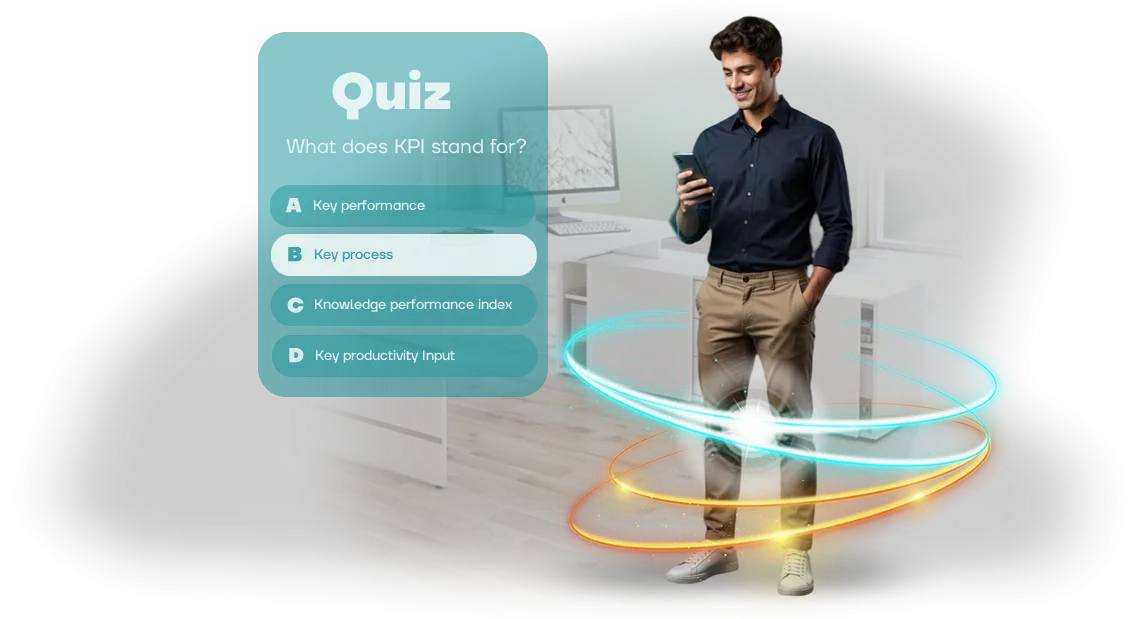
Competitions between departments turn dull training into a game where everyone wants to show results. An educational quiz from our team is not a checkbox exercise but a tool that changes employees' attitude toward knowledge and delivers a measurable impact for the business.
Genuine Interest in Learning
When colleagues compete, learning becomes exciting. Instead of passively watching lectures, employees search for answers on their own, discuss questions, and prepare for upcoming rounds. This works better than mandates to complete courses.
Engagement rises, and knowledge sticks naturally — through team discussion and the desire to win. People remember the material not because they "have to," but because it's interesting.
Uniting Departments
Competition between departments brings the team together around a common goal. Participants help each other, share experience, and see colleagues in a new light — this strengthens working relationships and eases tension between departments.
Team building happens naturally, without offsites or trainings. Healthy competition creates a positive atmosphere, and after the quiz colleagues discuss the results and look forward to the next round.
Transparent Knowledge Assessment
Managers get an objective picture: which topics have been mastered, where the gaps are, which team performs stronger. Quiz results are easy to use for planning corporate training and targeted motivation — rewarding strong performers and supporting those who lag behind.
Employees see that their efforts are noticed and evaluated fairly. This builds trust in training and reduces resistance to new programs.
In the end, the quiz solves three tasks at once: it engages people in learning, unites teams, and gives management clear numbers for decision-making.
Quiz Formats: From Quick Quiz to Meta-Game
The choice of format isn't about technical complexity — it's about what effect you want from training. Some teams just need a short poll at a stand-up, while a real competition between departments calls for an entire game universe with points, levels, and a shared leaderboard.
We build quizzes from simple to complex: from fast quizzes to a meta-game on Unity, where teams battle for the title of the best. Each format solves its own task — from "quickly check knowledge" to "build a system of ongoing competition and engagement."
| Format | Who It's For | What It Delivers |
|---|---|---|
| Short quiz (5–10 questions) | Launching training, warm-up at an all-hands meeting | Quick knowledge snapshot, easy employee engagement, clear start without lengthy preparation |
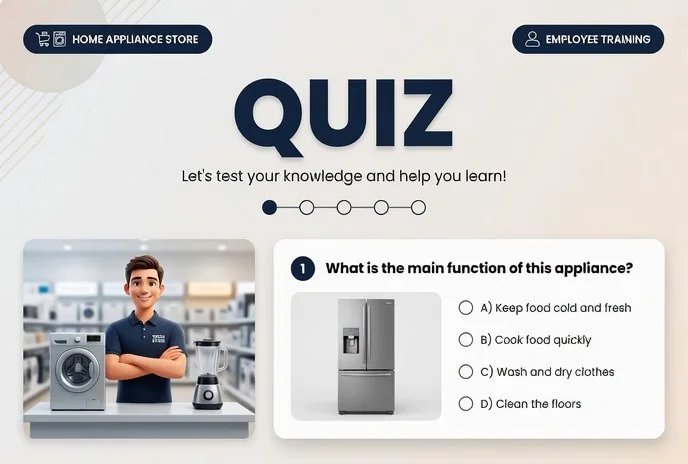
| Team quiz with rounds | Competitions between departments, corporate events | Excitement, healthy competition, team cohesion, and clear statistics on each department's results |
| Meta-game on Unity | Long-term training programs, quarterly championships | Sustained engagement, branded game environment, automatic result tracking, and growing interest in learning |
We'll advise which format will deliver the maximum impact for your task and adapt the quiz to your company culture.
How the Project Works: Stages and Timelines
A clear process is half the success of any project. We've broken the work into six stages so you always know what's happening, what decisions are being made, and when the result will be ready. No vague "work in progress" — only transparent steps with fixed checkpoints.
- Brief. We meet and discuss the goals: which departments participate, what competition format to use, how to measure success. We draft a technical specification in business language.
- Script. We prepare the quiz questions and mechanics: topics, difficulty, scoring rules. You receive a ready script for approval.
- Approval. We discuss the script and make revisions. You approve the final version — and we move to development.
- Development. We build the quiz on a reliable platform that works steadily even under heavy load. We test all scenarios so nothing fails on launch day.
- Launch. We deploy the quiz for employees, train the administrators, and provide instructions. The launch runs under our supervision.
- Support. After launch, we stay in touch: we quickly resolve participant questions, collect statistics, and help run the next rounds.
The entire project from brief to launch typically takes 2–3 weeks. You get a working competition system that unites teams and boosts engagement — no firefighting or extra approvals required.
What's Included in the Quiz Delivery
You get not just a program but a ready-to-use tool that can be launched within a few weeks. The delivery includes everything needed — from scripts to analytics — so your team can run interdepartmental competitions without hiring contractors.
- Quiz script tailored to your format. We prepare the questions and game logic around your company's goals: knowledge checks, product onboarding, team bonding. You get a ready-to-run storyline.
- Employee app on Unity. This is the program teams open on work computers or tablets. The interface is simple and intuitive — no manual needed to start playing.
- Analytics dashboard for managers. After each round, you see results by department: who's leading, where the gaps are, which topics need review. Analytics brings transparency and fuel for healthy competition.
- Instructions for administrators and participants. Short, clear guides on how to launch the quiz, grant access, and run the final. No guesswork — every step is laid out.
- Branding to match your style. The logo, color scheme, and competition name are built into the interface. Employees see their own corporate style, not a "foreign" program.
- Prize options and reward rules. We offer motivation mechanics and ready-made announcement texts so you can quickly kick off the competition and get departments interested.
- Technical support at launch. We help with setup, run a test launch, and answer the team's questions — before the quiz goes live.
This package lets you run the competition turnkey: no need to assemble a dev team or dig into technical details. Just appoint a person in charge — and within a couple of weeks, departments are competing.
If needed, we'll update the questions and mechanics for new company goals — extended delivery is discussed separately.
Case Study: Competition at a Large Company
A large retail chain with 200 employees across three departments — retail, logistics, and customer service — came to us with a typical pain point: fewer than a third of the team completed standard training.
Employees kept putting off courses, motivation declined, and managers couldn't see who was actually engaged. We proposed turning training into a competition between departments: quizzes with a shared rating, team points, and prizes for top results.
We launched a meta-game on our gamification platform — no complex integrations or software installation.
Each department saw its progress in real time, and the competitive spirit did what standard courses usually can't: employees reminded each other to complete the next stage so they wouldn't let the team down.
| Metric | Before Launch | After Launch | Impact |
|---|---|---|---|
| Training completion | 32% | 91% | 2.8x growth |
| Active participants | 40 people per week | all 200 employees | engagement +60% |
| Average test score | 61% | 88% | knowledge quality +27 p.p. |
| Requests for new content | a few isolated ones | 14 from managers | systematic interest in learning |
The company got more than just "completed training" — it got measurable knowledge growth and team spirit. A month after the competition ended, the client came back asking for the next season — this time for six departments. For us, repeated orders are the strongest proof that gamification works over the long term.
Answers to Common Questions About Gamification
We understand that adopting gamification raises questions for business owners and managers: will it disrupt workflows, how will it affect timelines, and will it be complicated for employees? We answer directly — no jargon, no fluff.
Is it too complicated to launch a competition between departments?
No. The quiz runs in the browser on computers and phones — nothing needs to be installed or paused for training. Simply send employees a link, set up access for each department, and announce the start. Preparation takes just a few days: we agree on the rules, design, and timeline together with you.
How much time does development and launch take?
A typical project takes two to four weeks. We gather the brief, prepare questions based on your materials, set up the overall style, test everything, and hand over a working link.
The competition can run from a few days to several months — we flexibly adapt to your plan and goals.
Can the system work alongside our internal tools?
Yes. The solution runs autonomously and doesn't require access to your servers or databases. If needed, we can set up result exports in convenient formats for reporting or integrate with your corporate portal via standard integration methods. You won't have to rebuild existing processes.
How do we evaluate results without overpaying for extras?
The cost directly depends on the number of questions, design scope, and support duration — we approve the estimate before starting. The effect is visible in the stats: how many employees completed the quiz, which departments are leading, and whether the average score has risen.
This data is collected automatically and is useful for rewarding winners and building clear reports for management.
How to Choose the Right Quiz Format for Your Goal?
Choosing a quiz format starts not with questions but with the goal. If the task is to quickly communicate a new instruction or product to all employees, a short auto-graded online quiz works well: it doesn't require synchronized participation and easily covers distributed teams.
If the goal is to engage people in a live competition between departments, you need a format where the score and excitement are visible: a live team quiz or a hybrid where part runs online and the final takes place in a shared hall.
The second criterion is the audience and its habits. Younger employees respond faster to dynamic mechanics with timers and rankings, while experienced specialists value in-depth questions and the chance to discuss answers.
It's important that the format doesn't distract from work but fits naturally into the rhythm: 10–15 minutes at the end of the day for an online quiz, or a full hour for a team competition with awards.
The third factor is budget and timelines. A ready-made quiz on a standard template launches in a few days and requires minimal resources. A custom format tailored to your corporate style, with graphics, sound, and leaderboard systems, is a project that takes weeks.
We help you find the right balance: don't overpay for extras, but don't skimp on what directly affects participants' emotions.
The final criterion is measurable results. A quiz must have clear metrics: completion count, average score by department, trends in repeated attempts. If a format doesn't produce numbers for analysis, it's hard to justify to leadership.
We offer options that show engagement and team progress from day one — so you see not just "people liked it" but a concrete contribution to training and motivation.
Ready to Get a Solution? Leave a Request
Interdepartmental competition is a way to boost employee engagement and accelerate learning without harsh administrative pressure. But to make it work, you need mechanics that captivate from the first minute and don't become a formality. We build educational quizzes exactly that way — with dynamics, scoring, and team excitement.
Leave a request — and get a cost estimate for your scenario, an implementation plan, and a consultation on game mechanics. We'll show how the quiz fits into your training system, what timelines are realistic, and which metrics you'll be able to track after launch.
What you get after reaching out:
- Cost estimate based on your scenario and employee count — before work begins
- Implementation plan: from brief to launch on the company's learning portal
- Consultation on interdepartmental competition mechanics — how to engage teams and avoid conflicts
- Quiz examples for your industry — see how it looks and plays
- Technical support and refinements after launch: we'll add questions, adjust settings, and help with analytics
- Recommendations on using quiz results to motivate departments
Fill out the form — we'll send the cost estimate within one business day and suggest a convenient time for a demo. We'll start with a free consultation, where we'll review your competition scenario and recommend a format that delivers visible results within the first month.