

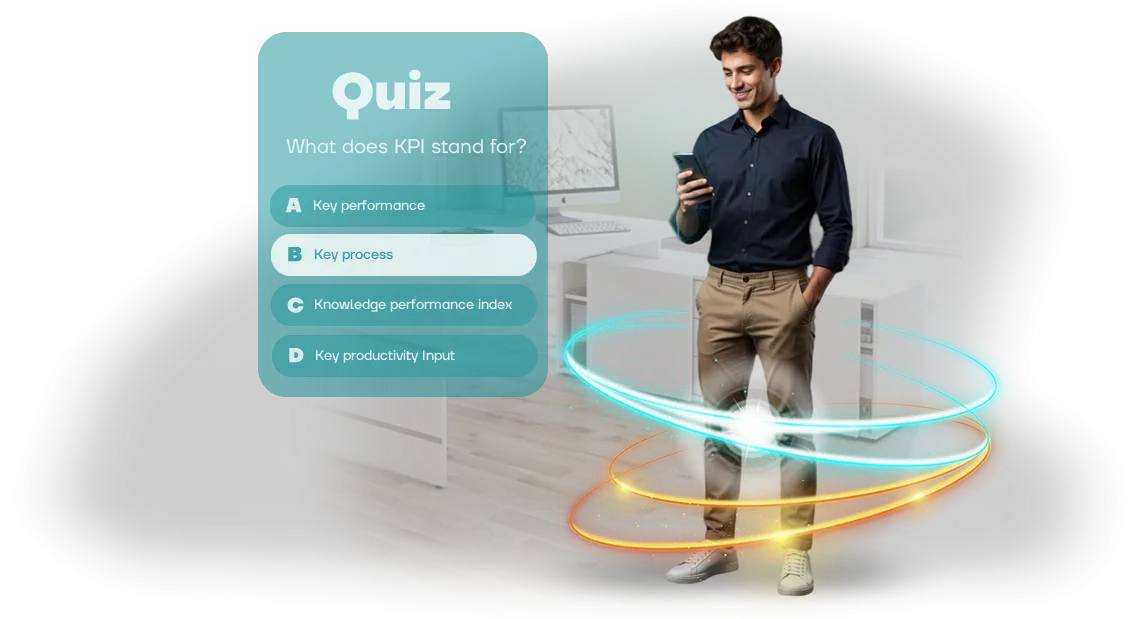
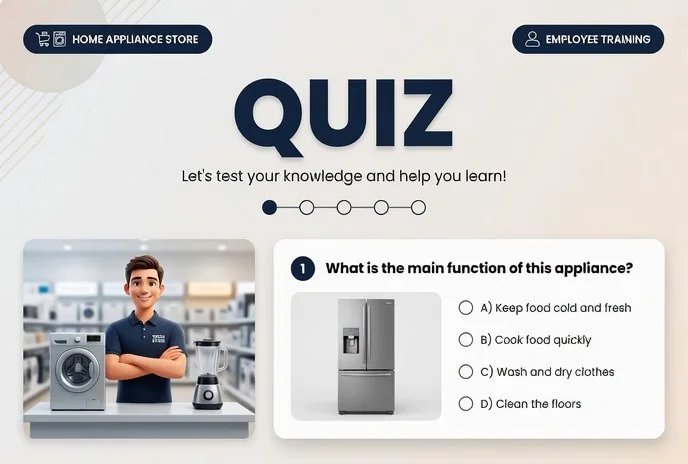

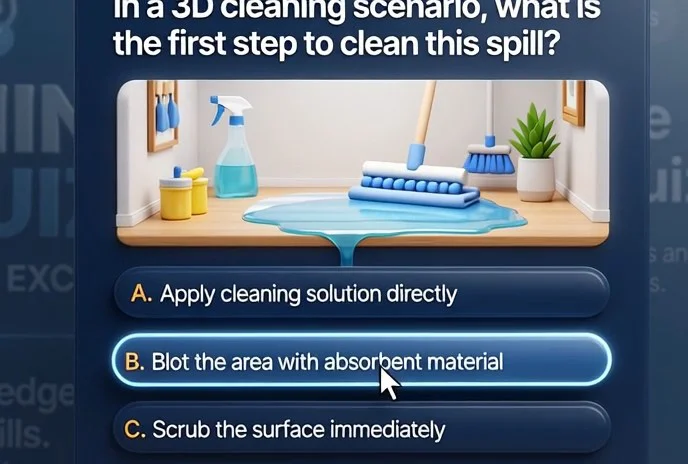
Training not working? Pico 4 Enterprise quizzes engage
Every manager knows: even an expensive training course does not guarantee that employees will start performing better.
Lectures and presentations are forgotten within a week, and knowledge checks become a formality — people mechanically pass the test and then make the same mistakes at work again.
As a result, the company pays for training but sees neither productivity growth nor measurable changes.
The problem is not staff motivation or the difficulty of the material. The problem is the format: a person only absorbs information when they are emotionally engaged. That is why we build training on quizzes for employees in the Pico 4 Enterprise virtual reality headset.
There is no passive viewing here — each participant enters an interactive environment where they must think, react, and make decisions, and game mechanics turn knowledge testing into a thrilling competition.
What does business get? Effective staff training that employees complete with interest rather than under duress. The quiz on Pico 4 Enterprise provides instant feedback: you see who has absorbed the material, who is making mistakes, and which topics need additional review.
The process itself takes far less time than a classic seminar, and results are saved in statistics for each employee.
We adapt the quiz to your specific needs: from safety rules and service standards to product knowledge and sales scripts. An interactive test for a company is not just a survey but a full-fledged skills simulator that practices actions in conditions close to real life.
The employee does not simply choose the correct answer — they see the consequences of their choice and remember the algorithm through practice.
The Pico 4 Enterprise quiz addresses a key need of any manager: training that actually improves team competence and reduces the number of errors.
We handle the development of the scenario, design, and game logic — all you have to do is launch the quiz and watch staff engagement grow from the very first session.
What an in-game quiz in VR gives: benefits for business
Employees quickly lose interest in briefings and on-screen tests. A game quiz in VR turns training into a live competition: the employee does not read abstract questions but enters an environment where knowledge must be applied here and now.
This changes the attitude toward training — from "have to complete it" to "interesting to try again."
The first benefit is increased engagement. In the Pico 4 Enterprise headset, a person is completely isolated from distractions: notifications, chats, office noise. Attention is held by the quiz scenario itself, not by willpower.
An engaged employee remembers material better: game-based learning in VR engages visual memory and muscle reaction, so rules and algorithms stay in mind longer than after a typical lecture.
The second benefit is faster training. In VR, there is no need to gather a group at the same place and time: each employee runs the scenario at a convenient moment.
The scenario takes 2-3 times less time than a classic training session, and knowledge retention is higher because the training is built on scenarios close to real work situations. The company gets a trained team faster and with lower organizational costs.
The third benefit is automatic knowledge assessment. The system itself records correct and incorrect answers, reaction time, and retry attempts. You do not need to check results manually: a clear report is generated for each employee and the team as a whole.
You immediately see which topics cause difficulties and can adjust the training program before a mistake becomes a habit.
Finally, a VR quiz is a modern way to enhance employer prestige. Employees share their impressions and tell colleagues and acquaintances about the unusual training.
You get not only a trained team but also additional reasons to talk about your employer brand as tech-savvy and caring about people.
Formats of educational quizzes for your task on Pico 4
The same quiz rarely works equally well for different tasks: beginners need a quick check of the basics, experienced employees need practice with complex scenarios, and managers need clear progress statistics.
That is why we select the quiz format according to your goal, audience, and launch method — from a short test during a break to a full VR immersion using Pico 4 Enterprise.
Below are the main formats that are already delivering results in business training projects.
| Format | For whom | What it gives the client |
|---|---|---|
| Quick question-and-answer quiz | For beginners and mass rollout | Knowledge check without taking time away from work, instant results for the whole group |
| Scenario with choice of actions | For practicing complex situations | The employee sees the consequences of decisions, skills are reinforced faster |
| Team VR quiz | For team building and motivation | Joint participation, competitive spirit, increased engagement |
| Game marathon with progress | For long-term training programs | Keeps interest over weeks, easy to track dynamics |
| Interactive test with feedback | For assessing mentors and managers | Gaps are immediately visible, training program can be adjusted |
Format is not an end in itself but a tool for your task. If you need to quickly check knowledge after a briefing, we use a short test. If practicing skills in a safe environment matters, we add scenario branches.
We adapt the quiz interface for Pico 4 Enterprise so that it remains convenient even for an employee putting on the headset for the first time, and you receive clear statistics for each participant.
Tell us what task your training needs to solve — and we will propose a format that will solve it with minimal implementation costs.
How quiz development for employees works: 5 stages
To make a quiz truly increase employee engagement and knowledge, it is not enough to simply gather a few questions. You need a well-thought-out scenario, an understandable interface, and reliable deployment on the hardware.
That is why we run the project according to a transparent seven-step process — you see the result at every stage and can influence it.
-
Brief and objectives — we identify the training goals, employee skill levels, and formats that already work in the company. Output: a quiz plan with clear success criteria and deadlines.
-
Scenario and questions — together with your experts, we build the structure: topics, difficulty levels, question types, and transition logic. You receive ready-made content, not just a shell.
-
Interface design — we create a user-friendly game screen for the Pico 4 Enterprise headset. The employee does not get distracted by "how to click" but focuses on the task.
-
Development and integration — we build the quiz on a professional engine, configure corporate data protection, and, if necessary, synchronize with your LMS or HR system.
-
Testing and debugging — we run scenarios on real hardware, check usability and stability, and fix errors. You get a product with no surprises on launch day.
-
Launch and adaptation — we install the software on the required headsets, configure accounts, conduct a short training for administrators, and prepare a reference guide.
-
Support and growth — after launch, we stay in touch: update questions, expand scenarios, add performance reports. The quiz does not become obsolete and keeps working for the business.
This process has been refined across dozens of corporate projects — you get a predictable result, a clear estimate, and full support all the way to the end user.
What is included in the delivery: a kit for launching training
You receive a ready-made kit for launching training on Pico 4 Enterprise — not just a set of files, but a fully functional tool. It includes the scenario, design, content, setup, and instructions — everything you need to run a quiz as early as this week.
- A quiz scenario tied to your learning objectives: question structure, difficulty levels, and progress logic. The employee gradually masters the material, and you see progress.
- An interface design in corporate style, adapted for the headset. All elements are legible, and controls are clear even to a beginner, which lowers the entry barrier to training.
- Content: question texts, answer options, explanations, and hints. You can use your own materials or entrust the preparation to us.
- Configuration for your device: installation, performance check, and calibration. The quiz is completely ready to use; no technical specialists are needed.
- Administrator and user instructions: launch, completion, and statistics collection. Any employee can understand it; preparation takes no more than 15 minutes.
- Support at launch and the ability to add new questions to the quiz after training.
This kit covers all issues — from idea to regular practice. You do not need to hire developers or understand technical details. All that remains is to set a date and invite employees.
Case study: how a game quiz reduced training time by 3 times
The head of the federal gas station chain «Magistral» came with a task: new employees forgot the order of actions in non-standard situations. Regular courses and paper instructions worked only during checks, and mentors spent weeks on individual explanations.
We proposed converting key scenarios into an interactive VR quiz format — and the first pilot groups immediately showed why this approach works better.
Quiz implementation results
Two months after launch, the average final test score rose from 72 to 92 — 30% higher than in the control group trained with the old program. New hire adaptation time fell threefold: from six weeks to two weeks. Mentor workload dropped by half — trainees ask fewer questions and get up to speed faster.
Why it worked
In a regular test, the employee chooses an answer from options, while in a VR quiz they enter a simulated situation and perform actions at a realistic pace.
The scenario's instant reaction shows the consequences of their choice, and the mistake is analyzed immediately — so the material is remembered at the level of automaticity.
This is how VR training effectiveness appears not in abstract scores but in a reduction of mistakes at the workplace.
After the pilot, the «Magistral» gas station chain expanded the program to all 120 stations and ordered additional scenarios for cashiers and managers. A repeat order and in-house replication are the best indication that the quiz solves the task faster than familiar formats.
Common doubts about VR quiz development: we answer
Before ordering a VR quiz for employees, every manager has the same questions: how will employees react to the headset, how much will it cost, and when will we see results. This is normal — new training always raises doubts. Below we answer the main concerns so you can make an informed decision.
Employees do not know how to use VR — will it be difficult?
The first launch takes a couple of minutes: the quiz interface is built on large buttons and hints, so it is enough to look at an element and press a button. We provide a short instruction and stay in touch during the first launch. After a few questions, most employees act confidently.
Is it expensive and unprofitable?
A VR quiz replaces venue rental, printed materials, and repeated in-person meetings — you pay once for a ready-made scenario and use it multiple times for different teams.
In addition, each employee's results are immediately visible in the common system, saving HR time and increasing engagement.
How long will implementation take?
Usually, the project takes from two weeks: we handle question preparation, interface design, and technical setup, while you only need to approve the brief and set a launch date. Thanks to ready-made developments and parallel work, deadlines remain predictable.
Is VR safe for eyes and the vestibular system?
We use professional equipment with high-quality images and an ergonomic fit. The session itself lasts 10–15 minutes — enough for a quiz and not overloading the vestibular system. For sensitive employees, a gentle mode with reduced dynamics is provided.
If your question is not listed here — write to us: we will advise whether VR is right for your task and how we will ensure results.Order quiz development and get results in 3 weeks
Employee training usually comes down to one thing — boring lectures and tests that are not remembered. A VR quiz turns knowledge testing into a live experience: the employee finds themselves inside a virtual scenario and answers questions by interacting with the environment. This increases engagement and genuinely improves material retention.
With us, the process takes exactly three weeks. Week one — brief and approval of the quiz scenario: topics, questions, difficulty levels. Week two — interface design and scene prototype.
Week three — assembly on virtual reality headsets, testing, and delivery of the final version. You do not wait months — in 21 days the quiz is already working for your employees.
By ordering VR quiz development from us, you receive:
- A ready-made script with questions aligned with your standards and regulations;
- An interface understandable to any employee — even without VR experience;
- Two or three question formats: multiple choice, actions in a virtual environment, object search;
- Administration: scoring, results summarization, result statistics;
- Adaptation for Pico 4 Enterprise headsets — with a guarantee of stable operation;
- Consultation on launching the quiz on the required number of devices.
The cost of VR training depends on the complexity of the scenario, the number of questions, and the design. During the consultation, we will clarify your tasks, calculate the cost of developing a custom quiz, and prepare a commercial proposal — usually within one business day.
Leave a request on the website to discuss your quiz and get an estimate. We will write back, offer options, and answer questions — after that, you can make a decision without any rush.
How to choose a quiz format for your tasks?
A quiz format cannot be chosen "blind" — it must solve a specific training task. There is no universal quiz: what works great for introducing a product will not suit testing knowledge after a course.
Therefore, when choosing a scenario, we look at three criteria: training goal, audience characteristics, and the format of the event into which the quiz is integrated.
If the goal is to quickly engage employees and spark interest in the topic, short dynamic rounds with instant feedback are optimal. Such quizzes work well at general meetings, planning sessions, or celebrations: they create a competitive spirit and do not overload participants.
If the task is to reinforce complex material, deeper mechanics are needed: scenarios with error analysis, retry attempts, and explanations after each question.
In the second case, the VR format provides additional immersion — the employee stays one-on-one with the material, without distractions.
The second guideline is who exactly is taking the quiz. For a young team accustomed to fast games, individual speed runs and competition with a leaderboard are effective. Experienced specialists, on the contrary, prefer meaningful tasks based on real work situations.
The usual learning style also matters: if employees have previously worked in groups, a team quiz will feel more natural than individual tests.
Finally, the format is chosen according to the event. For a conference or corporate party, a quiz displayed on a shared screen with voting is convenient — it unites the room and creates a festive mood.
For regular quarterly training, shorter individual sessions of 10-15 minutes that can be completed at a convenient time are better.
In this case, a simple scenario launch system inside the Pico 4 Enterprise headset is important, so that the employee can start the quiz themselves without technical help.
In summary: first, define what employees should understand, then assess their level and the conditions for completing it. If you need help choosing — we will analyze your tasks and propose a format that will deliver measurable results. That is the answer to the question of which VR quiz to choose.