

Boring Trainings Don't Work. The Solution Is an Agricultural Simulator
Employees don't retain information from boring lectures—that's a fact. The client spends time and budget on corporate training, and a week later the team works as before. Training effectiveness drops because passive listening creates neither interest nor practical skill. In the end, the business gets a formal checkbox rather than real competence growth.
A game-based format flips this process. An agricultural simulator is not just entertainment but a full-fledged training environment where the employee is placed in a realistic work setting: a field, greenhouse, farm, or processing facility.
Here they must make decisions, respond to emergencies, and apply knowledge immediately, not "on paper." Mistakes are safe and become part of learning, while correct actions create a feeling of success—and that is exactly what cements the material long-term.
This approach solves the main problem of corporate training: engagement. The employee turns from a passive listener into an active participant who sees the consequences of their decisions. This improves retention and, therefore, makes training several times more effective.
Learning stops being a punishment and becomes an understandable and even engaging process that employees want to go through again.
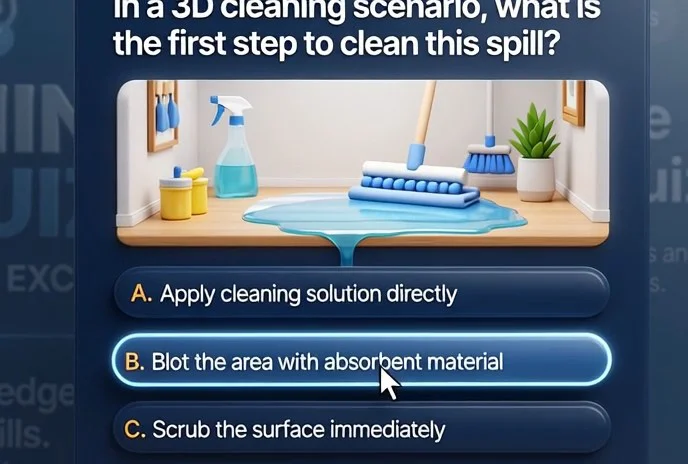
We develop educational quizzes in 3D locations built on the professional Unity engine—from detailed farms to complex production lines. The client receives a finished product that embeds into the existing employee training system and works repeatedly.
An agricultural simulator is a modern answer to the request "how to make training effective": with measurable results, lively team response, and real business value.
What You Get: Engagement, Retention, and Sales Growth
Employees retain only a small portion of information from regular training, and after a week only a few remember it.
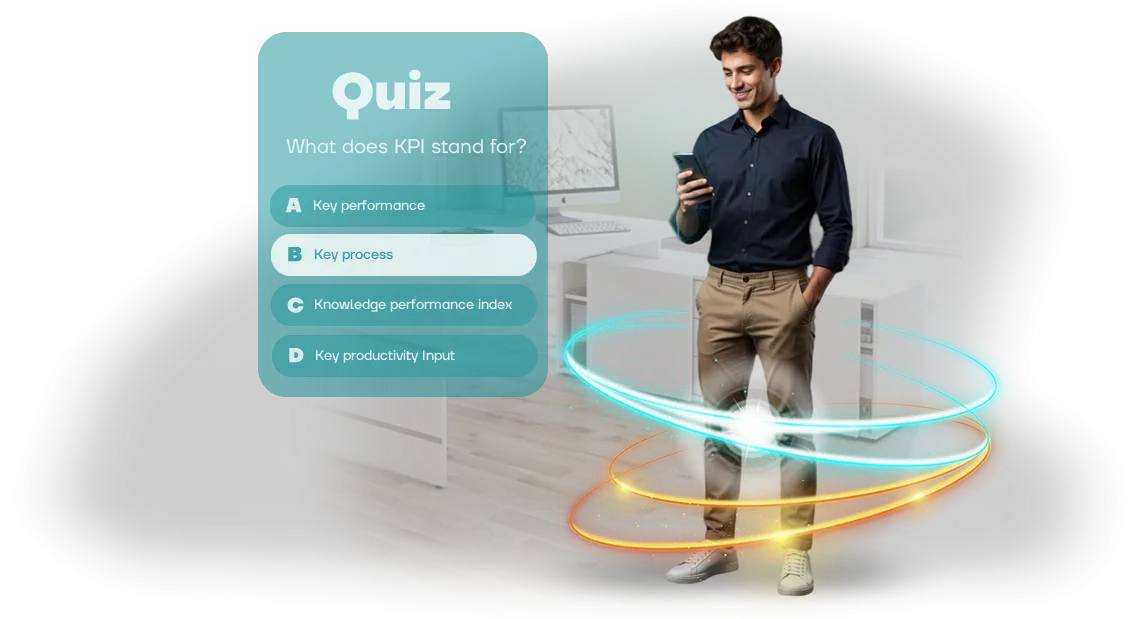
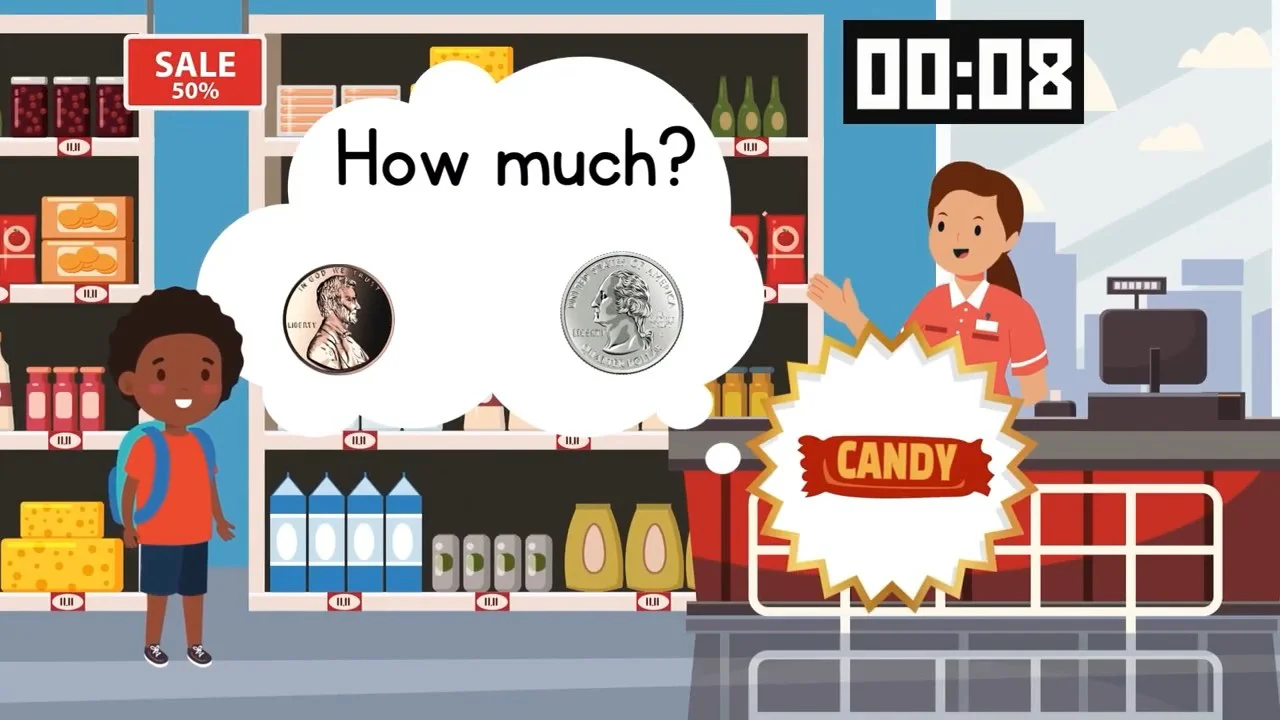
An educational quiz turns knowledge into practice: the employee goes through a scenario, makes decisions, and sees consequences—the material is absorbed through action. This format is especially effective for training on work standards, product knowledge, and sales scripts.
What you get after implementation:
- Engagement. Game mechanics hold attention: employees complete training with interest, not "under duress." Course completion rates grow several times compared to lectures.
- Material retention. Knowledge is practiced in real situations and repeated through different scenarios. Information stays in long-term memory—the employee applies it in actual work.
- Sales growth. Trained employees handle objections more confidently, know the product, and can offer upsells. As a result—higher average check and deal conversion.
- Lower turnover. When training is interesting, new hires settle in faster and feel the company's support. This reduces recruitment and onboarding costs.
- Unified standards. The quiz reinforces regulations and scripts, so every employee acts correctly in the same way. Quality control becomes simpler.
We create educational quizzes, including in the agricultural simulator format. Game locations and 3D models immerse employees in real situations from your industry, allowing them to practice skills without risking the business.
Order quiz development and get a measurable result: higher engagement, retention, and sales. Contact our team—we'll show you what this can look like for your team.
Training Game Formats for Your Objectives
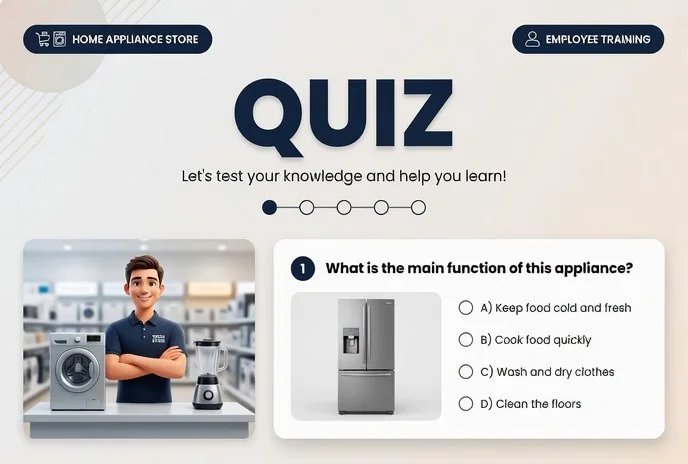
Training formats are not about "what looks nicer" but "what will change in the employee's work." A quiz tests knowledge, an interactive scenario teaches decision-making, and a 3D simulator provides safe practice on complex equipment.
We choose the format based on the objective: reduce errors, speed up onboarding, increase sales, or standardize processes.
First, we define the goal—the action the employee should perform differently. Then we choose the mechanics: from a quiz to a full 3D world. This way you don't overpay for unnecessary complexity and don't end up with a "game for the sake of a game."
| Format | For whom | What it gives the business |
|---|---|---|
| Quiz | Mass staff after instruction | Quick knowledge check, competitive spirit |
| Interactive scenario | Sales managers, service, line managers | Practicing dialogues and decisions without client risk |
| 3D simulator | Production, logistics, agriculture, equipment operators | Practice without accidents and downtime, fewer breakdowns |
| Full training world | Large departments with long onboarding for new hires | Unified training standard, clear link between actions and consequences |
For example, for an agricultural enterprise, a simulator allows practicing equipment setup and emergency response before going out into the field. The employee gains confidence; the business gets fewer breakdowns and defects.
Formats are easy to combine: we start with a quiz to assess the baseline, then add scenarios or a simulator for complex skills. We'll put together a program for your budget and timeline—from a short launch to a corporate university.
How We Create a Training Game: 7 Steps from Brief to Launch
A training game in the form of an agricultural simulator helps employees master work processes without business risk. We accompany the project from the first brief to launch and take care of all stages so that you receive a ready-made training tool, not another presentation. Below are seven steps of the work.
- Brief and immersion. We study your regulations, typical employee errors, and current materials—so that the game solves your specific problem rather than an abstract one.
- Concept and scenario. We propose a plot, task types, and quizzes—from simple questions to situational tasks reflecting a real workday.
- Approval and plan. We lock down mechanics, deadlines, and milestones. You can see what will be ready and when, and make edits without missing deadlines.
- 3D model and location development. We create a realistic farm and work areas on the Unity engine—detail helps employees transfer skills to real work faster.
- Logic and quiz programming. We configure completion rules, scoring, and error breakdown—each answer comes with an explanation of why it is correct.
- Testing and refinement. We run the game with your employees, collect feedback, and make final adjustments.
- Launch and support. We deploy the game on the required devices, train administrators, and remain available for updates.
What's Included in the Delivery: a Complete Kit for Launch
You don't get "source files on a disk" but a ready-made training system that can be launched immediately after handover. The delivery includes everything needed for operation: from graphics to scenarios and regulations.
Full Delivery Contents
- Ready 3D models and locations. Farm, equipment, fields, warehouses—all in the unified style of an agricultural simulator. The models are already optimized for smooth performance, so employees aren't distracted by lag or loading.
- Interactive training scenarios. Story-driven tasks that test knowledge in real situations: from choosing crops to setting up equipment. Scenarios can be easily changed to match your regulations—no programming skills required.
- Administrator dashboard. You see who completed the quiz, which errors recur, and which employees need additional training. This lets you close gaps precisely instead of pushing everyone through the same material.
- Launch and operation instructions. Step-by-step guides for your IT department or administrator: how to install, update, and quickly reconfigure the game for new tasks. Support remains on our side.
- Built-in results tracking system. Managers see each employee's progress: who succeeded and who got stuck at a certain stage. This data helps make staffing decisions and build the training program without guesswork.
Instructions and Support
Every kit comes with a short video guide for employees and a text manual for managers. We hand over the project with a library of pre-assembled scenes so you can quickly make edits: add a new location or change a question's text without rebuilding the whole game.
Support stays in touch after project delivery. We help with updates and answer administrators' questions while the system runs at your company. This removes the main risk—dependence on a single developer who "left and didn't leave contacts."
How AgroZemService Improved Training by 60% with an Agricultural Simulator
Agro-industrial enterprise AgroZemService (AZS) faced a typical industry pain: training employees in real fields requires a lot of time and carries risks.
A new hire must master dozens of operations—from setting up a seeder to responding to an accident—and a training error translates into broken equipment and downtime. Text instructions and lectures did not provide the required level of retention.
We proposed replacing part of the courses with an agricultural simulator built on Unity. In a virtual copy of the locations—a farm, hangar, and field—the employee works through typical scenarios: equipment preparation, planting season, emergency response. The game allows repeating complex operations without risk and at a comfortable pace.
Results were measured after three months: final test pass rates increased by 60%, the onboarding time for new operators was cut in half, and errors with real equipment dropped by a third.
The head of the AZS training center noted: "Employees perceive the simulator not as boring testing but as a game, so engagement and material retention have grown many times over."
This example shows that game mechanics work in agriculture just as well as in sales. If you need the same result—we design a simulator around your processes and standards.
Common Concerns: Cost, Timeline, and Game Adaptation
Clients rarely question the value of an educational quiz—the questions are usually about budget, timeline, and integration into current training. We address these concerns before the start: we set the cost, show a stage-by-stage plan, and adapt the game to your needs. Below are answers to the most frequent questions.
How much does quiz development cost?
The cost depends on the number of scenarios, mechanics, and graphics style. After a short brief, you receive a precise commercial proposal detailing all the work—the final price doesn't change during the process.
What are the timelines?
A typical project takes 2–4 weeks: from scenario to a quiz working in your system. You receive an exact calendar plan with milestones before the start and can see what is ready at each stage.
Will the game integrate into our LMS?
Yes. The quiz runs in the browser and connects to modern learning management systems: results, progress, and final scores automatically flow into your LMS. Employees don't need to install anything, and administrators don't need to keep duplicate records.
What guarantees do you provide?
Every project goes through internal testing before delivery. If something doesn't work as expected after launch, we fix it within a few days. You also get support during the initial launch.
How to Choose a Training Game Format for a Specific Task?
Choosing a training game format should start not with trendy solutions but with the task the company faces. In agriculture, employees often work in fields, on farms, or in greenhouses, so training should be short, clear, and accessible from any device.
We help determine what exactly you need: to quickly check knowledge of regulations or to teach employees to make the right decisions in unexpected situations.
If the main goal is to engage staff and practice a sequence of actions, a simulator format is suitable: a person controls a virtual farm or plot, sees the results of their decisions, and learns from mistakes without harming real production.
When the need is to regularly assess knowledge of standards, safety protocols, or quality requirements, a lighter quiz with explanations of correct answers is more effective.
We compare the scale of training, the number of employees, and the frequency of content updates, then propose the option with the best balance of value and budget.
When choosing a format, it's important to consider your business specifics: seasonality, staff rotation, and the team's digital skills.
During the brief, we ask not about technical details but about how your process works: where and when employees will complete training, who will support it, and what result you consider successful.
This helps cut out the unnecessary and choose a format that will actually be adopted rather than remain a pretty file without use.
In practice, we most often combine formats: short quizzes for regular knowledge checks and simulation modules for complex operations and rare situations.
This approach works for both large agroholdings with thousands of employees and small farms where individual skill practice matters.
Ultimately, you get a training game that solves a specific business problem and fits the planned budget, while we handle all the work of selection, development, and support.
Ready to Discuss Your Project? Get a Free Consultation
Developing an educational quiz always starts with questions: where to begin, how long it will take, and how to build the mechanics into current training processes.
That's why we suggest starting with a free consultation—it takes 30–40 minutes and helps clear up most doubts before you make a decision.
On the call, we analyze your task, talk through possible formats and the logic of a future scenario, and estimate approximate timelines. You get not an abstract commercial proposal but concrete options for your task and answers to the questions that matter to you right now.
We work remotely and stay in touch across the country, so a meeting doesn't require you to visit an office.
What You Get After the First Call
- Analysis of your task — we determine which quiz mechanics best suit your learning goals and employee audience.
- Preliminary launch plan — you'll see the main stages, timeline, and integration points with current training.
- Format recommendations — we'll also suggest how the quiz can fit into onboarding or annual certification.
- Resource estimate — you'll understand how much time your team will need for approvals and participation.
- Transparent proposal — we'll capture the terms in a commercial proposal so you can make a decision without pressure or hidden conditions.
Leave your request right now, and we'll get back to you within one business day. No obligations—just a practical conversation and clear next steps toward launching your quiz.