

Gaps in Pharmaceutical Knowledge — a Hidden Threat to Business
A pharmacist is the “front line” of the pharmacy business: customers entrust them with their health and money. When knowledge falls short, not only that individual suffers — the reputation of the entire chain is put at risk.
An error in drug compatibility or an incorrectly suggested dosage turns an ordinary visit into disappointment: the customer leaves for competitors and takes a negative review with them.
Gaps in knowledge are not visible in sales reports, but they show up in live communication.
The pharmacist plays it safe with phrases like “check with your doctor,” spends time searching for information in a reference book, and on a busy day simply offers a more expensive alternative.
As a result, the pharmacy loses trust, average ticket size, and repeat purchases — the things that directly drive revenue.
Classic courses and briefings do not solve the problem: information is forgotten within weeks, and it is difficult to check what employees actually know.
Pharmacist training becomes a mere formality, and the cost of that formality is mistakes in pharmacy work, complaints, and customer churn.
We bridge this gap with training quizzes integrated into the workflow that test knowledge in a game-like format. Employees review the material regularly, and you can see which topics cause difficulties at each pharmacy. This turns training into a manageable tool that protects reputation and increases profit.
What a Training Quiz Delivers: Benefits for the Company and Staff
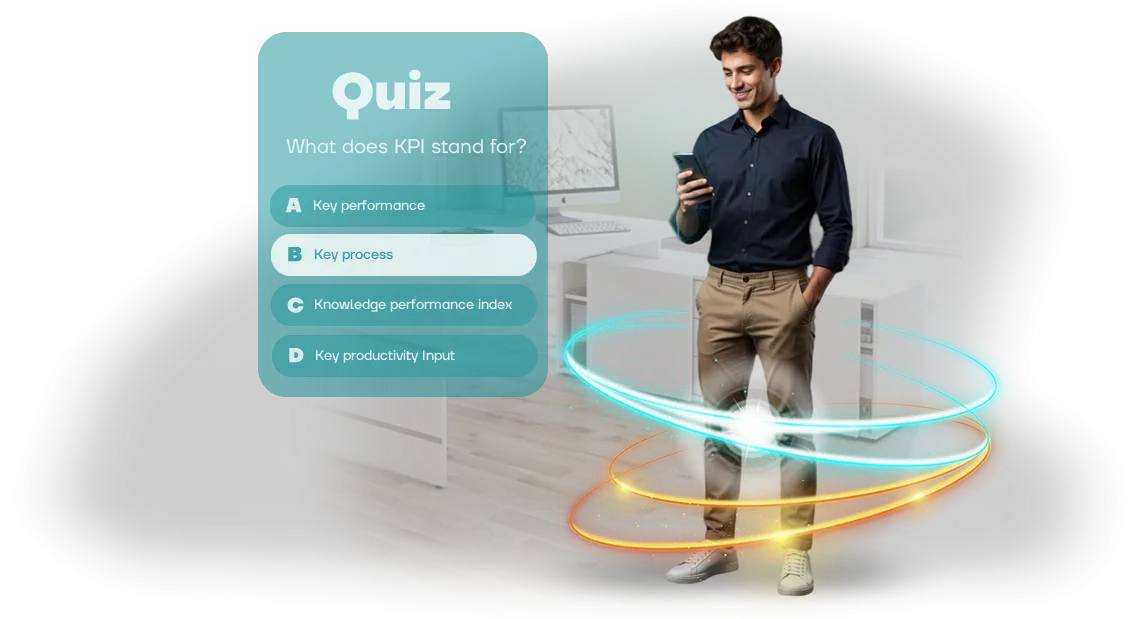
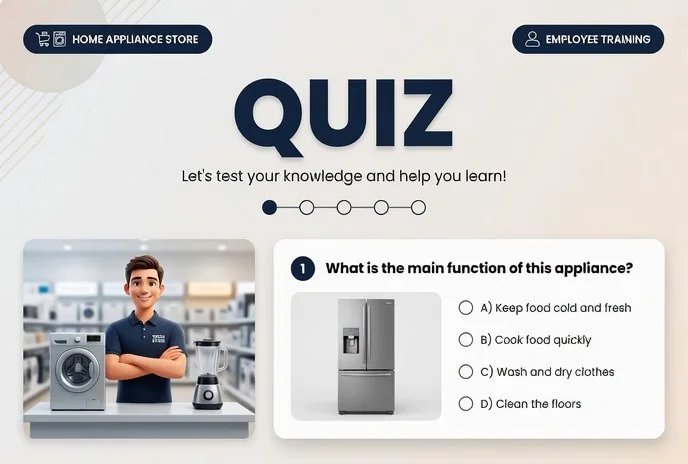
A training quiz turns a boring lecture into a game: employees get involved on their own instead of sitting on their phones. Instead of passively watching a presentation, there is a live quiz with questions and instant feedback.
This is the key benefit: staff engagement grows, and training stops being a formality. The company gets a team that actually absorbs the material, not just shows up at a mandatory training session.
The second advantage is deep retention. Training games for employees are built on repeating key facts in a question-and-answer format: thanks to game mechanics, information sticks naturally, without cramming.
This is especially important for pharmaceuticals: rules, regulations, and drug properties need to be kept in mind, and the quiz helps do that without stress. Employees are not afraid to make a mistake — they immediately see the correct answer and remember it.
The third benefit is control and transparency. A manager sees who has mastered the topic and who is trying to “cheat”: the quiz provides an objective picture.
You can test knowledge after new changes or prepare staff for certification, and get metrics that make it easy to plan professional development. Analytics based on the results help close gaps precisely and strengthen weak points.
In addition, the quiz keeps engagement going even after training: short rounds can be launched regularly to keep knowledge fresh. It saves time and makes professional development a continuous process rather than a one-time event.
You get a simple tool that fits into your existing training processes and delivers measurable benefits — from sales growth to fewer mistakes on the job.
Quiz Formats: Choose One for Your Tasks
For pharmaceuticals, it is especially important that employees do not just memorize instructions but can apply knowledge in conversations with customers. Regular tests yield boring statistics, while interactive training engages and reveals gaps.
our team develops quizzes for a specific business task: from initial training for beginners to regular certification of experienced employees. This reduces the time spent on knowledge assessment and increases the real readiness of staff.
Below are typical quiz formats we have implemented for pharmacies and pharmaceutical companies. Choose the one that fits your task, or suggest your own scenario — we will adapt it to your training program.
| Quiz format | For whom | What it gives the client |
|---|---|---|
| Drug training quiz | Pharmacists, medical representatives | Reinforcing knowledge without taking time off work, fewer errors in consultations |
| Team quiz competition | Pharmacy chains, sales departments | Team engagement, healthy competition, greater loyalty to training |
| Onboarding quiz for new hires | New employees | Quick ramp-up to the role, clear verification of material comprehension |
| Final certification | Training managers, HR | Objective assessment of knowledge, ready-made statistics for each employee |
The choice of format depends on the goal: if you need to quickly boost sales, a team quiz for pharmacies works well; if you need to prepare new hires to work independently, go with an onboarding scenario.
Each format can function as a standalone course or as part of an overall training system. If needed, we add a competitive element, hints, and answer explanations, so the employee understands where they were wrong and how to improve.
This approach makes the quiz not mere entertainment but a full-fledged quality-control and sales-growth tool.
Stages of Working on the Quiz: From Brief to Launch
A clear process means a predictable result. We have split quiz development into stages so that at every step you can see what is happening, control the timeline, and influence the project’s course.
- Brief and analysis. We discuss your training objectives, employee profile, and desired outcome. We collect source materials: regulations, instructions, standards. You get a structured vision of the future quiz without diving into technical details.
- Scenario and plan. Based on the brief, we create a game scenario: storyline, question types, difficulty levels. We set deadlines and control checkpoints. You approve the plan before development starts — this removes the risk of rework.
- Content development and approval. We create a quiz prototype and fill it with questions from your documentation. We adapt the format to the specifics of pharmaceutics: standard procedures, safety, rules for handling medications. You review intermediate versions and edit the wording until the content is convenient for your employees.
- Assembly and testing. We combine all elements into a single system, test it on different devices, and fix any issues. You receive a working version that can be shown to a pilot group before the full launch.
- Launch and employee access. We help connect the quiz to your internal environment and provide short instructions for participants. Training starts on schedule, and you do not have to deal with technical routine.
- Support and development. After launch, we collect results: completions, difficult questions, response speed. As needed, we add new topics and questions — the quiz remains relevant as regulations change.
This sequence lets you launch training without overloading your team and with a measurable outcome. At each stage you know what happens next and when the next result will come — no “black boxes.”
What Is Included in the Delivery: A Complete Kit for Launch
When you order a training quiz, it is important to receive not just a “game file” but a ready-made tool that immediately starts working toward your goal. We deliver a complete package — from a configured application to instructions and support for your team. The delivery includes:
-
Ready-made training quiz — a stable version of the application that runs on classroom computers or remote workstations. Day-to-day administration requires no special knowledge: standard PC skills are enough.
-
Complete pharmaceutical question bank — content prepared in line with industry requirements: drugs, dosages, standards, clinical scenarios. You can add and edit questions without involving a developer — through a simple admin interface.
-
Source code and modification rights — all materials stay at your disposal. If you later need to change the game mechanics or integrate it with an internal training system, your IT department or any contractor can do it.
-
Clear administrator instructions — step-by-step guides: how to launch the quiz, add employees, export results, and configure session settings. The instructions are written in plain language, with example screenshots.
-
Training for your specialists — a short hands-on session for administrators. Your staff will learn to manage the game, track progress, and handle common tasks — without constantly contacting us.
-
Technical support — we stay available for the entire period of operation: we help with launch, answer questions, and promptly fix any issues. Urgent requests are handled within one business day.
-
Basic improvements — we include a small package of updates for the coming months. If a new task arises — for example, adding a tournament mode or a separate question category — you can implement it within the support framework.
Case Study: How We Raised the Level of Pharmaceutical Knowledge
For the ZdravGrad pharmacy chain, we developed a training quiz for first-counter pharmacists. The task was not to “pass a test” but to reinforce knowledge of new drugs, indications, and contraindications — in a way that affected actual sales.
Regular lectures and PDF instructions produced low engagement: only 4 out of 10 employees finished the material, and they forgot half of it within a week.
We proposed a game format: short rounds of 5–7 questions with instant feedback, a colleague leaderboard, and error analysis. The quiz did not distract pharmacists from customers — training happened during quiet moments, on a tablet in the app.
In two weeks, all 340 employees took part, even though “live” training sessions had previously attracted no more than two-thirds of the staff.
Results After a Month
The average score on the control test rose from 58% to 93%. The share of employees who could confidently answer questions about new drug lines doubled.
Pharmacists began to suggest alternatives faster and to use paper reference books less often in front of customers — customers noticed immediately: the number of repeat consultations about new arrivals grew, and every fourth recommendation was accompanied by a mention of the training.
Why It Worked
Instead of dry “memorization,” the quiz provided practical scenarios: “what to recommend for a dry cough,” “what this drug cannot be combined with.” Employees saw their rating and closed their own weak spots, while we updated the question bank to cover new arrivals.
A month later, the chain ordered a repeat implementation for a second region — that is a better indicator of effectiveness than any test.
This same format is easily adapted to your product line, service standards, or internal regulations. Below — what the quiz consists of and how we launch it for your tasks.
Frequently Asked Questions and Concerns Before You Start
Before a project starts, customers often have the same concerns: will the quiz break down at the most critical moment, will it be hard to change questions, will corporate materials leak. Below we answer these questions — without technical details, just the essentials.
What happens if a failure occurs during training?
The quizzes run on the professional Unity engine, which ensures stability on any device — from old office PCs to modern tablets. An employee's progress is saved automatically, so even if the network drops, they continue the test from the same point.
We also provide fallback scenarios: if one employee has a problem, the others continue training without delay.
How often can questions and materials be updated?
Content changes along with industry requirements, so we build quizzes with future edits in mind. You send new questions — we update them within a few business days. No lengthy re-approvals or training interruptions: everything happens in parallel with current tasks.
How secure is corporate information?
Training materials for pharmaceuticals are sensitive data, so only employees can access the quiz, via private links or after authentication. The content is protected from copying and downloading, and all correspondence and file transfers take place over secure channels. You know exactly who completed the training and when, and you can export a report at any time.
What does the development cost consist of?
The cost depends on the number of questions, the number of scenarios, and the design. We calculate it individually after a short brief — and include a fixed estimate in the contract so there are no additional expenses at the start. You pay only for the features your team actually needs.
Our main goal is to remove risks before the contract is signed. That is why we set deadlines, a work guarantee, and support in the agreement, and after the launch we stay in touch: we help with updates and answer employee questions. This way you get not just a one-off project but a tool that works for years.How to Choose a Quiz Format for Your Team?
The quiz format for a pharmaceutical team depends on two things: how many people are taking the training and what task you are solving.
If you need to check the entire team's knowledge in a short time, one tool works; if you need to practice communication skills with physicians or run team building, another.
It is important to start from the goal, not from fashion: a quiz for the sake of a quiz will give neither engagement nor metrics.
We select the format at the briefing stage and propose a setup tailored to your team and training requirements. Here are typical scenarios that pharmaceutical companies choose most often:
| Format | For which team | What it gives the client |
|---|---|---|
| Individual timed quiz | Employees in different regions, a sample of 50 or more people | Checking each person’s knowledge, clear statistics across the team |
| Team game with rounds | Departments of 10–25 people, offline event or corporate party | Team bonding, solving cases together |
| Quiz trainer with branching scenario | Medical representatives, sales department | Practicing objection handling and communication standards without consequences |
| Short multi-day “marathon” | Distributed employees with mobile access | Continuous engagement, knowledge retention after the course |
This is not a rigid scheme: we combine formats, add gamification elements, and adjust difficulty levels to the team’s readiness. For example, for regular training a marathon is a better fit, while for annual certification an individual quiz in a personal account works best.
To avoid choosing the wrong format, it is enough to answer three questions: how many people, what is the training goal, and how much time employees are willing to allocate. You answer these questions at the briefing, and we propose the format and implementation timeline.
This often takes no more than a day — after the brief, you receive a quiz concept tailored to your team.
Ready to Discuss the Project? Get a Timeline and Cost Estimate
To order a quiz, you do not need to write a complex technical specification. Just describe the task — and we will prepare an estimate that clearly shows timelines, cost, and work stages.
You will immediately understand how long quiz development will take and what information will be needed from your team — this saves time and eliminates surprises at the start.
What is included in the estimate and how it helps your training process:
- A plan of the game structure and scenario: which topics and mechanics best engage employees.
- Realistic timeline — a launch date by which you can prepare internal communications.
- A stage-by-stage estimate: you understand what you are paying for and can change priorities after refining the task.
- The team composition: a manager, methodologist, developer, and designer who stay in touch until the release.
- Examples of ready-made pharmaceutical quizzes — we will show how we solved similar tasks for other clients.
- Integration recommendations: how to embed the game into your distance learning system or run it as a standalone service.
Once you receive the estimate, you can compare our proposal with other contractors and make an informed decision.
We have been making training quizzes for pharmaceuticals for more than ten years — our team has launched more than 50 such projects, each adapted to real business needs.
Leave your request on the page — in response, you will receive a timeline and cost estimate within one business day. It is free and carries no obligation. We will start with a short call to clarify the game’s goals, and then we will handle the design work ourselves.