

Why insurance requires regular employee training: a real problem
Customers leave because of insufficient knowledge among insurance company employees. Insurance products are complex, policy terms are constantly changing, and when a manager cannot quickly and confidently answer a question, the customer loses trust and goes to a competitor. Regular employee training becomes not a formality but a factor in business survival.
Traditional courses and training sessions do not solve the problem: information is forgotten within a week, and boring lectures demotivate staff.
That is why training challenges in insurance companies require a new approach — short, vivid, and engaging formats that actually change employee behavior.
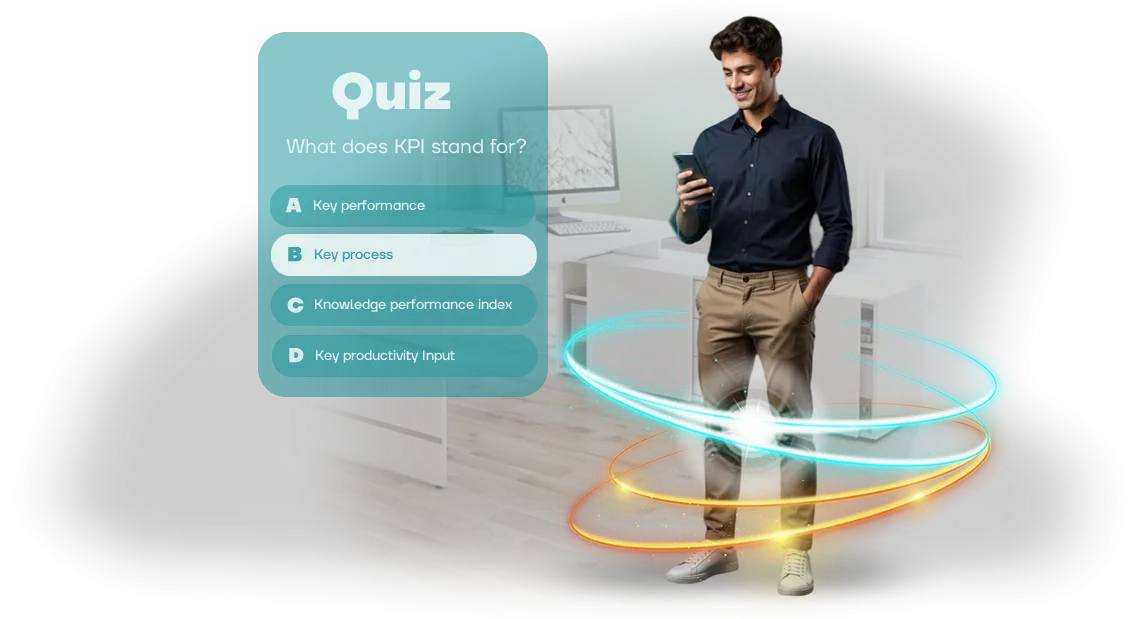
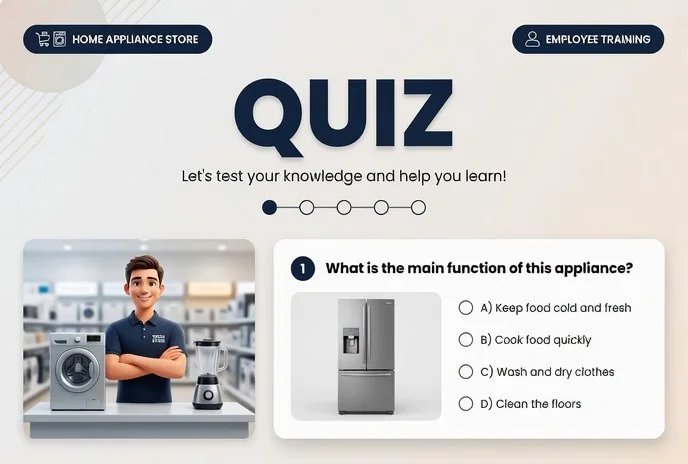
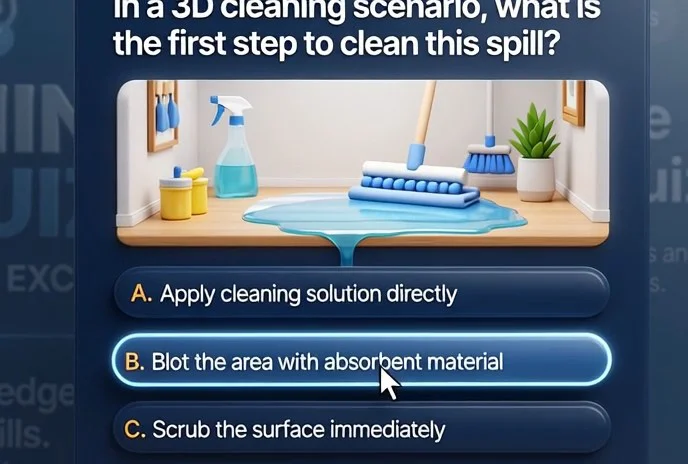
An educational quiz is a way to turn routine into a game. Short rounds, visual questions, and instant feedback help consolidate knowledge right in the process, while the competitive spirit makes employees return to learning again and again.
Staff motivation grows when learning feels like a quest rather than an obligation. Quizzes can be held weekly, updating questions to reflect new products and changes in legislation — this keeps knowledge fresh and ensures customers receive competent answers.
We develop educational quizzes for insurance companies that solve these challenges. Over several years, we have helped dozens of organizations reduce customer churn and increase sales precisely through well-designed employee training. We handle everything — from scripts to launch — so that training works without disruption.
What implementing quizzes in corporate training gives
Corporate training in the insurance sector often stalls: the amount of information is huge, products are complex, and employees perceive courses as a formality.
As a result, knowledge is not retained, new employees take a long time to get up to speed, and staff mistakes lead to direct financial losses.
Quizzes change this scenario — they transform learning from passive material review into active practice where every employee is engaged in the process.
The main benefit of implementing quizzes is increased employee engagement. When instead of a lecture employees need to answer questions, compete with colleagues, and receive instant feedback, healthy excitement kicks in.
People naturally strive to understand the material rather than just "sit through" an hour. This directly improves training effectiveness: knowledge is absorbed faster and stays in memory longer.
For new employees, quizzes become an onboarding accelerator. Instead of multi-day introductory courses, information can be broken into short game blocks that a newcomer can complete at their own pace.
It immediately becomes clear which topics are difficult, and explanations can be added in time. As a result, the adaptation period is shortened by weeks, and the new employee starts working with clients much sooner.
Regular quizzes also solve the challenge of knowledge updating — this is especially important when products and insurance rules change. Short monthly checks keep the knowledge base in shape without pulling people away from work for long.
Most importantly, quizzes reduce the number of employee errors: when an employee is confident in their knowledge, they make fewer mistakes in calculations, policy terms, and deadlines. For the company, this means fewer customer complaints, less rework, and higher revenue.
Implementing quizzes into corporate training is not just a "new gimmick" but a tool that pays off through measurable business results: higher engagement, faster adaptation, fewer mistakes, and a consistently high level of service.
Quiz formats for insurance products: how to choose
The choice of quiz format depends on whom you are training and what for: agents need to quickly master a new insurance product, administrators need to learn how to process applications without errors, and managers need to see the big picture.
Different tasks require different approaches: a quick test will work for one meeting, while a story-driven quest is better suited for regular training. Below is a comparison table to help you navigate.
| Format | Who it is for | What it gives the business |
|---|---|---|
| Online test with 10–15 questions | Agents and call center, when you need to quickly check knowledge of a new tariff | Employees remember the key product terms; you see who is already ready to work and who needs additional training |
| Quest simulator with scenario branching | New agents during onboarding | The newcomer follows the customer journey: from the first call to issuing a policy. Mistakes are analyzed within the scenario, so there are fewer of them in real sales |
| Situational simulation "loss dispute" | Claims specialists and managers | Practicing complex customer dialogues in a safe environment — direct preparation for real cases |
| Live quiz with scoreboard and team spirit | Managers and team leads at meetings and corporate events | Employees refresh their product knowledge in a game format; the leader sees knowledge gaps in real time |
We select the format based on your task: if you need to quickly bring 200 agents up to speed, we create a short test with automatic result processing.
If the goal is for employees to enjoy learning about products and keep returning to it regularly, we design a quest with a story, rewards, and ratings.
At the start, we conduct a mini-audit — we listen to how you currently train employees and propose a format that fits into your process rather than creating a new one.
All materials remain yours, and we can update the quiz for a new insurance product at any time — this is convenient when your product line is regularly refreshed.
How the development of a quiz for employees works
Training only works when employees actually complete the course rather than just pretending to. Our task is not just to put together a quiz but to build a process that takes minimal time from you and delivers measurable results.
We work according to a clear scheme: you tell us what employees need, and we turn that into a finished product with mechanics, design, and launch.
-
Brief and goals. We start with a short interview: who your audience is, what knowledge we are reinforcing, and what result you want to achieve. Based on the brief, we define the game scenario, the number of questions, and success criteria.
-
Script and questions. We develop the quiz structure: question logic, answer options, and error explanations. If needed, we adapt your materials or offer our own wording — one that is clear to an employee, not just to an expert.
-
Design and mechanics. The visual part matches your corporate style. We think through how to keep interest: points, progress, explanations for answers. The game should not look like a "check-the-box" test — otherwise, employees will close it within a minute.
-
Approval. We show a working version and make revisions until the result meets your expectations. Usually two or three iterations are enough — we do not hand over a "raw" product but polish it together with you.
-
Technical preparation. We launch the quiz on a convenient platform: your employee opens a link and completes the quiz on a computer or smartphone. Everything works through the browser, with no additional installations required.
-
Launch and completion. You receive a ready link to distribute — by corporate email, messenger, or through an LMS system. Employees complete the game at their convenience, and you get statistics: who completed it and which questions caused difficulties.
-
Post-launch support. If you need to adjust questions, add stages, or make a version for a new department — we are available and quickly make changes upon request.
This process saves you from routine: you do not need to explain the task to technical specialists or monitor deadlines. You hand the task to us and receive a ready-made tool that works immediately after launch.
What is included in the delivery of a ready-made training quiz
A ready-made quiz is not just a game but a complete solution for training and knowledge assessment. The delivery includes everything needed to launch as early as tomorrow: from the game scenario to administrator instructions.
-
Quiz scenario. A well-thought-out game structure: rounds, difficulty levels, question branching. The scenario is adapted to your insurance products, internal rules, and typical customer service situations.
-
Question bank. Dozens of questions on the product line, service standards, and regulatory requirements. Each question includes an explanation of why the answer is correct — so employees learn even from their own mistakes.
-
Gamification. Points, bonuses, timers, and leaderboards turn a boring knowledge check into a competition. This increases engagement and motivates employees to repeat the training, especially in distributed teams.
-
Administrator guide. Step-by-step instructions for setup: how to create a session, upload employees, assign the quiz, and view results. No programmer is needed for launch — your HR specialist is enough.
-
Training materials. Cheat sheets and breakdowns of difficult questions for self-preparation before the test. Convenient for both newcomers and experienced managers who want to refresh their knowledge before the sales season.
-
Statistics and reports. The admin dashboard shows who completed the quiz, what results they achieved, and which topics cause persistent difficulties. Based on this data, you adjust the training program and identify team weaknesses.
All of this runs on the professional game engine Unity, so the quiz is equally stable on computers, tablets, and inside a corporate portal. You receive a turnkey product — with materials that are easy to update as your product line or regulations change.
Case study: how a quiz increased insurance product knowledge by 40%
We developed an educational quiz for an insurance company.
Previously, employees were confused about policy terms: managers spent time double-checking details, customers received incorrect recommendations, and cross-selling of additional options was barely growing. Text instructions and presentations did not help — information was forgotten within a week.
We turned training into an engaging 2D quiz game. Employees complete short rounds with questions about insurance products and immediately see correct answers and explanations. The game runs on a computer or smartphone — employees can learn during a break without leaving work.
We used the Unity engine: it ensured stable operation on different devices and allowed quick content updates. Within two months, 140 managers completed the quiz — from beginners to experienced specialists.
The results exceeded expectations:
- Product knowledge grew by 40% — confirmed by pre- and post-launch control tests.
- Cross-sales increased: employees more confidently offered additional options and extended policies.
- The flow of errors in policy processing decreased, which meant fewer returns and corrections.
Company management included the quiz in the onboarding program for new employees, and six months later ordered a second version — with updated products and scenarios for different departments. Employees themselves asked for new rounds, which shows high engagement.
This case study demonstrates: well-designed training improves work efficiency and delivers measurable business value — it is not perceived as a boring obligation.
How to choose the right quiz format for your tasks?
Choosing a quiz format starts not with technical details but with the question: what problem are we solving?
A lightweight test with explanations works for onboarding newcomers, while a scenario simulator is better for practicing complex insurance cases, where employees see the consequences of their decisions. The same quiz can be configured for different goals — it is a matter of proper adaptation.
If the goal is regular professional development, choose a format with points and rating systems: it keeps up interest and motivation. To assess knowledge after a course, a short survey with instant feedback is enough.
At this stage, it is easy to overestimate your needs, so it is important to understand that the budget is better allocated gradually.
How to avoid mistakes? Start with one format, run a pilot test with a separate group, and evaluate the results. This helps you understand which option actually works in your company and avoid spending on unnecessary features. After the pilot, you can scale or adapt the mechanics to more complex scenarios.
Our recommendations are always based on tasks, audience, and budget. We show examples of quizzes for insurance companies and explain what will actually impact the result and what can be postponed to the next stage. In this way, you get a predictable outcome without overpaying.
What if employees do not complete the quiz? Common concerns
Managers often worry: "What if employees simply do not take the quiz?" This is an understandable fear — without motivation, any training turns into a formality. But the problem is not people; it is how the task is presented.
If a quiz is boring, long, and unclear in purpose, people will put it off. We solve this on three levels: motivation, difficulty, and value.
The employee must understand that the quiz is not an exam but practice. Short 5–7 minute rounds, competition elements, progress tracking, and completion rewards turn an obligation into a habit. We design the mechanics so that a person wants to come back and improve their result. This works even in large distributed teams.
Difficulty is the second fear. If the quiz is too easy, it is meaningless; if it is too hard, it scares people off. We build questions in increasing difficulty: from basic terms to real work situations, with hints after mistakes.
An employee completes the quiz at a comfortable pace and is not afraid to be wrong — here a mistake is part of learning, not a reason for punishment.
Finally, value. People complete training when they see how it affects their work. We connect the quiz to real tasks: an insured event, customer communication, policy issuance. After every answer, there is a short explanation of why it matters and how to apply it in practice. This creates understanding rather than rote memorization.
We have been creating educational formats for business for 10+ years and know how to address these concerns. Let us go through the most common ones.
Employees are not motivated to take the quiz — what to do about it?
We build in game mechanics: points, levels, ratings, and short completion windows. Managers see progress in real time, not "empty" reports. Plus, you can add internal motivation — recognizing top performers in a chat or giving a gift for the best result. The quiz becomes an event, not a duty.
What if employees do not understand why they need it?
Before launch, we prepare a short preview: what the quiz gives, how it relates to daily work, and what skills it will build.
Inside each question, there is an explanation of "why this matters." The employee immediately sees the value for themselves, not just an abstract company requirement.
What if the quiz turns out to be too difficult?
We adjust the difficulty to the actual level of the team. To do this, we conduct an audit before development: some questions are taken from real work tasks, and some are adapted. During the process, questions can be changed, and hints can be added. Your employees will not encounter terms they have never used.
Order an educational quiz for employees in the insurance sector
Ordering an educational quiz for employees in the insurance sector means getting not just a game but a tool that accelerates newcomer onboarding and increases managers' confidence in products and regulations.
In insurance, the cost of a mistake is high: an incorrectly issued policy or an improperly selected product leads to losses for the client and reputational risks.
A quiz translates complex rules into practical scenarios, and employees remember them through action rather than rote memorization.
We handle the entire journey: from script and game mechanics to launch and support. You do not need to assemble a team, manage designers, or supervise developers — you receive a turnkey solution and stay focused on the result.
What is included in a quiz order:
- audience and task analysis — we determine what knowledge and skills need to be reinforced among your employees;
- development of a training scenario based on your policies, products, and typical customer objections;
- game design and prototype — quiz mechanics, levels, hint and scoring systems;
- design in your brand style — the quiz looks like a natural part of the corporate culture;
- testing with a real group of employees — we verify that instructions are clear and questions are not controversial;
- launch and integration into your distance learning system — employees complete the quiz at a convenient time;
- post-launch support and statistics gathering — you can see which topics need improvement and refine the program.
Consultation and format demonstration are free. Contact us, tell us about your staff training challenges, and we will offer an option that fits your budget. Leave a request — we will prepare the cost calculation within one business day.