

Training Engineers: Why Old Formats Don't Work
A modern engineer has to keep dozens of regulations, process flow charts, and safety rules in mind. Every year there are more of them, while training time is limited. Traditional lectures, PDF instructions, and tests don't work: they are perceived as a formality.
An employee skims through slides to tick a box in the log rather than to remember the rules. Knowledge stays on paper, not in the head — after a week, there's no trace left. A manager sees completed logs but doesn't see real skills.
When engineer training becomes a farce, production safety suffers. Regulation violations occur not out of ill intent but out of misunderstanding and carelessness. Minor glitches grow into accidents, injuries, and costly downtime.
The company loses money on repairs, fines, and compensation, and along with that — the reputation of a reliable contractor. Every incident comes back to haunt them during audits and tenders.
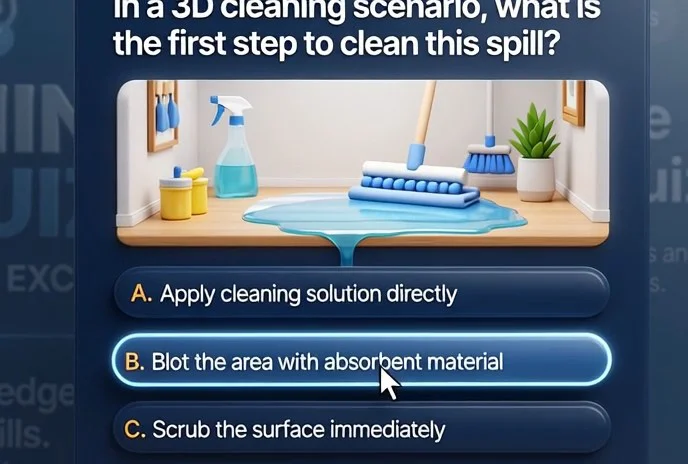
We are changing the approach to training. We develop 3D quizzes on Unity: an engineer finds themselves in a virtual production situation, makes decisions, and immediately sees the consequences.
This is not a perfunctory exam but skill training in conditions close to real life. The employee absorbs regulations and safety procedures naturally rather than through rote memorization — the business gets trained personnel and reduced risks.
What a 3D Quiz Delivers for Employee Training
Regular employee training is presentations and checkbox tests. After a week, knowledge fades, and mistakes repeat. A 3D quiz for employees changes the approach: a person steps inside a situation, makes decisions, and immediately sees the consequences. This format sticks in memory for a long time and works for safety and efficiency.
Engagement Instead of Boring Slides
The virtual environment turns training into a game: tasks, scores, competition between teams. Employees engage in the process with interest, not under duress. This is especially important for experienced specialists who believe they "already know everything."
Knowledge Retention Through Practice
Instead of memorizing instructions — practicing real actions. A mistake in a virtual workshop doesn't cost plant downtime but provides the same experience. Practical retention of material is higher than when reading documents, and employee confidence grows.
Risk Reduction and Occupational Safety
Hazardous scenarios — leaks, fire, equipment breakdown — can be practiced without threatening health. The engineer remembers the correct algorithm at the level of actions, not text. The result is fewer accidents, injuries, and fines — a direct benefit for the business.
| Format | Who It's For | What It Delivers |
|---|---|---|
| Occupational safety briefing | All employees | Safe actions become automatic |
| Engineer certification | Technical specialists | Knowledge assessment without stress or "cramming" |
| Onboarding for new hires | New employees | Quick integration into processes and regulations |
Such a quiz can be adapted to a specific production facility, regulations, and typical mistakes. Employees gain experience that is actually used on the job, while the manager sees visible growth in competencies and reduced risks.
3D Quiz Formats for Engineers: Choose According to Your Task
Engineers learn differently than office employees: it's important for them not just to memorize information but to understand how to act in a real production situation. Regular slides and tests quickly get boring and don't give a sense of practice.
A 3D quiz solves this problem — the employee finds themselves in a familiar workshop or site environment and makes decisions with instant feedback.
But the same quiz won't work for skills practice, certification, and team engagement all at once. We use different formats for different goals. Below is a table to help you choose the right option for your task.
| Format | Who It's For | What It Delivers to the Client |
|---|---|---|
| Trainer-quiz | Engineers mastering new equipment or technological processes | Practice of actions without risk to production, fewer errors in real work |
| Exam-quiz | Certification and knowledge checks after a theoretical course | Objective assessment of competencies, transparent statistics for each employee and crew |
| Quest-quiz | Teams that need to build cohesion or increase engagement in training | Material retention through emotions, team spirit, additional reach within internal communications |
Formats can be combined: first a trainer so engineers can calmly get the hang of it, then an exam for an official check. Or use a quest as the final stage of training when you need to reinforce the material in a light competitive form.
We'll help you choose the optimal format or a combination for a specific task — from a small department to a whole plant site. We'll guide you through timelines and implementation stages so that training goes smoothly without disrupting production.
How a 3D Quiz Is Developed: Project Stages
We've structured quiz development so that you can see the result at every stage and influence it. No "black box": the process is transparent, timelines are fixed in the contract, and every decision is agreed with you before moving to the next step. Below are the main stages of the project.
- Brief and goals. We define who needs to be trained and in what, what knowledge to check, and what outcome we consider successful. The output is a technical specification and a clear cost estimate with no hidden work.
- Scenario and mechanics. We turn training materials into questions, a storyline, and a 3D space. We align the visual style and progression logic so the quiz solves a training task rather than being mere entertainment.
- Pilot version. We assemble a working prototype with key levels. You see how the game looks and feels and make edits before full development begins.
- Development and content. We create all levels, questions, feedback for employees, and a scoring system. At this stage, we set up integration with your learning management system or corporate portal if needed.
- Testing and approval. We test the quiz on different devices, fix bugs, and prepare instructions for administrators and participants. You receive the final version after your official approval.
- Launch and technical support. We help deploy the quiz, train your team, and stay in touch: we update questions, fix unforeseen issues, and develop the project further.
This approach eliminates the main risks: mismatched expectations, missed deadlines, and a "raw" product. You accept the work stage by stage and always understand what's happening at each step of development.
What's Included in the Delivery: 3D Quiz Package
You receive a complete delivery package — not just a 3D quiz but a working tool for training and assessing engineers' knowledge. Everything needed for launch has already been thought through and is included.
- Quiz scenarios tailored to your regulations and instructions: questions are adapted to the engineers' profile, equipment specifics, and your company's technological processes.
- A package of 3D models of equipment and assemblies: employees explore the structure in volume, rotate parts, and memorize design features faster.
- An admin panel with a clear interface: you populate the question bank, change difficulty, deadlines, and configure access for groups without developer involvement.
- Automatic reporting: each engineer's results, group statistics, repeat attempts, and learning progress — all collected in clear tables.
- Employee personal account: completion history, mistake analysis, and access to reference materials right after answering.
- Instructions for working with the quiz: short training materials for administrators so your team quickly gets up to speed on content and launch.
- Technical support during implementation: we help deploy the quiz on your computers or internal network and check that it works on all devices.
- Update policy: we add new scenarios, questions, and 3D models during the support period so training keeps pace with production changes.
If something needs improvement, you can always reach out to us for a new version of the package. The key point is that the first launch happens without you having to dive into technical details.
Case Study: How We Improved Safety for Engineers at a Plant
At one plant, we encountered a typical situation: engineers knew the safety rules but regularly violated them in their daily work.
The reason — habit and the belief that "nothing will happen." After yet another audit, management realized that traditional briefings and posters don't change behavior, and they turned to us for a solution.
We proposed not a lecture but game-based training — a 3D quiz built on a professional game engine. Engineers found themselves in a virtual copy of their workshop and went through scenarios: equipment startup, work at height, emergency response.
Instead of dry questions — situations where the right action must be chosen. We added a competitive element: scores, completion time, and a leaderboard. This turned mandatory training into a lively competition.
Results became noticeable within the first month. 1,200 engineers completed the quiz, and the number of violations of key regulations fell by almost a third over the quarter. Re-testing three months later showed that 98% of employees give correct answers to safety questions. Managers received detailed reports for each department and saw which topics need additional review.
The main indicator for us — the plant renewed the quiz for a second year and asked us to adapt it for other workshops. This confirms: game-based training changes habits, not just entertains. We now use the experience from this project in new quizzes for industrial enterprises.
We know how to turn safety training into a tool that reduces risks and pays for itself through prevented incidents. Tell us about your task — we'll choose a format that solves it rather than just "ticking off" the training plan.
Answers to Common Questions About Quiz Development
Clients often ask the same questions: how long will development take, will the quiz fit into the current training system, and what happens if something needs to be changed after launch.
We address these concerns before the project starts so you understand the timelines, working format, and guarantees.
Each quiz is made for a specific business's needs, so there are no standard "out-of-the-box" answers. But there are typical requests we hear from training managers and HR directors. We answer them directly.
How long does quiz development for engineers take?
We build a basic turnkey quiz in 3–4 weeks: scenario discussion, question formulation, visuals in your brand style, and trial operation.
If the quiz needs to be embedded into a corporate portal or learning management system, the timeline will increase by a few days — but you'll receive a clear plan with dates at the start.
We show intermediate results every week. You don't wait "in silence" — you see the completed part and can make edits along the way.
Can we integrate the quiz with our learning system?
Yes. We make the quiz a standalone application or embed it into your portal via a link — with no complex setup. Employee results automatically flow into overall reporting if your system supports standard data exchange formats.
If you have a non-standard solution, we'll check compatibility on your server in advance and offer the most reliable option. You won't have to change your usual processes.
What guarantees are there that the quiz will work reliably?
We work with proven tools and professional equipment, so the quiz handles hundreds of employees taking it simultaneously without failures. We provide a technical guarantee for each project: if something breaks during operation, we fix it free of charge.
Additionally, you receive a clear administrator guide — how to launch the quiz, update questions, and view statistics. Usually, any employee without a technical background can handle it.
What if we want to change questions after launch?
We build in content update capability at the development stage. You'll be able to change questions, answer options, and hints yourself through a simple control panel — without developer involvement and without rebuilding the application.
If needed, we'll add new topics or change the design. This can be done at any time, and we'll advise on how to organize everything best.
Still have questions about your specific situation? Write to us — we'll discuss how a quiz can solve your engineers' training challenge and prepare a preliminary plan within one day.How to Choose a Quiz Format for Your Production Tasks?
Choosing a quiz format starts not with mechanics but with a question: what production task are you solving? If you need to quickly introduce new employees to regulations and safety procedures, a short multiple-choice test that can be completed in 10–15 minutes will work.
If the goal is to practice complex scenarios, such as emergency response, it's better to use a quiz in simulation form: the engineer receives input data and chooses a sequence of steps, while the system shows the consequences of each decision.
The second criterion is training frequency. For one-time briefings, a simple survey with explanations after each question is enough.
For regular knowledge checks, a quiz with cumulative statistics is more effective: you see which topics are difficult for a workshop or department and update training materials in time.
This approach reduces the risk of mistakes — the employee repeats difficult material until the skill becomes automatic.
The third point — scale and environment. If engineers work in the field and have access only from a phone, choose a lightweight format that works reliably even with a weak internet connection.
For stationary training in a workshop or office, you can use richer graphics and game mechanics — this holds attention and increases engagement. The main thing is that the format is convenient for the employee — then the training result will be higher.
There is no universal "best" type of quiz. That's why we start with a short brief: you describe your production tasks, and we propose a format that will address them faster and more simply than standard courses.
In the end, you get not just a game but a tool that reduces training time and decreases the number of mistakes on the job.
Order a 3D Quiz for Engineer Training Today
Engineers don't read instructions — they solve problems. Regular slides and tests quickly get boring, and knowledge fades right after the exam.
A 3D quiz turns training into practice: the employee enters a virtual environment where they test equipment and make decisions themselves. Material is remembered through action, not rote memorization.
We create such quizzes turnkey: we write the scenario, model work situations, and set up the assessment system. You don't need to understand the technology — we handle the stages ourselves and fit the finished product into your training programs. The result — increased engagement and objective data on each engineer's readiness.
To get this, simply leave a request for a free consultation. After reaching out, you receive:
- An analysis of your task and recommendations on the quiz format — we'll advise how to most effectively test your specialists' knowledge.
- A prototype demonstration before full development — you see the mechanics of the future quiz and adjust it without extra costs.
- Fixed timelines and a work plan with clear stages — you control the process instead of waiting for "whatever happens."
- Adaptation to your company's internal standards: style, terminology, regulations — employees learn "in their native language."
- Post-launch support — we'll update questions, add new scenarios, and answer administrators' questions.
Order a 3D quiz for engineer training today. Write to us or leave your number — we'll contact you at a convenient time and offer a solution for your task.