

Training heavy equipment operators: why quizzes are more effective than safety briefings
Every safety briefing ends the same way: employees nod, sign the log, and a week later remember only general phrases.
For heavy equipment operators and machine operators, this is not a formality — a mistake on the production floor costs downtime, repairs, and sometimes people's health.
Regular lectures and posters don't hold attention, so personnel knowledge control turns into a checkbox rather than real protection.
Quizzes for employees solve this problem: operator training stops being passive. A person answers questions, immediately sees their mistakes, and remembers the correct answer through action.
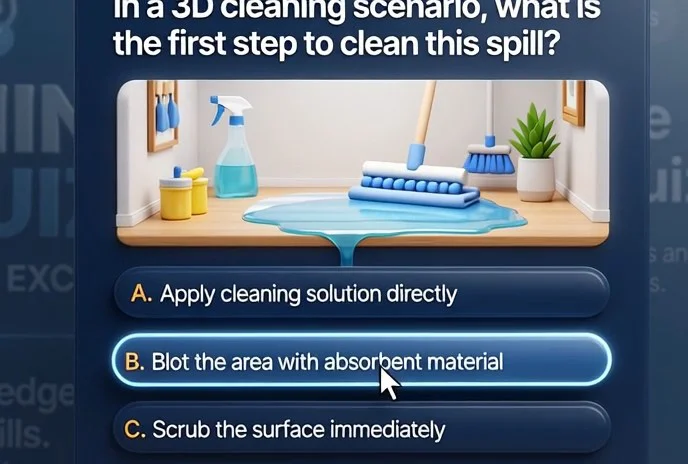
Educational games in 3D quiz format immerse them in situations as close to real life as possible — with equipment, routes, and emergencies. This way, knowledge stays in the head, not in the briefing log, and safety briefings stop being a boring formality.
We structure training so that every question works for production safety: employees practice emergency response algorithms, check their understanding of regulations, and learn to make decisions under time pressure.
The manager gets transparent statistics — who has absorbed the material and who needs additional review. This is real personnel knowledge control, visible in numbers rather than signatures on a sheet.
Notice: after this format, employees themselves ask to repeat the training because it's interesting. And interest is the best motivator for remembering rules. If you need results, not formal attendance — quizzes deliver reliably and measurably.
What benefits do training quizzes bring to business
Classic lectures and briefings don't hold the attention of experienced machine operators or beginners. A quiz in 3D game format turns knowledge testing into a competition where everyone sees their own results. We develop such quizzes and highlight five measurable benefits for business.
Increased engagement
The excitement of competition makes employees return to training. Instead of boring tests — game scenarios with points and levels. Employees complete the course instead of putting it off.
Fewer errors
Practicing emergency situations in a safe environment reduces the number of errors on real equipment. Each wrong answer comes with an explanation — knowledge sticks. The company gets fewer incidents and less downtime.
Savings on instructors
Quizzes take over the routine part of training: knowledge checks and theory review. Instructors only handle practice and complex questions. This reduces preparation time and instructor costs.
Progress tracking
The manager sees the full picture: who is ready to work, who is falling behind, and which topics cause difficulty. Data is collected automatically after each session. This makes it possible to identify risks early and adjust training plans.
Scalability
One created quiz can train any number of employees — in any branch, at any time. No need to organize group sessions, just provide access. Scaling training does not require increasing staff.
Quiz formats for training machine operators: from theory to practice
Training machine operators and heavy equipment operators is not only about transferring knowledge but also about monitoring its application.
A game-format quiz holds attention, and results immediately show which topics have been mastered and where additional preparation is needed.
We select quiz formats for the specific task: quick pre-shift checks, emergency situation practice, or comprehensive recertification. A comparison of options is in the table.
| Quiz format | Who it's for | What it gives the client |
|---|---|---|
| Short test on theoretical knowledge | All employees, including newcomers | Quick assessment of preparation, identifying gaps |
| Scenario-based quiz with production situations | Heavy equipment operators, machine operators | Practicing actions in emergency situations, reducing errors |
| Team quiz competition | Crews, shifts | Engagement, team building, material review |
| Combined format: theory + scenarios + error analysis | Staff undergoing recertification | Reinforcing knowledge, measurable results, readiness for certification |
How to choose a format
If you need to quickly check preparation before a shift, a short test works. When you need to practice actions during a breakdown or emergency, choose a scenario-based quiz for operators.
In any case, the quiz for machine operators integrates into current training without downtime. We adapt questions to your regulations and equipment model, and statistics for each employee help show the real picture of material retention.
How quiz development works: a step-by-step process for the client
Developing a training quiz for heavy equipment operators is not a "set it and forget it" process — it's one in which you participate as the client.
We've broken it down into clear stages: after each one, you see the intermediate result, approve it, and only then do we move forward. This way you control deadlines and quality, and the quiz turns out exactly as you intended.
- Requirements gathering and getting into the task. We study the specifics of operators' work, analyze typical errors and difficult situations. Together with you, we define which knowledge needs to be reinforced.
- Creating the scenario and questions. We turn the material into a quiz with clear wording and answer options. We approve the scenario before development begins, so nothing needs to be redone.
- Design and layout. We develop the visual style, interface, and structure — from the intro screen to the results screen. You see how it will look and make changes.
- Assembly and content. We create the quiz: add 3D graphics, sound, animations, and wire up the scoring logic and answer explanations. We show intermediate versions for review.
- Testing. We test the quiz on different devices and screen resolutions and fix issues. You get a stable, glitch-free version.
- Launch and implementation. We install the quiz on your devices and conduct training for employees. We help integrate training into the work schedule.
- Support and analytics. We collect completion statistics: how many people completed it, which questions cause difficulty. We refine content based on results.
What's included in the delivery: a complete training quiz kit
We provide the client with a complete set for launching training, not a "semi-finished product" that needs extra work. Scenario, questions, settings, instructions, and usage rights are all already tailored to your task and ready to use.
The kit covers the full cycle: from setting a training goal to analyzing each employee's results. The manager gets a tool that works immediately, without spending time studying specs and refining content.
Here's what's included in the delivery:
- A ready-made quiz scenario — a well-thought-out sequence of "learning — reinforcement — testing." The scenario is divided into blocks so operators and machine operators go through the material without overload, with increasing question difficulty.
- A question bank — on operating technology, safety, and regulations. Each question includes an explanation of the correct answer so the employee understands not only "what is right" but also "why this is the way it is."
- Settings tailored to your specifics — number of questions per session, time per answer, difficulty levels, topic order. An administrator can change parameters without a programmer — for a new shift or a specific section.
- Instructions and regulations — short guides for operators and machine operators: how to use the quiz, where to see results, who to ask questions. Everything is inside the interface, nothing to search for.
- Completion report — the system shows which topics have been mastered and which are worth reviewing. The manager sees the progress of each employee and the group as a whole.
- Content usage rights — the scenario, questions, texts, and settings are fully transferred to the client. You can freely use the kit within the company, roll it out to new shifts, and adapt it to updated regulations.
Bottom line: you get a closed training system that works on your side and doesn't require constant developer involvement. The content stays yours, and results remain transparent for control.
Case study: how a quiz reduced the number of errors on the production floor
For a large machine-building holding company, PromTechCenter, we developed a training quiz that replaced part of the paper briefings for heavy equipment operators and machine operators.
Employees worked through scenarios from real production situations: choosing a safe travel path, the sequence of actions in an emergency, signs of equipment malfunction. The quiz was integrated into regular training and took no more time than a standard briefing.
The client's main request was to reduce errors on the production floor. We built the scenarios so that the employee didn't just answer questions but saw the consequences of their choices in a simulation.
After each task — a short breakdown of why the option is correct and what will happen if the rule is violated. This format is easier to remember than reading instructions because it engages personal experience and emotions.
Case results
After two months of using the quiz, we, together with the client's occupational safety department, calculated the metrics. The numbers confirmed it: a successful training project provided measurable value to the business.
- The total number of operator errors in typical operations decreased by 37%.
- Cases of violating the order of actions in emergency situations became half as frequent.
- All 328 employees completed the quiz — 100% training without interrupting shifts.
- Six months later, the client ordered an expansion of the quiz to new departments and question rotation.
Now the quiz has become a permanent part of the training program: questions are updated every three months, and new employees take it right after hiring. A one-time initiative has turned into a systematic tool for knowledge control and reducing errors on the production floor.
Frequently asked questions about implementing training quizzes
Heavy equipment operators and machine operators often view training skeptically. So before launching a quiz, managers have typical fears: won't employees dismiss it, won't the system break, how to fit the quiz into the work schedule. We answer the most common questions.
What if employees don't accept the quiz?
The quiz is built around real work situations: signs, regulations, emergencies. It's a practical knowledge check, not a game. The competitive element and clear results help engage even experienced machine operators, and a pilot launch removes objections.
What if the quiz breaks during training?
Reliability is ensured by professional server infrastructure and redundant capacity. At launch, we assign a technical specialist, and after implementation, quiz technical support remains available.
How do we integrate the quiz into existing training?
The format adapts flexibly to your schedule: short modules after theory, control tests before authorization, or regular practice sessions. We determine the duration and frequency together so as not to overload employees.
Is it difficult to adapt content to our regulations?
Content adaptation is a standard service. You provide your regulations and typical situations, and we turn them into questions. If rules change, the material is updated without stopping training.
If your question isn't on the list, ask us directly.Order a quiz developed for your company's needs
Every company that trains heavy equipment operators and machine operators faces the same task: how to test knowledge so employees truly absorb the material instead of just "taking a test." A ready-made quiz with generic questions doesn't take into account the specifics of your equipment, regulations, and real situations on site.
We develop training quizzes turnkey — taking into account your instructions, equipment, and work scenarios, so the result is measurable and practical.
When you order quiz development from our team, you get:
- Adaptation to your equipment and regulations — questions are based on your instructions, not abstract examples.
- An intuitive interface for employees of any age — no need to learn how to use the program; everything is intuitive.
- Real-world scenario simulations — the operator sees not a dry question but a production case, and learns to make the right decision.
- Results control for the manager — immediately see who has mastered the topic and who needs additional training.
- The ability to update questions — the quiz never becomes outdated; you can add new tasks at any time.
- A flexible format — we work with small groups and entire shifts, including remotely.
Leave a request for a training consultation — we'll review your situation, suggest how to structure knowledge checks, and recommend the optimal format. After a short brief, you'll receive a cost estimate for the quiz for your team and implementation timelines. No hidden conditions: you know what you're paying for and what result you'll get.
You can order a quiz today — just write to us in the chat or leave your contacts via the form. We'll get back to you within a business day, answer your questions, and prepare a proposal tailored to your tasks. Let employee training become predictable, and knowledge testing convenient and effective.
How to choose the right quiz format for your team?
Choosing a quiz format starts not with the question "which quiz should we buy" but with the training goal.
For heavy equipment operators and machine operators, what matters most is not the number of correct answers but the ability to act in an emergency: stop the machine, react to brake failure, assess dimensions.
First, decide what you're testing: knowledge of instructions, reaction speed, or readiness for certification.
The first criterion is the team's skill level. Beginners benefit from educational formats with hints, explanations, and repeat attempts. Experienced machine operators benefit from time-limited tests with error analysis to find gaps accumulated in routine work.
For a mixed team, choose a quiz with difficulty settings: one scenario, different question sets by experience level.
The second criterion is where and when training takes place. If employees are in a workshop or on a site without stable internet, you need a quiz that works offline and syncs results later.
For remote training, a personal account is more convenient, where the employee takes the test at their own time and the manager sees aggregated statistics.
The key is that the format doesn't require technical knowledge from people, otherwise attention goes to setup rather than learning.
The third criterion is what you do with the results. For work authorization or qualification confirmation, you need a format with a results protocol and limits on retakes.
For regular skill maintenance, short ten-minute sessions once a month are enough — they don't pull people away from production and show dynamics. Ask yourself: "What will I do with the result?" — the answer will point you to the right format.
There is no universal quiz, but the best effect comes from a combination: short onboarding tests for beginners and complex scenarios for scheduled operator checks.
We select the format at the brief: we study the specifics of the equipment, shift schedules, and safety requirements, and show a trial version using your materials. This way you see how the quiz fits into training and can decide without risk.