

Training Quizzes for Pilots and Air Traffic Controllers: The Engagement Challenge
Standard training for pilots and air traffic controllers rarely delivers the right level of engagement. Lectures and tests are seen as a formality, and knowledge quickly fades. Managers invest in training but see no return: a month later, staff struggle with the same questions.
In a profession where a mistake can cost the safety of hundreds of people, this is an unacceptable risk.
The reason is that passively listening to a briefing does not create an emotional response. Pilots and air traffic controllers are used to acting and making decisions under time pressure, while standard slides do not provide that kind of challenge.
Even experienced professionals get lost when a situation goes beyond familiar procedures. Staff engagement drops, and knowledge checks become a box-ticking exercise. Game-based training changes this: it adds excitement, competition, and scenarios close to real life. Mistakes can be made in a safe environment rather than in the sky or on a radar screen.
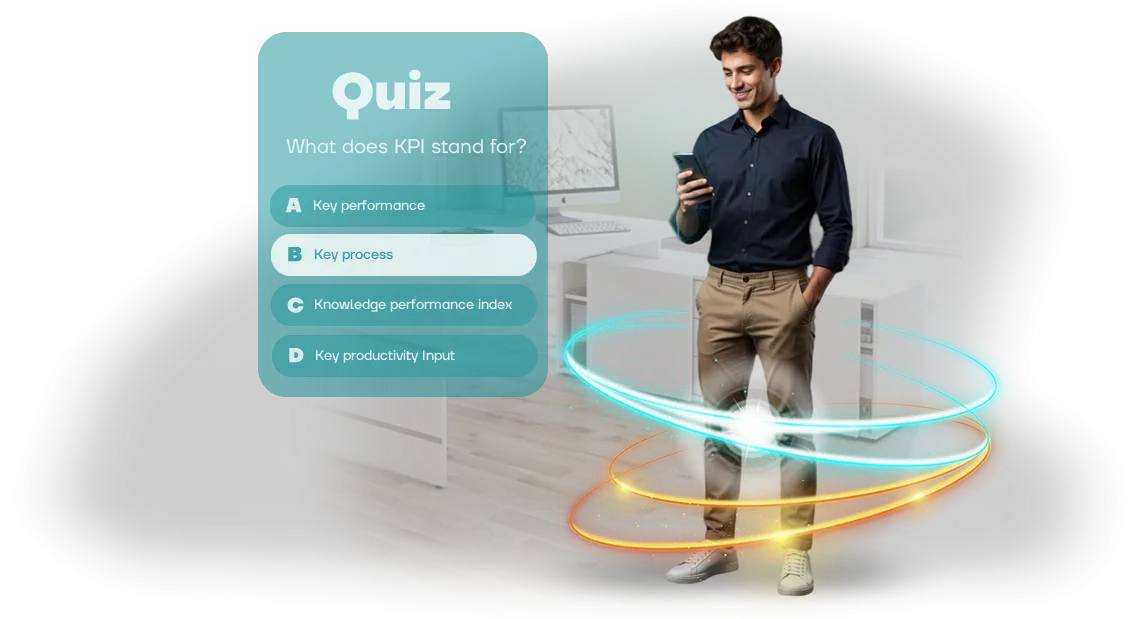
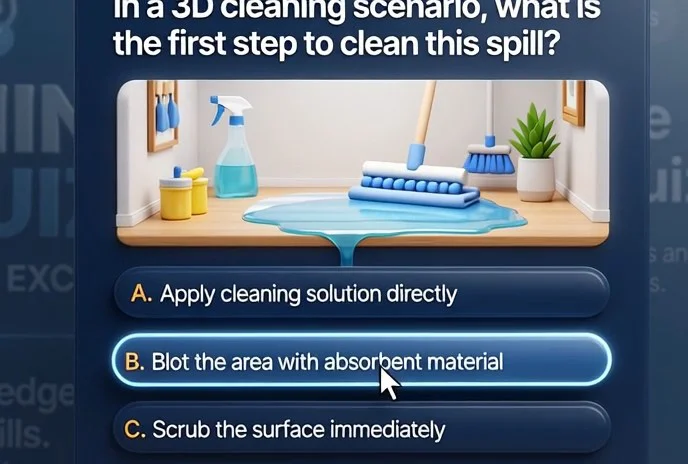
Training quizzes built as interactive 3D scenarios solve this problem. Employees do not just pick answers — they work through situations that arise in their daily operations.
Managers see an objective picture: who has absorbed the material, where the gaps are, and who needs additional practice. These quizzes can be taken individually or in a group, in the classroom or remotely — convenient for companies with multiple bases.
We develop exactly these kinds of solutions for the aviation industry. We help turn training from a routine chore into a tool that genuinely reduces risks and improves team readiness.
We draw on professional game technologies and the experience of aviation specialists. If standard training no longer works — we know how to change that.
What the Game-Based Training Format Gives Employees
Engagement Instead of Boring Lectures
Employees get tired of long presentations and briefings, so a quiz turns training into an engaging game. The excitement, the competition, the desire to show the best result keep attention to the very end — even those who usually sit back now get involved. Our team creates game scenarios that make everyone want to participate.
Material Retention 2–3 Times Higher
The game format engages emotions and active repetition, so knowledge sticks more firmly than with passive reading. Educational games for employees increase material retention by 2–3 times compared with ordinary texts.
This means rules and procedures will be applied in practice instead of being forgotten within a week.
Knowledge Check Speed: Minutes Instead of Weeks
Once the quiz is completed, you immediately see who has mastered the topic and who needs additional preparation. Corporate training becomes transparent: results are collected automatically, mistakes are highlighted, and there is no need to check tests manually. Difficult questions can be reviewed quickly and the program adjusted.
Higher Completion Rates and Regular Repetition
Short game sessions are more convenient than long courses, so employees are more willing to return to the material. Managers see higher training completion rates without constant reminders, and repeat quizzes reinforce knowledge. The benefit of a quiz is a consistently competent team and fewer errors on the job.
A Flexible Format for Any Team
The quiz adapts easily to team size and focus: from newcomers to experienced employees, from one department to the whole company. You can launch training for hundreds of people at once and get results for each individual. This makes corporate training consistent and manageable.
Quiz Formats for Different Company Objectives
Employees can be trained in different ways: some need no more than a quick knowledge check, while others need to practice actions in a stressful situation.
The same format will not deliver the same result for newcomers and experienced pilots — which is why we match the quiz to the company's specific objective.
In practice, three formats work well, and each addresses its own business challenge. A comparison by key metrics will show which option delivers the result you need: coverage, retention, or decision-making speed.
| Format | Target audience | Business benefit |
|---|---|---|
| Classic quiz — multiple-choice questions | New employees, periodic certification of all departments | Quick assessment of knowledge levels, full staff coverage, automated checking, and transparent statistics |
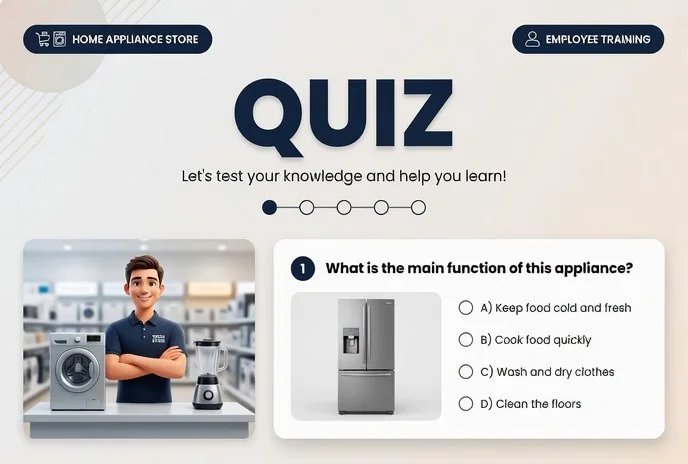
| 3D quiz — a quiz with visualization of equipment and processes | Pilots, air traffic controllers, engineers | Immersion in a realistic environment, higher retention, practicing procedures without safety risk |
| Educational game — a branching scenario with consequences for decisions | Experienced employees, crews, rare emergency situations | Training complex procedures, team coordination, analysis of each participant's mistakes |
Choosing a format does not mean compromise — in a single project we combine a 3D quiz for mass assessment and an educational game for practicing rare scenarios. This gives the company both broad coverage and deep skill development.
We develop on a professional game engine, so any format runs reliably on office computers and tablets.
How We Develop a Quiz: From Brief to Launch
Quiz development is a transparent process in which you participate at every step. It matters to us that you see how the future training tool takes shape and can influence it before launch.
We document agreements, show interim results, and accept revisions — without surprises or black boxes.
- Brief and task immersion. We examine who needs training and in what: what knowledge is being checked and which formats suit your employees. The result is a document with objectives and success criteria for your approval.
- Scenario approval. Together with you, we refine the questions, answer options, and explanations. For pilots and air traffic controllers, the wording must be unambiguous and comply with regulations — you receive a complete scenario for approval.
- Plan and timeline. We set out milestones, checkpoints, and deadlines. You know when the first version will be ready, when testing will take place, and when the quiz can be launched.
- Implementation and interim demos. We build the quiz and you see it in action: the interface, logic, scoring, and feedback. We make revisions before training is rolled out to the wider team.
- Testing with a real audience. We run a pilot version with a small group of employees. We observe how they take the quiz, note where questions arise, and refine it.
- Training launch. We deploy the final version, set up access and integration with your learning system. You get completion statistics in a convenient format — by groups, topics, and dynamics.
- Support and development. After launch, we stay in touch: we update questions, add new topics, and help when regulations change. The quiz grows together with your training program.
This approach helps you avoid surprises and get a tool that genuinely works within your training program. You always know what stage development is at and make the key decisions. At the same time, ordering a quiz takes a minimum of your time — we handle most of the work.
What Is Included in the Delivery: Customer Package
You get not just a game, but a launch-ready training kit for your employees. It contains everything you need to run the quiz without involving developers or technical specialists — from the scenario to usage rights.
Here is what the delivery includes:
- Quiz scenario — a developed storyline and questions tailored to your specifics: rules, procedures, emergency situations. The scenario is approved with you before development begins.
- Ready-to-use quiz game — adapted for training pilots and air traffic controllers, with professional graphics and voiceover. Runs on your hardware or via the cloud — no complex software installation required.
- Administrator guide — a clear manual: how to launch the quiz, add participants, change questions, and view results. Any employee can handle it without technical preparation.
- Participant quick guide — a short instruction for pilots and controllers: how to log in, answer questions, and complete the scenario. Minimal questions before training starts.
- Administrator dashboard — a convenient panel showing each employee's progress: who has completed the quiz, which topics caused difficulties, and who needs additional review.
- Completion report — automatic statistics from the quiz: overall score, error analysis, and proficiency level by topic. You see the real picture and areas for team growth.
- Usage rights — an unlimited license for your organization. You can use the quiz for all employees, update questions, and use it in future training programs.
The full package is handed over once the work is complete — along with documentation and launch support. All you need to do is set a date and invite your employees: everything else is ready to go.
Case Study: How a Quiz Helped an Airline Speed Up Knowledge Checks
When an airline approached us to develop a training quiz, the pain point was concrete: checking the knowledge of pilots and air traffic controllers took too much time and pulled crews away from their work.
The traditional format — paper tests and in-person sessions with an instructor — did not scale, and results were difficult to consolidate into a single database.
We built an interactive quiz on Unity: employees complete it on tablets or computers in 10–15 minutes, and managers see statistics in real time. This format works both in the training classroom and remotely — between shifts or flights.
What the Launch Showed
One of our clients used this quiz to run a knowledge check for 400 pilots and 60 controllers. The result: checking time dropped by 40% — it took six working days instead of ten.
Not a single flight was disrupted: employees took the test in convenient time windows rather than in fixed groups.
Why the Client Stayed
Within the first month, all 460 employees completed the quiz. Management received a transparent report for every question: it is immediately clear which topics pilots and controllers struggle with.
Based on this data, they restructured the training program and closed the gaps in a targeted way — that in itself is a training success story.
The airline did not just solve a one-off problem — two months later it returned with a request to extend the quiz to ground staff. This is why we recommend starting with a pilot group: you quickly measure the effect and decide where to apply the format next.
How to Choose a Quiz Format for Your Training Objective?
Choosing a quiz format starts not with a "nice visual" but with a question: what problem should the game solve?
For pilots and air traffic controllers, this is either checking knowledge of regulations, practicing actions in an emergency, or maintaining skills on a regular basis. Each of these objectives calls for a different type of quiz.
A text test will show whether an employee remembers a point from the manual. But it will not show whether a pilot can act when a system fails, or whether a controller can separate two aircraft within a limited time.
For that, you need a 3D environment close to the cockpit or workstation, where decisions are made at a realistic pace.
Here is a short reference table to help you choose the format:
| Training objective | Recommended format | What the company gets |
|---|---|---|
| Check knowledge of regulations | Classic quiz with explanations | Quick assessment, clear view of who is falling behind |
| Practice an emergency situation | 3D simulation with decision choices | Reaction training, not memory training |
| Maintain skills after a break | Short recurring game | Consistent level of preparedness |
We help match the format to the specific objective: we analyze where errors occur and propose a scenario — from a light survey to a full-scale 3D quest.
This is not technology for technology's sake, but a measurable result: fewer incidents, faster response, and clear statistics for every employee.
If you do not know where to start, come with the problem rather than a ready-made specification. We will propose a format that meets your training objective and show a pilot version before the full launch.
Frequently Asked Questions About Developing Quizzes for Employees
We understand that when ordering a training quiz for pilots and air traffic controllers, you look not at technical details but at results: will it be ready on time, who will support the project after launch, and what happens if something goes wrong. These are the right questions — training should not be interrupted.
That is why we set timelines, areas of responsibility, and the support format in advance. Below are answers to what concerns our clients most often.
How long does quiz development take?
Timelines depend on the format and number of scenarios, but we state them before work begins and fix them in the contract. A basic version typically takes two to four weeks, including approvals.
What happens if the quiz stops working?
After launch, you are not left alone with a problem. We take the quiz into maintenance: we respond within the agreed time, find the cause, and restore access so that the training schedule is not disrupted.
What guarantees do you provide?
We guarantee that the quiz will work according to the approved scenarios. A warranty period is in effect after delivery — if any errors are found, we fix them at no extra cost. You accept the result against a clear list of criteria.
How quickly are changes made?
If new questions come up during use or training rules are updated, we make revisions according to the agreed procedure. Urgent changes are handled on a priority basis so that planned sessions are not disrupted.
If your question is not on the list — write to us: we will advise on terms that fit your training program and employee schedule.Submit a Request to Develop a Quiz for Pilots and Air Traffic Controllers
Submit a request to develop a quiz for pilots and air traffic controllers — and receive a cost estimate, examples on your topic, and a launch plan within a few business days. We work remotely, so we can start the project in any region.
Our team has been creating training quizzes for aviation specialists for more than 10 years. Your employees will complete a scenario that reinforces regulations, emergency procedures, and safety standards — in a format that does not feel like a boring lecture.
By ordering a quiz from us, you get:
- an accurate cost estimate and timeline before work begins — no hidden fees;
- adaptation to your regulations and internal documents;
- a convenient system for completing and monitoring the quiz for a group of pilots and air traffic controllers;
- the ability to update questions and difficulty levels after launch;
- technical support and a guarantee on results for the entire period of use.
Submit your training request through the form on the website or via messenger — our manager will clarify the task and prepare a solution that fits your schedule. For many airlines, we maintain confidentiality and work within tight deadlines.
Start with a short message: you will receive the cost estimate for the quiz and a launch plan without unnecessary approvals. To run a training program this quarter, it is best to send your request in advance — that way the team will have time for testing and adjustments.