

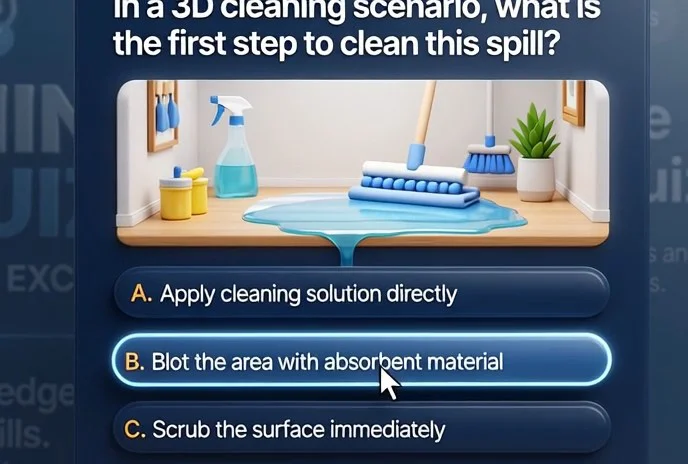
How to keep production workers engaged without boring safety briefings
Boring briefings are not just wasted time—they are a direct loss to the business. When a worker mechanically nods through a lecture and a week later cannot remember how to act in an emergency, the cost of that mistake is downtime, defects, and injuries. Engaging workers in training is not an “HR perk” but a tool for reducing costs.
An employee who completed training “for show” is a risk. They violate procedures and create emergency situations. When this becomes systematic, employee retention suffers: people do not want to work where training is a formality. Turnover grows, and with it the cost of finding and onboarding new hires.
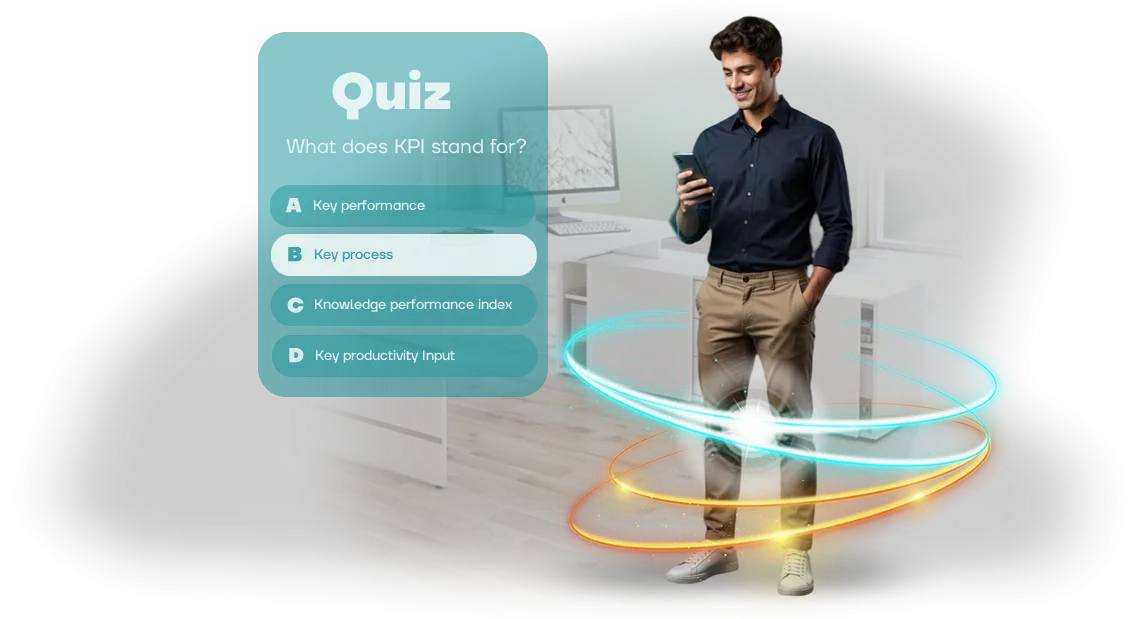
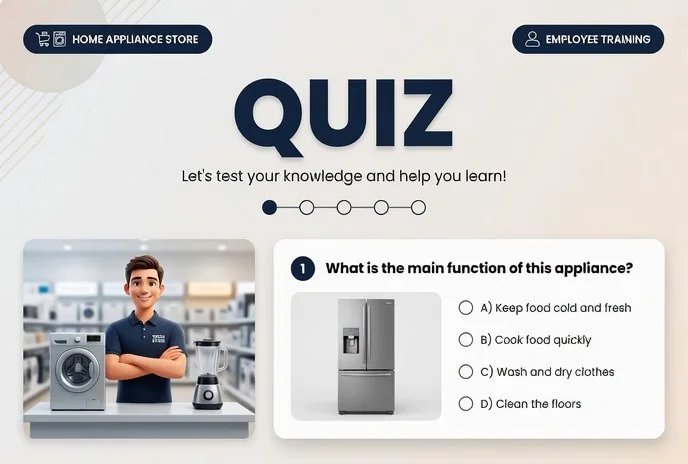
We solve this with learning quizzes that turn boring briefings into a live game. Workers do not memorize regulations by rote—they compete, see progress, and get results.
Game mechanics hold attention, and knowledge is reinforced through practice rather than “heard and forgotten.” Employee training becomes an event people want to come back to.
Worker engagement delivers measurable results: fewer errors on the line, faster onboarding for new hires, and a calmer atmosphere in the team. Employee retention improves—people see that the company invests in them and respond with loyalty. The briefing stops being an obligation.
The client gets a systematic tool: training takes less time, results are clear to the manager, and safety rules are actually absorbed. This is not magic but a well-tuned methodology proven across dozens of projects.
What a learning quiz gives the team
A learning quiz turns a boring lecture into an engaging competition. Production workers remember rules and regulations not because they are forced to, but because they find answering questions and comparing results with colleagues interesting.
Engagement rises immediately: employees ask for extra rounds themselves, discuss covered topics during breaks, and pass on experience to new hires. The benefits of quizzes for the team are obvious here—training stops being a chore and becomes part of working culture.
The second important effect is solving the main problem of corporate training: rapid forgetting. When a person simply reads instructions, they lose up to half of the content within a week.
In a gamified format, material sticks through repetition and emotion: correct answers are reinforced with feedback, mistakes are reviewed immediately rather than a month later. Learning happens at the level of practical skills, not dry facts—exactly what shop-floor workers need.
Better absorption of rules directly reduces the number of errors. An employee sees a question about a typical situation, recalls the procedure, and applies it to real work.
Fewer defects, less downtime, and fewer safety violations—training starts delivering measurable results within a month.
Finally, a quiz provides an objective assessment of employee knowledge. You see the percentage of correct answers per person and per topic, time taken to answer, and typical mistakes.
This gives a concrete picture of team competency, making it easy to adjust the training program and make staffing decisions. The quiz works simultaneously as a trainer and as a knowledge check.
In the end, you get a comprehensive tool: higher engagement, better material retention, fewer errors, and a clear knowledge assessment system. All of this fits naturally into your corporate training system and directly improves key production metrics.
Learning quiz formats for production workers
At one plant, employees go through occupational safety briefings; at another, they learn a new technological process; at a third, they need a quick knowledge check before a shift.
One universal quiz cannot solve all these tasks: different goals call for different formats—from short checks to team games.
We choose the format based on the specific task and production characteristics. This keeps people from being pulled away from work and embeds training into the working rhythm: some answer questions on the shop floor, some in a training room, and some as part of a team. The right format increases engagement and retention instead of turning training into a formality.
Typical quiz formats
| Format | Who it is for | What it gives the client |
|---|---|---|
| Individual quiz at the workstation | New employees, workers on different shifts | Knowledge check without stopping work, instant results per employee |
| Team game with screen and buttons | Teams, departments, competitions between shifts | Team building, live reaction, learning rules through competition |
| Mass quiz on tablets or on the shop floor | Entire workshop or plant, large-scale training | Unified coverage in a short time, automatic statistics collection |
| Refresher quiz-trainer | Employees before certification or after training | Reinforcing material, reducing errors on the job |
| Mini-survey before shift start | Operators, drivers, high-risk personnel | Quick readiness check, fewer emergency situations |
We discuss the format with you during the briefing: we take into account the number of employees, shift schedules, and the technical capabilities of the site.
The key thing is that the quiz solves your business task—improves safety, reduces defects, or accelerates the introduction of new processes. Everything else is our job.
How a quiz is developed, from brief to launch
We structure our work so you always know what stage the quiz is at and what you will get in the end. No “black boxes”: after the brief you receive a plan, then you approve the scenario, and the launch is supported by us.
This approach matters especially when training production workers—you have regulations and tight deadlines, so each stage is scheduled by dates and responsibilities.
Development stages
- Quiz brief. We discuss exactly who we are training: new employees, experienced staff, or a specific workshop. We set goals, question difficulty, and the desired outcome—error reduction, speed of getting up to speed.
- Plan and scope of work. You receive a calendar plan with intermediate milestones and the list of work. Changes can be made immediately, before development starts.
- Scenario approval. We prepare question texts, answer options, and a hint system. You see the learning logic and approve it before anything is built.
- Implementation. We create a quiz with a clear interface: large buttons, voice-over, and visual hints. Production workers should not have to read long instructions—everything is intuitive.
- Test run. We show a demo version, and you try it with several employees. We collect feedback and make final adjustments.
- Training launch. We deliver the finished quiz, connect it to your system, or place it on a convenient platform. Employees take it on a phone, tablet, or computer—without being tied to a workstation.
- Support and refinements. After launch we stay in touch: we fix questions, add new topics, and help with completion reports. You get statistics on who learned the material and how.
Each stage ends with a concrete result that you can see and approve. That is why launching the quiz goes without surprises, and production worker training delivers a measurable effect within the first weeks.
What is included in the quiz project delivery
When we hand over the project, you get a complete training tool, not a set of files and promises. The quiz is packaged so that HR staff or a workshop manager can launch it—without developers or technical specialists. As a result, deployment takes hours, not weeks.
The delivery package includes:
- Scenario and teaching materials — a ready-made lesson structure tied to your production processes, broken down by topic, with recommendations for the facilitator.
- Question bank — questions on occupational safety, technology, and regulations that test practical understanding rather than formal knowledge.
- Game logic and interface — configured rules, timings, hints, and a mistake-repetition mechanic so participants remember correct answers right during the game.
- Administrator guide — step-by-step instructions: how to create a session, invite employees, set up teams, and edit questions if needed.
- Training report — a summary for each participant: number of correct answers, topics that need retaking, and progress dynamics by group.
- Launch support — quick feedback after project handover and the option to adjust the scenario to the specifics of your site or workshop.
This package covers the entire cycle—from the first announcement of the quiz to the final knowledge check. A few days after handover, employees are learning in a game format, and the manager sees who needs additional training.
This reduces accident rates, speeds up the onboarding of new workers, and makes knowledge verification transparent.
Case study: how a quiz brought training to life at a plant
At industrial enterprises, safety training and equipment handling instruction often become a formality: lectures, presentations, and tests “for show.” Employees do not remember the key points, and violating instructions leads to downtime and risks.
We suggested that the “Volga-Mash” plant replace its dull briefing with a 3D quiz where each worker goes through scenarios on production sites in game form.
What it was like before the launch
The briefing took three hours, employees sat through it without interest, and the knowledge check showed only 60%. After training, rules still had to be reminded manually—shop managers spent several hours a week doing this, and mistakes kept repeating.
What they got after launching the quiz
We built a virtual space with the plant’s key zones and embedded questions that actually arise in real work. The quiz itself pointed out mistakes and explained the correct answer—this replaced repeated lectures with individual training.
First-month results: training time dropped from three hours to 40 minutes, 87% of employees passed the test on the first attempt, and engagement grew many times over—workers had to be persuaded to end the session.
Equipment handling errors fell by 35%, so shop managers stopped spending time reviewing typical violations.
Why it worked
The key was not a game for the sake of a game, but a connection to real tasks. A worker sees their own site, familiar machinery, and immediately understands where danger awaits. Knowledge is cemented through action, not rote memorization.
The plant now uses the quiz for all new employees and for scheduled retakes. According to the production director, training became “not a duty, but a tool that actually reduces accident rates.” We continue to support the project and update content as regulations change.
How to choose the right quiz format for your task
The choice of quiz format depends directly on the task you set for it. If you need to quickly check knowledge of safety regulations or procedures, a compact test with clear answer options is enough.
If the goal is to reinforce complex production processes and reduce the number of errors, scenario-based cases work better—where an employee makes decisions in situations close to reality.
For production workers, it is important to consider their schedule, shift patterns, and how they are used to receiving information.
Training should not pull people away from work for an hour, so we choose the duration and mechanics so the quiz can be completed in a few minutes—on a phone or on a shared screen in the shop. This directly affects completion and results.
That is exactly why we do not offer template solutions. An individual approach means we first analyze your situation: how many people need to be covered, which topics are critical, and what equipment is available.
Non-standard requirements—such as integration with your accounting system or special rules for different teams—also fit into the format we design for you. The choice of format becomes an extension of your goals, not the other way around.
So the main thing is not to start with “which format should we pick,” but with what you want to change in employee behavior. If you are unsure which option is right for your team, ask us during the brief.
We will help you find your bearings and propose a format that delivers measured results without wasting time or budget.
Answers to common questions about quiz development
Before launching a learning quiz, clients tend to ask the same questions: how long will development take, will the entire training system need to be reworked, and what happens if something goes wrong. We answer right away so you can make a decision without unnecessary doubt.
We build quizzes that genuinely work in production—without failures or long approvals. Below are the main concerns that managers and business owners bring to us.
How long does quiz development take?
On average, a quiz for production workers is ready in 2–4 weeks. The timeline depends on the number of questions, scenarios, and difficulty levels. We break the project into stages and show intermediate versions—within a few days you see the question structure and sample wording.
If you need to meet a certification date or a new line launch, we agree on an accelerated schedule. Deadlines are fixed in the contract, so delays without your involvement are excluded.
How will the quiz fit into current training?
The quiz does not replace your briefings and lectures—it strengthens them. You can use it as part of induction training, an intermediate knowledge check, or a final exam. We adapt the questions to your regulations, standards, and specific workplaces.
Employees take the test on a computer, tablet, or in the training area—no additional equipment is required. Results are saved, and you see who has absorbed the material and who needs extra preparation.
What guarantees that everything will work?
We take responsibility for the result: each project is tested with real users before handover. We give a one-year warranty on the quiz—if something breaks, we fix it quickly. And of course, we stay in touch after launch.
Development is done on the professional Unity engine—a stable foundation used by many industrial simulators. So you are not getting a toy, but a tool that employees will use for a long time.
Start a learning quiz project for your team
Imagine: a new shift of workers comes to production and within a week already knows safety rules, regulations, and quality standards. A learning quiz makes employee training interesting—they check their knowledge themselves and see progress.
We develop such quizzes turnkey—from scenario to launch on tablets, computers, or interactive panels.
You do not need to dive into methodologies or the technical side—the process is entirely on us. We adapt questions to your instructions and regulations. You get a tool that is easy to update and reuse for every new shift.
When you contact us, you get:
- Consultation — we explain how the quiz will fit into your training system.
- Scenario and structure — we design the logic of questions and levels for genuine material retention.
- Turnkey development — a ready-made quiz with a clear interface and result tracking.
- Pilot launch — we help you test it with a group of employees and collect feedback.
- Updates and support — the quiz will work reliably, and you can add new topics.
Each item is a step toward fast and measurable training. You see who has learned the material and who needs help. The plant gets a unified knowledge standard; the staff gets motivation.
Order a quiz today—start with a free consultation. Tell us what materials your employees work with, and we will propose a suitable format. Leave a request on the website—we will contact you within one business day.