

Athletes and sports coaches are difficult to engage in learning
Coaches and athletes live in a world of seconds, scores, and results — they are used to dynamics, competition, and instant evaluation of their actions.
When they are offered a standard lecture, a presentation, or a paper test, their attention drifts within the first minutes: the information does not hook them, and the compulsory nature causes resistance.
The coach spends time preparing materials but sees that athletes just go through the motions, and after the training they cannot apply the knowledge in practice. Formally completing courses changes neither behavior nor results — the knowledge remains only in the report.
At the same time, updating rules, safety procedures, and training methods is a regular necessity, and if the material is not absorbed, mistakes are costly: injuries, fines, lost competitions. The sports audience demands respect for their time and the familiar competitive mechanics.
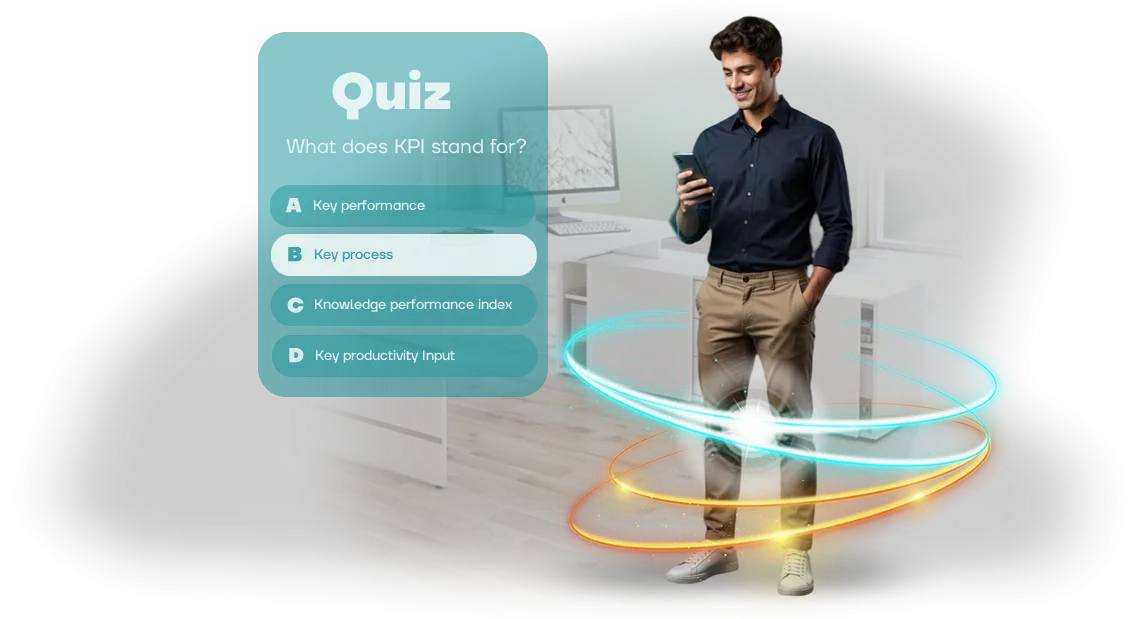
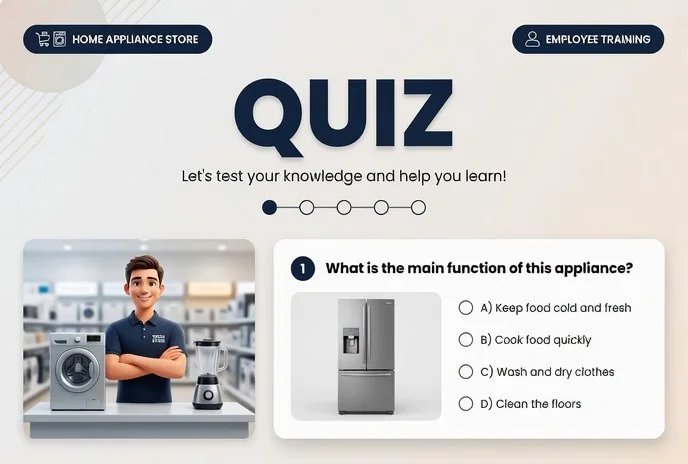
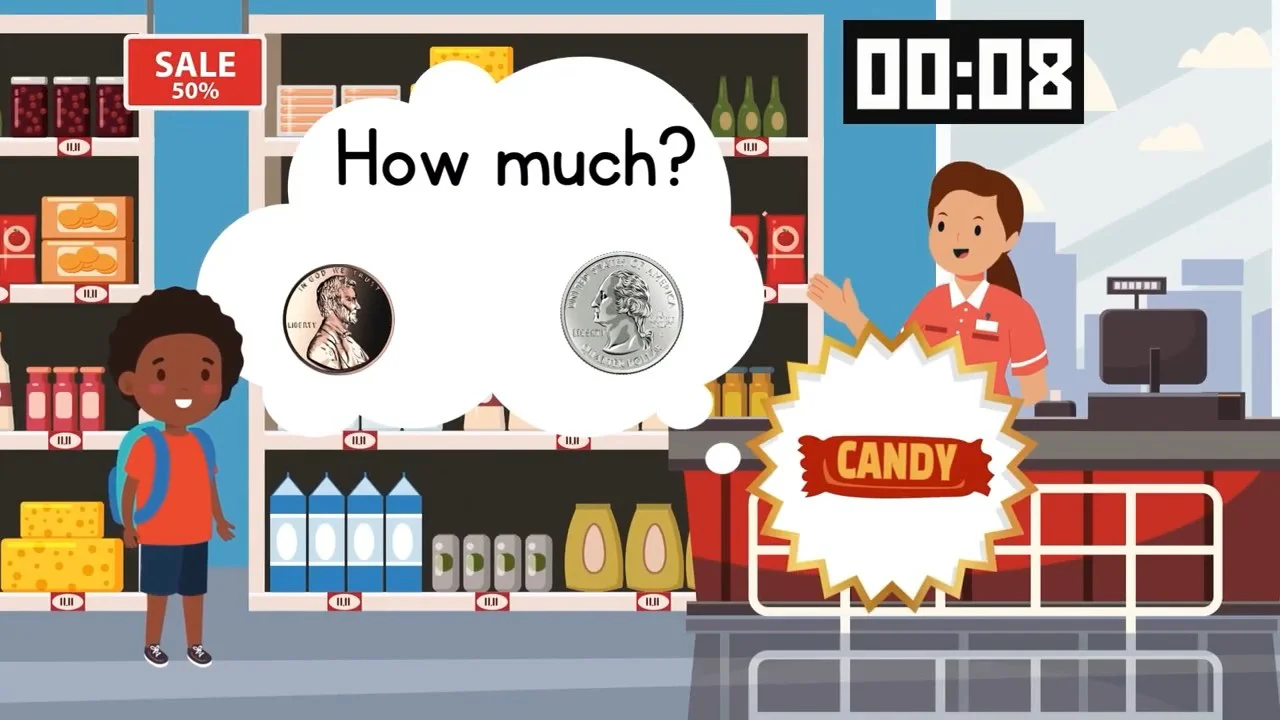
For training to have a real effect, it must be as dynamic as the training session itself. A quiz for athletes turns knowledge assessment into a game: questions appear on the screen, answers require quick reactions, and the result is visible immediately.
This format naturally increases athletes' motivation — everyone wants to show the best result and outperform their colleagues, and this works better than any persuasion.
An interactive quiz is also effective for training coaches: it allows them to practice complex situations, analyze mistakes, and remember important details without boring rote learning.
This makes learning not a duty but part of the training process, which athletes themselves return to with interest.
This is exactly the format we are developing — it easily integrates into the learning system and provides measurable progress that both management and the team itself can see.
5 benefits of game-based quizzes for athletes and coaches
Game-based quizzes solve the main problem of sports training: athletes and coaches perceive theory as a boring obligation. Rules, tactical schemes, and regulations often remain in manuals rather than in the mind.
Gamification turns studying these topics into an engaging process with a clear goal — and here are five key benefits this delivers.
First — increased engagement. Instead of passive reading, athletes get an interactive competition where points are awarded for correct answers.
Healthy competition within the team gets even those who usually sit on the sidelines involved, and the coach sees the group's live activity.
Second — better retention of rules and tactics. The game format with instant feedback reinforces material through repetition and emotions: mistakes are immediately analyzed, and correct decisions are remembered in the context of real game situations. This works better than dry lectures because knowledge is tested in practice.
Third — saving time and increasing training efficiency. Short quizzes can be held between training sessions or in the locker room, without allocating separate hours.
The coach does not need to check notebooks: the system itself shows who has mastered the topic and who needs additional explanation — training becomes measurable.
Fourth — reducing drop-off in training. Monotonous courses get boring, and athletes lose motivation halfway through the program. Quizzes keep interest through a variety of activities, levels, and rewards, so participants complete the program rather than quitting halfway.
Fifth — transferring knowledge to the real game. Questions are based on typical situations from the field: how to act under pressure, when to open up for a pass, how to comply with new restrictions.
This way athletes learn to make decisions faster and behave more confidently in matches, and the coach gets a team that understands tactics at a word.
In summary: a game-based quiz is not entertainment for its own sake, but a tool that increases engagement, accelerates memorization, and reduces attention loss. For a sports organization, this is a direct path to a better-prepared team and peace of mind for the coaching staff.
Quiz formats for your team's specific task
Athletes and coaches are competitive people: they complete dry tests formally, but they remember and discuss a game.
The quiz format directly determines how deeply the team will analyze tactics, rules, and regulations, and how quickly it will apply the knowledge in training or in a match. One format covers one task: reinforcing theory, checking knowledge, or building team spirit.
We select a quiz format for the customer's specific goal — from individual study to a tournament between teams. To simplify the choice, we have collected the most popular options in a table.
| Quiz format | Who it is for | What it gives the client |
|---|---|---|
| Solo — simulator for coaches | Individual training of athletes and coaches, new employees | Individual pace, clear progress statistics for each participant |
| Team game | Group classes, training camps, club departments | Team building, joint error analysis, and development of a common tactic |
| Competitive quiz | Tournaments between teams, branches, or national teams | Increased motivation, healthy excitement, identification of leaders and best knowledge |
Each format can be combined: for example, start with a solo simulator for coaches to level the base, and finish the season with a team tournament as a final check.
We develop quizzes for any of these scenarios and, if necessary, combine formats in one training program. Book a consultation — we will advise which format will bring quick results without unnecessary costs.
How quiz development goes: from brief to launch
We have structured the process so that you see the result at every stage. No "black boxes": you understand what is happening, control the timeline, and make edits before launch.
From the first brief to the finished game usually takes 3–5 weeks — depending on the amount of content and the number of scenarios.
- Brief and tasks. We fix the quiz goals: what knowledge we reinforce, for which audience of athletes or coaches, what level of difficulty is needed. We determine the format: solo or team, timer, answer explanations.
- Concept and scenario. We collect questions and answer options based on your materials, add game mechanics and 3D design. You receive a document describing the scenario and a visual example — this is the base for approval.
- Concept approval. We make edits on style, difficulty, and question logic. We approve the final scenario to move forward without unnecessary iterations.
- Game development. We build the quiz: screens, animations, scoring, feedback on answers. You can track progress via the demo version at intermediate stages.
- Testing and debugging. We check the game on different devices and scenarios: one player, several teams, unstable internet. We eliminate everything that hinders launch.
- Launch and support. We place the quiz on your platform or ours, train administrators, and provide instructions. After launch, we support the game and update content as needed.
This way you get not just a "game" but a working training tool with a clear schedule and transparent reporting. Deadlines are fixed in the contract, and we are responsible for every stage.
What is included in the delivery of a ready-made solution
Ordering a ready-made quiz, you get not just a game, but a working tool that can be launched immediately after delivery.
The delivery package includes everything for training athletes and coaches: the game part, question content, a clear admin panel, and a full set of documents — without hidden stages or additional investments.
- A ready-made quiz game with professional graphics and adaptation to the style of your club or federation.
- A question bank on your topics: technique, tactics, rules, sports history. You can add to it at any time without a programmer.
- An admin panel for assigning tests, viewing results, and monitoring completion — all statistics in one place.
- Instructions and methodological materials for coaches and administrators: how to organize training, motivate participants, and analyze mistakes.
- Training for your team: we conduct a demo, show how to change questions, adjust difficulty, and use reports.
- Flexible adaptation of the quiz to different skill levels — from beginners to experienced athletes, so that everyone finds it interesting.
Your employees receive a clear package that does not require technical skills: one responsible person is enough, and we take care of the entire methodological part. This approach saves implementation time and allows you to launch training within the first week after delivery.
Case: how a quiz improved competitive training results
Coaches often face a situation where athletes know the exercises on the court but get confused in theory: tactics, rules, recovery specifics. Explanations at training camps are forgotten after a couple of days, and knowledge checks take time that is already scarce.
A quiz solves this problem: it turns learning into short game sessions that athletes complete themselves, at a convenient time, and with a clear result.
Here is an example from practice. For a sports club of an amateur league, we developed a series of quizzes on competitive preparation: tactics, sports nutrition, working with emotions.
Amateur League "Breakthrough League" launched the quiz among its teams and compared the results after two months.
| Indicator | Before the quiz | After the quiz |
|---|---|---|
| Passing the theory test on the first attempt | 58% of athletes | 82% of athletes |
| Regular repetition of preparation materials | 12% of the team | 70% of the team |
| Use of new tactical schemes in matches | Isolated cases | In 9 out of 10 teams |
The main thing the coaches noticed was that not only academic performance grew. Athletes began to initiate tactical discussions themselves, ask questions, and prompt each other.
Engagement in the preparation process increased by 60%: even those who used to skip theory classes took the quizzes. Academic performance increased by 40%, and teams became noticeably faster at analyzing mistakes after games.
The result we built into the case is simple: when learning looks like a game, athletes do not put it off "for later." The game format provides instant feedback, and the competitive element motivates them to return to the material again and again.
After the first season, the club ordered an extended version of the quizzes for the league's next divisions.
How to choose the right quiz format?
The direct answer: the right quiz format is determined by the learning goal, not by fashion or habit. If you need to quickly check knowledge of rules and regulations, a classic multiple-choice test is enough.
If the task is to teach how to act in a stressful situation on the field or make decisions in seconds, an interactive scenario close to reality works better. Therefore, we first analyze what exactly athletes and coaches must master, and only then propose a format.
Quizzes are conventionally divided into several types. Text questions are convenient for checking theory: competition rules, anti-doping requirements, safety regulations.
Situational quizzes immerse the participant in a specific match or training episode and ask them to choose the correct action — this trains tactical thinking.
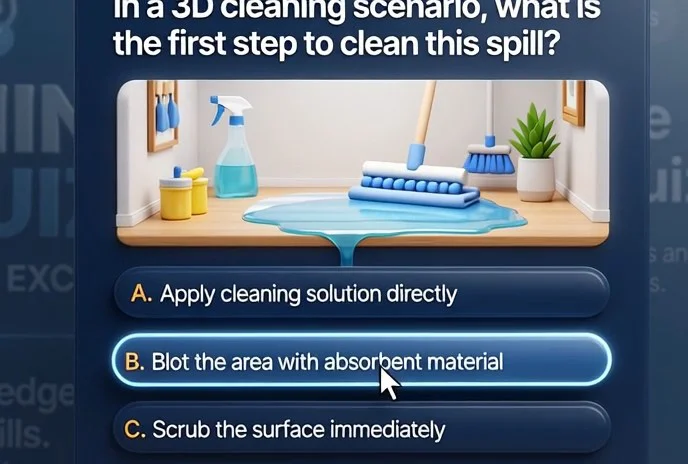
Competitive formats with a scoreboard and points add excitement and engage the team, while 3D games allow you to model a playing field, equipment, or player positions — things that cannot be shown with a flat picture.
The choice of format should not fall on the customer's shoulders. We conduct a short consultation: we find out the number of participants, their skill level, technical capabilities (laptops, tablets, a TV in the hall), and the time the team is willing to allocate for training.
After that, we offer 2–3 options with a forecast of engagement and results. This way you get not an abstract "quiz," but a tool for your task — whether it is initial training for beginners or regular testing of the coaching staff.
An illustrative example is sports clubs where we replaced boring tactical lectures with an interactive quiz with 3D scenes.
Coaches noted that players remembered formations faster and understood mistakes better because they saw the situation through the eyes of a match participant. That is why we do not use templates: each format is built for a specific topic and audience.
If you are unsure which option suits you best, call or write to us. At the consultation, we will review your task, show examples of different formats, and help you choose the one that will have the maximum effect on training athletes and coaches. This is free and places no obligation on you.
Frequently asked questions about developing training quizzes
For sports organizations, it is not the technology itself that matters, but the result: onboarding new employees into the regulations faster, checking coaches' knowledge before the season, increasing engagement in training. However, before launch, customers have the same questions. We answer them directly.
We develop quizzes on the professional Unity engine and take on all stages — from collecting questions to launch. Therefore, typical doubts about timelines, complexity, and support are resolved before the work begins.
How long does it take to develop a quiz?
A project with 50–100 questions and basic mechanics takes 2–3 weeks. If multimedia presentation, scenarios, and multiple levels are needed — 4–5 weeks. We set exact deadlines in the contract and meet them.
How difficult is it to integrate the quiz into current training?
The quiz works in the browser — coaches and athletes do not need to install software. Just send a link or embed a block on the internal portal. We adapt the mechanics to your processes and, if necessary, integrate with standard distance learning systems.
What about support and guarantees?
After launch, we stay in touch: we fix issues, help adapt content, and monitor stability. The quiz warranty is 12 months, during which all improvements for identified problems are at our expense.
Who will update questions and content?
You can do it yourself via a simple admin panel — without a programmer. Or entrust updates to us: we will propose a regular maintenance format so that the quiz always meets current training standards.
Order quiz development for your team
You can order a quiz in a few simple steps: you describe the task, we take care of everything else — from idea to a ready scenario that employees will complete with interest, not "for show." No unnecessary technical information, just a clear plan, deadlines, and a result you can present to management.
After your inquiry, you receive:
- Task analysis — we examine what knowledge needs to be checked, what gaps need to be closed, and in what format it is best done.
- Format selection — "question-answer," "true/false," "Jeopardy-style," or a team quiz — for your audience and training goals.
- Timeline and cost estimate — we give realistic figures before work starts, without hidden extra charges or fine print in the contract.
- Demo version — a working sample of the game before the final launch, so you can clearly see what will appear on the screen.
- Commercial proposal — we fix the scope, timeline, and terms, convenient for approval within the company.
- Consultation — we answer questions as the project progresses, help with question content, and adapt to your specifics.
Leave a request or write to us — we will discuss how to make your team's training useful and engaging. After that, you just approve the plan and launch the quiz for your employees.