

Managers Are Losing Deals: How to Train for B2B Sales Growth
Managers lose deals not because they don’t know the product, but because of repeated mistakes in negotiations. Classic lecture-style sales training rarely changes behavior: after a month, only a small part of the material remains, and it doesn’t turn into a skill.
In B2B sales, the cost of a mistake is high — one failed contact means lost revenue that has to be compensated with new leads.
After training, a manager can answer questions perfectly, but in a real conversation with a client, the old pattern kicks in: they push too hard, don’t listen to objections, or forget to ask the key question. A skill is cemented only through practice and feedback, not through one-time listening.
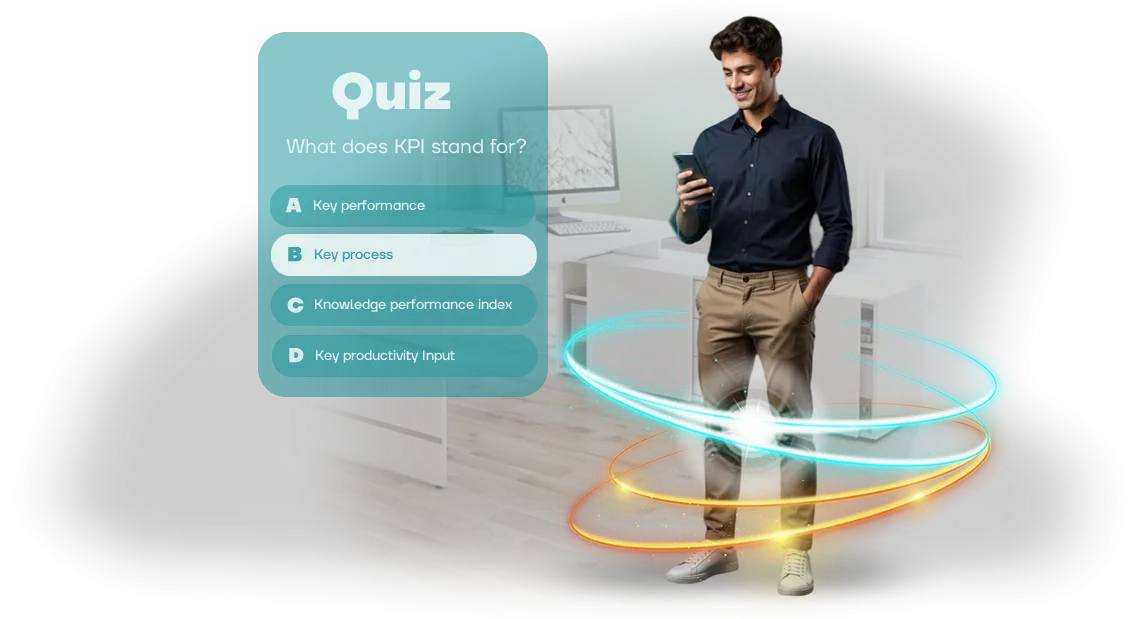
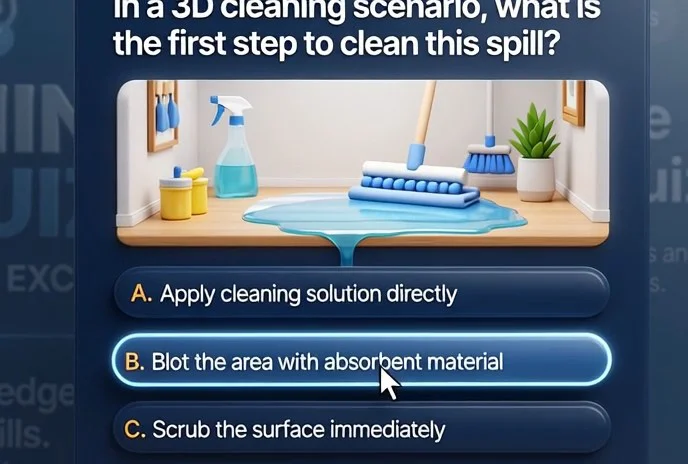
Gamified training solves this problem. Learning quizzes turn repetition into a game: the manager immediately sees where they were wrong, reviews the alternative option, and next time acts differently.
Short rounds of 10–15 questions can be taken at any time without breaking the schedule, and regular repetition builds a stable behavioral pattern in B2B sales.
For a sales manager, a quiz is a measurable knowledge control tool. The results show which mistakes each manager makes: where they lose qualification, how they handle price objections, when they fail to move the dialogue to the next step.
This data makes it possible to improve training with precision and see B2B sales growth by specific team skills.
Wehave been developing interactive quizzes for commercial teams for over 10 years. Our format with a dialogue-based 3D simulator lets you train complex B2B sales scenarios in a safe environment and then confidently apply them in real meetings. This closes the gap between knowledge and action and increases deal conversion.
What Employee Training in Game Format Gives You
Employee Engagement: They Participate Instead of Sitting It Out
Ordinary lectures and presentations hold attention for a few minutes at best, and then employees start thinking about something else. A quiz forces everyone to answer, choose an option, and see the result immediately. Even passive participants get involved because game mechanics turn training into a competition.
This directly affects business: an engaged employee remembers the material rather than just being present at a training session. For a sales department, this is the difference between “heard it at training” and “uses it in negotiations.”
Material Retention: Knowledge Turns into Skill
A person remembers 10% of what they read and up to 90% of what they do themselves. A quiz gives employees the opportunity to make decisions in a safe environment: handle client objections, choose the right product presentation, and see the consequences of their choice. A mistake in a game doesn’t cost money, but it teaches faster than theory review.
After a series of questions, an employee is left not with abstract information but with ready-made behavioral scenarios. In a real conversation with a client, they have already mentally gone through that path and act more confidently.
Personnel Assessment: Everyone Is Visible
A manager gets an objective picture: who has absorbed the material, who is answering randomly, and who is performing above average.
This is not a test for the sake of evaluation but a tool for management decisions — where to strengthen training, who needs support, and who is ready for more complex tasks.
The game format removes the fear of being tested. Employees take the quiz in a calm environment and show their real level of knowledge instead of trying to “look good.”
Speed of Onboarding for Newcomers: Faster Time to Full Productivity
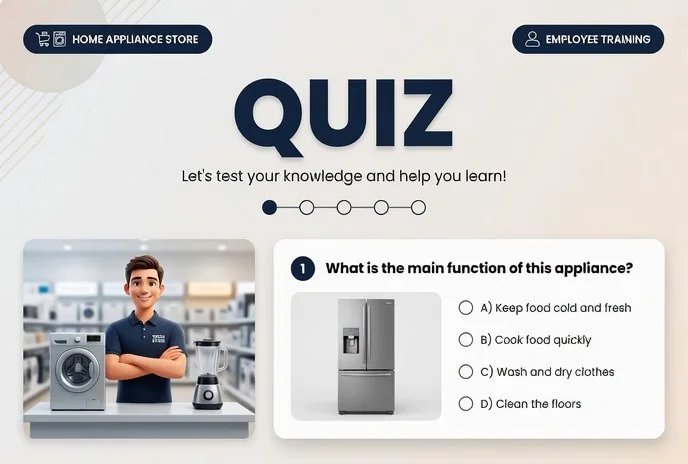
A new employee often gets lost in the flow of information in the first weeks. A quiz packages key knowledge about the product and sales techniques into short scenarios that can be completed in one day. Onboarding shrinks from months to weeks, and first sales start earlier.
Game-based methods also work for experienced staff — a quiz refreshes knowledge and reminds about procedures without boring repetition. The corporate training system becomes alive, not an obligatory chore.
Quiz Formats for B2B Sales Tasks
B2B sales team training solves several tasks at once: newcomers need to quickly learn the product, experienced managers need to sharpen negotiations with objections, and a sales manager needs to understand where the team is weak. One quiz format can’t handle all this. So we divided training into three scenarios, each covering its own business task.
Below is a table of formats: who they are for and what you get as a result.
| Format | For Whom | What It Gives the Client |
|---|---|---|
| Quick knowledge check | New employees, managers before a sales launch | See gaps in product knowledge in one test. Bring people up to speed faster, save on onboarding. |
| Negotiation simulator | B2B sales managers, senior negotiators | Practice handling objections and techniques without the risk of losing a client. Confidence and deal conversion grow. |
| Team quiz | The entire sales department and related units | Engages through competition, the team shares experience. A unified knowledge base is formed within the department. |
Formats can be combined: first a quick knowledge check, then a negotiation simulator, then a team quiz as final certification. You get measurable results for each employee — completion statistics will show who needs more training and who is ready for complex deals.
How a Training Quiz Is Developed
Developing a training quiz for employees is not a “black box.” To keep you in control of the process and aware of when you’ll get the result, we broke the project into clear implementation stages — from brief to launch and support. Here’s what the client journey looks like in practice.
-
Brief and goals. We discuss your situation: product specifics, typical manager mistakes, and desired results. The output is a clear technical specification and timeline plan.
-
Training script. We create the quiz based on real sales dialogues: situations, answer options, and error analysis. You see the full script text before technical development begins.
-
Approval. You make edits, we refine. It’s important that the script is accurate for your industry and product, so we don’t drag out iterations — usually one or two are enough.
-
Technical implementation. We build the quiz on the professional Unity engine: interface, answer logic, and visual design in your corporate style. You get a working prototype for review.
-
Focus group testing. Several employees take the quiz, we collect feedback and adjust ambiguous questions so that the training is comfortable and useful.
-
Launch and support. We host the quiz on your platform or ours, set up administrators, and grant access to statistics. After launch, we analyze completions and help update content as the product changes.
This process reduces risks at every step and ensures that the quiz development solves exactly your business task — not just “makes a nice test.” You always know what is happening and make key decisions together with us.
What’s Included in the Quiz Delivery Package
The delivery package includes not just a program but a ready-made training tool that can be launched immediately after handover. You get everything needed for employees to start taking the quiz and for you to see how their sales skills change.
- A ready-made bank of questions and scenarios tailored to your sales department’s tasks. Product questions, negotiation techniques, and objection handling — designed to train the right skills right away.
- Admin panel. Change questions, completion deadlines, and assign employee groups yourself — without contacting developers.
- Training analytics. For each employee, you can see the number of attempts, correct answers, typical mistakes, and progress dynamics. Data is exported into a convenient report for the manager.
- Branching scenarios. The quiz reacts to answers: on a mistake, it shows a hint and explains why the option is wrong — the employee learns right during the quiz.
- Instructions for administrators and participants. Short guides on how to launch the quiz, set up access, and interpret results. Everything is clear without special training.
- Startup support. We help implement the quiz, answer questions, and adjust content after the first completions if needed.
This delivery package covers the entire cycle: preparing questions — launch — result tracking. All you have to do is assign the task to your employees and, in a week, see who has already raised their level of sales knowledge.
Implementation Example: How a Quiz Improved Training Performance
Classic sales training often never reaches the actual work process: managers memorize theory but get lost in real conversations with clients. The result is prolonged onboarding for newcomers and costly negotiation mistakes. Ordinary lectures and tests don’t build skills because they lack decision-making practice.
For the distributor Komus, we built an interactive quiz with dialogue scenarios. The employee goes through short cases: responds to objections, selects terms, and works through deal stages.
Each answer is immediately analyzed — the manager sees where they were wrong and what they should have done. The training takes 20–30 minutes a day, so it’s easy to fit into the work schedule.
The effect was measured after a month. Onboarding for new managers dropped from five weeks to two — they reached their targets twice as fast. Accuracy on product questions rose from 60% to 90%, and the number of correctly handled objections increased by a quarter.
Managers noted that training became more predictable: results are visible for each employee, not just from a final test.
Unlike a regular test, a quiz simulates a real dialogue and requires making decisions. This is why knowledge turns into skill: managers don’t just memorize scripts — they use them in live conversation. That’s what sets our development apart from standard courses.
This case shows: a quiz is not entertainment but a working tool with a clear return. The company gets qualified managers faster, reduces mentoring costs, and cuts losses from sales mistakes.
If you need to improve training performance — tell us about your task, and we’ll prepare a demo on your real cases.
How to Choose a Quiz Format for Your Task?
Choosing a quiz format starts not with technology but with three simple questions: how many people need training, what task the training solves, and how complex the material is. The answers already determine the right format — we handle the rest.
Team size. If you have up to 15–20 employees, a lightweight text quiz with answer options is enough — it’s quick to prepare and easy to update.
For teams of 30–50 or more, interactive gamified formats work better: they hold attention and let you track each person’s progress without manual checking. When you have distributed employees across different cities, we choose a format that opens equally well on any device.
Training objectives. For onboarding newcomers, a basic knowledge check with clear feedback works well — a person immediately sees what they have learned and what is worth repeating.
For periodic certification, a quiz with timing and a passing standard is better, so you can objectively assess readiness.
If the goal is to practice sales or negotiation skills, a dialogue scenario is more effective than simple questions: the employee responds to client statements and gets feedback, like in a real conversation.
Content complexity. When the product is simple and there’s little knowledge to cover, a short quiz of 10–15 questions is enough. If the product is technically complex or the line is wide, it’s better to split the content into several thematic blocks and deliver them gradually.
For products with frequent updates, you need a quiz that’s easy to extend — we make the content editable so you can change questions without developer involvement.
In the end, there is no universal answer, but there is a clear algorithm. Describe your situation — team size, training topic, and expected result — and we’ll suggest a format that solves the task rather than just entertaining employees. This is free and with no obligation.
Answering Frequently Asked Questions About Development
We hear the same fear on almost every brief: “What if the quiz freezes during an important training session?”, “How will we change questions without a programmer?”, “Who will support us after launch?” These concerns are valid — the speed of employee onboarding and sales results depend on the training tool.
That’s why we design the quiz from the very start to be stable, manageable, and not require technical knowledge from you.
Below are answers to the questions most often asked before the start. If your scenario isn’t here, just write to us — we’ll explain how we solve the task in your specific case.
What happens if the system can’t handle the load when the entire sales department takes the quiz at the same time?
We use a professional server architecture that handles simultaneous connections from all employees with plenty of headroom. Before launch, we run tests simulating peak load, and on launch day we stay in touch to react quickly if anything goes off plan.
Will we be able to update questions and scenarios without bringing in a developer?
Yes. We build a simple admin panel that lets any employee change the question bank, add new blocks, or adjust the scenario. The process takes a few minutes, requires no programming, and doesn’t break the mechanics already set up.
Who is responsible for the quiz working after project delivery?
We don’t disappear after launch. Technical support is active for the duration of the quiz usage: in most cases, we respond within a couple of hours and resolve the issue remotely.
If substantial improvements are needed — we discuss scope and timeline, fix the plan, and implement it without unnecessary bureaucracy.
Leave a Request for Quiz Development
A quiz for employees is not entertainment but a tool that genuinely increases sales and speeds up onboarding. But for it to work, the scenario, questions, and mechanics need to be properly tailored to your specifics. We handle this: from idea to launch.
Now is the time to move the discussion into a practical plane. Leave a request for quiz development — and we’ll prepare a project estimate for your tasks, and also show a demo quiz on a live example from the B2B sales field. No abstract promises — only what you can evaluate and try on your team.
What you get after your inquiry:
- A free consultation — we’ll analyze your situation and advise where a quiz will deliver quick results.
- A project estimate: timeline, stages, cost — based on the scope and scenario complexity.
- A demo quiz on a real B2B sales case — you’ll see the mechanics and engagement before development starts.
- A launch plan: from briefing to integration into training, with clear roles and checkpoints.
- Recommendations on questions and scenarios — tailored to your products’ specifics and typical client objections.
- Support at every stage and after launch — we’ll help update content and analyze results.
Leave a request for a consultation — tell us about your team and tasks. We’ll contact you within a business day, clarify the details, and prepare a proposal you can immediately discuss with your management.
Start with a simple step — and in just a couple of weeks, your employees will be sharpening their sales skills in a format they actually enjoy.