

Why Employees Fear Financial Consultations?
Financial consultations are one of the most critical areas in client-facing work. An employee must quickly navigate products, respond to objections correctly, and convey confidence all at once.
Any hesitation, inaccurate number, or questionable recommendation destroys client trust, and restoring it later is very difficult.
Standard employee training—lectures, presentations, knowledge-based tests—does not deliver the main thing: the skill of live dialogue. A person may know all the wording, but still get lost in a real conversation when a client asks an unexpected question, doubts, or provokes.
As a result, staff act by template, avoid complex topics, or provide inaccurate information—and this directly hurts consultation conversion rates.
Fearing mistakes, employees are afraid to take responsibility, waste extra time on approvals, or simply avoid complex requests. Staff errors cost the business dearly: a dissatisfied client leaves to competitors and brings along those they told about the bad experience. Lost deals and damaged reputation—that is what stands behind insufficient training.
To break this cycle, you need employee training that provides practice in a safe environment.
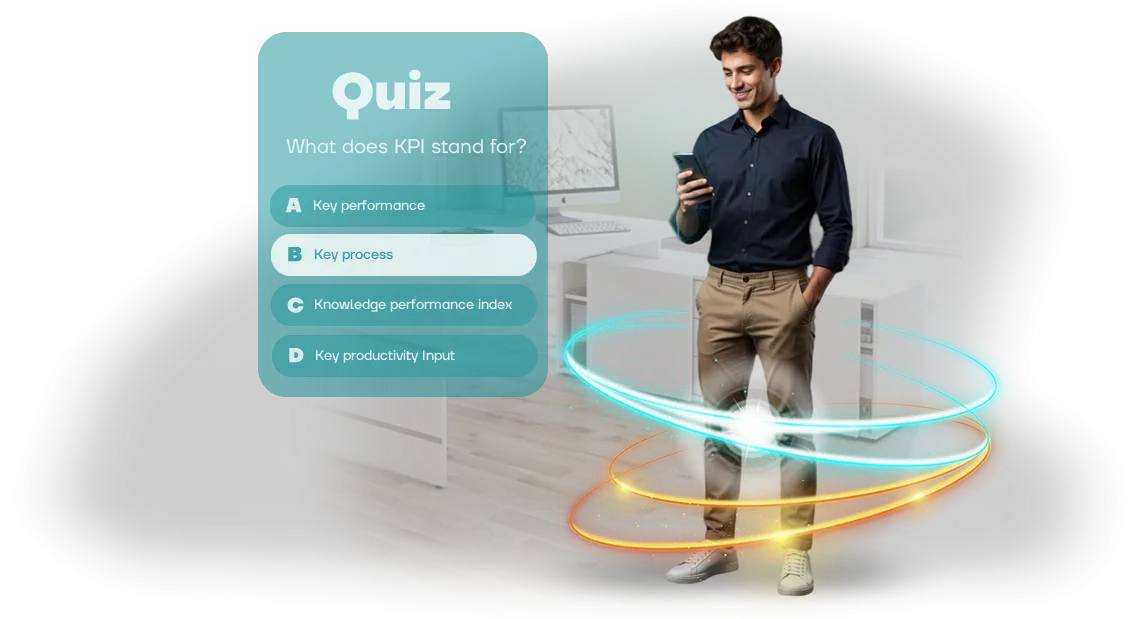
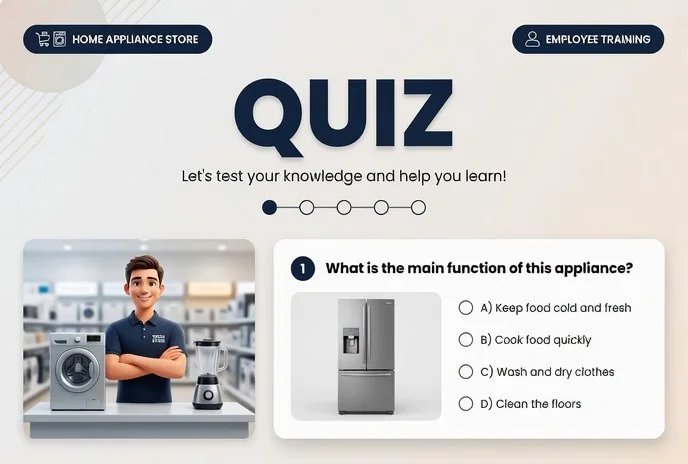
We develop a conversational 3D quiz simulator on Unity where an employee trains on realistic financial consultation scenarios: practices greetings, hears objections, learns to argue, and drives the conversation to a result.
The scenarios are close to real situations from your practice, and each training session is followed by feedback on errors.
As a result, staff approach clients not with memorized theory, but with ready-made behavioral skills for difficult situations. Employee confidence grows, client trust strengthens, and staff errors become a rare exception rather than the rule.
We have been helping companies implement such training formats for ten years—and we see measurable growth in consultation quality and repeat sales. Let's discuss how to adapt this approach to your business objectives.
What Benefits Will a Training Quiz Bring
In financial consultations, the price of a mistake is lost client trust. A training quiz turns scattered requirements and regulations into a single simulator where employees practice the sequence of actions in a safe environment. This is not a test for evaluation, but a working tool for skills growth.
The first thing you will notice is skills growth. The consultant solves tasks close to real inquiries: how to present a product correctly, how to handle an objection, how to close a deal.
After a short session, mistakes in live work become rare, and new employees quickly reach the required level.
The second effect is engagement. The game format with instant feedback and a light competitive spirit is perceived by the team as an interesting task, not an obligation.
Employees return to the quiz on their own to stay sharp—such training does not require constant supervisor oversight.
Third—a unified knowledge standard. When all consultants answer the same scenarios, you level the quality of service: the client receives equally confident answers in the office and during follow-up.
This reduces the number of contentious situations and strengthens the image of a reliable financial partner.
Fourth—teamwork. Joint discussion of results and review of complex cases unite the department and create a habit of helping each other. Thus, one employee's successful practices quickly become the property of the entire team.
In total, a staff quiz delivers managed development: competent employees, an engaged team, and stable consultation quality. These effects build client loyalty and reduce the load on the manager.
Quiz Formats for Financial Consultations
Different training tasks require different formats. A lecture or presentation will not help an employee confidently conduct a financial dialogue.
A consultant needs not only product knowledge, but also the ability to handle objections, explain terms, and stay calm during tense negotiations. Therefore, we recommend choosing a format for a specific goal rather than using a one-size-fits-all solution.
Below is a comparison of formats we develop for training employees of financial institutions.
| Format | For whom | What it gives the client |
|---|---|---|
| Dialogue simulator | Consultants, front-office employees | Practice of real dialogues and objections, development of argumentation skills, readiness for difficult clients |
| Employee test | All employee categories | Quick knowledge check, gap identification, automatic assessment, and clear statistics |
| Quiz with leaderboard | Large teams, branch networks | Engagement in training, healthy competition, increased motivation, repetition of material in a light game form |
The formats are easy to combine: first a test identifies weak points, then a dialogue simulator improves communication skills, and a leaderboard quiz reinforces the material emotionally.
We use professional development tools, including Unity—this allows us to create vivid scenarios as close as possible to real consulting practice.
The main thing is to set the goal correctly. If you need to check knowledge, a test is enough. If communication skills with clients are important, choose a dialogue simulator. If you want to increase engagement and training regularity, a leaderboard quiz will work.
We will help you choose the optimal format for your task and audience, and if necessary, combine them into a single training system.
How the Quiz Development Process Works Step by Step
Any training quiz for financial consultants begins not with questions, but with goals. We split the project into six stages so you can control each step and understand what you are paying for. Each stage's result is approved before moving to the next.
-
Brief and goals. We discuss which employee knowledge needs to be checked: regulatory requirements, product lines, client communication scripts. We set success criteria—for example, a target percentage of correct answers or the reach of the trained team.
-
Scenario and rules. We prepare the quiz structure: number of questions, answer options, and explanations after each. We agree on the scoring logic and the conditions for successful completion—so employees understand what to aim for.
-
Design and interface. We style the quiz in your company's corporate identity, making screens clear and comfortable on any device. The focus is on usability, not visual excess: an employee should concentrate on the content, not on which buttons to press.
-
Content fill. We write questions and answers based on your financial consultation regulations. Each question is accompanied by a brief explanation so that training works even after an incorrect answer—the employee immediately learns what is right.
-
Testing. We run the quiz on a test group: we check the correctness of questions, the transition logic, and the accuracy of result output. We collect feedback and make final edits before launch—no surprises on the first day of training.
-
Launch and support. We place the quiz in your learning system, grant access to employees, and accompany the first attempts. We help interpret results and adjust questions as needed—training remains relevant.
Thanks to this step-by-step scheme, you see intermediate results and avoid "surprises" at the final stage. As a result, you get a working knowledge assessment system, not just a set of questions.
What Is Included in the Quiz Delivery Package
When you order a quiz for training financial consultants, it is important to receive more than just a game—you need a working tool. We deliver a complete package with everything needed for launch and control, from an admin panel to methodological materials.
Here is what is included in the delivery:
- Admin panel—content management, configuration of questions, scenarios, and access rights. You can change topics and difficulty yourself without involving programmers.
- Reports for each employee—you see who completed the quiz, which topics cause difficulties, how many attempts were made, and how results improve. Based on the data, it is easy to adjust training.
- Methodological materials—a ready-made instructor guide, recommendations for conducting the quiz, and an analysis of typical errors. Your internal trainers can launch training without our support.
- LMS integration—results are automatically transferred to your learning system. This simplifies HR record-keeping and meets compliance requirements.
- Launch support—we help configure the quiz, run a pilot with your team, and hand over all instructions.
- Updates on request—after launch, we stay in touch: we add new questions and scenarios if products or regulations change.
This package covers the full cycle: you receive not just a program, but a competency measurement system that can be used immediately in daily work.
Case Study: Sales Growth After a Training Quiz
We developed a training quiz for the managers of the bank Rost-Finance. The task was simple: teach employees to confidently sell financial products, from credit cards to investment solutions.
Previously, training consisted of lectures and presentations, but knowledge was quickly forgotten, and managers got lost in real client conversations.
We replaced passive learning with a dialogue simulator: the employee communicates with a virtual client, responds to objections, and selects a suitable product.
After the quiz launch, the conversion to financial product sales increased by 30%. Managers became more confident in consultations and more often offered additional products—the average check increased by 12%.
Training time was reduced from two days to four hours of practice, and new employees reach the required level in a week instead of a month.
Results the bank saw
- A unified consultation standard across all branches.
- The manager sees each employee's results in a personal dashboard.
- Content updates without stopping training: a product changes—a scenario changes.
- The bank ordered another module for onboarding new employees—a repeat contract.
We work on a professional development platform that allows us to quickly adapt the quiz to the bank's new products. Therefore, training remains relevant, and employees gain exactly the knowledge needed to drive sales growth.
How to Choose a Quiz Format for Your Task?
There is no universal format—and that is normal. Choosing a quiz always comes down to three questions: who is learning, what material is being mastered, and how many resources are you ready to invest.
If you answer them before starting, implementation will be faster, and the result will be visible from the first sessions.
First, the audience. Experienced consultants lose interest in simple "choose the correct answer" questions; they need analyses of complex dialogues and unusual clients. Beginners need short feedback and hints.
The subject of financial consultations is delivered differently: for interns—step-by-step scenarios; for senior staff—branching dialogues with a virtual client.
The second guideline is content complexity. Simple regulations and product lines can be covered with light formats and quick rounds.
But the skill of conducting a conversation, neutralizing objections, or explaining product risks is trained in dialogue simulators: the employee lives through the scenario and receives a review of their decisions.
We create such formats on the Unity platform—a live dialogue with a virtual interlocutor holds attention and changes behavior, not just knowledge.
The third factor is the training budget.
This is not about a specific amount, but about the task: a compact 15–20 minute quiz can quickly check knowledge, while a full simulator with scenario branches pays off over time—it is used for refresher courses, new hire onboarding, and certification.
Estimate how many employees will take the course and how often it will run: a permanent process needs a format that is easy to extend.
If you are unsure, send us a description of your task, and we will select an option for your timeline, audience, and budget. Over the past 10+ years, we have delivered dozens of training projects for financial companies—we will make training useful, not a formal checkbox.
Common Client Concerns Before Launch
Before any training program launch, clients have the same concerns: will employees like the quiz, will it break at the worst moment, how much time will it take, and how can questions be changed later.
We have gathered the most frequent objections and answer them briefly—just as we would in a meeting.
What if employees don't want to take the quiz?
We make training look like a game rather than an exam: short 5–7 minute rounds, a lively interface, and immediately clear feedback. Built-in ratings and rewards turn participation into a competition people actually want to join.
What if something breaks on launch day?
We build in fallback scenarios and test all system situations before launch. During the active phase, you get support—a specialist is available to quickly resolve any issue. This is a standard part of the contract, not a "verbal promise."
Isn't it long and expensive?
We work according to a transparent plan: you know the timeline and scope in advance.
Most quizzes are launched within 2–3 weeks, and the cost is calculated based on your task—without "pay extra for everything that moves." After launch, you receive a ready-made tool that does not require ongoing support investments.
What if I need to update questions or add a new block?
Content is updated without involving programmers: through a simple admin panel, you yourself change wording, answer options, and question scenarios. This means the quiz does not become obsolete as your products or regulations change.
We hear these questions from almost every client. To see that the quiz suits your team, you can attend a short presentation with a live demo—we will show you how it works.Order the Development of a Quiz for Your Employees
Leave a request, and we will prepare a quiz that genuinely improves the quality of financial consultations.
You don't need to understand the technical side: we will propose the format, question structure, and knowledge assessment system, and you will receive a ready-made tool for employee training.
Within one business day, we will have a short consultation on your request: we will explain how the quiz fits into your current training, which scenarios your employees will practice, and how long development will take. This is free and non-binding.
What you get after contacting us:
- Consultation: we will analyze your tasks, audience, and challenges in preparing financial advisors.
- Cost and timeline estimate: a transparent calculation for your scope—without hidden conditions.
- Format selection: quiz scenarios ranging from basic knowledge to complex cases with client objections.
- Work examples: we will show how similar projects worked in other companies.
- Question logic: we will propose a structure and an analysis of consultant errors.
- Launch plan: stages, milestones, and support from brief to implementation.
We specialize in training quizzes for the financial sector, so we understand the specifics of the product: regulations, typical client objections, and requirements for wording accuracy. The goal is not just to check knowledge, but to reinforce the skill of confident consultation.
Leave a request—and as early as next week, your employees can start working with new scenarios. Fill out the form or write to us directly: we will help you choose a format and calculate the cost for your request.