


Why executives underestimate the role of employees in cybersecurity
Many executives see cybersecurity as an IT department task: buy licenses, close the perimeter, install filters — and no need to return to the topic. But the human factor remains the main channel for leaks and incidents.
An employee who fails to recognize a phishing email or opens an attachment "from the director" negates any technical defenses.
The paradox is that employee training is still perceived as a formality. A regular lecture or handing out a memo creates the illusion of informing: people listen, nod, and a week later act the same as before.
Knowledge that was not tied to a specific situation and reinforced with practice does not become a skill. As a result, the business pays not for protection but for consequences — from lost data to halted processes.
The executive rarely cares about the fact of a breach itself; they care about the costs: failed deals, reputational damage, fines, time spent on recovery.
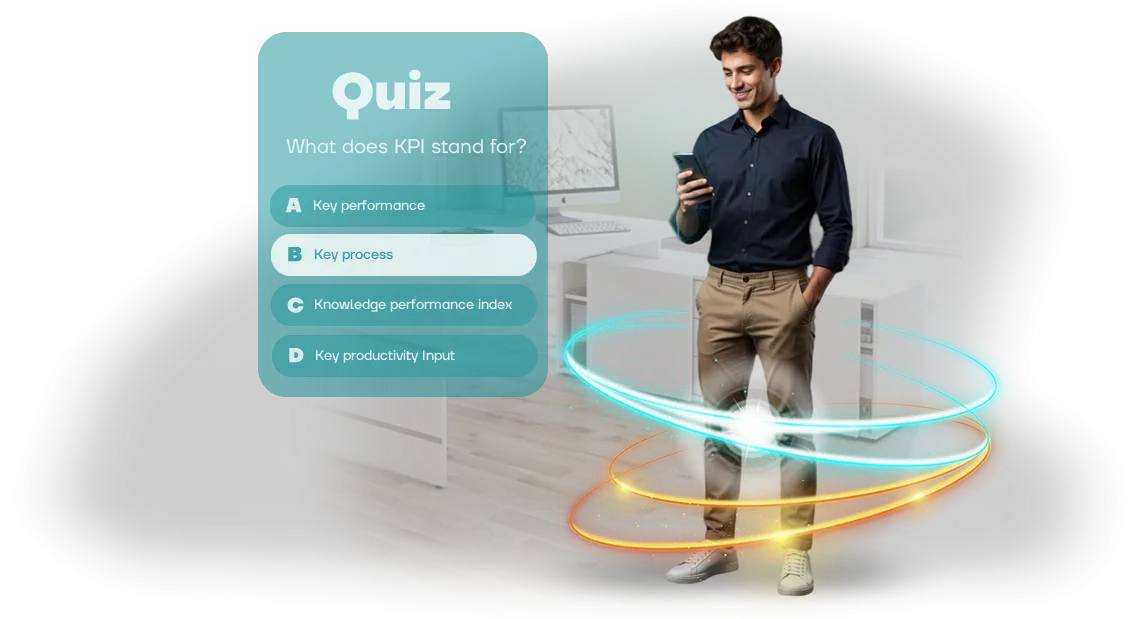
That is why it is important to measure the level of cybersecurity not by the volume of purchased software, but by employee behavior. A knowledge check in the format of a quiz for employees shows the real picture: who understands the threats and who answers at random. This approach turns training from a mandatory event into a risk-control tool.
We help close this gap. We develop corporate training quizzes that are embedded into the workflow and check not abstract knowledge but readiness to act in typical dangerous situations.
The employee receives instant feedback, and you get clear team statistics and the ability to strengthen weak areas in time.
What a training quiz gives a company
Employees are the target of attacks, but most companies invest only in technical protection. Meanwhile, phishing and social engineering break any perimeter: one click is enough.
A training quiz closes this hole — it turns a boring instruction into a live scenario where the employee makes decisions themselves and sees the consequences.
The company gets measurable results:
- Increased awareness. Employees begin to recognize attachments, links, and password requests before it is too late.
- Practicing response during an attack. Virtual incidents in a safe environment teach the procedure: disconnect the network, change access, notify the administrator. In a real situation, the hand already knows what to do.
- Fewer incidents. Systematic training reduces the number of successful attacks by 60–70% — data from large companies confirms this.
- Knowledge control. The manager sees who has learned the material and who keeps making mistakes. The quiz automatically collects statistics by department and identifies weak areas.
- Engagement without coercion. Gamification and a competitive spirit motivate employees to complete the training faster than ordinary courses.
Wehave been building such simulators for 10 years — on the professional Unity engine, so the graphics are realistic and the scenarios convincing. The quiz is customized to your regulations and includes questions based on your internal rules.
Implementation takes no more than two weeks, and results are visible after the first training drills.
Quiz formats: choosing the right one for your business task
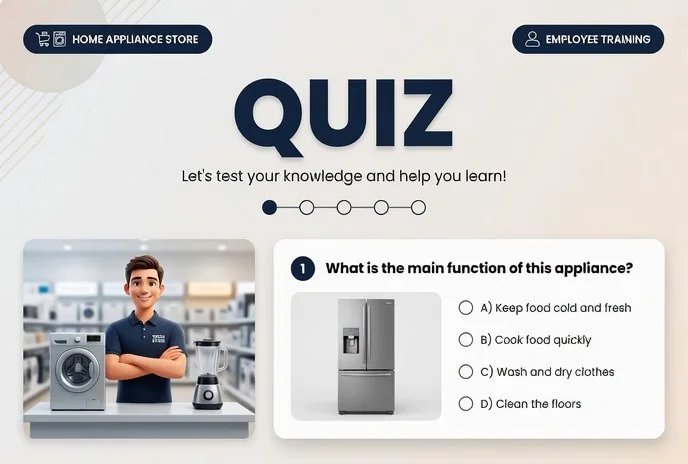
There is no single right quiz format — only one that fits the task and audience. Short surveys save time but do not develop skills, while classic tests check theory but quickly become boring.
For cybersecurity training, it is especially important that an employee can recognize threats in a real situation, not just know the rules. The right format determines how engaged employees are in training and how quickly they begin to apply their knowledge.
Let's compare the main formats we use in projects — each one solves its own task.
| Format | When to choose | What it gives the business |
|---|---|---|
| Short survey | Quick knowledge check after an instruction session | Saves time, shows gaps |
| Classic test | Mass assessment of employees | Automated grading, clear statistics |
| Team quiz | Motivation and team building | Excitement, engagement, high retention |
| 3D quiz simulator | Cybersecurity training, practicing response during attacks | Simulates real threats, mistakes are reviewed immediately, skills are reinforced |
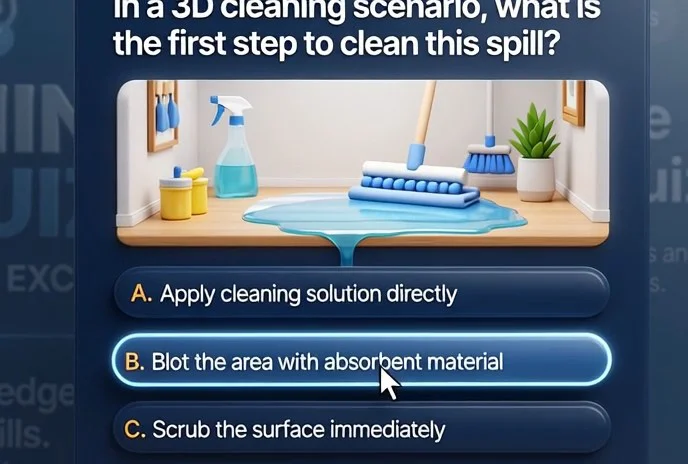
It is the last option that delivers the greatest results in cybersecurity training. The employee enters a dialogue with a virtual interlocutor, receives an email with a suspicious link, or faces an unusual situation — and must make a decision on their own.
A 3D simulator cannot be completed "on autopilot" because every action has consequences, and this completely changes the attitude toward training. Training turns from a boring obligation into an interesting scenario that people want to complete.
We will help you choose the best format or combine several: for example, start with a short survey to measure the baseline, then run a 3D simulator for deep skill practice. This way you get a measurable result without wasting extra time and budget.
How we develop a quiz: process and stages
Let's briefly explain how the work is structured so you understand what happens at each step and what result you receive. We do not overload you with technical details — only clear stages, timelines, and roles.
- Brief and task immersion. You talk about your employees, training goals, and the problems the quiz should solve. We ask clarifying questions, study your internal regulations, and put together a scenario for the future quiz.
- Scenario and format approval. Based on the brief, we propose the quiz structure: number of questions, difficulty levels, game mechanics, and dialogue options. You see the texts and logic before development begins, so there are no surprises at launch.
- Prototype creation. We build a working version with key scenarios: how the employee answers, what they see when they make a mistake, and how they get correct explanations. This lets you test usability and engagement before we fill the quiz with full content.
- Full version development. We fill the quiz with all questions, add dialogue branches, a results scoring system, and roles for different groups of employees. In parallel, we prepare materials for the administrator: how to change questions, add new participants, and collect statistics.
- Testing and revisions. We test the quiz on real scenarios: from computer to smartphone. You get access to a test version, provide feedback — we make changes and finalize the version.
- Launch and support. We upload the quiz to your platform or integrate it with your corporate portal and train administrators. After launch, we stay in touch: we answer employee questions, fix bugs, and help update content.
This approach takes two to four weeks depending on the volume of materials and the number of questions.
You see the result at every stage instead of waiting for "the finished product someday." In the end, you get a tool that starts working for training from day one, not a product that requires lengthy refinements after delivery.
What is included in the ready-made employee training solution
We prepare not just a "quiz" but a complete package that can be launched right away. Inside is everything needed to conduct cybersecurity training without involving developers or extra approvals.
The ready-made solution includes:
- Quiz scenarios tailored to your tasks: from basic rules to complex situations with phishing emails and social engineering. Each scenario is adapted to the employees' skill level.
- A bank of questions with explanations: after answering, the person sees why the chosen option was correct and others were not. This turns the test into training rather than just a check.
- Administrator guide: how to launch the quiz, add employees, and schedule the completion time. Everything is designed for someone without technical training.
- Participant guide: a short memo on how to log in and complete the quiz. Employees do not waste time figuring out the interface.
- Access to the our team platform: you get a personal dashboard where you see results by department, progress, and bottlenecks. Data updates automatically.
- Results report: downloadable in PDF or Excel — for the manager, HR, or certification committee.
- Support at every stage: we help with launch, answer employee questions, and adjust scenarios after the first run if needed.
We stay with you after handover: we make sure training goes smoothly and supplement materials as threats evolve. You get a working tool, not a set of files — employees complete the quiz, and you see their real level of preparedness.
Case study: how a quiz raised the cybersecurity level in a company
One of our clients — a company with a distributed network of branches — faced a typical problem: despite regular briefings, employees kept clicking phishing links. Each such action created a risk of data leakage and financial losses. We suggested turning dull training into a quiz that actually changes behavior.
Together with the client, we collected real attack examples from their industry and built scenarios close to real work situations. Employees did not just answer questions — they learned to recognize suspicious emails, fake websites, and unusual access requests.
The quiz format with competitive elements increased engagement: participation became voluntary rather than mandatory.
The results impressed even the executives. Two months after launch, the number of clicks on phishing links dropped by 67%, and incidents related to the human factor decreased almost threefold. Moreover, employees themselves asked for new rounds — training stopped being a formality.
What the case demonstrated
Wesaw that the quiz works not as a one-time action but as a system. The company got a tool that can be updated for new threats and launched for new employees.
Most importantly, risks and direct losses from attacks decreased, and the security team began spending less time investigating incidents.
After the successful pilot, the client ordered an expanded version for all departments and now uses it when onboarding newcomers. This confirms: quiz-based training delivers measurable results, not just a "checkmark" in a report.
How to choose the quiz format for your company's tasks?
The choice between a short test and a 3D simulator depends on the problem you are solving. If you need to quickly check how employees understood the instruction — a test is enough. If it is more important that they act correctly during a real cyber threat — choose a simulator.
A short test is a quick knowledge snapshot. It covers all employees, requires no special preparation, and takes little time. You get an objective picture: who has learned the material and who needs a refresher. It is convenient for regular checks and control after regulation updates.
A 3D simulator immerses the employee in a scenario: a phishing email, an attempted hack, a suspicious request. They must make a decision under conditions close to reality. Such practice builds a lasting skill that kicks in during a real threat. It requires more investment, but the result is many times higher.
| Format | For whom | What it gives the client |
|---|---|---|
| Short test | All employees, regular knowledge check | Fast coverage, time savings, clear results |
| 3D simulator | Key specialists, practicing actions | Deep retention, protection from real threats, engagement |
| Combined | Comprehensive training program | First diagnosis, then practice — sustainable results |
There is no universal format — we select one for your task, budget, and timeline. If you are in doubt, start with a short test: it will quickly show gaps. Then add a 3D simulator for the most critical scenarios. We will design a program for your company — from choosing the format to analyzing results.
Common doubts before ordering a training quiz
Before ordering corporate training, the same doubts usually come up: will the content become irrelevant, how to fit the quiz into the workday, and won't employees dismiss it as another "mandatory task." We hear these questions all the time, so we design quizzes to avoid such problems. Let's examine the most common concerns.
Will the content become outdated in just a few months?
The quiz is built on a modular principle: the basic rules of cybersecurity remain unchanged, while current attack scenarios and new threats can be added on request.
We provide the client with a content template so they can change questions without rebuilding the program or diving into technical details. This way, the company quickly closes current risks and does not spend budget on redoing the course from scratch.
Is it difficult to integrate the quiz into work processes?
All you need to launch is a link — the quiz opens in a browser on any computer or tablet. It requires no installation, easily integrates with your training platform, and creates no burden on the IT department.
Usually, it takes 2–3 days from sharing the link to receiving the first statistics: the manager sees each employee's progress and the overall picture.
Will employees treat it formally and skip it?
We focus on competition, short scenarios, and personal benefit: everyone understands how to protect their own data and work accounts. Completion takes 10–15 minutes, and the game mechanics with rankings keep interest high.
As a result, almost everyone completes the quiz — and this reduces the number of incidents rather than becoming a checkmark of completion.
If you recognize your situation in these doubts — contact us. We will discuss your tasks, show examples, and offer a quiz that truly works for your company's security.Order a quiz development for your employees
It is impossible to raise the cybersecurity level of a company with instructions alone — employees let them go in one ear and out the other.
A quiz with 3D simulator elements turns training into a game: participants examine real threats, make decisions, and see consequences immediately. This format is remembered far better than standard tests, which means staff truly begin to follow security rules.
We do turnkey development: we analyze your task, create a scenario, build an interactive quiz on a professional engine, and integrate it into your training system.
You do not need to understand technical details — you get a finished product that can be launched for employees right away.
What you get by ordering a quiz
- A scenario tailored to your business processes and typical threats in your industry — from phishing to data handling.
- An immersive 3D simulator where employees "experience" dangerous situations in a safe environment and train their reactions.
- Gamification: points, levels, a ranking among colleagues — this keeps interest and healthy competition alive.
- Styling in your brand style: logo, corporate colors, tone of voice — the quiz looks like part of your corporate culture.
- Accessibility on any device: computer, tablet, smartphone — employees can complete training at a convenient time.
- Clear analytics for the manager: who completed the quiz, which topics cause difficulties, and where training needs reinforcement.
- Technical support and updates after launch — you are never left alone with the product.
This approach has already proven effective: companies report increased engagement in training and a lower number of incidents related to the human factor.
Leave a request for quiz development — tell us about your task, and we will offer a solution that fits your budget and timeline. Staff training will become simple, clear, and genuinely useful for the business.