

Employees Lose Customers Due to Weak Consultations in Pharmacy
A pharmacy customer rarely arrives with a ready-made prescription. Most often, they are looking for advice: what to replace a familiar medicine with, how to help a child with a cold, what to choose for allergies.
It is at this moment that the decision is made whether the person will return to your pharmacy. If the consultant hesitates, gives template answers, or simply tries to “sell something more expensive,” trust is destroyed.
The customer leaves with the feeling that they were not helped, and next time they will avoid your pharmacy.
The quality of pharmacy consultations becomes the main factor that sets you apart from your neighbors, and it is precisely this quality that suffers because of staff uncertainty.
The problem is not that employees do not want to work well. The problem lies in the pharmacy staff training system. Lectures and multiple-choice tests do not prepare employees for live dialogues.
The employee knows the theory, but when a visitor asks an awkward question, they get lost and make consulting mistakes: they do not clarify symptoms, mix up dosages, and do not know when to refer the customer to a doctor.
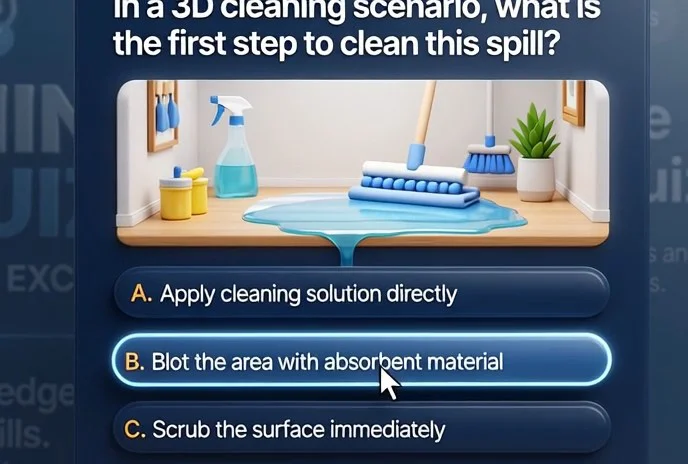
What is needed is practice with real scenarios — case reviews, dialogues, feedback. It is precisely such training that improves service quality and conversion to purchase. We develop interactive quizzes that simulate situations from everyday pharmacy work.
Employees practice pharmaceutical consulting skills on a simulator rather than in front of a customer, and they come out prepared. This way, you stop losing customers and get a confident team that generates profit.
What Changes After Launching a Training Quiz
Boring lectures and PDF instructions do not engage staff — employees go through training formally and immediately forget the material.
The company our team develops training quizzes for pharmacy based on dialog-based 3D simulators: the pharmacist enters a virtual pharmacy, conducts a dialogue with a customer, and receives an assessment of their actions. This works where ordinary training stalls.
Here is what will change after the launch:
- Team engagement — training turns into a game: employees themselves strive to complete the quiz, compete in the rankings, and discuss difficult questions as a team. Gamification removes the main pain point — “training just for the sake of a checkbox.”
- Growth in competencies — scenarios simulate real consultations: selecting an analog, handling customer objections, clarifying symptoms. The employee trains in a safe environment rather than on a live customer and reinforces the correct action algorithms.
- Staff efficiency — a confident pharmacist finds the right approach to a visitor faster, provides better consultations, and increases the average check amount. The uniform service standards embedded in the quiz are applied by employees in their daily work.
- Clear analytics for the manager — you see who has absorbed the material and who needs additional support. There is no need to guess: statistics for each employee show completion results, mistakes, and progress.
- A uniform level of training across the entire network — whether in the central pharmacy or a remote location, staff work according to the same standards. The quiz can be launched for both new hires and experienced employees, adapting the difficulty to the business objectives.
Launch such a quiz — and you get not a “studied instruction” but a team that confidently consults and affects revenue. We take on the development of scenarios, gamification, and integration into your training system, while you get a measurable result within a month.
Quiz Formats for Staff Training Objectives
Staff training produces results when the format matches the task. Some need a quick knowledge check after a webinar, while others need safe practice of a difficult conversation with a customer.
We select the format for a specific goal: from short mobile tests to a full-fledged dialogue simulator where the pharmacist trains to consult without risking their reputation.
Below are typical scenarios that address different training needs.
| Format | For whom | What it gives the client |
|---|---|---|
| Short mobile test | Frontline staff, knowledge check after a lecture or briefing | A quick snapshot of the whole team’s knowledge, results instantly available in statistics, minimal time away from work |
| Dialogue simulator with a virtual customer | Pharmacists and consultants who need to practice handling objections and sales scenarios | Increased confidence, quality consultations without stress for beginners, the ability to repeat a scenario until a confident result is achieved |
| Game format with rankings and points | A team or several pharmacies where it is important to engage and sustain interest | Higher motivation, healthy competition, unobtrusive repetition of the material |
| Detailed quiz with mistake analysis | Certification of specialists, checking residual knowledge | Gaps by topic become visible, the training program can be refined in a targeted way, objective assessment for the manager |
Each format is easy to adapt to your specific context: a pharmacy chain, a medical center, or a drug manufacturer.
The main thing is to choose the right tool, and then training will stop being a formality and begin to deliver a measurable effect in the form of confident employees and satisfied customers.
How We Create a Quiz: From Brief to Launch
We have structured the process so that you always understand where the project stands and what will happen next. You will not have to guess what is going on behind the scenes: all key stages, timelines, and approval checkpoints are fixed in the plan in advance. Below is a typical path for a quiz from the first brief to launch with your employees.
- Brief and immersion in the task. We discuss what knowledge needs to be checked, where employees most often make mistakes, and what result matters to you. We capture the learning objectives and format so that the quiz solves a real business problem rather than serving as mere entertainment.
- Plan and work stages. We create a transparent road map with dates, areas of responsibility, and approval checkpoints. You know in advance when you will receive the materials and can plan your team’s workload.
- Scenario and question approval. We provide you with the quiz structure, questions, and answer options for review. We make edits before development begins — this avoids expensive fixes at the final stage.
- Development and assembly. We build the interactive quiz using professional equipment and polished tools and show you intermediate versions. You see how the solution looks and works before the official launch.
- Pilot launch. We test the quiz on a small group of employees: we check usability, question logic, and the correctness of results. Everything we find is fixed in advance so that we do not have to collect feedback after a wide rollout.
- Implementation and training launch. We place the quiz in your system or provide access via a link, onboard employees, and help with instructions. For you, this is simple: we handle the technical side.
- Support and result analysis. After launch, we monitor statistics, answer questions, and refine content if we see weak spots. You receive a completion report and understand which topics to review in the next cycle.
This sequence helps avoid surprises and keep the project under control without unnecessary approvals. You know who does what, when the result will be ready, and what you are responsible for at each step. In the end, the quiz launches on time and immediately benefits staff training.
What Is Included in the Quiz Delivery Package
We deliver the project turnkey — you get not just files but a complete training system. The package includes the assembled quiz, instructions for staff and administrators, access to analytics, and technical support. There is nothing you need to refine or configure yourself.
- Ready-made quiz. Already configured for your pharmaceutical consultation scenarios: questions, dialogue situations, and knowledge checks. Employees can start using it immediately after installation.
- Instructions for staff. A short guide on how to work with the quiz, what it provides, and how to apply the results in daily communication with customers.
- Instructions for administrators. A clear manual: how to add employees, update questions, and adapt content to new company standards.
- Access to training analytics. You see who has completed the quiz, which tasks caused difficulties, and where your team needs additional training.
- Recommendations for program development. Based on the data, we suggest which topics to reinforce through live training sessions or to add to the next scenario.
- Quiz technical support. We answer questions, help at the start, and quickly resolve any issues during operation.
This package allows you to launch training within a few days. Employees quickly master the tool, and you get data to monitor the quality of pharmaceutical consultations and see how the team’s skill level grows. Everything else is our job.
Case Study: Growth in Consultation Accuracy in Pharmacy
A pharmacy chain approached us with a challenge that was not obvious at first glance: pharmacists knew their products well, but in live dialogue with a customer they lost their way.
Hints from instructions did not help — customers needed a consultation in plain language, with attention to their doubts and clarifying questions. We proposed not another lecture but a dialog-based 3D simulator where the employee trains on realistic customer-facing scenarios.
We developed a quiz-simulator for PharmLine: the pharmacist sees a virtual customer, hears their remark, and chooses how to respond.
Every incorrect step immediately shows the consequences — customer misunderstanding, refusal to purchase, or doubt about the specialist’s competence. The training took 10–15 minutes a day and was presented as a game, so employees engaged with interest rather than under duress.
Two months after launch, the share of correct consultations in control checks rose from 37% to 82%. Repeat purchases based on pharmacist recommendations increased by a quarter, and complaints about rudeness or unclear explanations virtually disappeared from the feedback book.
The network’s head noted that employees themselves asked for new levels — meaning training had ceased to be an obligation and had become a habit.
What turned out to be key was not the format itself, but the fact that the simulator teaches decision-making under pressure, just like in a real pharmacy.
After two weeks of use, pharmacists began asking customers the right clarifying questions instead of simply listing drug properties. That is exactly what drives growth in consultation quality — not memorizing instructions.
The case showed that even an ordinary quiz, built on the principle of live dialogue, changes employee behavior.
We collected feedback, updated the scenarios for new product categories, and continued the partnership — now the client is expanding the simulator to all pharmacy chains in the region.
If you want the same systematic result without lengthy training sessions — let’s discuss your scenario and calculate the timeline.
How to Choose the Right Quiz Format?
Choosing a quiz format starts with a simple question: what exactly do you want to change in your staff’s work? If the goal is to quickly refresh knowledge about a new product line, a short 10–15 question test with explanations of mistakes will work.
If the task is to teach employees to confidently consult customers, you need a dialog-based quiz with real-life situation analysis.
And when it comes to regular knowledge maintenance across a network, it is convenient to combine short weekly surveys with an in-depth scenario once a month.
Team size is the second reference point. For a small pharmacy, a simple format is enough: questions in a messenger or on a tablet in the break area, with answers collected in a couple of days.
For a network with dozens of locations and varying staff skill levels, a dialog-based simulator works better: it adapts to each response, gives each participant their own path, and highlights weak points. This way, you achieve an equal level of knowledge without additional costs for mentors.
The third step is to check how the quiz will fit into the work rhythm. Training should not pull staff away from the shelves and customers.
That is why we recommend breaking the material into short 10–15 minute sessions: an employee completes one scenario between customers and immediately sees the result. With this training format, staff turnover decreases and knowledge is reinforced in practice.
If you are unsure which format suits your team, start with a pilot launch: take one pharmacy or department, run a short quiz, measure mistakes and engagement. Based on this data, it is easy to scale the solution across the entire network.
We help with format selection at the brief stage — we assess your team size and business goal for free, so you do not overpay for unnecessary options. As a result, a pharmacy quiz brings growth in repeat sales and confidence in staff communication with customers.
Answers to Frequently Asked Questions Before Starting
Before launching a training quiz, clients usually have the same questions: will we meet the deadline, what happens if changes are needed, and can the result be trusted.
We answer the main ones so that you can make an informed decision and start the project without unnecessary doubt.
We work transparently: we fix the terms in the contract, show intermediate results, and stay in touch after the launch. Here is what is important to know before you begin.
How long does quiz development take?
A typical project takes from two to four weeks — the timeline depends on the number of topics, levels, and the complexity of the scenarios. At the start, we create a calendar plan with control checkpoints so you can see progress every week.
If you need a pilot launch for one group of employees, we can first create a reduced version and then expand it. This way, you get the first results faster and understand how the quiz works in your environment.
Can the quiz be refined after launch?
Yes, the quiz remains flexible after launch. We build in the ability to update questions, hints, and scenarios in advance — this allows training to be adapted to new products or regulations without a complete rework.
We accept refinements upon request: you send your wishes, and we assess the timeline and cost. Minor edits, such as changing the text of a question or answer, are usually made as part of our support service.
Will the quiz work on our employees’ devices?
We will design the quiz so that it runs reliably on the equipment already in use at your company — from office computers to tablets at points of sale. Before launch, we test it on the main configurations and take into account the specifics of corporate networks.
If you have specific requirements, such as working in a closed network, we include them as separate tasks. You always know on which devices the training will run without issues.
What guarantees do you offer on the result?
We fix guarantees in the contract: functionality, timelines, stages, and acceptance criteria. If testing reveals a discrepancy with the stated scenario, we correct it at our expense until it fully matches the requirements.
After the launch, we provide technical support: we monitor the quiz’s operation, help resolve incidents, and advise your administrators. You are never left alone with the product after the project is delivered.
Shall We Discuss Your Staff Training Challenge?
Staff training often comes down to format: presentations do not engage, and knowledge checks become a formality.
A quiz solves this problem, but to deliver a real result, it needs a scenario tailored to your specifics — especially in pharmacy, where not only knowledge of drugs matters, but also correct handling of customer questions.
We invite you to a short staff training consultation: we will clarify your goals, review which knowledge needs to be strengthened, and select a quiz format for your team.
In 30–40 minutes, we will discuss your situation and propose a solution — without unnecessary bureaucracy and with your timelines in mind.
What you will get from this meeting:
- request a quiz — you describe the task, we propose a scenario and mechanics;
- training consultation — we will analyze the target audience, question difficulty, and the expected result;
- calculate the project — we will send an estimate of the timeline and scope of work in a clear format;
- order a quiz — after the consultation, you will receive a launch and ongoing support plan;
- we will select the format: from short tests to dialog-based consultation simulators;
- we will define success metrics: how we will know that employees have absorbed the material and are applying it in their work.
The consultation is non-binding. You will get a clear picture of how the quiz will fit into your training system and will be able to make an informed decision. Leave a quiz request — we will contact you within one business day and arrange a convenient time to talk.